February 28, 2005
Technorati

What's happening on the Web right now?
This is interesting.

Random Links 16
43 Things
Stumbled on this last week. Raised the question once again, "What do you want to do with your life?"
The Passion of Hotel Rwanda
Ok I REALLy want to see this movie!
What is Practical Theology? Part I & Part II
For me, being theological and practical though maybe distinguished at times should never be divided.
Clarity of Mind – the importance of local
These follow suggestions for living healthily “in a toxic culture ”stuck out" (The applications to church were really good too!) ...
“…What will help are simple things like
1. Not living alone…
2. Keeping close contacts with family and friends…
3. Living more fully…
4. Living in the moment…
5. Live more slowly…
6. Live more locally…”
Ministry is bad for you?
I'm one of those who don't fit in the "survey". But then again I had good friends and mentors. Many thanks to them.
February 25, 2005
A Brotherly Critique and Response
I asked a local Christian bookstore this week when is A Genereous Orthodoxy arriving (since I asked them to bring in at least 20 copies - more than 4-5 friends would want a copy immediately). I was surprised by the answer. We need to wait for the second printing - no stock!!! I guess those who can't wait might find another means to get the book.
I must admit, that I read the book pretty fast to try to participate in the group blog aGenerousorthodoxy.com discussion which is at this point quiet. :-) But as I rushed through there were more than 4-5 occassions that I wanted to pause further and ask Brian - are you REALLY saying this? or What do you mean? If we really do what you say here, what would happen? I've read you before, but this part makes me wonder? .. that kind of questions.
I need to get my copy back from a friend and I'll start doing those exercises. all in all, I appreciated his "confessional" approach in charting his journey. I've read almost all the reviews I could get on this particular book. Some I think were fair, others I thought totally missed the point. Especially at some points I wondered (after reading some severe critique - which came across "unfriendly" to put it mildly) would some of my former teachers in seminary or even myself be "excluded" judged under the light of these criterias. I'll probably delve more on that another time. The fact is once published, one needs to face the praise as well as the criticism. There's no turning back. Or is it?
That's why, I found this article worth a read : A Brotherly Critique and Response. I think before one starts hurling "unfriendly" charges or heresy or doomsday prophecy (to be honest, I'm always tempted to do so myself), is there another way (which I want to learn)? Read on if you're interested (Brian's reply to the theologian in italics).
___________________________________________________________________
There is no excess of civility in our public discourse these days, and sadly, that's too often the case in the world of the church too. This note from a respected theologian shows a very different tone, one that I think is much more in line with our message and mission. My responses are inserted
-- like this. - Brian
Brian:
Just completed reading A Generous Orthodoxy. A good book. Good mix
of thoughtful and provocative material laced with powerful
illustrations and a nice touch of humor (especially the first
chapter). I also like the way you reframe, or out-frame, a number of
traditional positions or questions--this has always been one of your
great strengths.
I particularly appreciated the chapters 5,6, 9, and 14. The chapter
on Missional will be excellent for introducing people to the misional
discussion--the two diagrams are great. Your distinction between E
vangelical and evangelical is a useful way to affirm a valuable term
while trimming off some baggage--I liked it. And the mystical/poetic
theme gives voice to something that many of us have felt but not
articulated very well. Thanks. The chapter on Methodism is helpful--I
used your diagrams with a young believer at our church who I am
discipling and ecouraging to start helping someone else--he got the
idea immediately.
I have been chewing on a couple of other points in your discussion and
thought I would mention these to see if I am reading you correctly,
and if I am, to raise a question or two, or perhaps to suggest an
alternate perspective.
1. Exclusivism, etc.
I am wondering about a couple things in this part of your discussion
(pp. 112-14):
a. It seems to me that you have not worked up to your usual standard
of charity here--it has the feel of "my best against your worst" which
elsewhere you have encouraged us (appropriately) to avoid. I am
thinking particularly of your assessment of exclusivism: "I should
just rejoice that I am one of the blessed--meaning I can retire in
Naples, etc." This is a pretty strong ad hominem which I am sure did
not apply to your grandparents in Angola, although I suspect that they
would have lined up on the exclusivist side. No doubt there are some
exclusivists (and universalists, and inclusivists) who are playing out
their days on the links, but that probably has a lot more to do with
cultural influences than theology.
-- I think this is a really legitimate critique. I wish I had done a better job of being charitable in that section. I guess I tried to soften condemning or finger-pointing tendencies by putting it in the first person (maybe the reason Paul uses first person in Romans 7?), but still, I think this is one of the places where people could take offense, and I wish I had avoided it better. Thanks for pointing it out to me.
b. I am not sure that a moderate exclusivist position can't point you
to Los Angeles (again, it didn't seem to confuse your grandparents).
How about something like this for a proposal (using your basic
language):
One signpost tells me that some people aren't ever going to be
blessed [ultimately, at least, because Jesus really seems to believe
in hell]. Does this mean that I should just rejoice that I am one of
the blessed--meaning . . .? Of course not, for I realize that the
story of God's people has always been that they are blessed in order
that they might be a blessing to all nations. So this signpost points
me toward mission, not away from it.
--Yes, that's well put.
c. If you feel the need to distance yourself from certain
formulations of exclusivism, as I think I would myself, couldn't this
be done by employing an upper case/lower case distinction as you did
with E/evangelical?
--Great idea.
2. Why I am Biblical
Basically I liked this chapter. I agree that we have for too long
"flattened" the Bible by a kind of "scientific" approach to exegesis
that treated its various genres like technical prose. This kind of
reductionism needs to be critiqued, and I find your discussion helpful
in emphasizing the narrative and poetic aspects of Scripture.
But I would also say that just here I have some concern. It feels to
me that in avoiding the reductionism of the past you bring in your own
reductionism which could be just as harmful. When you say " . . . the
Bible itself contains precious little expository prose" I wonder how
that applies to some pretty lengthy sections of the pentateuch or
particularly to the epistles. Granted (as you point out) there are
some poetic elements in the letters, but that is not the bulk of the
material.
-- Sorry I wasn't clear enough here. "Expository prose" for me meant prose intending to explain - like essays or textbooks. So I'm not including history or law in the Old Testament as expository - they'd be narrative and law. And I'd put the epistles in the category of ... epistles. Letters aren't the same as expository prose, although I suppose the lines get blurry. What I was trying to say (not well enough) was that there isn't much in the way of "First and Second Sexual Morality" in the Bible, or "A Treatise on Free Will," or "The Book of the Trinity," or that sort of thing. Again, I could have been a lot clearer.
I think the emphasis on narrative and poetry is important because it
opens up the way for imagination. By being less specific, it is (in
some ways) more mind-expanding. By opening up more possibilities, it
leads to less certainty in interpretation and hopefully more humility
on our part. All this is good and I am on board with you. But if we
minimize the sections that are more expository, don't we risk the loss
of some pretty important data that shaped the basics of the chrisitian
tradition. ... I am just trying to think through what we are going to
give the next generation to work with.
So those are my current thoughts/questions. I know you are busy, so
no need to reply.
__________________________________________________________________
February 24, 2005
Writing, Publishing & Printing

There's more to Joel than globetrotting through the ministry of Servlife huh ?... he's a juggler too!
Joel Vestal was in town this week to see what can be done to get his book printed. It's been a very good learning experience for me as well as I sat with him during the discussions with the relevant peopple on issues ranging from paper thickness to how to print the cover, shipping costs, etc. Some of these lessons have been very useful at least for general knowledge. Here's a Sneak Preview of the book.
But of course, that's more of the closing labour pangs (in some ways) to see the birth of the book. I'm still trying to conceive some ideas and see how to get two articles out. Blogging is ok and fun but writing articles or even a book ... now that's quite a different ball game.
I manage to stumble on No Train, No Gain Writing Resources which looks helpful.
I'm also checking out these powerpoints from an upcoming conference. Writing for Your Mother- what a cool title. And of course the more serious, How to Write a Book Proposal
Maybe someday I'll manage to juggle my way into writing a book and beyond. :-) For now, it's working on this weeks interactive message, finish one article, prepare for part two of the children's "orientation" program, and a number of others immediate concerns. Ah ... I'm looking forward to have supper with Juggling Joel tonight before he flies off again.
February 23, 2005
Random Links 15
A national spotlight shines on local pastor (via Stephen Shields)
who said a "local" pastor can't have "regional" or even "global" influence? :-) we're in a GLOCAL world aren't we? ... even if not totally
Beyond Bullets
I kind of "intuitively" was moving this direction ... this guy really takes it deeper and further.
Blink and The Wisdom of Crowds: How to improve the decision-making environment.
awesome exchange between the authors and totally stimulating as I read it while waiting for May Chin to come down from her office (loads of articles are read this way!) and will finish it afterwars before I sleep. Seems there will be more the next few days here
Apologetics and Theology Both Need to Change
now the word "embodied" just keeps popping up lately! Good corrective.
Hotel Rwanda
when are they going to show it here in Malaysia?
February 22, 2005
Church: What do you long for?

I found Brother Maynard's attempt to put into words his longing in this post "to clarify this journey" resonating with much of what I've been going through especially coming to April this year will be five years. I'm praying that Bangsar Lutheran Church will see God moving in our midst as we explore similar themes along our story here in Malaysia.
__________________________________________________________________
1. I long for a church that is low-key. I’m tired of hype, I’m tired of noise, and I’m tired of intensity. I used to like all those things, but I no longer equate these with “signs of life.” I long for something more contemplative, a place that can acknowledge worship as being intellectual as well as emotional.
2. I long for a church with deep interpersonal relationships. I was attracted to a place that talked about relationships and tried to build relationally, but with growth, time, and change, what started as relational has become merely functional. Faith walks need camaradarie, lives shared one with another.
3. I long for the attainable challenge of Jesus. Put the other way, I’m tired of being challenged, by which I refer not to the challenge of the gospel or the challenge of Jesus, but to the challenge of leaders who seem to continually push for greater levels of sanctification. Ever unattainable, this leaves one straining for an unreachable goal and feeling cast down for falling short. To elaborate, this causes a situation in which a believer perpetually feels or is actually considered “not quite good enough” to engage in ministry. I long for the challenges which God give the grace to attain, rather than the challenges of men which one strives fruitlessly to attain.
4. I long for a decentralized structure, and I long for servant leadership among peers. Power corrupts, which is a danger in the church as anywhere else… and a heirarchical structure is the breeding-ground for the corruption of church leaders. Jesus talked about this, about what can happen to church leaders who start well but end up enamoured with their positions. Practically speaking, this drives the necessity for decentralization so that the structures can be interrelated but independently manageable in smaller sizes.
5. I long for a culturally relevant church. I don’t understand why cross-cultural missionaries attempt to understand culture to present the gospel within it, while churches in the developed world tend to simply withdraw from their own culture, often condemning its evils. Unfortunately for them, our culture is filled with people who need to see real Christianity in action — they’ve seen enough caricatures of Christianity already. Being culturally relevant in the early 21st century means understanding -gasp!- postmodernism.
6. I long for a church that can be outwardly-focused without constantly pushing evangelism on the congregation, and for a church that does not relate evangelism with church growth as an end.
7. I long for a church that recognizes the value of ancient traditions. I’ve long been saddened by the iconophobia in many evangelical circles, discomfort with symbolism, suspicion toward any type of mysticism, and the ignoring of rich faith traditions from Advent to Passover.
8. I long for a church that is not uncomfortable with mystery or with the sacraments. The evangelical understanding I’ve been taught on the Eucharist is anemic, and the standard baptism explanation of “an outward symbol of an inward faith” misses the spiritual act, which still has an element of mystery in it.
9. I long for a church that recognizes the value of story. Scripture is story, and so are the lives it touches. One cannot presume to talk about relationship without recognizing the importance of personal stories.
__________________________________________________________________
Unsung Sages
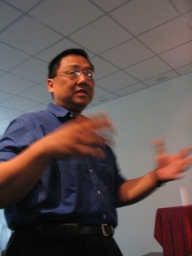
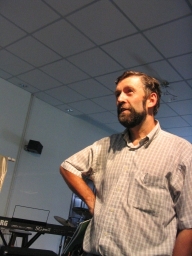
The first time I met Michael Lee was when I was a Christian Fellowship president in a secondary school at one of the Scripture Union camps. Strangely, we managed to connect more the last few months and especially the last few weeks as I rethink and re-do the children's ministry. He was the first to mention Godly Play to me. He's a genuine never-stop learning veteran in this area. In fact, I actually was really impressed when I drove one of his former campers (who's now grown up) and could see the simple and yet significant impact Michael had on his life in the long term. That says a lot to me.
Through Michael, I was introduced in one whom I'll call the Intergenerational Guru and advocate for Christian education and Church. Dr. Allan Harkness (whom I later found out is the editor of the Journal of Christian Education). We had dinner on sunday night at Pastor Micky Kua's place. he's defintaly not an ivory tower scholar but one who's passionately practical as well. It's just great to get energized by Sages who share not only knowledge and insights but practical reflections, ideas and lessons. I got two of Dr. Allan's articles and they are exactly what I needed (plus a bonus new revised book by him entitled "Praying together" (according to him I'm the second one in Malaysia who has it!! It's ok not to be no. 1 huh? who cares .. my wife says it's a good book). I must say, it's been a great week so far. And it's just Tuesday.
Both of them came by the Father's House around 4.30pm a while ago. And it's like when the kids last Sunday get their second blessing from the greeters. I felt myself getting a second dose of encouragement by one sage who's a thoughful practioner and another sage who's a practical scholar. Both of them shared more than knowledge and experience, they shared life, passion and joy in serving in their respective callings.
I heard or read from somewhere that more and more the local churches would be looking for church consultants to help them in developing and growing churches. Well, for me having the chance to hang out, laugh, interact with wise men like these two has been most rewarding ... I know they've paid the price (and are still paying it) to do what they do. And to just think about the blessing of getting their wisdom for FREE and having a new friendship/connection with them is just ... what can I say ... I'm speechless. :-) At least, i must record my thanks to them and to God. Amen!
February 21, 2005
The Blogs Must Be Crazy
... or maybe bloggers must be crazy? Check what Peggy Noonan has to say:
The blogosphere isn't some mindless eruption of wild opinion. That isn't their power. This is their power:1. They use the tools of journalists (computer, keyboard, a spirit of inquiry, a willingness to ask the question) and of the Internet (Google, LexisNexis) to look for and find facts that have been overlooked, ignored or hidden. They look for the telling quote, the ignored statistic, the data that have been submerged. What they are looking for is information that is true. When they get it they post it and include it in the debate. This is a public service.
2. Bloggers, unlike reporters at elite newspapers and magazines, are independent operators. They are not, and do not have to be, governed by mainstream thinking. Nor do they have to accept the directives of an editor pushing an ideology or a publisher protecting his friends. Bloggers have the freedom to decide on their own when a story stops being a story. They get to decide when the search for facts is over. They also decide on their own when the search for facts begins. It was a blogger at the World Economic Forum, as we all know, who first reported the Eason Jordan story. It was bloggers, as we all know, who pursued it. Matt Drudge runs a news site and is not a blogger, but what was true of him at his beginning (the Monica Lewinsky story, he decided, is a story) is true of bloggers: It's a story if they say it is. This is a public service.
3. Bloggers have an institutional advantage in terms of technology and form. They can post immediately. The items they post can be as long or short as they judge to be necessary. Breaking news can be one sentence long: "Malkin gets Barney Frank earwitness report." In newspapers you have to go to the editor, explain to him why the paper should have another piece on the Eason Jordan affair, spend a day reporting it, only to find that all that's new today is that reporter Michelle Malkin got an interview with Barney Frank. That's not enough to merit 10 inches of newspaper space, so the Times doesn't carry what the blogosphere had 24 hours ago. In the old days a lot of interesting information fell off the editing desk in this way. Now it doesn't. This is a public service.
4. Bloggers are also selling the smartest take on a story. They're selling an original insight, a new area of inquiry. Mickey Kaus of Kausfiles has his bright take, Andrew Sullivan had his, InstaPundit has his. They're all selling their shrewdness, experience, depth. This too is a public service.
5. And they're doing it free. That is, the Times costs me a dollar and so does the Journal, but Kausfiles doesn't cost a dime. This too is a public service. Some blogs get their money from yearly fund-raising, some from advertisers, some from a combination, some from a salary provided by Slate or National Review. Most are labors of love. Some bloggers--a lot, I think--are addicted to digging, posting, coming up with the bright phrase. OK with me. Some get burned out. But new ones are always coming up, so many that I can't keep track of them and neither can anyone else.
But when I read blogs, when I wake up in the morning and go to About Last Night and Lucianne and Lileks, I remember what the late great Christopher Reeve said on "The Tonight Show" 20 years ago. He was the second guest, after Rodney Dangerfield. Dangerfield did his act and he was hot as a pistol. Then after Reeve sat down Dangerfield continued to be riotous. Reeve looked at him, gestured toward him, looked at the audience and said with grace and delight, "Do you believe this is free?" The audience cheered. That's how I feel on their best days when I read blogs.
That you get it free doesn't mean commerce isn't involved, for it is. It is intellectual commerce. Bloggers give you information and point of view. In return you give them your attention and intellectual energy. They gain influence by drawing your eyes; you gain information by lending your eyes. They become well-known and influential; you become entertained or informed. They get something from it and so do you.
6. It is not true that there are no controls. It is not true that the blogosphere is the Wild West. What governs members of the blogosphere is what governs to some degree members of the MSM, and that is the desire for status and respect. In the blogosphere you lose both if you put forward as fact information that is incorrect, specious or cooked. You lose status and respect if your take on a story that is patently stupid. You lose status and respect if you are unprofessional or deliberately misleading. And once you've lost a sufficient amount of status and respect, none of the other bloggers link to you anymore or raise your name in their arguments. And you're over. The great correcting mechanism for people on the Web is people on the Web.
There are blogs that carry political and ideological agendas. But everyone is on to them and it's mostly not obnoxious because their agendas are mostly declared.
7. I don't know if the blogosphere is rougher in the ferocity of its personal attacks than, say, Drew Pearson. Or the rough boys and girls of the great American editorial pages of the 1930s and '40s. Bloggers are certainly not as rough as the splenetic pamphleteers of the 18th and 19th centuries, who amused themselves accusing Thomas Jefferson of sexual perfidy and Andrew Jackson of having married a whore. I don't know how Walter Lippmann or Scotty Reston would have seen the blogosphere; it might have frightened them if they'd lived to see it. They might have been impressed by the sheer digging that goes on there. I have seen friends savaged by blogs and winced for them--but, well, too bad. I've been attacked. Too bad. If you can't take it, you shouldn't be thinking aloud for a living. The blogosphere is tough. But are personal attacks worth it if what we get in return is a whole new media form that can add to the true-information flow while correcting the biases and lapses of the mainstream media? Yes. Of course.
Random Links 14
THE POLITICS OF JESUS : An Anabaptist Understanding Of The New Testament (via Prodigal Kiwi)
a simplified summary of John H. Yoder's classic book by Nathan Hobby with James Patton. I need to watch book spending ... summaries help to delay the purchases for a short while :-)
born again?
we talked about the John 3:1-17 passage in the last district pastors prayer meeting. It's interesting to look back on how I used to rigidly define this phrase and today how enriched I am by more insights like this one from Maggi.
Nourishing Imagination: Using Direct Speech
In a speed reading world, quality blogs like this and the links inside requires one to learn to read slowly.
The things to do
My wife May Chin would say ... "I didn't need to read this article to know this!"
Getting things done
I like the 2 minute rule.
Biblical advice for bloggers
Back to the Bible for bloggers? :-) Pretty good advice I must say.
February 20, 2005
Postmodern Children's Ministry

I was so excited when I saw this book last week and immediately bought it. Now, I'm slowly working through the book together with Young children & Worship and also insights from Faith Inkubators.
here's some stuff that Ivy Beckwith wrote in introduction of her book that moved me and affirmed me especially after my "humble" attempt at facilitating the orientation with the BLC kids (and parents & helpers) today.
"The church's ministry to children is broken. A cursory look doesn't reveal its brokenness. From the outside children's ministry looks healthier than ever. But it is broken. It's broken when church leaders and senior pastors see children's ministry primarily as a marketing tool. The church with the most outwardly attractive program wins the children and then the parents. It's broken when we teach children the Bible as if it were just another book of moral fables or stories of great heroes. Something is broken when we trivialize God to our children. It's broken when we exclude children from perhaps the most important of community activities: worship. It's broken because we've become dependant on an 18th-century schooling model, forgetting that much of a children's spiritual formation is affective, active, and intuitive. It's broken when we depend on our programs and our curriculum to introduce our children to God -- not our families and communities. It's broken when we've come to believe that church has to be some other than church to be attractive to children. It's broken when we spend lots of money making our churches into playlands and entice children to God through food fights and baptisms in the back of fire trucks. And perhaps most importantly, it's broken when the church tells parents that its programs can spiritually nurture their children better than they can. By doing this, we've lied to parents and allowed them to abdicate their responsibility to spiritually form their children. A church program can't spiritually form a child, but a familiy living in an intergenerational community of faith can. Our care for children is broken and badly in need of repair. Let's imagine together a new way, a new future."
I tried to imagine once again how BLC's children's ministry could be especially the past months. It lead further into what does it mean to be families and extended families in our young church context. Of course, once the flood gates are open my heart and mind is in the process of working through what and integrated intergenerational church could look like. What are th necessary steps we need to take?
I've seen enough in the Malaysian Children's ministry scene to know what I don't want and what I think is deeply wrong. If I start mentioning names, I might be shot simply for challenging the so called "most popular and most succesful" children's ministry. Who am I to even raise questions huh? I'm a father of a young two year old son and soon another one will come. We are a young family. I'm a pastor of a young church with lots of toddlers and some primary school level kids. I was a former youth pastor (not too sure how successful I was) that "felt" the strong waves and trends of children's ministry revival in a local church context. There's a strong passion to move beyond children's ministry that's just overtly pragmatic, competative, reward driven and segregated that's more B.F. Skinner influenced than Scipture and Savior influenced. Often, disatisfactions help to breed questions. I think I mentioned a while ago about a T-shirt quote "Deconstruction is the beginning of Construction" ... somehting like that. Questions are more pressing as my Godchildren are growing, more kids are added and birthed into the BLC faith family, and of course having a second child creates a greater urgency.
I ask questions, I can't help it .. the questions is part of my quest to be faithful to God's heartbeat (that that process requires deeper theological reflection, a sincere gradual growth in authenti spirituality, and learning from minority (or softer less marketed) voices in ministry which more and more makes me see the cracks in not just popular children's ministry supposedly success formulas, but church ministry as a whole)
So, I can relate to what Ivy is talking about in the quote in some way in our Malaysian context. But, more importantly .. there's this warmth in my heart and fire burning within me to say YES! to a new way and a new future starting from where I am as a family and where we are as a local church. And with that kind of "heart beat" pumping, I move on towards the more "hands on" baby step questions ...
The about 45minutes spent today with the 8 children (and parents and helpers) was a rewarding one. I was especially touched when during our mini-feast time, when I asked who would like to share biscuit with me (after I had given away all of mine), one of the children immediately offered one for me. Then, there were many little suprises in their response to my "modeling" whether it's walking slowly, talking softly and the use of the "special space" rug that really touched me. I'm not children worker veteran (in fact I never saw myself in that category) but today's "less than perfect and even "fumbling" first "orientation" session was a small and significant win I'd liek tocelebrate and be thankful. All of us wanted to see this work and even with some glitches here and there, overall I came home today feeling wonderful. Because, I sense God's approval and affirmation on what we are trying to do here. And now it's to stick on the track ... there's still so much more to learn and thank God ... there are people cheering us on. At least that's how I felt after having dinner with a veteran children's ministy worker and a intergenerational worship, Christian education and church guru (Many thanks to the host who provided dinner and a listening ear). All in all it's been a pretty good Sunday.
February 18, 2005
The Matrix Family




We had some fun as we passed by China town on the way home today!
February 17, 2005
Random Links 13
I've been doing random links quite a bit partly because there's a lot of catching up to do as far as life, family, and ministry is concerned. So before any Random Thoughts or more reflective posts are coming ... I'll just keep dropping some links with quick impressions - just for a short while (When I ask Gareth can Mummy carry him he says "just a short while!" - he knows Mummy can't carry him too long because baby no.2 is pretty big now and is getting ready to come into this world soon).
Resources for Christian Theology
Now there's a lot here for one to slowly dig into ... a wide variety of areas too. Not for the faint hearted .. or lazy minds.
The Ekklesia Project
A School for Subversive Friendships ... some of these pamplets are awesome!
A Church Worth Staying In
I was on the phone with someone who sees himself as a "believer" but "unchurched". The word "belonging" came up a couple of times. After looking at the characteristics mentioned in this link - I'm drawn to prayer once again.
Making It Up and Making It Happen
Vision is more than just drafting a vision statement. I like the quote in this link ... which suprising ly is actually from an 18th-century inscription from a church in Sussex, England:
"A vision without a task is but a dream,
a task without a vision is drudgery,
a vision and a task is the hope of the world."
Working with vision
Here's Chris' statement that captures my attention:
"I've never been a big fan of the "Vision Statement," being the kind of guy that eschews fixed statements of fact in favour for evolution and emergence of meaning. However, I do feel it is important to have something bigger to move towards, a vision of the world that one co-creates with others. This vision can change over time as we engage with the world around us, but its good to have an idea of something bigger to invite us into the future we want."
The Magic of 150
Here we go again ... how can a number like this make us pause and think and re-think our ability to healthily connect to one another and accomplish tasks together? The examples given are really food for thought. Now a google search for "the Hutterites". :-)
Random Links 12
I'll need a cup of coffee to walk through these excellent pieces (Thanks JYG for linking me back to Christian Counter Culture).
Welcoming but not affirming: Homosexuals & the Church.
I heard that in the Chinese church scene in Malaysia there's some controversy from a certain individual and a book he published and launched lately. I haven't read it yet but I can already feel the reactions from a variety of people. We can't ignore this just because the matter is less vocal in our context. It's there.
The Way of Love: Turning Judgement to the Love of God
I've got the book ... like the diagrams. Love it when the names Boyd and Bonhoeffer go together and have some interaction here and there. But it's the central thesis of the title that draws me.
Loving Those We Oppose: Love in the Midst of controversy
I told some people lately there's a difference between suicide and martyrdom - when it comes to raising questions, challenging people or introducing change. I guess that was more about the "wisdom" spectrum or keep the "mind" sober. Like it or not ... it's never just about being smart or street wise. Matters of the " "heart" and attitude must not be neglected.- as Spener put it so well, "... disputing is not enough either to maintain the truth among ourselves or to impart it to the erring. The holy love of God is necessary."
Growing the Kingdom: How Christians really influence our world
I'll be reading this piece in the context of the whole context of the "Evaluating Church Growth" book I mentioned before which is alread quite an engaging read even before I come to Snyder's chapter :-)
February 16, 2005
Random Links 11
The Baby Name Wizard's NameVoyager
This ia a really cool Java site ... of course when keying in the names Sivin or Gareth the following wors popped up, "No names starting with Sivin (or Gareth) were in the top 1000 names in any decade."
Random Name Generator
If I were a stylish girl ... Noe Adila Kit could be my name (that was during the first try *hahaha*) Have fun!
Bi-Vocational Ministry (Part II)
Interesting peek into bi-vocational ministry.
The Christian Calendar
Since being more conscious of the church year or Christian calendar I appreicate words like this more, ... "Our secular calendar has its beginning with the Roman Empire where on January 1 Roman state officials took office. The Christian calendar is to be a daily reminder that we are first citizens of the kingdom of God and secondly citizens of the state and culture."
February 15, 2005
Evaluating the Church Growth Movement

Listening to three buddies share about their church life and thus Christian life was very enlightening (thanks for their openness). What's interesting is a comment I heard today on how the environment they are part of keeps moving and going with no sign of a "pause" to reflect and ask "needed" questions. What they've been sharing seems to be (in all honesty) the unheard stories of so called "successful", "growing", "Megachurches" (in Malaysia I think the 1000 attendance mark would probably qualify as a Malaysian version of the beginnings of a "mega church" form and style).
On the other end of the specturm, I hear stories of "micro churches" (or house churches) and the stuggles that comes with that "package".
After lunch today, I realize that the talk about numbers, church growth, methodologies are important starting points but one must not stop there. Because deeper beneath the surface we're asking about the nature of the church (there's much theological vibrations actually going on), what it's really all about (the yearning for genuine community and spirituality is present) and then how does our practices (with all its imperfections or at least inadequate executions) attempt to embody what we perceive as faithfulness to a Kingdom vision and values. Of course, we aren't just interested to be a huggy warm fuzzy club. There needs to be "space" for us to honestly talk about this.
A T-shirt caption caught my attention last night .. "Deconstruction is the beginning of Construction.". I'm hearing more and more stories of "deconstruction". I hope that beyond the listening (which is so necessary) I could serve as an encourager towards the emergence of "construction" stories.
That's the more personal dimensions of what requires a vigourous "relook" at the church growth movement (which I sense had a strong hold of many Malaysian churches) at a macro level. For starters, here's an excerpt:
"When you hear the term church growth, what words or phrases come to mind? You may think of megachurches, small groups, numbers, contemporary worship, marketing, or a host of other concepts that have occasionally been promoted as popular church-growth theory.In contrast, you may identify the term church growth with effective evangelism, church planting, church extension, making disciples, church multiplication, or other aspects of outreach that seek to win people to Christ and enlist them as responsible members of his church.
These differing perceptions of the term church growth, and the emotions that arise from them, clearly point to misunderstanding and disagreement regarding the term, as well as the movement. Church growth is one of those ideas that cause us to draw lines in the sand. We are either for an emphasis on church growth or against it. There seems to be little neutral ground. Donald McGavran, the father of the modern Church Growth movement, recognized early on the divisive nature of Church Growth thought in a letter to his wife, written from Costa Rica on September 8, 1961: “It is clear that emphasizing the growth of the churches divides the camp. It is really a divisive topic. How strange when all are presumably disciples of the Lord Jesus Christ.” Dr. McGavran’s words still ring true today. Church Growth continues to divide the camp, as the five viewpoints expressed in this book will demonstrate."
February 14, 2005
4 Lessons for Malaysian Churches
I couldn't resist posting this up from my sage-friend from Grace@Work that came into my INBOX during Chinese New Year. Somehow I see myself somewhere in there :-) This ecommentary conveyed grace to me and spurred me to stay the course and grow in areas I'm weaker. This post is dedicated to anyone discouraged with the state of church in any given context (We "feel" because we care enough to even get frustrated).
__________________________________________________________________
4 Lessons from W. L. Gore & AssociatesMost of us have probably heard of Gore-Tex fabrics, fabrics
“which have a transparent plastic coating that makes them
waterproof and wind proof but keeps them breathable.”
What you may not know is that the company that produces
them, W. L. Gore & Associates, was deemed the most
innovative company in America by FAST COMPANY magazine
(December 2004 issue, 54 - 62).
(W. L. Gore and Associates have been in business since
1958.)The article gave 6 reasons why the company is effectively
innovative. I found 4 of them particularly pertinent for
those of us thinking about better ways of “doing church” in
the 21st century.1. “The Power of Small Teams: Gore tries to keep its teams
small (and caps even its manufacturing plants at 200
people). That way, everyone can get to know one another and
work together with minimal rules, as though they were a task
force tackling a crisis."For years church growth specialists have mooted 200 as the
church growth barrier that needed to be breached if a church
was serious about becoming really big. It was Robert Banks,
I think, who countered that 200 may actually be God's
protective ceiling, that somehow, by growing beyond 200, a
church loses something fundamental in its character. Indeed
I have found that when churches grow beyond 200, there is a
subtle shift away from people, to procedures, buildings, and
techniques.I have always being haunted by the fact that when the church
was penetrating the Roman empire, it's primary manifestation
was house churches of about 40 people each. Yet the biblical
metaphors for the church, like "body" and "household" imply
close personal relationships between her members. Clearly,
community and mission are not mutually exclusive. And groups
like Gore confirm that intimate communities can also be very
effective in the pursuit of a mission.There may be more to contemporary buzz words like "missional
communities" than we realize.
2. "No Ranks, No Titles, No Bosses: Employees, dubbed
'associates' have 'sponsers' who serve as mentors, not
bosses."As churches grow larger, leaders are seen more and more as
decision makers, speakers, and vision casters. Nothing wrong
here apart from the fact that such leaders end up having
little time to develop and nurture people. Soon, such
churches begin to actively promote people who are decision
makers and speakers, but no longer even ask if such people
are personally involved in developing others.But the heart of the Christian faith is people
transformation. Leaders indeed may have many tasks, but
Christian leadership is finally about developing people.
Jesus invested a large part of His time developing His
disciples. Paul was always nurturing people in the context
of relationships. Indeed, one of the qualifications for
leaders in the New Testament is a track record of having
being able to nurture one's children well ( 1Timothy 3:4-5).Should we be surprised that the primary task of leaders in
Gore is to develop people? How many of our churches are full
of people whose potentials are untapped because they are
seen as merely cogs in the church machinery?We have so many church leaders who are treasurers, speakers,
strategic thinkers, committee members etc., so few who are
disciplers and mentors, people who invest quality time in
developmental relationships. There are many tasks that need
to be done but what is the core of Christian leadership?
Indeed what is the core of the Christian faith?
3. "Make Time for Face Time: ...anyone in the company can
talk to anyone else. Gore discourages memos and prefers
in-person communication to email."The fact that God came to us as Jesus Christ tells me
straight up that God puts a high premium on personal
communication. God is spirit and invisible. But Jesus, truly
man and truly God, gives God a face (John 14:9).Indeed even the apostles understood the power and necessity
of face to face relationships (3 John 13-14), and that there
are some blessings that can only be given and received, face
to face (Romans 1:9-12).Today, I find that churches can be some of the most
impersonal places around. A few things lend to this. One, is
the increasing shift of many churches away from a community
mind set to a task mind set. Listen to the language from the
pulpit. Often, the focus is on things that need to get done,
for the Lord of course. Relationships are expected to happen
by auto pilot.Another trend that works against the building and nurturing
of face to face relationships is the rise of technologies
that are meant to enhance communication. I really appreciate
instant messaging, hand phones, emails, and sms messaging. I
can't see how I can function without these technologies in
my life and my work.But human beings are complex beings. We are embodied beings.
We were given five senses by God and none of them are
superfluous in human relating. Face to face and eyeball to
eyeball relationships are critical to the health of any
human community. if this is true for a bottom line entity
like Gore, how much more true it must be for the church of
Jesus Christ.On this score many of our churches are in deep relational
doo doo.
4. "Tale the Long View: Gore is shockingly impatient with
the status quo but patient about the time --- often years,
sometime decades --- it takes to develop revolutionary
products and bring them to market."There is a gross misunderstanding in the church. Because we
serve an almighty God we assume that things should happen
quickly. Therefore most of us in the church are very
impatient about the purposes of God. I know I am.God is indeed all powerful but He works "in the fullness of
time (Galatians 4:4)". His plans are for the ages. Instead I
have found groups as disparate as Communists and radical
Islamic extremists who are much more patient about the
pursuit of their goals.Communists believe that even if they do not see victory in
their life time, their battle is still valid because their
children will taste the fruits of victory. If not their
children, then their children's children. Some Muslim groups
are committed to their cause even after they face setbacks
because they believe that in Allah's timing victory is
assured.In contrast your typical church long term planing exercise
is for the next 3 - 5 years. Not 3 - 5 generations. I wonder
what the impact will be if our churches, seminaries,
parachurch groups etc., and even our families, start to plan
for 3 - 5 generations. What will our plans look like then?
What sort of structures and programmes will we need to
ensure that the values and purposes of God are passed down
from generation to generation?I suspect that automatically, we will have to shift our
emphasis from buildings and procedures, to discipling and
mentoring. Surprised?
Many of us are discouraged when we look at the church today.
But I am beginning to be more hopeful. There is a quiet
revolution that is taking place. More and more I am
encountering Christians, some of our best and brightest, who
are growing very sceptical of how church is usually done.Some of them have been badly burnt by the systems in place.
Some just intuitively feel that they have been sold a bill
of goods and they are not buying it anymore.Some are quietly working for renewal within their churches.
Some still attend their church services but are seeking more
authentic experiences of Christian community elsewhere.I also know leaders in denominations ranging from the
Brethren to the Lutheran, who are attempting to build
churches that are closer to what they see in Scripture.
Often such leaders are lonely because they are perceived to
be weirdos on the fringe, by the mainstream.I guess that is the price to be paid for any sort of
prophetic ministry. But I hope these leaders take courage
from a growing body of literature that is calling the
church back to fundamentals, and from sources as unexpected
as FAST COMPANY, and realize that they are on the right
track.I hope that they will take the long term view and press on.
I am proud to stand with them.
Your brother,
Soo-Inn Tan
February 11th 2005
Write me! At: sooinn@graceatwork.org
__________________________________________________________________
February 13, 2005
Random Links 10
Two New Lists - Getting Rid of BAD Discipleship Paradigms
This was so simple but very helpful - From a focus on "Do and Don't Do" List --> what is "Constructive" or "Destructive" List. How come I didn't think of that?
Missional Leaders: Architects of the Imagination
"Pastors are architects of the imagination. All that we do in administration, liturgical life, visitation and pastoral care can be bent toward the chief task of forming an imagination among the people of God so that they can enter God's future." ... now this is profound and personally engaging my imagination. Nourishment for my soul on a Sunday evening.
Subversive Interview - Dallas Willard (via emergesque)
In this three-part interview, Relevant Magazine’s Keith Giles speaks candidly with Dr. Willard about the two opposing theologies of atonement-centered Christianity and disciple-making Christianity, and the state of modern Christianity today
Ten Years to 184 Million Small Group Participants
I know for many of us it's more than just about the numbers. But is there a place for a healthy understanding of what the "numbers" can mean? or at least to stir our thinking ... as a pressure ... I'd say no. To make me pause and think, why not?
Kabod Has Left the Building?
meditative reading for the upcoming ministerium meeting for my denomination ... hmmm.
The Liberal Arts
This young lad stayed in my house for a couple of months. He's "blossomed" into quite a brain. some pretty good links here (will take ages for me to work through them). I think it's strictly for mavens ... I'll like the connector role :-)
February 12, 2005
Random Links 9
A Troika of Books for Taking on a New Role
There's a list of very useful and helpful questions that bring scattered minds into some focus.
Search Institute
Here's what they say about themselves, "Search Institute is an independent nonprofit organization whose mission is to provide leadership, knowledge, and resources to promote healthy children, youth, and communities." I've downloaded a number of free downloads related to the 40 developmental assets
FC Now
Fast Company's Weblog
Precious Moments

It's been quite a while since we managed to take a family picture. Tonight, thanks to my brother John ... we managed to capture one before baby no. 2 arrives.
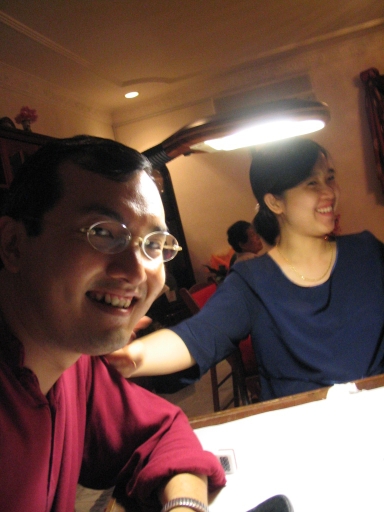
I was just playing around with my camera and was delighted to capture a fun moment we had around the Mah-Jong table (we didn't know how to play but we had fun spinning dices)

The art of taking your own picture is quite an acquired skill. I have pretty long hands to capture a moment like this. :-)

Ah ... my amazing wife May Chin exactly one month before the due date.
February 11, 2005
Random Thoughts before mini-gathering

I couldn't resist taking this shot. It's so nice to drive around Kuala Lumpur and Petaling Jaya during Chinese New Year. It's almost empty on some roads :-)
Saw the Fantastic Four Trailer that sparked some childhood memories of enjoying the Fantastic four cartoons on TV. Had a look at the movie website .. hmmm ...
On a more serious note, it's refreshing to read a new non-western blog by Joseph Oloya Hakim (Thanks Joel for the link)
Last night it was good to catch up with my room mate from seminary, we still laugh at the same stories and relive those fun moments when we were in classes. I'm glad that there'll be some movement as far as his and his wife's lives are concerned. I'm looking forward to see "new possibilities" for them.
I got this weekly blessing in my email inbox today ... good during this holiday break and now transitioning back to normal life very soon. Starting tomorrow...
"O God, your Word tells me that,
whatever my hand finds to do, I must do it with my might.
Help me today to concentrate with my whole attention on whatever I am doing,
and keep my thoughts from wandering and my mind from straying.
When I am studying, help me to study with my whole mind.
When I am playing, help me to play with my whole heart.
Help me to do one thing at a time, and to do it well.
This I ask for Jesus' sake."
February 09, 2005
Nice ... Blessings

Well, we don't have a lot of decorations during Chinese New Year (apart from hanging some Chinese New year cards *grin*). May Chin got this and after we put it up. Gareth just said "Nice!"
I started off the day feeling "wow! last night I had some nice sleep ..." Feeling rested is really one dimension of blessing.
Happy Chinese New Year to all ...
February 08, 2005
Reunion Dinner

The dishes were simple but Mom is a fantastic cook it's quality and simplicity at its best! I'm still full!

Of course, the dinner is more of family coming back together (at least once a year if possible). Kuala Lumpur is our "hometown" so we don't need to drive out to another state. But, it's still good to be together during this chinese new year eve (even though we meet up quite often). We've been through a lot together.

It's nice to see Gareth enjoying the company with my Dad and my brother's hairstyle really is into the year of the rooster! :-) Dad is an art director, John is an entertainer (e.g. clowning, ventriloquism & street magic), I'm a pastor (who's some kind of artist I think *grin*). Let's see how Gareth will turn out (no pressure!0

Now with more vocabulary Gareth is doing well to communicate with my mom. I think she must have enjoyed it when we sang John 3:16 in Mandarin together. It was a song she sang to me when I was a kid.
Random Links 8
Brian Walsh - Transformation: Dynamic Worldview or Repressive Ideology?
such loaded questions as i scroll down the post. Coulcn't resist downloading the pdf.
Todd Hunter's Blog
Reading it more again ... good post on seeking balance.
Today's New International Version Online Bible (via Jason Clark)
Never really followed the controversy. Glad to have it online though :-)
Emerging Fragments
amazing image .. sparks to think on church (i.e. ecclesiology)
Preservation, Transition, Reinvention
All three have been and are in progress in my journey ... more on this later.
Random thoughts on CNY eve 2005
CNY = Chinese New Year, the rooster will crow tomorrow. Bye bye .. monkey!
I read David Chong's post on "Divisive Labels?" and decided to leave an extended comment. It would have been longer but "reality" - i.e. Gareth was fussing for a nap.
It's "energizing" to see On the Edge of Bangsar functioning as "space" for the current leadership team of BLC to learn together.
This cool statement really "hit" me a while ago, from it's not the gospel, it's us! (thanks Andy)
The gospel itself is offensive, but we should not be offensive. The fault should not lie with us.
I think my body is regulating itself so i can start munching recklessly during Chinese New Year. But it is ironic that the first day of Chinese New Year is Ash Wednesday, so this Chinese culture bit and our Christian heritage coincides is intriguing and seems to "open" myself for creative engagement :-)
Had sometime to think about Chaos while reading a pretty good leadership book a while ago. Settled my heart a little as I pondered on some of the questions in between paragraphs.
This statement from Chris Choong's post "Mulling over apologetic method" really made me chuckle:
" ... a bunch of undergraduates trying to find meanings and truth...how pathethic! Get some lives, dear students~ DATE instead of DEBATE.. hahahaha ..."
I recall a recent phone conversationwhere there was obvious "excitement" in the voice of my "thoughtful" friend as our dialogue fluctuated between the "emergence" of his faithre-development/reconstruction/renewal and the "surprise meeting" of a girl. Ah ... as we soar the heights of philosophy, ethics and theology ... when all is said and done, Humanity kicks it with a loud shout and brings us to the ground once again :-)
Reading tributes like this one " No. 17: A Window to the World" always tugs my heart. First, it makes me smile with appreciation to the one who's made an impact as well as the one who acknowledges it. Second, it spins my mind off thinking about the people who have made a difference in my life. This exercise is crucial for humans to "be" humans in the best sense of the word.
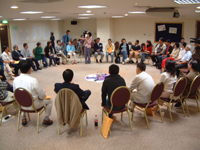
Open Space Technology

Here's Open Space World (English) & Open Space World (Chinese).
I was checking out what I printed from OpenSpaceFacilitatorsToolbox while trying to put Gareth to sleep. I've probably had glimpses of something like this here and there. But this whole framework - paradigm - technology - whatever you want to call it has really "opened up space" in how one can invite conversation, participation ... and action.
February 07, 2005
Random Links 7
A Brief Rule for Pastors and Other Servants
This is good for me and anyone who want to pastor or serve.
Free Bible Activity Sheets
These have been extremely helpful as we try to integrate the children in our worship gathering.
The Waiting Room
It's great to see the "BLC community blog" vibrating with pictures and posts again.
On the Edge of Bangsar
Before I slept last night I was reminded that "leadership" is must not to be confined to merely the tasks at hand, but the "journey"-perspective (and our story) is important to keep us on track to what's important. This "BLC leaders blog" gives space for us and others to travel along together.
Genesis to Revelation
Thanks Jordon Cooper for this link. You may listen in online to these recorded sessions and journey through the Bible with Dr. Craig R. Koester.
Martin Luther on Education
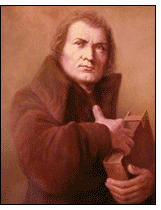
“If I could leave the preaching office and my other duties, or had to do so, there is no other office I would rather have than that of schoolmaster or teacher ... for I know that next to that of preaching, this is the best, greatest, and most useful office there is ... It surely has to be one of the supreme virtues on earth faithfully to train other people’s children....” ~ From Martin Luther on Education (thanks Jerng for the link)
I've been telling people if I'm not a pastor, apart from the secret ambition to be a movie director (now no secret!), I would have enjoyed being a teacher or lecturer of some sort (at least in high school or college/university level).
February 06, 2005
Random Links 6
the 50 Most Influential Christians in America
Ah ... another list for our reference. I think many of us in Malaysia would recognize more names here than the Times list. I was definately surprised to see some names make it ("Oh, I didn't know he was a Christian" kind of reaction). Brian McLaren was excluded (not noticed) though :-P
Idealab Library: The Off The Map idea resource center...
I really like the practical and thoughtful ideas shared here. The "McLaren & Hunter -- What would you guys do?" section has been a personal favorite.
Top Jobs 2005
I know lots of people with top jobs! of course, pastors, theologians, missionaries, church planters, etc. are always under the radar.
Top 10 Future Careers
hmmm as usual pastors are not included. :-P But we know better :-) ha!
(Thanks alwyn for the two job/career links)
Emergent '05 San Diego Blog
It was appropriate for the desert pastor to close his episode at the convention with a picture of a fountain! I love the video clips ...
From Rat to Rabbit

You're Watership Down!
by Richard Adams
Though many think of you as a bit young, even childish, you're actually incredibly deep and complex. You show people the need to rethink their assumptions, and confront them on everything from how they think to where they build their houses. You might be one of the greatest people of all time. You'd be recognized as such if you weren't always talking about talking rabbits.
Take the Book Quiz
at the Blue Pyramid.
It's been some time since I've done these online quizes (thanks dbctan for this one). I haven't read this novel before maybe I should try.
February 05, 2005
Random Thoughts ignited by Emergent '05
A big "Terima Kasih" (Thank you) to Desert Pastor for making the video clips, pictures and summaries-thoughts-insights available. This would be the kind of conference/convention I'd like to be part of. In style as well as substance. I admit I'm just biased.
I'll just pick out some excerpts (in bold) that "blinked" at me :-) and my immediate unrefined random responses (in normal fonts)...
On "Humanity"
Kara began by showing us a photo of her two children, dressed for Halloween. They were wearing costumes instead of regular clothing, but their faces were normal. She then went on to suggest that the opposite is often true of us: we wear normal clothes each day, but feel compelled to put on masks, thus hiding our faces. We do this for many reasons, but often in response to worry or concern over what others and/or God "expect" from us.LaRon then picked it up and quickly led us through a summary of how often God's "face", his people's "faces", or our own "face" is mentioned in scripture. This he tied to two things: the imago Dei, and authentic community.
The first thought that popped into my mind is our preoccupation here in Malaysia (and possibly Asia) on the need to "Save Face" or "Give Face" - (i.e. the give and take because we don't want to be in a position of "shame"/"dishonor" and avoiding to put someone else in that position and thus result in the discomfort of both parties.) This "culture" or "way of relating" at times helps us to sweep aside minor petty differences but in many ways ignores "matters of importance" that we need to deal with head on. Unlike some of our western counterparts who IMHO are often more upfront with their views, we are tempted to nuance them so much until it's no longer clear. Thus, expectations aren't clearly expressed and confusion or even conflict is knocking on the door.
"Opening worship"
Tonight's General Session was excellent. It all began with the worship team from Church of the Apostles leading us in an amazing Eucharistic service that focused on the Transfiguration. The liturgy they crafted included ancient elements re-cast in song and prayer and testimony, and climaxed with everyone partaking of Holy Communion together.... I really appreciate how this year's convention is pulling in actual communities of faith and having them share from the platform rather than only using "big names." It's refreshing...and a really good call.
A round of applause for Karen Ward and the new kind of Lutherans+Episcopalians from Church of the Apostles. For many years I've already grown tired of the Worship Wars debate. Then there's this "fear" that if we don't adopt a certain style of worship (usually using a praise band at times well done other times under pressure to perform). Then there's this frustration of trying hard to "reintroduce" the best of Liturgy to "minds" stuck in the so called "leading worship as leading a string of songs mentality". At times I see some success that gives hope, at other times I keep on "wondering" - "What's going on here?. A well crafted "liturgy" (order of worship that integrates all elements - musical or non-musical - especially the spoken word and the Sacraments) would be refreshing for our Malaysian church scene. Any one want to take up the challenge?
on "The Church"
speaking for myself, what this morning's dialog encouraged was a much needed shift in focus among many emerging church types: embrace the tensions associated with the institutionalized church rather than simply adopting a wholesale rejection of her. This shouldn't, however, discourage us from exploring how we can or should "be" the church.
This is a growing reality for me as I see more and more the inside workings of a "slightly institutional denomination" family/tribe I'm part of (there are times I wonder whether we need more clarity and guidelines because things may be organic but becoming disorderly... hmmm). More and more I feel it's an issue of "mindset" more than just "methodologies. I have this gut reaction to the word "Institution" (as if it's a taboo word), maybe I need to see it as "infrastructure" or even "interface" (I hope I'm using this word correctly *grin*). After listening tostories of "political powerplay" in so called supposedly "independent" churches or those who are more "congregational" in structure, hey I seem to have more "freedom" to explore in a denomination that has a Bishop! ironic but true.
"Bloggers Lunch"
no quotes here but maybe some of us Malaysian Christians who are blogging can meet up someday in some way. Let me "save this" as a future catalytic project. Something like this did happen during our Emergent Malaysia Christmas party '04.
"Cool Professor"
Off-camera, Kent elaborated on how impressed he's been with the depth and quality of questions he has heard coming from delegates during everything that he has attended thus far. What's going on here is unique, and in part, it's a sincere and focused desire to "understand" that is characterizing this year's convention.I salute professors like Kent, who are at Emergent as much to learn themselves as to help others learn.
I know there are some cool seminiary lecturers or "intellectual" giants out there ...whether it's Seremban, Klang, Petaling Jaya, Kuala Lumpur or other parts of Malaysia. I might be calling you soon for a cup of coffee with some of us. Oh yeah ... and if you're passing by from overseas ... please drop me an email.
On "Scripture"
Rather than lead us in a complicated and heated discussion on how our epistemologies affect the way we interpret and interface with scripture, Brian and Stan were "modeling" a relationally oriented hermeneutic, helping us to tie Stan's personal story about growing up with Jesus' story and interaction with James and John, with each of our own stories and the world we live in today.
I look forward for this kind of interaction between two or even more individuals in our context. We've seen the "lecture" model, or the "present paper wait for response then some questions" model, then there's the "panel or experts" presenting "minipapers" closing with some questions. Even thought I mentioned the importance of "mindsets" earlier, but it's our methods of interaction that often sends a stronger message isn't it? And I think our methods also "model" the "mindsets" inherent in what we are trying to communicate. So, there is this delicate balance of the interior and the exterior expression of our message. This "relationally oriented hermeneutic" is very attractive, now how does all this work in a local church? that's the question that's scratching me.
Hi Bob ... I'm Gareth!

Finally they meet face to face :-) It was quite an exciting experience for Gareth (2 year and 4 months old) bump into Bob the Builder at KLCC last Monday.
Actually, I think I was the one who got REALLY excited first! It's been really enjoyable these past few months especially as May Chin and I strike fun "conversations" with Gareth. Topics revolve around "colours", "shapes", "trains", "birds", "What's papa or mummy's name? what's his name?", "counting from 1-20" (we try ...), "ants" (which he has some personal hostility against - May Chin has that for lizards and cockroaches!) .. and much more.
We sing "Jesus, name above all names" with him in the car. Other personal favorites are "Give me Oil in my lamp", "Hallelu, Hallelujah!", a few days ago we tried "Your love is amazing!". Oh yeah .. not forgetting the African song "Neh Noh lita si Mama!"
Of course, there's the routine "The Lord's Prayer" before he sleeps. And the big "Amen" at the end truly completes the day. We're so grateful as we recollect all these special moments. There are times of discipline as well, it's the whole package. And now, we await baby No. 2. Kind of finalized the Chinese name, now the English one ... hmmm ....
February 03, 2005
Random Links 5
CNN LARRY KING LIVE: America's Most Influential Evangelicals
After skimming through the transcript, I realized why I never bought a "Left Behind" book. I was suprised by TD Jakes and counldn't help but resonate with the little that Brian McLaren had to say (or was given time to say). I was drawn to a comment by one of the callers when she said,
"Good evening, Larry. Good evening to your panel. I would like to preface my comment to Mrs. LaHaye by saying that I highly respect Reverend Jakes and Mr. McLaren because they seem to be the most compassionate, understanding and open-minded of the evangelicals."
Thanks to the voiz for providing Larry King Live Interview with Brian McLaren: Video Highlights (via Planet Emergent)
The Church and Mission: Quotations to Stir Heart and Mind
My two favorite subjects that fill my bookshelves. Thanks to Gobi fof highlighting this quote:
"THE GOSPEL is global good news. Thinking globally, God acted locally. The gospel is good news about personal, social, ecological, and cosmic healing and reconciliation. It is good news to the whole creation—to the whole earth and in fact to the cosmos."~ Howard A. Snyder, Global Good News
Open Space Technology
Now the ideas here really opened up space in my mind about conversations, learning, and how we can organize ourselves and more importantly get things done!
Make Poverty History
I love the opening once I click on the site and the mantra "make poverty history" really sticks in my mind ... now it's what's next? and how?
February 02, 2005
The Tipping Point
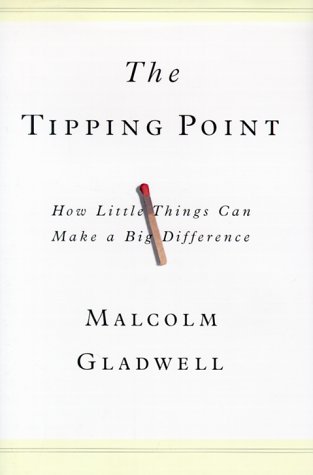
I'm reading this book again ... this time more leisurely and slowly. What is the Tipping Point? Here's what the author Malcolm Gladwell says the book is about ... just to get started,
"It's a book about change. In particular, it's a book that presents a new way of understanding why change so often happens as quickly and as unexpectedly as it does. For example, why did crime drop so dramatically in New York City in the mid-1990's? How does a novel written by an unknown author end up as national bestseller? Why do teens smoke in greater and greater numbers, when every single person in the country knows that cigarettes kill? Why is word-of-mouth so powerful? What makes TV shows like Sesame Street so good at teaching kids how to read? I think the answer to all those questions is the same. It's that ideas and behavior and messages and products sometimes behave just like outbreaks of infectious disease. They are social epidemics. The Tipping Point is an examination of the social epidemics that surround us."
Check ou this Tipping Point - Net Version and thoughts on how it works with blogs.