March 22, 2007
中 庸 - The Doctrine of the Mean
There's much to chew on in these classic texts. The Doctrine of the Mean brought up some hidden surprises which in some sense gave me words of some of the intuitive approaches I've already been using unaware.
Some excerpts to jump start my brain juices and heart currents:
_________________________________________
Zhongyong I. 3.
"莫見乎隱,莫顯乎微,故君子慎其獨也。
There is nothing more visible than what is secret, and nothing more manifest than what is minute. Therefore the superior man is watchful over himself, when he is alone.
Zhongyong VI. 1.
子曰:「舜其大知也與!舜好問而好察邇言,隱惡而揚善,執其兩端,用其中於民,其斯以為舜乎!」
The Master said, "There was Shun:– He indeed was greatly wise! Shun loved to question others, and to study their words, though they might be shallow. He concealed what was bad in them and displayed what was good. He took hold of their two extremes, determined the Mean, and employed it in his government of the people. It was by this that he was Shun!"
Zhongyong X. 1
子路問強。
Tsze-lû asked about energy.
Zhongyong X. 2.
子曰:「南方之強與?北方之強與?抑而強與?
The Master said, "Do you mean the energy of the South, the energy of the North, or the energy which you should cultivate yourself?
Zhongyong X. 3.
寬柔以教,不報無道,南方之強也,君子居之。
"To show forbearance and gentleness in teaching others; and not to revenge unreasonable conduct:-- this is the energy of Southern regions, and the good man makes it his study.
Zhongyong X. 4.
衽金革,死而不厭,北方之強也,而強者居之。
"To lie under arms; and meet death without regret:-- this is the energy of Northern regions, and the forceful make it their study.
Zhongyong X. 5.
故君子和而不流,強哉矯!中立而不倚,強哉矯!國有道,不變塞焉,強哉矯!國無道,至死不變,強哉矯!」
"Therefore, the superior man cultivates a friendly harmony, without being weak.-- How firm is he in his energy! He stands erect in the middle, without inclining to either side. -- How firm is he in his energy! When good principles prevail in the government of his country, he does not change from what he was in retirement.-- How firm is he in his energy! When bad principles prevail in the country, he maintains his course to death without changing.-- How firm is he in his energy!"
_________________________________________
I'm pretty amazed how relevant the above wisdom is for today. Food for thought tonight.
March 20, 2007
大 學 -- The Great Learning
Slowing down and glancing through the opening pages of The Great Learning opens up new horizons. There's a little bit of a time warp experience too ... where suddenly I'm reinterpreting my primary school learning in a new light. This is refreshing. A lot resonates with what I intuitively feel about learning, study, knowledge, various relations, and personal excellence. I read James Legge introductory remarks with much interest.
________________________________________________
子 程 子 曰 : 『 大 學 孔 氏 之 遺 書 。 而 初 學 入 德 之 門 也 。 於 今 可 見 古 人 為 學 次 第 者 , 獨 賴 此 篇 之 存 , 而 論 孟 次 之 。 學 者 必 由 是 而 學 焉 , 則 庶 乎 其 不 差 矣 。 』
子程子曰:『大學孔氏之遺書。而初學入德之門也。於今可見古人為學次第者,獨賴此篇之存,而論孟次之。學者必由是而學焉,則庶乎其不差矣。』
My master, the philosopher Ch'ang, says: "The Great Learning is a Book transmitted by the Confucian School, and forms the gate by which the first learners enter into virtue. That we can now perceive the order in which the ancients pursued their learning is solely owing to the preservation of this work, the Analects and Mencius coming after it. Learners must commence their course with this, and then it may be hoped they will be kept from error."
"The Great Learning is a short text generally attributed to Confucius, for the first chapter, and his disciple Zengzi for the ten following commentaries. It is the first of the Four books which were selected by Zhu Xi in the Song Dynasty as a foundational introduction to Confucianism. It was originally one chapter in Li Ji (the Classic of Rites). A part of Legge's introduction to his translation of the book is quoted below.
This Treatise has undoubtedly great merits, but they are not to be sought in the severity of its logical processes, or the large-minded prosecution of any course of thought. We shall find them in the announcement of certain seminal principles, which, if recognised in government and the regulation of conduct, would conduce greatly to the happiness and virtue of mankind. I will conclude these observations by specifying four such principles.
First. The writer conceives nobly of the object of government, that it is to make its subjects happy and good. This may not be a sufficient account of that object, but it is much to have it so clearly laid down to 'all kings and governors,' that they are to love the people, ruling not for their own gratification but for the good of those over whom they are exalted by Heaven. Very important also is the statement that rulers have no divine right but what springs from the discharge of their duty. 'The decree does not always rest on them. Goodness obtains it, and the want of goodness loses it.'
Second. The insisting on personal excellence in all who have authority in the family, the state, and the kingdom, is a great moral and social principle. The influence of such personal excellence may be overstated, but by the requirement of its cultivation the writer deserved well of his country.
Third. Still more important than the requirement of such excellence, is the principle that it must be rooted in the state of the heart, and be the natural outgrowth of internal sincerity. 'As a man thinketh in his heart, so is he.' This is the teaching alike of Solomon and the author of the Great Learning.
Fourth. I mention last the striking exhibition which we have of the golden rule, though only in its negative form:-- 'What a man dislikes in his superiors, let him not display in the treatment of his inferiors; what he dislikes in inferiors, let him not display in his service of his superiors; what he dislikes in those who are before him, let him not therewith precede those who are behind him; what he dislikes in those who are behind him, let him not therewith follow those who are before him; what he dislikes to receive on the right, let him not bestow on the left; what he dislikes to receive on the left, let him not bestow on the right. This is what is called the principle with which, as with a measuring square, to regulate one's conduct.' The Work which contains those principles cannot be thought meanly of. They are 'commonplace,' as the writer in the Chinese Repository calls them, but they are at the same time eternal verities."
________________________________________________
The Chinese Classics -- Volume 1: Confucian Analects by James Legge
I know people who have a good grasp of Aristotle and Plato etc. I'm a total amateur in all this. I'm also a little bit tired of the privileging of certain western based philosophies (as well as specific epistemologies) while ignoring my roots. But since I can read both Chinese and English ... I thought I'd go with the basics. So, I'm starting with The Chinese Classics — Volume 1: Confucian Analects by James Legge. I read with interest the life of James Legge who "Believing in the necessity of missionaries being able to comprehend the ideas and culture of the Chinese, he began in 1841 a translation in many volumes of the Chinese classics, a monumental task admirably executed and completed a few years before his death."
Some excerpts which caught my immediate attention tonight:
_____________________________________
【第一章】 【一節】子曰、 學而時習之、不亦說乎。CHAPTER I. 1. The Master said, 'Is it not pleasant to learn
with a constant perseverance and application?【第五章】子曰、道千乘之國、敬事而信、節用而愛人、使民以時。
CHAP. V. The Master said, To rule a country of a thousand
chariots, there must be reverent attention to business, and
sincerity; economy in expenditure, and love for men; and the
employment of the people at the proper seasons.'【第七章】子夏曰、賢賢易色、事父母、能竭其力、事君、能致其身、與朋友交、言而有信、雖曰未學、吾必謂之學矣。
CHAP. VII. Tsze-hsia said, 'If a man withdraws his mind from the love of beauty, and applies it as sincerely to the love of the virtuous; if, in serving his parents, he can exert his utmost strength; if, in serving his prince, he can devote his life; if, in his intercourse with his friends, his words are sincere:-- although men say that he has not learned, I will certainly say that he has.'
【第八章】
【一節】子曰、君子不重、則不威、學則不固。
【二節】主忠信。
【三節】無友不如己者。
【四節】過則勿憚改。CHAP. VIII. 1. The Master said, 'If the scholar be not
grave, he will not call forth any veneration, and his learning
will not be solid.
2. 'Hold faithfulness and sincerity as first principles.
3. 'Have no friends not equal to yourself.
4. 'When you have faults, do not fear to abandon them.'
__________________________________
February 13, 2007
The Scripture Principle
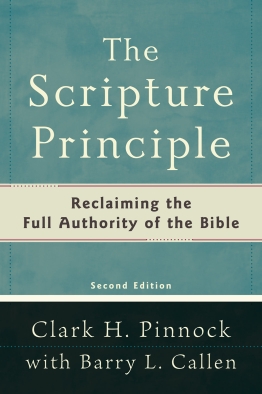
Sometimes I get these little pleasant surprises when I walk into a Christian bookstore. And seeing the book above at Glad Sounds was one of them. In Malaysian ringgit before the special discount it cost RM76.95.
I recall during theology classes during my seminary days, we took some time reading significant paragraphs from Clark Pinnock's 1984 edition. So, when i saw the appendix: The Inspiration and Authority of the Bible: Thoughts since 1984, I was drawn to read the book from the back (which nowadays I often do).
Before I went into seminary, I had never heard of the word "inerrancy" but I read the Scriptures as often as I could for nourishment and guidance for my Christian life. I don't recall ever questioning it's authority. I suppose it's tempting to be more "sophisticated" in my understanding of Biblical authority after more "education" and I know the question and use of the word "inerrancy" is a hot button issue for some. I confess very often hair-splitting debates to tire me. But that's my bias perhaps influenced more by my appreciation of Lutheran pietism and suspicion of Lutheran scholasticism which is a story for another day.
The following paragraphs leaped out as I scanned the book:
"Rather than the hard rationalist approach to biblical authority and interpretation, I had come to appreciate the story and mystery of Scripture, the key role of the Spirit's ministry in original inspiration and current illumination, and the need to listen as well as to reason.My core conviction had become one of certainty of truth arising more from the work of the Spirit through the biblical text than from a tight rationalism rooted in supposed human theory of biblical errorlessness of the text per se. I nonetheless saw retaining the word "inerrancy" as a possible path of wisdom given circumstances in the evangelical community (admittedly more a political than a theological stance. I also saw the need to carefully nuance the implications of this word given the circumstances of the biblical text itself.", p.268
The final words might raise the eyebrows of some ... but let's read this slowly before we sleep.
"Now, concerning the hot button issue, biblical inerrancy, the item for which some battle most vociferously, it is not our preferred term for rendering the concept of biblical trustworthiness. Why? One reason is that inerrancy begs clear definition (which is why, ironically, we can continue to use it), and more importantly because it suggests a degree of technical accuracy that is foreign to Scripture. It places, in effect, a modern standard of accuracy upon the text and is then forced to explain away the phenomena of scores of minor flaws. The Bible does not use the term "inerrancy" but places emphasis upon its own saving and sanctifying power as witness to Jesus.What really disturbs us with regard to the term "inerrancy" is the harm that it does. It almost makes one afraid to open the Bible lest some flaws in the text might overthrow confidence in God. It places the church at a perilous and unnecessary risk. ... We think it better to use a term like "trustworthiness" or "infallibility," which speaks of Scripture as reliable and never failing in its intended purposes. Is it not true that in the Bible we hear the Master's voice in spite of scratches of the needle on the record? The issue is not whether the Bible is totally accurate as we define accuracy, but whether it leads us to the truth of God as all evangelicals believe.", p. 272
For me it's important to keep as closely the relationship between the Bible and Christ. I also believe it's important to be open to the Spirit's illumination of the texts read and reflected upon especially in community with others for mutual encouragement, learning and discernment.
More and more, I see the Scriptures challenging my own values or views which I bring to the text. And the moment I humble myself - I begin to "see" myself better as I study the text better. All the scholarly insights are helpful as part of the more "communal" paradigm I have adopted while not feeling an unhealthy lack of confidence because I am not an expert. Scholarly study then becomes a support rather than speculative exercises.
As a pastor and ultimately as a Christian, I believe one's spirituality plays a crucial role in the process of reading, reflecting and responding to God's voice as one engages with the authoritative Scriptures before us. And not forgetting, the missional direction the texts especially within the overarching narrative from creation to consumamtion - somehow keeps the whole process being privatized or merely part of religious consumption.
Just some immediate thoughts ...before I sleep. I'll throw in an extra interview Ma href="http://www.christianweek.org/stories/vol14/no05/story4.htm">Clark Pinnock’s uneasy journey which might give a richer context to the discussion.
February 11, 2007
Dogmatics in Outline

Here's 2 confessions (which I may have made before).
First, There are many times when I post up a book which I think is worth reading ... most of the time I haven't finished reading the whole book yet. It's more of saying this is a book I plan to read or has caught my attention. I do have at least 4 books which I have finished reading which I hope to post up in due time - perhaps during the Chinese New Year holidays (we'll see). But I though the introduction grabbed me so much I need to let it out!
Second, I have not finished reading a book by Karl Barth before. Heard and read a lot about him but somehow 160 page book seems more managable than his 13 volume magnum opus Church Dogmatics. My motivation is simple ... since he's considered by many at least one of the most important theologians of the 20th century, I should at least read a little bit :-) A book review helps to wet one's appetite.
Third, and this is not a confession. I'm teaching catechism to a new batch of adults for baptism and affirmation soon. One of the basic intros or reintroductions to the faith is using the framework of the Apostle's Creed. I thought reading this book will enrich my own deeper education.
And now, excerpts from the foreword to the Torchbook edition which kept me awake a little longer last night:
"... Is not the term "Systematic Theology" as paradoxical as 'wooden iron'?
... A 'system' is an edifice of thought, constructed on certain fundamental conceptions which are selected in accordance with a certain philosophy by a method which corresponds to these conceptions. Theology cannot be carried on in confinement or under the pressure of such a construction. The subject of theology is the history of the communion of God with man and of man with God. This history is proclaimed, in ancient times and today, in the Old and New Testaments. The message of the Christian Church has it's origin and its contents in this history. The subject of theology is, in this sense, 'Word of God.' Theology is a science and a teaching which feels itself responsible to the living command of this specific subject and to nothing else in heaven or on earth, in the choice of its methods, its questions and answers, its concepts and language, its goals and limitations. Theology is a free science because it is based on and determined by kingly freedom of the word of God: for that very reason it can never be 'Systematic Theology.', p. 5
And the following surely redeems the words "dogma" and "dogmatik" for me :-) and challenges me to go deeper than superficiality. Of course, I admit I still do not see myself as a detailed researcher or strong on details. But that does not deter me from plunging deeper into a better understanding or appreciation of the subject matter at hand.
"...He who is interested in only the superficial impression given by unpleasant catchwords cannot and will not able participate in the truths (of the dogmas) or the truth (of the dogma) ... He who, after learning a little about the meaning of 'dogmatics,' undertakes to delve more into detail, will, I promise, discover (regardless of the method he may employ) in this theological discipline and in theology in general a great amount of necessary, thrilling, and beautiful tasks which are fruitful for the Church and for he world."
, p. 6
February 05, 2007
Asian Reflections
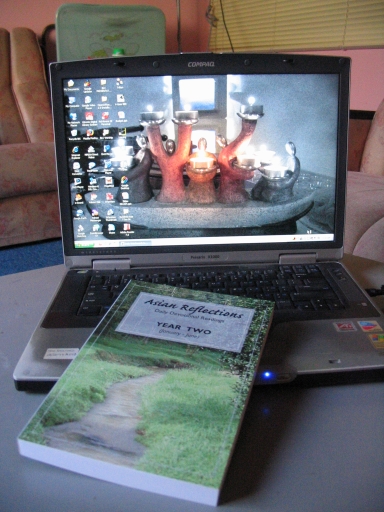
When I was asked to be one of the writers for Asian Reflections Year 2 by Scripture Union. I felt very honored to be given this chance to contribute. It was a lot of hard work ... writing the reflections I mean. But I found the whole process very helpful for me to connect the context where I am in with the content of the Scripture passages assigned to me which was a good chunk of Psalms from 51 -72. Somehow, this "space" set aside for the act of thinking, praying and writing open up myself to encounter the Triune God!
I learnt a lot about myself too for example, I need a good editor. I know my English is mediocre and I don't have a flair for fancy writing. I feel what I write is very ordinary but I try to keep things as honest as I can with some hope from a Gospel centred approach. I confess the Lutheran "Law and Gospel" Grid is very much alive in me :-)
Here's what I wrote as a short over view for the meditations I wrote (it's pretty much kind of my second thoughts on prayer too in between the lines):
"Overview of Psalms 51--72
Psalms 51--72 give us a window into how one’s faith wrestles with the realities confronted by a variety of life experiences, especially in 'seasons of disorientation'. In fact, many 'cursing' or 'imprecatory psalms' (Psalms 58, 69) confront us throughout these devotional readings. There are also prayers where one deals with the inner and outer conflicts of sin (Psalm 51), feelings of betrayal (Psalm 55), insecurity in the midst of danger (Psalm 56) and deep abandonment (Psalm 62). And in spite of the more apparent individual focus of these psalms, there are also themes which place the individual in the wider context of God's work corporately in a nation (Psalm 72) and even, further globally, amongst many nations (Psalm 67). Many of these psalms give us the language of prayer in times when we have lost the words to pray. Even when we are at the lowest point of our faith journey, these ancient prayers direct our hearts to be open to God's surprises and to hope beyond our limited horizons.
The Christian martyr, Dietrich Bonhoeffer, calls the psalms the prayerbook for Christians. He says, 'Not the poverty of our heart, but the richness of God's word, ought to determine our prayer.' As followers of Christ, not only do we have these rich psalms (including all their rawness) to guide our prayers, but more importantly, we are able, through them, to pray them with Jesus because, as Bonhoeffer encourages us, ‘only in and with Jesus Christ can we truly pray.'"
If you are interested to get copies of the Asian Reflections (which has a host of many other Malaysian Christians, Pastors and Leaders who have contributed) please go here.
January 25, 2007
The Bible Experience - NT
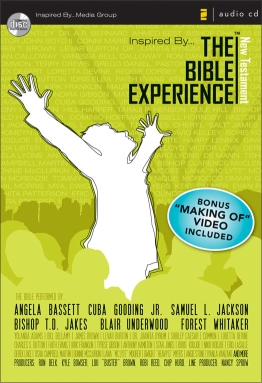
I stumbled on The 2disc Mp3 version at Glad Sounds Jaya SS14. I've always wanted to "listen" to the Bible ... and this version really raises the bar and sets the standard in terms of the quality of audio Bible reading.
I've just finished listening to the whole Gospel of Luke (started last night), continued in the afternoon, and heard the last chapter 15minutes ago.
Here's an interesting piece from International Herald tribune:
"... The 21-hour production, which lists for $49.99 (€39), features the voice talents of more than 250 singers, clergy and actors, including Denzel Washington, Cuba Gooding Jr., Angela Bassett and Alfre Woodard. Blair Underwood portrays Jesus, and Samuel L. Jackson, who played a Scripture-spouting hit man in "Pulp Fiction," is the voice of God.
... The producers decided early on to cast only black actors and other personalities, hoping to attract a black audience, as well as fans of some of the world's biggest box-office draws. They also wanted to shatter the Hollywood mold of white Bible productions.
"I was particularly interested in developing a product that might resonate with the African-American community," Bowser said. "I've long felt that Christian product tends to ignore our perspective."
He called it "a gift from our community to the world to be shared and appreciated by all.""
It's not a cheap gift but it's worth the price. After listening the Gospel of Luke, I'm ready for more!
October 09, 2006
A Dictionary of Asian Christianity
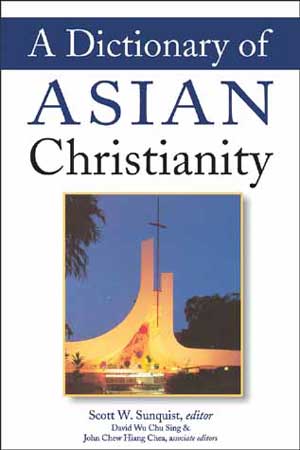
After spending some extended conversationsat the Lausanne YLG-06 with Brad Smith (Thanks Brad for the stimulating conversations and questions posed) on Asian theologies, and all that's related to that. My consciousness about Christianity in Asia is heightened :-) So, I decided to spend some time checking out some of the articles in the Dictionary of Asian Christianity. Here's some excerpts of what leaped out for me this afternoon.
"One of Ricci's first efforts at this accomodation was to publish a tract on friendship, a subject of extreme importance and interest to the Chinese, for whom friendship and human relationships rank above other virtues. Of equal importance to this small booklet was Ricci's own modeling of friendship. he was more than a scholar -- he was a remarkable human being whose life of friendship, humility, and love demonstrated the faith of which he wrote." - entry on "Ricci, Matteo" (Sherman I thought of you when I was reading this!)
"To show he was no longer a Sikh, he cut off his long hair, distributed all his possessions to the poor, and began the life of a Christian sadhu. Clad in a saffron robe and a turban, he went on evangelistic tours throughout India. His greateste joy was to serve and suffer for Jesus, whose love he felt so deeply. For years he walked on the slopes of the Himalayas in his incessant ministry of preaching the Gospel, encountering many hardships from the climate, robbers, steep narrow roads, and persecution. He visited many parts of Punjab and Jammu and Kashmir and then preceeded father to Baluchistan and Afghanistan. He soon came to be known as the "apostle of the bleeding feet." Meanwhile he spent eight months in St. John's Divinity School at Lahore, but he found this too confining. He did not want to limit his ministry to any particular denomination. As a wandering sadhu, he could carry the message of Jesus Christ to all churches and to all people of other faiths." - entry on "Sunder Singh""De Nobili was the first missionary to study philosophical Hinduism deeply. He adopted a Hindu lifestyle, including a strict vegetarian diet, and encouraged his converts to remian Hindu in every possible way. A few dozen baptisms demomstrated the potential of his approach before controversy led to a ban on further baptism. The issues are still controversial today despite belated official church approval for de Nobili's methods." - entry on "De Nobili, Roberto"
"De Silva believed that the acknowledgement of spiritual truths in other religions would not weaken one's commitment to the Christian faith; rather, he was convinced that one's own faith could be deepened and broadened by a sympathetic and intelligent understanding of faiths of others. His thesis was that the truths in Buddhism could be absorbed or adpated into Christianity and could fertilize and enrich a Christian's own faith. In his publications and lectures, he tried to facilitate Buddhist-Christian dialogue and help people of these two faiths overcome prejudices and past misunderstandings of each other." - entry on "De Silva, Lynn"
"According to inscriptions, the Nestorian monk Alopen, from Syria (Da Jin), arrived in the capital city of Changan om 635. He was escorted by Duke Fang Xuen-ling, with a guard of honor, to an audience with Tang emperor Tai Zong (626-49), who invited him into the imperial library and asked him to translate the Bible into Chinese. The emporer allowed a monastry housing 21 monks to be built in the capital and, as a gesture of honor, permitted his portrait to be placed in it. Emporer Gao Zong (649-83), son of Tai Zong, bestowed upon Alopen the title of "great patron and spiritual lord of the empire." It is uncertian whether the title was only honorific or whether Alopen had been appointed an archbishop by the Nestorian patriach in Seleucia-Ctesiphon, Persia." - entry on "Nestorian Church, China"
There's more ... I haven't finished the entry on "Ancestor Worship" and "contextualization" which looks interesting.
August 29, 2006
Adventures in Missing the Point
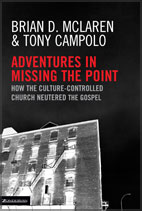
The paper back version of this book has discussion questions which is an added value. I've asked a local bookstore to bring it in. Hopefully soon :-)
I read the chapters on "Homosexuality" and "Sin" again in preparation for the workshops I was conducting and found them most helpful. One key thing I appreciate about the conversations between Tony Campolo and Brian McLaren in this book is they never discuss the issues in abstract and brings the topics to a level that is practical and personal. There are points where both the authors would disagree or would prefer more emphasis on certain aspects. And yet, they do so with respect and civility. Good stuff.
Here's a sample of how they keep the issues in check with stories and the focus on people. We start with Tony.

“When critics of my beliefs about homosexuality do not understand is that I’m trying to make up for a horrendous failure during high school.
Roger was gay, we all knew it, and we all made his life miserable. When we passed him in the hall, we called out his name effeminately, we made crude gestures, we made him the brunt of cheap jokes. He never took showers in PE. Because he knew we’d whip him with our wet towels.
I wasn’t there, though, the day they dragged Roger into the shower room, and shoved him into the corner. Curled up there, he cried and begged for mercy as five guys urinated on him.
The reports said that roger went to bed that night as usual, and that sometime around two in the morning he got up, went down to the basement of his house, and hanged himself.
On that day I realized that I wasn’t a Christian. I was a theologically sound evangelical, believed all pints of the Apostle’s Creed, declared Jesus to be my Savior. But if the Holy Spirit had actually been in me, I would have stood up for Roger. When the guys came to make fun of him, I would have put one arm around Roger’s shoulders, waved the guys off with another and told them to leave him alone, to not mess wit him, because he was my friend.
But I was afraid to be Roger’s friend. I knew that if you stood up for a homosexual, people say cruel things about you, too. So I kept my distance. If I hadn’t, who knows if Roger might be alive today.
I am not asking that Christians gloss over biblical teachings, nor that we justify same-gender eroticism. I am simply reminding Christians that we are supposed to love people – even those we have been socially conditioned to despise. I am calling Christians to reach out and show kindness and affection toward their homosexual neighbors – who number at least fifteen million in the United States. If we Christians cannot love these neighbors as we love ourselves, then we are violating the command of Jesus (Matthew 19:19) and ought not call ourselves his followers.”- pp.177-178
Brian chips in after Tony's extended chapter working through attitudes, misconceptions, key scriptural passages and possible ways forward, an interesting insight and story.

“What if my child told me, “Dad I think I’m a homosexual”? What if the child of a church friend were homosexual? How would I want the church to respond to my child?
This isn’t a theoretical question. Tony’s chapter helps people translate this from an abstract question for theologians, or from a political question for the Religious Right, into a very practical and personal issue for all of us: How do we treat our neighbors, our colleagues, our sons and daughters? Before focusing on the morality of “their” sexual partners, Tony forces us to face the morality of our treatment of fellow human beings, neighbors, people Jesus loves and to whom Jesus sends us to express that love.
This issue ceased being theoretical for me a few years ago, when I made the very worst mistake of my pastoral career. Our church has a listserv where members dialogue about faith issues. For a few weeks homosexuality was the subject of a lively discussion. A man in our church who had struggled with homosexual orientation for his entire adult life, and who had confided his struggles to me, wanted to post a message so that others could know what a homosexual feels like when he hears statements like “Hate the sin, love the sinner.” But he couldn’t break his anonymity: that would be too risky and painful for him and his family. So to preserve his anonymity, he asked me to post his message under the pseudonym Pain.
He sent me the message to post, and I did. What I didn’t realize was that, when I copied his message, I also copied the return-path information at the bottom of his e-mail. Anyone who read his e-mail to the end could read his name. I had no idea what I had done until a friend called me and told me. Mortified, I called the man, who had already seen my mistake. I rushed to his house, where I found him weeping. His wife was weeping.
I died inside. But we talked, we prayed, I apologized, he forgave me.
Still, the fact remains that a homosexual man whom I had hurt so deeply (though accidentally) was far more merciful to me that most of our churches are to homosexuals.”-pp. 189-190
August 28, 2006
Uncommon Decency: Christian Civility in an Uncivil World

"Can Christians be civil in a world falling apart?
In these wild and diverse times, prolifers square off against prochoicers, gay liberationists confront champions of the traditional family, husbands and wives face each other in court, artists attack legislators, and "politically correct" intellectuals abhor crusading fundamentalists.
Philosopher and ethicist Richard Mouw is concerned that, too often, Christians seem to be contributing more to the problem than to the solution. But he recognizes--from his own personal struggle--that it's not easy to hold to Christian convictions and treat sometimes vindictive opponents with civility and decency."
The paragraphs above invites us to look into the book. My reason was simple and perhaps existential - How do we engage in conversation with someone who holds strong convictions who are different from us? We tend to focus a lot on how to persuade the other person to accept our views of positions. But increasingly I believe we cannot pursue that process with out the practice of "convicted civility". This book introduced me to this helpful term.
The relevance of this particular approach and reflection is urgent as I witness needed dialogue and healthy debate within the Christian community (and even beyond that) often degenerating into fruitless disputes and off-tangen directions which after some time drain the resources within us for better things ahead.
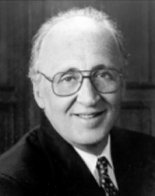
Richard J. Mouw is one self-proclaimed Calvinist who breaks the stereotype of a crusading philosopher, scholar, and author in the Reformed tradition. I found myself receptive to the gems he offers.
I'm not much of a book reviewer. It's simpler for me to share what has caught my attention and match it with my own reflections. So nothing fancy. What you see is what you get.
“one of the real problems in modern life is that the people who are good at being civil often lack strong convictions and people who have strong convictions often lack civility.”— p.12
During the E06 conference Workshop I facilitated we began framing our discussions between Dogmatism & Tolerance and the tension in between. The refreshing insight I got from Prof. Mouw is that no one needs to be "conviction-less" (that's not in question), the problem is we lack civility. I think he's right.
“Christian civility does not commit us to a relativistic perspective. Being civil doesn’t mean that we cannot criticize what goes on around us. Civility doesn’t require us to approve of what other people believe and do. It is one thing to insist that other people have the right to express their basic convictions; it is another thing to say that they are right in doing so.” – p. 20
Sometimes it "feels" or maybe "perceived" just because we allow the "other" person to voice their views we walk the slippery slope of compromise. The temptation to be quick to "defend" or to "show the fault of the other view" bubbles in us when some patience to hear them out further could clear the way better. At the end, we might all land up with different conclusions but we'd become better people as we walk through the issues and concerns - especially when we can get in touch with the deepest fears or highest hopes. We might not change our "views" but our "view" of the other person and what they stand for may change.
“When Jesus showed “acceptance” to prostitutes and tax collectors, he did not condone their sexual or economic behaviors. He loved them in spite of their unsavory ways. He called Mary Magdalene and Zacchaeus to correct their ways and become faithful disciples.
But Jesus refused to define people in terms of their present sordid circumstances. He affirmed their potential for living as faithful and creative children of God.” – p. 22
Acceptance, approval, affirmation. The way we negotiate how these words and what they represent and convey is needed as we deal with uncomfortable issues. so, often the battle is not out there but within us - our heart attitudes, the paradigms in our heads, and the praxis we are used to.
We talked about Homosexuality and Race/Religion/politics to keep the workshop concrete and not abstract. And even in the midst of that, I think conscious effort was needed for us as Christians especially to see the human faces behind the controversial issues. The temptation to be over excited about the issues and the arugments surrounding it tend to de-humanize us (both parties perhaps on the opposing end) if we are not careful.
“To be civil toward people does not mean that we have to like them… I can treat this person with gentleness and respect even if I haven’t manufactured those feelings that would count as “liking” them.” – p. 22-23
This was liberating! :-) and realistic. But I think keeping in view how we feel about the other person is one big challenge.
“Ad hoc adjustments are necessary for all of us. We are on a pilgrimage, and our favorite formulas are often nothing more than helpful summaries of what we have seen thus far. We have to be open to new challenges as we continue in our journey.” – p.164
So often, it's appreciating the limits of our perspectives and especially the limits of language for me has ironically been most liberating.
“Our fundamental allegiance is to the gospel alone. In the light of that basic allegiance, all other commitments must be tentative. … we must not be drawn into ideological attachments Convicted people are easily captivated by polarized positions, but Christian disciples ought to be very suspicious of hard-line identifications with either “left” or “right.” - p. 164-165
Even if one doesn't want to be "captived by polarized positions", the reality of being labeled by others is still inescapable. To some we are too left, to others we maybe too right, for many we may appear position-less, the list goings on. When all is said, I pause and submit my "struggles" to Christ for constant self-examination. What is true for us in our daily ethics is similar to our work in progress musings. Things look static on paper and when it's captured in words to some degree ... when we all recognize it's surely more dynamic.
“The recognition that God’s standards of truth and morality are the only reliable reference points for our lives should instill in us a humble spirit. Arrogant self-righteousness must have no place in our hearts. It’s one thing to believe that God’s revelation is the only sure and certain guide for our journey; it’s another thing to act as if we ourselves possessed a sure and certain grasp of all the complexities of revealed truth.” – p. 166
I've heard this raw expression of the above refined paragraph: "You are free to affirm your convictions, but you don't have to be a jerk doing it" It cuts both ways.
“Seeing God’s patience means being modest in what we expect of other people.”- p. 168
Sometimes, I wonder whether it's easier to be more modest in my expectations for non-Christians than fellow Christians. Partly, because the inner voice may say "We should now better as Christians!" But then again ...
“This is what civility comes to, finally: an openness to God’s surprises. What that openness marks out lives, we have learned patience – along with the flexibility and tentativeness and humility and awe and modesty that will inevitably come to the patient heart. And since none of this is possible without a clear sense of who we are, and to whom we belong, the patient heart will also be a place where convictedness has found its home.” – p. 169
Patience is rare these days. How often I have failed in this area. Hopefully after reading this post - and for some of us this book ... the atmosphere of "patience" will increase starting from those of us who proclaim we worship one who is "gracious and compassionate, slow to anger and rich in love."
August 18, 2006
Review: Embracing Grace Part 2 & Part 3
I just came back from Labuan so I'll need myself to get reorientated. Thanks to John Frye again for giving us part 2 & Part 3 of his review of a book I hope comes to Malaysian bookstores soon, and more people will begin so how the insights might help them as a Christian and one who's serious about the gospel. Somehow I get the sense there's still a lot of ungrace in our world (even the "Christian" world), and we often so boldly claim we've got the "gospel" right (and figured out). Kyrie Eleison.
_________________________________________________________________
From Part 2
We continue to think with Scot McKnight about "what is the gospel?" as he writes Embracing Grace: A Gospel for All of Us.Chapter 1 opens "The gospel is more like a piece of music to be performed than a list of ideas to endorse. ...Thus, it is a gospel that is both proclaimed and performed."
A Story to Perform"...[W]hen the gospel is embodied it tells the gospel story better than anything Hollywood can flash on the screen and better than any novelist can put on paper. ... We don't want to be told that the gospel all of a sudden will solve all our problems and make the world shine its happy face on us...because we know it isn't true."
The gospel is neither "glitzy" nor "tame."
It doesn't erase all problems.
It's not about "being nice to one another" and all will be well.The gospel is not about being phony and pretending to be perfect. It doesn't create walls that separate people, but invites "everyone to come to the table and listen to Jesus." In a "come-as-you-are-culture," people are looking for an authentic gospel with permeable walls.
"A stronger way of saying it is this: this generation is challenging the Church to perform what it proclaims, or, to use a less elegant phrase, to put up or shut up."
Scot recounts the "performance" of Patrick of Ireland, tells the story of NorhtBridge Church in Illinois near the Wisconsin state line, and affirms Solomon's Porch in Minneapolis.
Chapter 1 ends with "Proclamation and performance of an authentic gospel combine into credibility."
...next: the beginning of the gospel...
From Part 3
EIKON if YUKON (a little humor there)Chapter 2-- The Beginning of the Gospel
McKnight affirms that if we're to get the gospel right, we have to begin at the beginning. Thus, Chapter 2 sweeps us back to Genesis 1:1 and into the creation story.
Because the concept of "the image of God" is vital to the gospel, McKnight introduces the phrase Eikon of God. Adam and Eve were "Eikons." Eikon is the Greek term for the Hebrew tselem which means "image." Scot does this because the phrase "image of God" has been over-used and diluted in eons of theological debate.
"When God made humans [Eikons of God], he gave them hearts, souls, minds, bodies, and wills to make them individuals; God gave them other individuals just like themselves so they could live in community; and he gave them a world in which to live. ... The gospel is about every one of these dimensions of human life--the human's relationship to herself and himself, to God, to others, and to the world and to the society in which we live."
It's a Beautiful Day in the Neighborhood:
The Life of "Fat Freddy Rogers"After a brief overview of a fat, lonely kid named Fred Rogers, who went to seminary and then founded the kids' TV show "Mr. Rogers' Neighborhood," Scot notes, "Mr. Rogers, so I believe, gave a generation or two of kids a profound sense of their specialness, their Eikonic status, and showed that we were made to live out this life in our neighborhood."
INDIVIDUALISM IS THE BIGGEST OBSTACLE
TO THE GOSPEL OF EMBRACING GRACEWhy? Because individualism excludes from the discussion of the gospel our relationship to God and to others, leaving us on our own to determine who we are.
Eikons Are Made to Embrace
We're designed to relate: to relate to God, to others, and to our world.
Scot McKinght closes Chapter 2 with this: "Humans are by nature Eikons: that is who we are. By nature, we are designed with the inalienable right to be embraced and to embrace: embracing God who made us and embracing ourselves, embracing others, and embracing our world."
"The gospel that tells our story begins with this beginning."
__________________________________________________________________
August 15, 2006
Review: Embracing Grace Part 1

Special Thanks to John Fyre for sharing his review series with us. I'm away from internet access for a couple of days. So I decided to pre-post from other blogs point to stuff that's "nourishing" & "nurturing" (as opposed to "draining!")
_________________________________________________________________
What is the gospel?
Scot McKnight's Embracing Grace: A Gospel for All of Us is a readable and enjoyable advance in our understanding of "the gospel of the kingdom of God" announced and lived by Jesus.
I think it answers many questions raised in conversations today, a primary question being "What is the gospel"?
To keep us from reducing "the gospel" down to expressions that fall so short of the expansive grace of God revealed in Jesus Christ, McKnight gives us a compelling book, not a marketing pamphlet; a theology, not a ticket out of hell.
So, who is this Scot McKnight?
Scot is a baseball fanatic, one could say, since his son Lukas is a scout for the Chicago Cubs. He's happily married to Kris who, by the way Scot writes about her, is his favorite companion and travel friend. He's a chef who can prepare fine Italian cuisine ("Risotto al Basilico, anyone?"). He was, in his younger years, the star basketball shooter for what is now Cornerstone University in Grand Rapids, MI (just ask his coach Gary Raymond). He's an aficionado of fountain ink pens ("a fine Pelikan Piazza Navona, anyone?") He is an author, cranking out more good books than Shaklee does pills. And to my way of thinking Scot is "a new kind of scholar"-- a respected scholar who has not lost sight of the ordinary guy or girl who is trying to follow Jesus.
I don't think Scot has ever seen the proverbial "ivory tower" that he's supposed to live in. Scot is a theologian for the street, for the corner market, the college campus, the little church hidden in the high corn of Iowa. But don't be fooled by this casual demeaner because with a little flick of his fountain pen, McKnight can skillfully joust with the best of the Jesus scholars and New Testament studies geeks.
For Those Who Need to Know (non-Type A's feel free to skip this)
McKnight is presently the Karl A. Olsson Professor in Religious Studies at North Park University (Chicago, Illinois), where he is also the Department Chair and the Director of the College of Christian Life and Thought. Scot obtained his Ph.D. at the University of Nottingham (1986). McKnight is a member of the Society of Biblical Literature and the Society for New Testament Studies. He is the author of more than twenty books, including the award-winning The Jesus Creed: Loving God, Loving Others (Paraclete, 2004), which won the Christianity Today book of the year for Christian Living. His most recent books include Embracing Grace: A Gospel for All of Us (Paraclete, 2005), The Story of the Christ (Baker, 2006), and Praying with the Church (Paraclete, 2006). He has a new book (see!) coming out in November called The Real Mary: Why Evangelical Christians Can Embrace the Mother of Jesus. Other books include Jesus and His Death (Baylor, 2005), A Light among the Gentiles (Fortress, 1992), A New Vision for Israel (Eerdmans, 1999), Turning to Jesus (Westminster John Knox, 2002), Galatians (Zondervan, 1993) and 1 Peter (Zondervan, 1996), Interpreting the Synoptic Gospels (Baker, 1988), and he is a co-editor with J.B. Green and I.H. Marshall of the award-winning The Dictionary of Jesus and the Gospels (IVP, 1992) as well as the co-editor, with J.D.G. Dunn, of The Historical Jesus in Current Study (Eisenbraun’s, 2005). He regularly contributes chapter length studies to books and articles for magazines and online webzines. Scot's books have been translated into Chinese, Korean, and Russian.
Embracing Grace: A Gospel for All of Us
Prologue and Introduction
So what's Scot up to in his book Embracing Grace?
Prologue-- "It [the gospel] does not belong to one and only one denomination; it belongs to the whole church."
"An undeniable feature of the attractiveness of Jesus is that he wasn't distracted by endless debates about theories: he rolled up his sleeves and invited people to join him in his vision for the kingdom of God. ... The gospel is good enough on its own, and it doesn't need to be propped up with proofs. Stories are like that. No one needs to prove that the...Lord of the Rings or Charlotte's Web are good stories."
Introduction-- "So, how would I define the gospel? The gospel is the work of God to restore human beings to union with God and communion with others, in the context of a community, for the good of others and the world."
"God embraces you and me and
God embraces others and
God embraces the whole created order.
Then:
You and I embrace God back and
We embrace others and
We embrace the entire created order.
The gospel is designed to create this cycle of grace."
...to be continued..."
__________________________________________________________________
August 01, 2006
The Sky Is Falling
Looks good :-) Thanks Mark Priddy and everyone at Allelon for making these resources available (and the ongoing goodies online)!
The sky is falling .. ... the earth is moving ...
June 21, 2006
The Sense of the Call

It's been quite a while since I've posted up the books I've been trying to read. Very often, I'm overwhelmed with the amount of stuff I want to reflect on and yet have not seriously dwelt longer on. It's the I glance through lots of material widely but have a deeper desire to plunge in deeply as well.
Perhaps it's out of need as I'm my 7th year in BLC and my 10th year in living out my response to "the call" upon my life that drew me to this book. Marva Dawn's words below did catch my attention immediately:
"Why is it SO HARD to serve God these days? Everywhere I go, pastors and lay people tell me how discouraged they are. Congregational budgets are not being met; council leaders or influential members lurk and attack like crocodiles; volunteers are difficult to gather; there is always too much work to do and not enough time to do it, too many needs and not enough saints to meet them all."(p. 1)
someone asked me on Sunday how would I describe my last 6-7 years in planting and pastoring Bangsar Lutheran Church? I paused and replied, "It was much HARDER than I expected .. *smile*".
The funny thing is after a wedding recently, another "fulltime" pastor friend asked me how come I look so relaxed and seem like I'm enjoying what I'm doing. Perhaps the hardship doesn't show huh? I know I'm not acting or something. It''s true there are lots of surprising joys ... but there are also discouraging times. It's a mixed bag. I'm learning every day to take note of where "grace" is happening.
It was good to be reminded, "... the sense of our call is that God's Kingdom reclaims us, revitalizes us, and renews us and thus reigns through us before others, on behalf of others, sometimes in spite of others, and always with others." (p. 13). There's a lot to unpack in the last statement. And I'm looking foward to process this slowly through the book.
At this stage, I've only read until this part on "patience" ...
"... we need patience -- or perhaps we should resurrect the old rendering, "long-suffering". It will cost us loads of long hours, myriads of conversations, scads of sorrow, masses of disappointments and frustrations engaging people in the instruction and mission of the Kingdom. The only thing that makes it worth the bother is that the Kingdom is the only treasure worth having." (p. 18)
I'm not ready to "surrender" the whole concept and idea or image of "calling" to the my past charismatic experiences or encounters with so called "prophetic" personalities. I've been happily revising the content of what "calling" means and I trust it's closer to the Biblical-theological vision I'm growing to appreciate and understand better. Some baby steps forward with stumblings here and there. I think this book will give me some space and make room for more improvement.:-) I especially like the way the whole "Sabbath Way of Life" is thown in the equation.
March 04, 2006
Nails and Thorns

Here's the Nails and Thorns: Lent Meditations (pdf) where I'll be posting daily meditations from.
Some months ago, my fellow Methodist pastor Rev. Ting Moy Hong invited me to write for the Malaysian TRAC Methodist Youth version lent Meditations. I said why don't we make it a joint Lutheran and Methodist project. Of course, all this is first and foremost possible because of our friendship since seminary days. so, it was great to invite fellow Lutheran Alwyn Lau along and then Anglican morphing into a Methodist (or whatever) Sherman Kuek and at the last moment Pentecostal married to a methodist pastor Rhema Rao. Thanks to Aaron for working hard in adapting a cover design plus working on the layout.
After reading through the meditations with all the different styles and all. I realised even though some of the writings might sound more "youthful", overall I think it's written with a more intergenerational mindset in mind. Well, one thing I enjoyed is that in this project in a very practical way starting with our friendship and the whole process I was encouraged by the commitment and generousity we experienced throughout. Anyway, please accept this as our gift to using this Lent Season to not just give up stuff but more importantly grow in maturity as a Christ-follower.
December 03, 2005
The Shape of Practical Theology
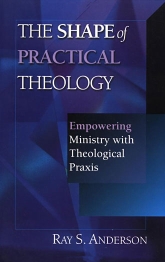
I read this less than an hour ago and found that I needed to hear this l ...
"It is bad theology to have to love the world more than God, and to confuse our service to God with our being sent into the world. It is bad theology to interpret the calling of God in terms of the needs of the world, rather than in our being sent to the world to do God's work and reveal his glory.
A theology that cripples and destroys the self-esteem and sense of worth of a minister is not made better by "success" in ministry. A theology allowing no "sabbath rest" for the one who does the work of the ministry is a theology of th curse, not a theology of the cross. A healthy theology contains healing for the healer and freedom for the fighter of God's battles. A healthy theology, of course, is a theology of a loving God who knows that to be God is to be responsible, even for our faltering and fallible efforts. " (pp. 287-288)
A useful review starts by saying, "This book offers surprises for a variety of readers. For the scholar who suspects that "practical theology" is an academic Trojan horse full of mere pragmatists, it relies heavily on the work of some of this centuries most supple theological minds, e.g. Karl Barth and Thomas Torrance. For the practitioner who has lost hope that erudite theological reflection has any bearing on the daily work of ministry, it opens previously inaccessible recesses of a nourishing well."
I needed the nourishing tonight ... I'm glad I borrowed the book from the seminary library .. it's overdue .. but renewed for another month!
November 28, 2005
The Community of the Word

I'm always drawn to books on ecclesiology ... I think it's because it's become part and parcel of my life and ministry as well as my thinking process (informally in conversations and formally in my MTheol Program) - so when this gem arrived in SUFES bookstore I grabbed it.
So far I've only managed to read three chapters randomly - I'll quote some highlights for me and try to say something from my side :-):
Chap 1: THE CHURCH IN EVANGELICAL THEOLOGIES, PAST AND FUTURE by D.G. Hart
"Theology is generally a better source for agenda setting than history" (p.23)
A good intuitive and intelligent work of theology could keep us from th paralysis of analysis? Theological vision is meant to be liberating and not suffocating, forward looking rather than nostalic rehash of the past. I do believe theology (when not restricted to the academic-I-can't-understand sense) at its best is meant for all. Personally, I'd love to see more pastors integrate it with their ongoing messy ministries so we won't get sucked in the nitty gritty and lose sight of the bigger picture.
"The fundamental difference between the old Protestants like Calvin and Luther and the new ones like Edwards and Hodge was whether the church was a subjective, invisible quality shared by the truly converted or an objective medium of grace outside of which there is no ordinary possibility of salvation." (p. 25)
This is the first time I'm introduced to see this difference in this particular way.
"the phrase evangelical ecclesiology 'is an oxymoron, like 'an honest thief' or 'airline food'." (p. 25-26)
I giggled when I read this one!
"Protestanism in its very nature demands repudiaion of a high view of the church and its ministry as the means by which salvation proceeds ... does the church communicate or mediate grace through Word and Sacrament?" (p.37)
This maybe the reason why I see myself drawn to the study of church it's importance because a big chunk of my initial Christian walk had a very LOW view of the church and often I confess it was just me and Jesus - that's it. When actually it was so supposed to be that's the start and not that's it!
"Evangelical piety is inherently suspicious of the church as a medium of salvation. ... evangelical forms of devotion have so stressed the direct work of te Holy Spirit of the believer that Christians' embodied existence seldom becomes a factor in understanding the process of salvation." (p. 39)
I do recall and still see much emphasis on "personal devotions" often disconnected with a more "embodied" and "corporate" dimension. I think the moment of kind of "got it" (not as possession or arrival but a lightbulb moment!) I found myself free from being entangled with self-inflicted "desert moments" and open to the wider work of the Spirit where I may not expect it. For example, Holy Communion now means so much more than just a ritual but truly a place to pause and encounter Jesus afresh and in fact to be "filled with the Holy Spirit." I used to try too hard to pray for an hour in tongues to access the work of the Spirit. Now I'm learning to surrender more.
Chap 3: PRACTICING CHURCH: Evangelical ecclesiologies at the end of modernity by Jonathan R. Wilson
"Both the best and worst of evangelical ecclesiology are rooted in the passionate evangelical commitment to mission. This engenders flexibiity that contributes significantly to the accusation that evangelicals do not have an ecclesiology. We do -- but our ecclesiology is so flexible that it is difficult at times to identify an effective one." (p. 71)
I see much of that flexibility expressed through the parachurch structures I'm in touch with especially in student ministry. Glimpses of this here and there in local churches before it becomes institutionalized or corporatized (which happens very quickly it seems). Getting to know the Roman Catholics has provided a useful mirror for self-understanding the past years ... especially in the area of "flexibility."
"... when ecclesiology has been entirely abandoned in favor of a mission. By this I mean that no critical reflection is taking place on the mission and its attainment. ... the life of the church has no implicit or explicit roots in the triune God. At this point the church easily and inevitably becomes instrumental to something other than that mission give by God." (p. 71)
I see this all over the place ... lots of resolve, loads of resolutions ... and yet lost our roots? Repentance is in order ...
"... the evangelical church needs to maintain a missional ecclesiology with its commitment to mission, and concomitant flesxibility while also remaining faithful to our commission. The best way to describe this and equip ourselves for faithful flexibility is to add to our missional ecclesiology an improvisational dimension. When evangelical ecclesiology is improvisational it enables the church to fulfill its mission in changing circumstances."(p.71)
as a non-classically trained (in fact unproperly trained) guitar player I can appreciate this image of "improvisation". I think it's great guiding metaphor for theology as well as methodology.
"... the ecclesiology of Brian McLaren is a still-developing attempt at improvisation. ... To continue with the imagery drawn from jazz, McLaren's session in the studio has developed some promising possibilities, but more rehearsal is needed. Mclaren's ecclesiology is a work in progress. In a word, it is ... well, emerging." (p. 72)
Yup ... the author has got this one right ...
Chap 6: THE CHURCH AS MISSIONAL COMMUNITY by Darrel Guder
"The term missional is an attempt to move the discussion beyond too narrow definitions of mission as merely one among the various programs of the church, and to find ways to think about the church's calling and practice today in the light of the fact of the multicultural global church."(p. 116)
I've said it more than once ... it's a great term .. open to abuse like all terms but very helpful in just opening up my mind.
"The church that Jesus intended, ... is missional by its very nature. ... the purpose of the apostolic mission: to found missional communities to continue the witness that had brought them into being. ... Thus, the Scriptures' collective purpose, we contend, was the continuing formation of already missional communities for faithful and obedient witness. ... Defining missional in such a way has broad implications for the entire theological task, starting with ecclesiology but not stopping there" (pp. 116-117)
Abstract or more philosophical theology perhaps has its place in the bigger picture but I see for the overall purpose and movement of the church - the missional lens has more potential in connected those often disconnected with each other structurally - e.g. seminary, local churches, parachurches, networks, etc. while at the same time providing theological resources and frameworks to integrate theology, spiritual formation and visible practices.
"We are heirs of both human reductionisms and of divinely empowered resistance to such disobedience." One of the pressing requirements for the development of a missional ecclesiology today is the task of learning how to read and interpret our history dialectically." (p. 120)
A challenge I see after serving as a pastor the last 8 years is from young to old - to start even appreciating history .. and then learning to interpret it. So, very often I find myself telling stories or giving short historical backgrounds before sharing a "quote" (just to model that).
"Since Western ecclesiology did not operate under the fundamental principle that the church is called, gathered, formed and sent to be God's witnesses in the world, we did not initially form churches with that sense of missional vocation. the question of missional calling was really forced upon the emerging global church by the reality of being minority churches in completely non-Christian settings, and illumined by their own interaction with Scripture as translations into vernacular languages made this possible." (p. 123)
It's nice to hear this self-critique from a western theologian. I hope we in Asia won't have to follow unnecessary dead ends and then get knocked to our senses. It will happen ... but I hope we'll harness our energies now on what it means to be called, gathered, formed and sent!
"Who is the church of Jesus Christ and what is it for?" (p. 124)
sounds like a simple question ... PAUSE first then SLOWLY answer.
"Christian witness is corporate in order that it can also be individual and personal. God calls people into discipleship, formation by Jesus, in order to send it out as an apostolic community, so that each of its members can be an apostolic witness with that flame of the Spirit ignited on every head." (p. 125)
"The ancient greeting that ended the liturgy. 'Ite missa est' must be understoof not merely as "Go, you are dismissed," but rather, "Go you are sent." "(p.126)
everytime, I give the Benediction or give words of dismissal during the Holy Communion or close in prayer , etc. I consciously and intentionally think this, feel this, and pay attention whether I will this ... beign dismissed is just "bye!" but being sent not that's totally different posture and direction!
"The purpose of God's mission is ultimately the acknowledgement and enjoyment of the glory of God; it happens as grace extends to more and more people; the evidence of that spread is growing thanksgiving to God which displays before the world the loving character and purposes of our God. It is the church to an ever-growing understanding of who it is and what it is for." (p.128)
So often what is marks our mission is a display of pressure (or even panic at times) .. evangelism as sales pitch has "totally stolen" the joy of many when it comes to being part of the mission. But I love the words "grace extends to more ..." That's what it's supposed to be ...
November 05, 2005
Google Print

This REALLY brightened up my day! It's a Sunny day too!
September 28, 2005
A New Kind of Conversation
I'm a little left behind this "ongoing conversation" since it started. Partly because I'm "in transition" in a number of ways :-) I hope to catch up once things are more settled at least at our new place of refuge.
I personally find this "book project" fascinating .. first, in it's title and topic and second, in the way it's written with the aid of the medium of blogging.
Check out the following for a sampling of what's happening and ongoing ...
What is Postmodernism? - Bruce Ellis Benson
I've been asked this quite a lot lately ... Brian's response is worth checking out here
Spiritual Formation in a Postmodern Context -- Brian McLaren
It's not just about knowing the context, it's about how we relate this to discipleship and how all this affects or even refocused how we can do "spiritual formation"
Evangelical Faith & (Postmodern) Others -- Kenzo Mabiala
This is REALLY good and introduced the idea of "postcolonial" thinking ... which has been popping up in this blog as well.
Postmodern Ministry; In Search of A Living Orthodoxy -- Ellen Haroutunian
I've heard of a generous orthodoxy .. now how does all this translate into a "living orthodoxy". This is not just word play ... it's allowing words to shapre our reflection. I'm still cautious and concerned when the word "postmodern" may be misused as a "brand" name ... but then that's always the temptation if we are not alert.
Bible, Theology and Postmodernism -- Myron B. Penner
Ah! here comes something on the Bible ... Phew ... :-)
August 09, 2005
Scot's Top Ten Books Series ...
Since we're still on the topic on books Prof. Scot McKnight has been serving us with a whole menu of books.
My wife might not be too happy about the "temptations" due to these links to buy the books Scot recommends ... but then again .... :-)
Top Ten Books: Spiritual Formation
Top Ten Books: Missional Formation
Top Ten Books: Responding to Left Behind
Top Ten Books: New Testament Theology
Top Ten Books: Earliest Christianity
My first Meme
Like him I don't really know what Meme is (now I do after reading the link), but since I got tagged by Shermen Kuek new kid on the blog! .. I will respond ...
1) Total Number Of Books You Own:
I've actually don't know the exact number ... (many people know I'm lousy with numbers!) I don't think it's a lot ... but I'll just let the pictures speak for themself! :-)





2) The Last Book You've Bought:
I think I bought at least 3 or 4 at one go ... but since Mr.S.K and I have the same initials, I'll put him up ... :-)

3) The Last Book You've Read:
I have this habit of often reading a few books at one go ... but I think I can claim Brian's latest book as one I finished reading.
4) Five Books That Mean A Lot To Me:
(And I'll throw in one more that's free online... partly because one of the authors became a friend and a mentor from a distance at a critical time of my journey)




5) Tag Five People And Have Them Fill This Out On Their Blogs
(all locals and avid readers I think!):
Kia Meng
David Chong
Chris Rao
Ben Ong
Alwyn Lau
August 03, 2005
Reclaiming God's Original Intent for the Church
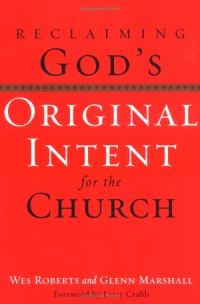
Wes Roberts and I had a short email exchange regarding the late Stanley Grenz. This is another occassion where I know someone through their blog first before their book. The co-author Glenn Marshall pastors a congregation of about ninety members (in the past I'd probably pick up a book by one who pastors maybe 9000 members - obviously something has changed in me *grin*).
I must admit the red cover caught my attention ... but then it was the introduction that drew me in. Especially the following:
"Consider this question: Who was the "successful" prophet -- Haggai or Jeremiah?" My gut reaction went Jeremiah ... maybe because he has a longer prophetic book under his name, maybe because he's considered the "weeping prophet", ... maybe ... then the next line went on, "Before you answer, think about your definition of success. How would you want your own success defined?" Oppss .... then our wise guides carry on and sets the tone of the book:
"At first glance, Haggai seems more successful. But why? People listened to Haggai. He built coalitions. The temple was rebuilt under his ministry. He got things done.
Now, think about Jeremiah's "success," or lacl thereof. During his ministry Judah collapsed and went into exile. When Jeremiah spoke God's Word, people refused to obey. He was threatened and imprisoned -- even left in a cistern to die. All this happened even though he remained faithful to the Lord.
Jeremiah spoke the truth at a time when it wasn't wanted or respected. he opposed and confronted the popular false prophets of his day. H epersevered in faithful ministry under demanding circumstances, dealing mainly with obstinate people. So was he a success or a failure?"
As I reflect again the past 5 years of having a breath of new life serving in Bangsar Lutheran Church (we're celebrating our anniversary this Saturday!) and various opportunities I believe God has opened up for me, it may be premature to assess myself - but it's good to pause and consider where I'm at and where next ... maybe the gut reaction answer "Jeremiah" was God's way to encourage me ... because the authors use him to frame some questions (they don't put down Haggai by the way but affirm both callings as valid) but here's there focus:
"If you feel more like Jeremiah, consider these three questions.
First, how do you determine success?
... Second, can Jeremah's ministrys be a model of success?
... Third, is it possible that smaller is okay?
The next few paragraphs are gems ... and timely (even for the coming Lutheran convention and elections!) ... and resonates with me ... and serves as God's voice calling me deeper and further ....
"As with Jeremiah's ministry, struggle provides the canvas for us to tell God's story honestly and authentically. what our culture needs above all else is a genuine witness to the Lord Jesus Christ that's in tune with the times.
The people of oour commuities need to be able to look at our churches and see a model of what it means to live under God's reign. Our communities of faith need to demonstrate a clear alternative to power structures of the world.
Jeremiah serves as an example of this type of demonstration. Against great odds, he stood against the tide of unbelief and remained faithful to his Lord. His story offers us the opportunity to see what authentic ministry is. It gives us the perspective to say to the people of his world that while they find strength in numbers, we find strength in the Lord. While they find power in money, celebrity, or position, we find power in the Holy Spirit.
We need to show the world -- which often seeks pleasure apart from God -- that we're willing to suffer and sacrifice for a kingdom that cannot be shaken. As a pastor, to serve in the world as Jeremiah did is not insignificant. It's a great and holy privilege."
Amen!
I'm comforted and challenged at the same time ...
Anyway, here's a theocentric summary and a Next Wave interview
April 29, 2005
The Journey from Texts to Translations
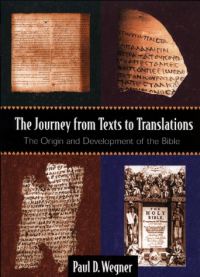
someone asked me about the Apocrypha last night ... I realised though I had some basic answer and reponse which I think is ok - my historical and content details are very rusty (*grin*).
I think many of the new Christians who come to our church have asked this before why there are more books in the Roman Catholic Bible. So, when I saw the book above for such a good price at the Glad Sounds bookstore sales .. I quickly got one for the church library. I think it's a good intro to the questions and issues raised by inquisitive friends..
Here's what Scot McKnight, Karl A. Olsson Professor in Religious Studies, North Park University blurbs for the book ..
"When it comes to books on the Bible, students are often forced to choose between technical systematic theology or detailed commentaries; a good book on the Bible as Bible is hard to find. Further, what students often look for are "facts" about the Bible (how it came into being, how books were selected, how the manuscripts fared, and how the translations were undertaken) and this book admirably provides the kind of facts students need. Charts are abundant, tables everywhere, and the text clearly written and clarifyingly illustrated. This is a delightful book which will serve generations to come.
Here's a summary & review of the book!
Just glancing through it a while ago I think the visuals will enhance the usefulness for new comers to the faith and those who are interested in the Bible. We'll leave the more complicated debates another time ...
April 21, 2005
The Church on the Other Side
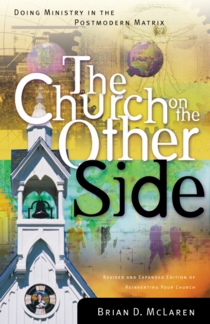
When I first came across Reinventing the Church around 1999 I knew I wanted to get the book (especially after reading a favourable review from NEXT WAVE) . So my friend Daniel got it from Bookstore and sent it to me. This was my first Brian McLaren book which blew me away (I'mean challenged me and comforted me at the same time!) Those days he was an unknown.
Here's how it looked like (before the revised edition) I think there's still one copy at the Glad Sounds Resource Centre near my house :-) It's interesting to compare the reviews on this book in Amazon with the Church on the Other Side.
Anyway, I was asked by Kairos Reseach Centre to write a book review on a book I was passionate about guess which one I chose (this was my maiden book review so I'm still very romantic about it *grin*)? Check out the cover of the magazine ...

Anway, why all this little history? I guess I'm gearing up how would I respond (in my view) to questions like "What is emergent?" , "Why are you engaged in this?", "Seeing as one of the emergent values is missional, to whom is your mission?" kind of questions. Way before "emerging church", "emergent" or even "postmodern" became buzz words, or labels or whatever .. it was simply a genuine resonance with ideas and questions and possible directions to move forward. Of course, now I might explore the word "post-colonial", "post-western", or even "global" to engage further in conversation ... but then words are meant to help, clarify, stimulate not make things too difficult :-)
I liked the book because it gave me a picture of how a pastor "reflectively" works through the pressing challenges before him and doesn't want to be boxed up in pre-fixed answers or pre-packaged mindsets. I gave one away two weeks ago to a fellow pastor friend who was open to share what's going on in the head and the heart in the midst of challenging ministry situations. I felt this book might open up some possibilities or hope (which it gave me)
So here's my maiden book review written in 2002. I'll probably follow up with a second thoughts kind of post later.
The Church on the Other Side
Brian D. McLaren Zondervan, 2000
BY SIVIN KIT
The author of The Church on the Other Side is not pastor of a mega church; neither has he written books that flood our bookstores. Yet, I believe he has something worthwhile to say that is worth listening to. Unlike purpose driven Rick Warren or seeker targeted Bill Hybels, Brian McLaren sees himself as a "reflective practitioner ... focused on the down and dirty of doing ministry, but trying to have a high altitude understanding of when, where, how, and why we are doing it." This book gives us a glimpse into his thinking and provides us with an opportunity to resonate with his passion for "doing ministry in the post modern matrix."
His basic premise is simple: "if you have a new world, you need a new church." But don't misunderstand him, he's not talking about forming new denominations or initiating new church movements or religious campaigns. He goes deeper. He defines "new" as new in kind but not in age. McLaren carefully points out, "We won't need a new religion per se, but a new framework for our theology. Not a New Spirit, but a new spirituality. Not a new Christ, but a new Christian. Not a new denomination, but a new kind of denomination." His focus is on changing our attitude towards change itself and carefully wrestling with what must change and what must not.
McLaren proposes that we are born in an age of a transition from Modernity to Post Modernity. He uses the analogy of "tectonic activity" which describes the constant but imperceptible movement of the large fractured plates of the earth's crust. Once in a while, an earthquake occurs. Only then do we become aware of the unseen forces acting on the earth. Almost immediately, the changes in our world force us to admit that our "old maps" no longer fit into the new reality.
It may be said that human history is not unlike the physical earth in that it, too, is susceptible to 'tectonic activity', albeit of a different kind. The resulting 'tectonic' changes such as those sparked off by scientific discoveries and developments create new situations to which society must adapt.
For instance, think of the impact the automobile has had on the environment, the economy, the family unit, and even courtship and sexuality! Think of radio, air travel, birth control pills, antibiotics. Think of space travel, the personal computer, the Internet, genetic engineering ... the list goes on! Even the cultural, political and religious realms are not as stable as we think.
How has the church fared in the face of all these developments? Has it been contented to remain "the way we've always been," and assume that it is doing fine and make good progress using the 'old maps' of the past as guides to the new, post modern age? Or should it not, during this time of transition, respond by seeking creative solutions to new realities? In this regard, McLaren helps us by suggesting a 13 strategy framework for doing ministry in a fast changing world:
I Maximize Discontinuity.
2 Redefine Your Mission.
3 Practice Systems Thinking.
4 Trade up Your traditions for Tradition.
5 Resurrect Theology as Art and Science
6 Design a New Apologetic.
7 Learn A New Rhetoric.
8 Abandon Structures as They are Outgrown.
9 Save the Leaders.
10 Subsume Missions in Mission.
11 Look Ahead, Farther Ahead.
12 Enter the Post modern World Understand it, Engage it, Get Ready for a Revolution.
13 Add to the List.
Though McLaren writes from a North American context for a North American audience, he acknowledges that some of his reflections were stimulated by his contacts with Asians. After reading the book, I was pushed to think about what the whole discussion on "Post Modernity" means for us in Malaysia. Whether we follow the Western classification of Pre modern, Modern, and Post modern is up for debate. But one thing we do agree on is that we, in Malaysia, also live in a fast changing world.
Think of the social impact that is the result of our latest economic recession, the political uncertainties after the sacking of the former deputy prime minister and the religious climate since the last general elections. Think about the on going controversy concerning the status of Malaysia as an Islamic State; and the struggles and challenges Christian students in the universities must face as they are exposed to the sciences and to conflicting religious viewpoints. And of course, the recent September 11th incident has undoubtedly changed the world.
Closer to home, think of cell phones interrupting our worship services and Bible studies, the impact of satellite TV (ASTRO) on youth ministry, and the content of our conversations with our non Christian families,and friends. Those in urban churches must think through the demands of the marketplace for their time, attention and energy, and the resulting impact on church participation. We need to grapple with all these issues urgently and understand what the repercussions are, not just for the individual, but especially for the church.
As a young pastor turned church planter ministering in these times of fast changing realities (whether we call it post modern transition or not), I am challenged by McLaren's book to reconsider many 'sacred cows' I've inherited in the course of my church life, seminary education, and interaction within the Malaysian Christian community in general. These 'sacred cows' include the search for the perfect church model/structure (usually with a "Big is better" mentality), or the particular evangelistic programme that will solve all our problems (usually copied wholesale), or some revival experience that will rev up the whole nation at one go (usually one mass event), or clinging on to a particular theology or tradition that is considered most faithful to God (most of the time without considering the differences in historical and cultural contexts).The list goes on! Certainly, there is much value in these things, and through them I have discovered helpful tools for ministry. My philosophy of ministry has also been expanded and my heart has been warmed by the passion behind these efforts.
And yet I am concerned that in our desperation to make things happen in our churches, we are tempted to grasp at any available answer or to resort to 'fix it all' solutions. However, the real answer lies in having a proper understanding of the momentous changes that are happening in the world today. Only then will we be able to develop an effective response that integrates theology, mission and church ministry. In this regard, McLaren's book serves as an excellent resource for struggling pastors.
SIVIN KIT IS PASTOR OF THE 2 YEAR OLD BANGSAR LUTHERAN CHURCH.
April 14, 2005
Wanting More

Happy Birthday Joel Vestal! I'm so happy for him to have such a blessed in the basement time :-)
There aren't many chances that I've in being part of the process of printing a book and also to see how the final touch up looked like. Further more even before reading the book actually knowing the author in person.
This is a long awaited post ... and I think it's timely now since it's Joel's Birthday. Joel, here's a picture of the baby who was born near the birth of your book :-)

For those in are in Malaysia who want a copy of the book please email me (Joel was kind enough to leave a box of books for us ... all the proceeds of the book will go to ServLife orphanages.
As you can see in the picture below, he was really excited like a father holding on to his new born baby! :-) I'm the Chinese looking "midwife" next to him equally proud of his efforts.
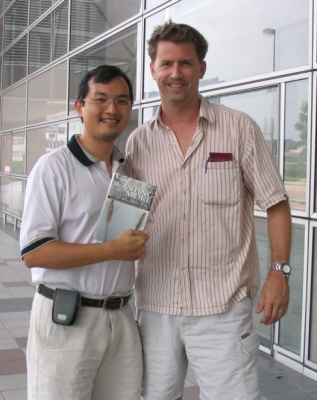
Anyway, here' some paragraphs I picked out ... to wet your appetite (there's lot real life stories of "Indian Joel" as I call him cheekily one day). Joel mentioned that he had the North American audience in mind, BUt I told him what he shared in the book has relevance for us too in Asia:
"Augustine wrote that the older we grow in faith the less we like to be instructed -- but we all need to be reminded. This book will take you on a journey across the globe and at the same time remind you of some important keys for your own spiritual journey here at home. Perhaps it will bring instruction for some as well. My hope is that it will leave you wanting more. You don't have to buy a plane ticket or get your passport to travel on this journey with me (though perhaps you will want to after reading the book!)." (p.15)"Clearly, the way we approach global ministry in North America needs to change... perhaps it is a paradox to say that we as westerners can make the most impact overseas by taking a back seat and working through local church communities that are indigenous to a particular region. After all, these people know their culture and language. they live in the same standard of living, and face the same daily struggles as the souls they are trying to reach." (p. 26)
"... I believe that we, as the western church, do simply play a crucial role in world evangelization. And yet, the western church simply cannot accomplish the task on its own." (p. 27)
"The purpose of the church is to both fill up and to pour out. It is the gathering of the people for worship, sacrament, teaching and community so they can be sent out to demonstrate and proclaim the love of God in their community and the entire world. Unfortunately, churches in the West are usually best known for the first aspect (bringing people in), but rarely for the second (sending disciples out)." (p. 33-34)
"The core issues of a healthy, vibrant church are not rooted in the organizational structure or style of music but in the character qualities of its people -- qualities like humility, integrity, brokenness, holiness, love, authenticity and patience. So embrace the diversity of the body of Christ. Celebrate how Jesus is building His church today in so many different kinds of models and forms." (p. 40)
"Mother Theresa taught me something very beautiful that day about prayer, and I will never forget it. There is a mystery and a deep beauty to the role of prayer in the Christian life. Prayer embraces both vertical and horizontal dimension of the Christian journey. The spiritual nurturing and growth of our lives as our ministry to the poor, lost and despised are woven together like two pieces of yarn. Discipleship and evangelism are married. Being and doing are somehow integrated in a holistic manner. Like breathing is to the human body, prayer is essential to us as followers of Jesus to both our spiritual growth and service to others." (p. 115)
The Last Word and the Word after that
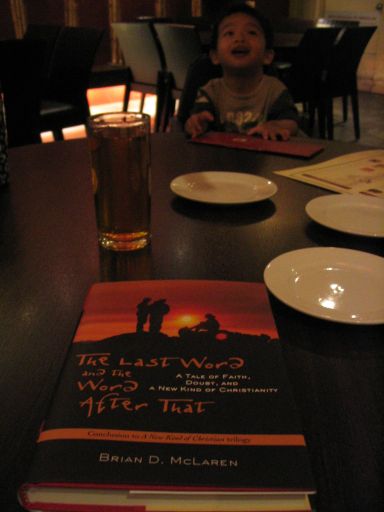
Finally, I got the final book of the New Kind of Christian trilogy by Brian McLaren ... in fact it was the only copy I could get after calling one of the managers at the bookstore. Apparently, there were only two copies brought in (to test the market?) but when Gareth and I arrived there was only one :-P
I'm already into p. 125, and I wish I could just go on. But I need to sleep because I'm speaking at a seminary chapel tomorrow. And I hope to do well and have a focused mind *grin*. Brian's book is a little distracting on this account. It's been a good read so far. And I actually started glancing through the commentary at the end of the book which i think is a fabulous idea. I wish the earlier two books did the same.
I found Brian's words in his website noteworthy before the book came out:
- but at the moment, I'm less anxious and more excited.
... I hope you'll enjoy the book when it comes out. Remember - my goal isn't to make you think the same way I do: I'll just be happy if the book makes you think. I have loads of respect for others who don't reach the same conclusions I do - and I hope they'll be able to do the same for me. At the end of the day, if people experience increased energy to love God and their neighbors, that matters most.
And if the status quo is destabilized so something better can shake loose ... thanks be to God."
Amongst all of Brian's books I read, I enjoy the trilogy because of the kind of space this "creative fiction" allows in one's mind and imagination to explore often very serious topics and deep concerns. I also enjoy a kind of child-like playfulness in a sense that's often lost when we explore theological concepts. Sometimes (not all the time) this is necessary for us to get closer to the truth of the matter. So I decided to recruit baby Elysia and Gareth for two photos ...
Well, as I mentioned before I don't necessary agree with all the details in Brian's books ... but I appreciate the questions he raises and proposals he offers. At least they give me some space to begin working out my own answers. I've always found him a great conversation partner.
I'll just leave you tonight with some paragraphs from the introduction that caught my attention and as usual let Brian speak for himself ... thanks my friend *grin* for this accesible effort.
“As I see it, more significant that any doctrine of hell itself is the view of God of which one’s doctrine of hell contributes. William Temple once said that if your concept of God is radically false, the more devoted you are, the worse off you will be. So this book is in the end more about our view of God than it is about our understandings of hell. What kind of God do we believe exists? What kind of life should we live in response? How does our view of God affect the way we see and treat other people? And how does the way we see and treat other people affect our view of God?” (p. xii)
“At any rate, at heart this book is about the goodness of God and the life with God. This means is is about the gospel and about justice and mercy and a new way of understanding their relationship -- suggesting that God's justice is always merciful and God's mercy is always just. This book flows from the hunch that the heart disease afflicting the Christian community is chronic and serious rather than cosmetic: deep in our hearts, we don't fully love God because we are not fully confident that God is fully good." (p. xiv)
"The word destructive is often associated with the word deconstructive but the association is erroneous. Deconstruction is not destruction; it is hope. It arises from the belief that sometimes, our constructed laws get in the way of unseen justice, our underdeconstructed words get in the way of communication, our institutions get in the way of the purposes for which they were constructed, our formulations get in the way of meaning, our curricula get in the way of learning. In those cases, one must deconstruct laws, words, institutions, formulations, or curricula in the hope that something better will appear once the constructions-become-obstructions have been taken apart. The love of what is hidden, as yet unseen, and the hoped for gives one courage to deconstruct what is seen and familiar. This book, in a sense, attempts to deconstruct our conventional concepts of hell in the sincere hope that a better vision of the gospel of Jesus Christ will appear." (p. xvii)
April 11, 2005
Margin
here's a review of the older edition
I kind of introduced this concept of "Margin" coined by Richard A. Swenson in my message yesterday at the worship gathering. Frankly, I was very much aware that I too needed to heed the call to watch how my life get's overloaded in all areas. The fact is I'm definately not in a place in my life where I've fully managed to be have a good "margin" :-) But, it's good to have some language to remind me to stay healthy.
Here's what I read out tas part of the message ...
"Marginless is being thirty minutes late to the doctor's office because you were twenty minutes late getting out of the bank because you were ten minutes late dropping the kids off at school because the car ran out of gas two blocks from the gas station -- and you forgot your wallet.Margin, on the other hand, is having breath left at the top of the staircase, money left at the end of the month, and sanity left at the end of adolescence.
Marginless is the baby crying and the phone ringing at the same time; margin is Grandma taking the baby for the afternoon. Marginless is being asked to carry half the burden. Marginless is not having time to finish the book you're reading on stress; margin is having the time to read it twice.
Marginless is fatigue; margin is energy.
Marginless is red ink; margin is black ink.
Marginless is hurry; margin is cam.
Marginless is anxiety; margin is security.
Marginless is culture; margin is counterculture.
Marginless is the disease of the new millenium; margin is the cure."(p. 13)
I can relate to the book reading part a lot :-) But I do wonder whether thos eof us who hear the above quote consider this state of "marginless" as a disease of our times. Living in the capital of Malaysia and just listening to our conversations ... it seems to be in our city life in Kuala Lumpur ... most of us have "overloaded" lives and it's hard to "let some stuff" go and we're taking upon ourselves more "loads". But I think a deeper concern is there's an illusion that because of our abilities, education, and technology we deceive ourselves that we are "limitless". This surely is not spoken ... but our actions speak very loudly.
here's some other stuff that I highlighted and brought me to more than one pause:
"Analyzing progress and social trends from this macroscopic view lends a valuable perspective. But we do not see pain as clearly from this distance as we do when it sits in front of us. Pain comes alive when it talks -- even more so when it cries." (p. 24)"Margin has been stolen away, and progress was the thief" (p. 25)
"Before we can subjugate progress, we must first break the addiction." (p. 29)
"Margin ... knows how to nurture relationship. In fact, margin exists for relationship."(p. 30)
"Margin is the space between our load and our limits." (p. 69)
"... margin is not a spiritual necessity. But availability is. God expects us to be available for the needs of others. And without margin, each of us would have great difficulty guuarenteeing availability. Instead when God calls. He gets the busy signal." (p. 77)
I'm encouraged through reading Swenson's book I can have a greater awareness of beyond stress and change but also margin, limits and loads. We only have one life ... and I want to live it to the fullest :-)
April 08, 2005
Signs amid the Rubble: The Purposes of God in Human History
As I was trying to get my study room organized (finally!), my eyes caught this thin book squeezed in between two other thicker ones. I don't recall ever finishing the book but I think I did glance through some pages. So, I decided to just jump to the back and read the late Bishop Newbigin's lectures which touched on "Gospel and Culture". After reading one, I realized I haven't signed the book yet and put my usual captions on every book I purchase ... I scribbled the following words ... "Newbigin never fails to nourish me.".
Consider the following paragraphs I used my marker to highlight (for a review check out, Witness to the Signs),for now let's hear Newbigin again.
" ... Christianity is what generations of us have made of the gospel, and we know we have often made a mess of it. We're not talking about religious experience either, because that also is a very ambivalent affair. We're talking about a factual statement. Namely, that at a certain point in history , the history of the world , God who is the author , the sustainer, the goal of all that exists, of all veing and all meaning and all truth, has become present in our human history as the man Jesus, whom we can know and whom we can love and serve, and that by His incarnation, His ministry, His death and resurrection, He has finally broken the powers and that oppress has created a space and a time in which we who are unholy can nevertheless live in fellowship with God who is holy." (p. 113)"...if it is true that all authority is given to Jesus, and that He has thereby created a space and a time in which , in spite of the powers that seem to control us, we can obey Him, then to refrain from telling other people that this is so is not merely to betray the trust that has been given to us by our Lord, but it is also a collusion with the occupying power. It is colluding with that power which deceives human beings into believing that the final authority lies for example in the free market. And that is why it seems to be fundamental that we place at the center of our concern for mission the simple responsibility to tell the story. "(p. 114)
"I know that the responsibilities of politics and economics have to be taken with utter seriousness. Whatever else we do for people -- to come to know Jesus, to love Him, to serve Him, to honor Him, to obey Him -- that is the greatest thing we can do for anyone and it is the specific thing entrusted to us. It must be the center of our mission." (p. 115)
"If we accept the fact that the gospel is a factual story about what God has done, we have immediately to say that that story has to be told in a human language. And language is the very heart of culture. It is the key to culture. And therefore there is no gospel which is not already embodied in a culture." (p. 116)
"... whether we are talking about our own culture or about another one -- the crucial question is whether we tell the story, whether we continue to recount the mighty acts of God, whether we continue over and over and over again to read and reread and ponder the story of Jesus, because it is only the telling of the story that can change the meaning of the words we use and the concepts that we entertain." (p. 117)
"The Christian gospel ... affirms that the manisfestation of the sovereignity of God was made not in an overwhelming display of power but in the humiliation of the cross. Moreover, that atoning deed on the cross, which was in fact not defeat but victory, has been made known not as a great public demonstration, which would mean the end of human history, but as a secret communication to a very small company chosen to be witnesses, so that there could be a space and a time within which there is freedom, freedom to dissent, freedom to disbelieve, even freedom to blaspheme, so that there could be freedom for a freely given allegience, so that the rule of God, the kingdom of God, would not be a matter of coerced obedience, but freely given love and obedience, the obedience of loving children." (p. 118)
"... I plead that we stop arguing about whether or not other people are going to be saved. I do not believe that that is our business. I do not believe we have a mandate to settle those questions. We know from the teaching of Jesus that one thing is sure -- that at the end there will be surprises; that those who thought they were in will be out, and those who though they were out will be in. The Bible as a whole and the teaching of Jesus give to us both immensely universalistic visions of the all-embracing power of God to save and to heal, but also and especially in the teaching of Jesus very, very harshwarnings about the possibility of losing the way, about the possibility of being lost, about the broad and inclusive way that leads to destruction and the narrow way, the hard way, that leads to life." (p. 120)
"... What is the point of missions? And the answer I believe is quite simply is the glory of God. If God has done those things which we repeat in our creed, if God has so loved the world that He gave His only begotten Son, what is our response to that? Is it an argument about who is going to be saved? Surely not. It is thanksgiving. It is the question, how can I glorify God? How can I respond to that matchless gift? And mission is acting out that question." (p.120-121)
Posted by sivinkit at 09:45 PM | Comments (2)
April 07, 2005
Constants in Context
Constants in Context: ways of perceiving culture in mission gives a glimpse of the contents in the book. I've found Steven Bevans' book Models of Contextual Theology to be very helpful - I tend to get linked through authors not just the topics. It's a personal thing :-)
Anway, building on some of the directions sparked by Mangoes and Bananas in my adventures in theology and missiology, I was also drawn to the desire to see how the "constants" and ""context" interact and inform each other. Previous ways of framing the question could be what's absolute? what's relative? What's unchanging? and what's changing? , etc. So, first of all I felt these two words (i.e. Constants & Context), help to take some emotional charged temptations aside (at least for now *grin*) and help me work through some of the issues. The "inner movement" for me personally is always, "ok? now what's next? how can we move forward?" (I'm indebted much to my teacher Rev. Dr. Hwa Yung for springing me free into this direction and recognizing the need to be aware of the presuppositions I'm working with ... the seeds of all this goes back to those classes in seminary and personal conversations).
This collaborative effort in this particular book is a rich resource - consider the opening words in p.7,
"One of the most important things Christians need to now about the church is that the church is not the ultimate importance. To say this is not to deny the church's divine origin or to believe one whit less of it that is "the people mad eone with the unity of the Father , Son, and of the Holy Spirit" (LG4). The church is indeed, the "universal sacrament of salvation" (LG 48; AG1), "imbued with the hidden presence of God." Nevertheless, the point of the church is not the church itself. The church's foundation and continued existence are not to provide refuge from a sinful world or to provide a warm and supportive community of lonely souls, or even less to be a plank of salvation on a tempestous sea that threatens damnation. The point of the church is rather to point beyond itself, to be a community that preaches, serves, and witnesses to the reign of God. In doing this the church shares in and continues, throught the power of God's Spirit, the work of its Lord, Jesus Christ. so completely does the church live for God's reign that, when finally is fully established, the church will be subsumed into is all-encompassing reality. "Only the Kingdom ... is absolute and it makes everything else relative" (EN 8.)
I'm freewheeling the idea of working on matters relating to church for my Masters programme - so here's some words that puts some perspective on the endeavour :-)
In my eavesdropping the emerging church (especially the UK, USA and a little bit with NZ and Australia) as well as emergent conversation there is sometimes the tendency to be drawn into the philosophically framed discussions on for example Foundationalism (which I think is an important and valid one) or sociologically framed discussions such as the changing cultural shifts and be tempted to miss out the possibilities that missiologically framed discussions could provide (which I think allows the conversation to widen including non-westen immediate concerns).
For me it's not either/or ... it;s definately both/and to sound little more cliche but it's mainly accepting different starting points while seeking to see how we're heading to the future working out how the Gospel touches our various contexts. And I think there is a climate in the present conversations for acceptance of a variety of starting points which I see as encouraging.
So for emergent malaysia as a network that opens up space for grassroot (i.e. local church) conversations and constructive work to emerge *grin* while connecting with others globally - fellow "reflective practioners". The accent is less on philosophical loaded catergories or terminology in the Malaysian context (though some of us would have fun doing it) but if what I sense is correct based on our last few conversations, it seems to have started more a more missiological starting point (I think that's what moves our hearts). Then again those of us seriously engaged in this effort know it's a fascinating webs of interactions between sociology, philosophy, theology, missiology, cultural anthropology, Biblical exegesis, etc isn't it?
It's a long journey ahead ... starts with small steps!
April 06, 2005
Mangoes or Bananas?
The subtitle is pretty attractive - The Quest for an Authentic Asian Christian Theology and reflects the genuine concern of my former Christian theology and Asian Theology lecturer, and also principal of the seminary I studied in, Rev. Dr. Hwa Yung (later he served as the Director of at Trinity Theological College, Singapore, and now Bishop of The Methodist Church in Malaysia). Of course, now after graduating from seminary, stumbling and fumbling in life and ministry as well as progressing/growing in learning and expanding minsitrial horizons I find myself at a place more able to interact with what he shared with us from a different angle.
I must say he was a passionate teacher and a sharp mind with a deep concern for "on the ground" ministry faced by pastors in the local churches. And I found working through his Doctoral thesis during the classes quite an experience, but of course, it was more then just intellectual engagement, there was friendship, mentoring of some sort, and heart talk on the church scene in Malaysia. This deep respect is unchanged.
A good review by Amos Yong can be found here, I think he pretty much captures what I've been hearing over and over in the classes I attended, :-).
... Hwa’s thesis is that a truly indigenous Asian Christian theology has yet to emerge insofar as previous Asian Christian theological contributions have been held captive by western presuppositions, concerns and methods.Thus, for example, he concurs with missiologists like Charles Kraft and anthropologists like Paul Hiebert that Enlightenment rationality has bequeathed to the contemporary mind what Hiebert calls the "flaw of the excluded middle": the arbitrary reduction of reality to two tiers—phenomenal and noumenal, to use Kantian language—that contemptuously dismisses or purposefully ignores the middle realm of spiritual and demonic beings. This has resulted in less than fully contextualized theologies that have only superficially engaged Asian cultures and mentalities which include ancestors and complex layers of cosmological spirits. Asian Christian theologies have therefore to date been more akin to bananas (Asian-yellow on the outside, but Western-white on the inside) than mangoes (the quintessential Asian fruit representing an authentic homegrown theological product).... More adequate contextual Asian Christian theologies, Hwa suggests, must therefore be theologies of mission or missiological theologies. With this in mind, he develops four criteria by which to assess Asian Christian theologies: (A) their ability to address the diverse socio-political Asian contexts in which the Churches find themselves; (B) the empowerment they bring to the evangelistic and pastoral tasks of the Churches; (C) the means by which they facilitate the inculturation of the Gospel; and (D) their faithfulness to the Christian tradition."
My fellow seminary mate and now pastor use to tell me this book is where our teacher first states what he want to do, tells us what he thinks are inadequate in people's theology whether ecumenical or evangelical and then gives us some pointers ... and insome ways many of us went through some form of "deconstruction" (the stronger word) or at least "reconsideration" (to put it more mildly).
I was then happy that there was a place for the supernatural in his proposal, and
provided me with some language to stand pretty firm and try to interact with some Asian Theologians at a memorable workshop on reading the Bible organized by the ecumenical (and the what is seen as the more "liberal" influenced) Christian Conference of Asia There was a lot of necessary (I think!) critique ... enough to get me in a Rethinking mode ... but just when I felt we're into Construction mode ... it's time to graduate ... and we're plunged into the reality of ministry, until I suppose things started to crash for me and then I found myself in "reconstruction" not only theologically, but even spiritually and in ministry ... (that's another story)
Amongst Yong's critique .. I find these few to be intriguing and resonate with some thoughts I had, probably more at an unrefined intuitive level,
"Hwa expends much energy exposing the inadequacy of the western theological paradigm, based as it is on Enlightenment dualistic categories. His argument that Christian theology has yet to achieve emancipation from the West and genuine contextualization and inculturation in Asia, is surely successful. Yet, Hwa does not in turn suggest what kind of worldview would be superior for the emergence of a genuine Asian Christian theology."
This is exactly what I felt at some points of the classes, I'm not sure what are his views now (I should check) But we were all expecting him to write his constructive proposals for Theology and Ethics in days to come but now he's Bishop (so that's quite a different role). This of course, opened up my interest and openness to see try to understand the "postmodern", "premodern" or alternative worldviews (whatever that means) - at least, I was sensitized to my own worldview and what influences it.
If "dualism" is to be discarded, is "monism" now favored? Hwa never comes out and says that an Eastern worldview is to be preferred to that of the Enlightenment West. On the one hand, this may be what is implied by his suggestion that a fully contextualized Asian Christian theology must be presented and comprehensible in Asian categories. On the other hand, his treatment of theologians like Thomas, Song, and Koyama would seem to suggest that the Asian worldview is the object toward which inculturation is directed rather than the framework within which theologizing occurs. It would seem that Hwa advocates a "biblical" worldview. Does this refer to a Hebraic-Semitic, a classical-Hellenistic or an Eastern Orthodox paradigm? Hwa does discuss the classical worldview, and suggests that Asian Christian theologians would benefit from an encounter with the patristic fathers. But his reading of the fathers is itself dependent on westerners (E. L. Mascal and Thomas Oden; similarly, Hwa’s rejection of theological pluralism with regard to other religious traditions seems to rely on the work of Western evangelicals like Harold Netland). "
These are tough questions Yong poses and it does and has crossed my mind too ... but I suppose though Hwa doesn't come out and say what worldview ... I felt that in a sense we're all exploring what this worldview is ... the directions he pointed to definately was helpful to me ... I tried to read a little on the Desert Fathers for areas of spirituality, and then at elast have an awareness of the Patristic Fathers in terms of theology, I also founf myself being more willing to wrestle with issues related to other religions, pluralism, secularism and now globalization. But, what has happened is I found myself on a journey of exploration now. And trying to do all this while being a church planter (5 years ago) and now pastor of 50-60people at the same time interacting with youth and young adults. It has never been a purely intellectual exercise for me. Personally, I don't mind drawing from the work of westerners as a tentative or transitional process ... the fact is there's not much in Asia we can do yet because there's still a lot of work in progress ... so a kind of fluid interaction is still very useful We've got to start somewhere. At least, raising the questions and begin moving ...
"What does his own constructive proposal consist of? Perhaps if Hwa had included in his analysis and assessment Catholic thinkers like Raimundo Panikkar, Bede Griffiths, and Aloysius Pieris, or other Protestants like Stanley Samartha or those affiliated with the Association for Theological Education in South East Asia (ATESEA), he may have been forced to confront this question more straightforwardly. Rather than simply rejecting Panikkar’s and Samartha’s work as tainted with Advaita Vedantism, or dismissing Pieris for his recourse to Buddhist praxis and spirituality, or labeling ATESEA thinkers as Christian-Confucian syncretists—none of which he does, but which would be easy enough for any evangelical to do, Hwa would have had to more clearly identify and delimit options available to Christian theologians in arguing against these Asian-based theologies."
A constructive proposal was in progress (I suppose), constructive proposals are so needed in our part of the world. But whenever we move into constructive mode, there's always need for "space" to explore, converse, interact, even make some mistakes - hopefully not too bad that it'll hurt the church(?!). And constructive proposals must not stay at a theological level ... it has got to have a parrallel practical dimension - which I felt more from Rev. Dr. Hwa Yung in our personal interactions and conversations. More on some areas he pointed out tomorrow. This is becoming a long post. Anyway ... as I joked with a friend about the book, hey before Rowan Williams became the Archbishop of Canterbury he wrote an endorsement for the book ... cool! here's what he said,
"The contribution of Hwa Yung's excellent work is to suggest that we have as yet hardly seen the beginning of an authentic Christian theology for Asia. He shows with great clarity how both radical and conservative Asian theologians have so far failed to break out of western captivity and points the way to a fresh and powerful recovery of authentic Christianity in a genuinely Asian mode. This book is a hugely welcome contribution to a discussion on method in Asian theology, which is rapidly becoming more and more sophisticated and interesting." ~ Rowan Williams, Bishop of Monmouth
March 28, 2005
The Radical Evangelical
Long before reading Brian McLaren's A Generous OrthodoxyI found this little book at the STM library in Seremban (SPCK books are hard to find here) and Dr. Nigel G. Wright rocked me pretty hard (for which I'm grateful). I thought of borrowing the book again to see how I'd react to it now after 4 years.
Here's what it's about:
"The gospel we profess is the most radical power on earth, reaching to the depths of our personal, social and political existence. It needs a radical people to embody and proclaim it. This book examines the nature of evangelical theology, dealing with areas of persistent disagreement and controversy, such as the status of the Bible, the nature of Christ's achievement on the cross, the meaning of 'hell', and offers a new way forward which remains committed to the fundamentals of faith, while retaining a flexible response to the challenges of the future."
Blink
I really enjoyed the Tipping Point. That's the main reason I just went ahead and picked up Blink yesterday.
I read this interesting exchange between two authors here, "Blink and The Wisdom of Crowds: How to improve the decision-making environment.", first. so I might get the other book. Apart from more theological, pastoral, and spirituality related stuff. I enjoy books on leadership, learning and thinking - in short stuff about our humanity!
So far the Intro is pretty captivating, such as the following:
"We believe that we are always better off gathering as much information as possible and spending as much time as possible in deliberation. We really only trust conscious decision making. But there are moments, particularly in times of stress, when haste does not make waste, when our snap judgements and first impressions can offer a much better means of making sense of the world."
(p.14)
My mind was thrown into multiple flashbacks after reading this and just having a fresh look and some of the decisions I made - from buying books to major transitional decisions. I landed up falling asleep and had a nap. But, it was an insightful exercise!
"When our powers of rapid cognition go awry, they go awry for a very specific and consistent set of reasons, and those reasons can be identified and understood."
(p.15)
I couldn't help but think of one case where I had an "intuitive" feel that something was amiss. But then rationally, I justified in making a decision or at least enter into so called "analysis" that at the end was wrong. Hmm.... can we really indentify and understand the set of reasons that caused this mistake? will read on and see.
"When it comes to the task of understanding ourselves and our world, I think we pay too much attention to those grand themes and too little to the participation of those fleeting moments. But what would happen if we took our instincts more seriously? What if we stopped scaning the horizon with our binoculars and began instead examining our own decision making and behaviour through the most powerful of mircroscopes? I think that would change the way was are fought, the kinds of products we see on the shelves, the kinds of movies that get made, the way police officers are trained, the way couples are counseled, the way job interviews are conducted, and on and on. And if we were able to combine all of those little changes, we would end up with a different and better world."
(p.16-17)
I think it's a parallel process - i.e. the grand thems and the fleeting moments. But, anything that gives value to little changes, the so called mundane, or the micro aspects of our lives helps me to keep things personal and not jump off into impersonal sounding ramblings on big picture concepts and ideas and thus lose the important concrete stuff right before my eyes.
So, for now .. at least. This book brings some balance. At least another perspective and in good Malcolm Gladwell style some interesting new language to use to process ideas. It does open up possibilities - I like possibilities!
March 15, 2005
Reading the Bible for the Love of God
I stumbled upon this in Glad Sounds Resource Center where I always pop by since it's 2 minutes walk from my home :-) It's at a special price of RM29.90 so that's a good buy since most books are expensive. But it's a gem ...
As I was flipping through the pages, the following paragraph caught my eyes under the heading "Relativity and Relationship,
"... To say that all knowledge is relative may not be so far from saying that all knowledge is relational... To say that all knowledge is relative is not to say that there are no absolutes, but only to accept that we do not have absolute knowledge of the absolutes. We are not infallible, collectively or individually. In fact, "relativism" is often defined as the belief that all knowledge is relational."
now that's really thought provoking ... but before one dismisses the book as some liberal garbage which it is not, The Discerning Reader calls it "An excellent, balanced book that corrects two extreme views about Bible reading. Refreshingly original, this is a must read."
TheoCenTriC BooKShoP highlights the following about the book,
"It is possible to "believe the facts but miss the meaning" of the Bible. The purpose of the Bible is not to communicate scientific facts or objective history. Its purpose is to communicate the message of God to us in order that we might know God experientially through the Bible. "Words seek to communicate, to relate. God, through his Word, seeks a relationship with us" (p. 41). If the Bible is treated as a therapeutic textbook or science manual, it is being misused. The Bible shows us God's heart by showing us Jesus and calls us to respond with personal loving trust in a personal God who personally speaks a message of good news to us through its pages. Reynolds book is a nice reminder of the importance of viewing Scripture as a means rather than an end - the difference between bibliolatry and knowing God!"
February 25, 2005
A Brotherly Critique and Response
I asked a local Christian bookstore this week when is A Genereous Orthodoxy arriving (since I asked them to bring in at least 20 copies - more than 4-5 friends would want a copy immediately). I was surprised by the answer. We need to wait for the second printing - no stock!!! I guess those who can't wait might find another means to get the book.
I must admit, that I read the book pretty fast to try to participate in the group blog aGenerousorthodoxy.com discussion which is at this point quiet. :-) But as I rushed through there were more than 4-5 occassions that I wanted to pause further and ask Brian - are you REALLY saying this? or What do you mean? If we really do what you say here, what would happen? I've read you before, but this part makes me wonder? .. that kind of questions.
I need to get my copy back from a friend and I'll start doing those exercises. all in all, I appreciated his "confessional" approach in charting his journey. I've read almost all the reviews I could get on this particular book. Some I think were fair, others I thought totally missed the point. Especially at some points I wondered (after reading some severe critique - which came across "unfriendly" to put it mildly) would some of my former teachers in seminary or even myself be "excluded" judged under the light of these criterias. I'll probably delve more on that another time. The fact is once published, one needs to face the praise as well as the criticism. There's no turning back. Or is it?
That's why, I found this article worth a read : A Brotherly Critique and Response. I think before one starts hurling "unfriendly" charges or heresy or doomsday prophecy (to be honest, I'm always tempted to do so myself), is there another way (which I want to learn)? Read on if you're interested (Brian's reply to the theologian in italics).
___________________________________________________________________
There is no excess of civility in our public discourse these days, and sadly, that's too often the case in the world of the church too. This note from a respected theologian shows a very different tone, one that I think is much more in line with our message and mission. My responses are inserted
-- like this. - Brian
Brian:
Just completed reading A Generous Orthodoxy. A good book. Good mix
of thoughtful and provocative material laced with powerful
illustrations and a nice touch of humor (especially the first
chapter). I also like the way you reframe, or out-frame, a number of
traditional positions or questions--this has always been one of your
great strengths.
I particularly appreciated the chapters 5,6, 9, and 14. The chapter
on Missional will be excellent for introducing people to the misional
discussion--the two diagrams are great. Your distinction between E
vangelical and evangelical is a useful way to affirm a valuable term
while trimming off some baggage--I liked it. And the mystical/poetic
theme gives voice to something that many of us have felt but not
articulated very well. Thanks. The chapter on Methodism is helpful--I
used your diagrams with a young believer at our church who I am
discipling and ecouraging to start helping someone else--he got the
idea immediately.
I have been chewing on a couple of other points in your discussion and
thought I would mention these to see if I am reading you correctly,
and if I am, to raise a question or two, or perhaps to suggest an
alternate perspective.
1. Exclusivism, etc.
I am wondering about a couple things in this part of your discussion
(pp. 112-14):
a. It seems to me that you have not worked up to your usual standard
of charity here--it has the feel of "my best against your worst" which
elsewhere you have encouraged us (appropriately) to avoid. I am
thinking particularly of your assessment of exclusivism: "I should
just rejoice that I am one of the blessed--meaning I can retire in
Naples, etc." This is a pretty strong ad hominem which I am sure did
not apply to your grandparents in Angola, although I suspect that they
would have lined up on the exclusivist side. No doubt there are some
exclusivists (and universalists, and inclusivists) who are playing out
their days on the links, but that probably has a lot more to do with
cultural influences than theology.
-- I think this is a really legitimate critique. I wish I had done a better job of being charitable in that section. I guess I tried to soften condemning or finger-pointing tendencies by putting it in the first person (maybe the reason Paul uses first person in Romans 7?), but still, I think this is one of the places where people could take offense, and I wish I had avoided it better. Thanks for pointing it out to me.
b. I am not sure that a moderate exclusivist position can't point you
to Los Angeles (again, it didn't seem to confuse your grandparents).
How about something like this for a proposal (using your basic
language):
One signpost tells me that some people aren't ever going to be
blessed [ultimately, at least, because Jesus really seems to believe
in hell]. Does this mean that I should just rejoice that I am one of
the blessed--meaning . . .? Of course not, for I realize that the
story of God's people has always been that they are blessed in order
that they might be a blessing to all nations. So this signpost points
me toward mission, not away from it.
--Yes, that's well put.
c. If you feel the need to distance yourself from certain
formulations of exclusivism, as I think I would myself, couldn't this
be done by employing an upper case/lower case distinction as you did
with E/evangelical?
--Great idea.
2. Why I am Biblical
Basically I liked this chapter. I agree that we have for too long
"flattened" the Bible by a kind of "scientific" approach to exegesis
that treated its various genres like technical prose. This kind of
reductionism needs to be critiqued, and I find your discussion helpful
in emphasizing the narrative and poetic aspects of Scripture.
But I would also say that just here I have some concern. It feels to
me that in avoiding the reductionism of the past you bring in your own
reductionism which could be just as harmful. When you say " . . . the
Bible itself contains precious little expository prose" I wonder how
that applies to some pretty lengthy sections of the pentateuch or
particularly to the epistles. Granted (as you point out) there are
some poetic elements in the letters, but that is not the bulk of the
material.
-- Sorry I wasn't clear enough here. "Expository prose" for me meant prose intending to explain - like essays or textbooks. So I'm not including history or law in the Old Testament as expository - they'd be narrative and law. And I'd put the epistles in the category of ... epistles. Letters aren't the same as expository prose, although I suppose the lines get blurry. What I was trying to say (not well enough) was that there isn't much in the way of "First and Second Sexual Morality" in the Bible, or "A Treatise on Free Will," or "The Book of the Trinity," or that sort of thing. Again, I could have been a lot clearer.
I think the emphasis on narrative and poetry is important because it
opens up the way for imagination. By being less specific, it is (in
some ways) more mind-expanding. By opening up more possibilities, it
leads to less certainty in interpretation and hopefully more humility
on our part. All this is good and I am on board with you. But if we
minimize the sections that are more expository, don't we risk the loss
of some pretty important data that shaped the basics of the chrisitian
tradition. ... I am just trying to think through what we are going to
give the next generation to work with.
So those are my current thoughts/questions. I know you are busy, so
no need to reply.
__________________________________________________________________
February 24, 2005
Writing, Publishing & Printing

There's more to Joel than globetrotting through the ministry of Servlife huh ?... he's a juggler too!
Joel Vestal was in town this week to see what can be done to get his book printed. It's been a very good learning experience for me as well as I sat with him during the discussions with the relevant peopple on issues ranging from paper thickness to how to print the cover, shipping costs, etc. Some of these lessons have been very useful at least for general knowledge. Here's a Sneak Preview of the book.
But of course, that's more of the closing labour pangs (in some ways) to see the birth of the book. I'm still trying to conceive some ideas and see how to get two articles out. Blogging is ok and fun but writing articles or even a book ... now that's quite a different ball game.
I manage to stumble on No Train, No Gain Writing Resources which looks helpful.
I'm also checking out these powerpoints from an upcoming conference. Writing for Your Mother- what a cool title. And of course the more serious, How to Write a Book Proposal
Maybe someday I'll manage to juggle my way into writing a book and beyond. :-) For now, it's working on this weeks interactive message, finish one article, prepare for part two of the children's "orientation" program, and a number of others immediate concerns. Ah ... I'm looking forward to have supper with Juggling Joel tonight before he flies off again.
February 20, 2005
Postmodern Children's Ministry

I was so excited when I saw this book last week and immediately bought it. Now, I'm slowly working through the book together with Young children & Worship and also insights from Faith Inkubators.
here's some stuff that Ivy Beckwith wrote in introduction of her book that moved me and affirmed me especially after my "humble" attempt at facilitating the orientation with the BLC kids (and parents & helpers) today.
"The church's ministry to children is broken. A cursory look doesn't reveal its brokenness. From the outside children's ministry looks healthier than ever. But it is broken. It's broken when church leaders and senior pastors see children's ministry primarily as a marketing tool. The church with the most outwardly attractive program wins the children and then the parents. It's broken when we teach children the Bible as if it were just another book of moral fables or stories of great heroes. Something is broken when we trivialize God to our children. It's broken when we exclude children from perhaps the most important of community activities: worship. It's broken because we've become dependant on an 18th-century schooling model, forgetting that much of a children's spiritual formation is affective, active, and intuitive. It's broken when we depend on our programs and our curriculum to introduce our children to God -- not our families and communities. It's broken when we've come to believe that church has to be some other than church to be attractive to children. It's broken when we spend lots of money making our churches into playlands and entice children to God through food fights and baptisms in the back of fire trucks. And perhaps most importantly, it's broken when the church tells parents that its programs can spiritually nurture their children better than they can. By doing this, we've lied to parents and allowed them to abdicate their responsibility to spiritually form their children. A church program can't spiritually form a child, but a familiy living in an intergenerational community of faith can. Our care for children is broken and badly in need of repair. Let's imagine together a new way, a new future."
I tried to imagine once again how BLC's children's ministry could be especially the past months. It lead further into what does it mean to be families and extended families in our young church context. Of course, once the flood gates are open my heart and mind is in the process of working through what and integrated intergenerational church could look like. What are th necessary steps we need to take?
I've seen enough in the Malaysian Children's ministry scene to know what I don't want and what I think is deeply wrong. If I start mentioning names, I might be shot simply for challenging the so called "most popular and most succesful" children's ministry. Who am I to even raise questions huh? I'm a father of a young two year old son and soon another one will come. We are a young family. I'm a pastor of a young church with lots of toddlers and some primary school level kids. I was a former youth pastor (not too sure how successful I was) that "felt" the strong waves and trends of children's ministry revival in a local church context. There's a strong passion to move beyond children's ministry that's just overtly pragmatic, competative, reward driven and segregated that's more B.F. Skinner influenced than Scipture and Savior influenced. Often, disatisfactions help to breed questions. I think I mentioned a while ago about a T-shirt quote "Deconstruction is the beginning of Construction" ... somehting like that. Questions are more pressing as my Godchildren are growing, more kids are added and birthed into the BLC faith family, and of course having a second child creates a greater urgency.
I ask questions, I can't help it .. the questions is part of my quest to be faithful to God's heartbeat (that that process requires deeper theological reflection, a sincere gradual growth in authenti spirituality, and learning from minority (or softer less marketed) voices in ministry which more and more makes me see the cracks in not just popular children's ministry supposedly success formulas, but church ministry as a whole)
So, I can relate to what Ivy is talking about in the quote in some way in our Malaysian context. But, more importantly .. there's this warmth in my heart and fire burning within me to say YES! to a new way and a new future starting from where I am as a family and where we are as a local church. And with that kind of "heart beat" pumping, I move on towards the more "hands on" baby step questions ...
The about 45minutes spent today with the 8 children (and parents and helpers) was a rewarding one. I was especially touched when during our mini-feast time, when I asked who would like to share biscuit with me (after I had given away all of mine), one of the children immediately offered one for me. Then, there were many little suprises in their response to my "modeling" whether it's walking slowly, talking softly and the use of the "special space" rug that really touched me. I'm not children worker veteran (in fact I never saw myself in that category) but today's "less than perfect and even "fumbling" first "orientation" session was a small and significant win I'd liek tocelebrate and be thankful. All of us wanted to see this work and even with some glitches here and there, overall I came home today feeling wonderful. Because, I sense God's approval and affirmation on what we are trying to do here. And now it's to stick on the track ... there's still so much more to learn and thank God ... there are people cheering us on. At least that's how I felt after having dinner with a veteran children's ministy worker and a intergenerational worship, Christian education and church guru (Many thanks to the host who provided dinner and a listening ear). All in all it's been a pretty good Sunday.
February 15, 2005
Evaluating the Church Growth Movement

Listening to three buddies share about their church life and thus Christian life was very enlightening (thanks for their openness). What's interesting is a comment I heard today on how the environment they are part of keeps moving and going with no sign of a "pause" to reflect and ask "needed" questions. What they've been sharing seems to be (in all honesty) the unheard stories of so called "successful", "growing", "Megachurches" (in Malaysia I think the 1000 attendance mark would probably qualify as a Malaysian version of the beginnings of a "mega church" form and style).
On the other end of the specturm, I hear stories of "micro churches" (or house churches) and the stuggles that comes with that "package".
After lunch today, I realize that the talk about numbers, church growth, methodologies are important starting points but one must not stop there. Because deeper beneath the surface we're asking about the nature of the church (there's much theological vibrations actually going on), what it's really all about (the yearning for genuine community and spirituality is present) and then how does our practices (with all its imperfections or at least inadequate executions) attempt to embody what we perceive as faithfulness to a Kingdom vision and values. Of course, we aren't just interested to be a huggy warm fuzzy club. There needs to be "space" for us to honestly talk about this.
A T-shirt caption caught my attention last night .. "Deconstruction is the beginning of Construction.". I'm hearing more and more stories of "deconstruction". I hope that beyond the listening (which is so necessary) I could serve as an encourager towards the emergence of "construction" stories.
That's the more personal dimensions of what requires a vigourous "relook" at the church growth movement (which I sense had a strong hold of many Malaysian churches) at a macro level. For starters, here's an excerpt:
"When you hear the term church growth, what words or phrases come to mind? You may think of megachurches, small groups, numbers, contemporary worship, marketing, or a host of other concepts that have occasionally been promoted as popular church-growth theory.In contrast, you may identify the term church growth with effective evangelism, church planting, church extension, making disciples, church multiplication, or other aspects of outreach that seek to win people to Christ and enlist them as responsible members of his church.
These differing perceptions of the term church growth, and the emotions that arise from them, clearly point to misunderstanding and disagreement regarding the term, as well as the movement. Church growth is one of those ideas that cause us to draw lines in the sand. We are either for an emphasis on church growth or against it. There seems to be little neutral ground. Donald McGavran, the father of the modern Church Growth movement, recognized early on the divisive nature of Church Growth thought in a letter to his wife, written from Costa Rica on September 8, 1961: “It is clear that emphasizing the growth of the churches divides the camp. It is really a divisive topic. How strange when all are presumably disciples of the Lord Jesus Christ.” Dr. McGavran’s words still ring true today. Church Growth continues to divide the camp, as the five viewpoints expressed in this book will demonstrate."
February 02, 2005
The Tipping Point
I'm reading this book again ... this time more leisurely and slowly. What is the Tipping Point? Here's what the author Malcolm Gladwell says the book is about ... just to get started,
"It's a book about change. In particular, it's a book that presents a new way of understanding why change so often happens as quickly and as unexpectedly as it does. For example, why did crime drop so dramatically in New York City in the mid-1990's? How does a novel written by an unknown author end up as national bestseller? Why do teens smoke in greater and greater numbers, when every single person in the country knows that cigarettes kill? Why is word-of-mouth so powerful? What makes TV shows like Sesame Street so good at teaching kids how to read? I think the answer to all those questions is the same. It's that ideas and behavior and messages and products sometimes behave just like outbreaks of infectious disease. They are social epidemics. The Tipping Point is an examination of the social epidemics that surround us."
Check ou this Tipping Point - Net Version and thoughts on how it works with blogs.
January 25, 2005
Young children & Worship

I first heard of Godly Play by a veteran children's worker and somehow was drawn to the phrase and the theology & methodology that comes with it. The UK Godly Play site has some good starter information and a cute lamb as well. I just finished the second meeting with those involved in our "ministry to children". We're stumbled and fumbled along the way the past few years.
Looks like I'll plunge in myself to get things started once again. Lord, help me and please add extra strength and bring reinforcements!
The next step is to see how this Christian nurture emphasis can work out in families. One step at a time ... baby steps even for a 32 year old like me who enjoys hanging out with children and tried teaching Gareth to walk slowly yesterday with some success. :-)
I was delighted to pick up more than one new insight as I worked through parts of the book (e.g. the function of silence and the need for economy of words, and the need to pay attention to the sound and rhythm of my words). Insights that aren't just for children but for all. I feel very humbled as I "wonder" through its pages and force myself to think in concrete terms. Good practice after so much of theological reading nowadays.
December 28, 2004
My Faith So Far

The last time I finished reading a book in less than three days was by A New Kind of Christian by Brian McLaren (I think I took longer for the sequel The Story We Find Ourselves In), It's amazing how I related to much of the "fiction" in the books with my own faith journey.
I never heard of Patton Dodd before reaching for this book. He's even got a blog with title My Blog So Far.
Patton does a wonderful job taking me through his world of charismatic Christianity and I could relate to even the example of the songs he mentioned and more than one "eye brow raising" ministry times he describes (This Fresh! Joy! episode is really hit home for me.) Even though many of his experiences are more rooted in American soil and a kind of "charismatic/pentecostal" subculture which is not that institutional in Malaysia compared to the USA (but very much present in "mutated" forms" or "whole sale copy cat" forms). But, it was strange how so many flashbacks of my own story occured while reading his story. The beauty is how he crafts the inner thoughts he had during his estatic as well as confusing moments which were in different words what I was thinking in those days. I just found honesty so comforting and liberating. Thus, I absolutely agree with what is said here in the back cover:
"Honesty is a rare commodity. Sometimes it’s rarest in the world of religion. Like the blues in music, there’s something oddly uplifting about it. Patton Dodd offers an honest and engaging reflection of his experience in the world of charismatic Christianity – poignant, even painful, yet somehow uplifting. Whatever your religious background, you'll learn here, and perhaps be nudged toward greater honesty in your own spiritual search.” - – Brian McLaren, pastor, author ()
Special note for Malaysians: all the Jossey Bass published books are expensive from our point of view, i.e. everybook I bought was above RM70 :-(. so you've got to either be pretty desperate or a major risk taker. I got mine in MPH 1 Utama
November 09, 2004
Travel Mercies
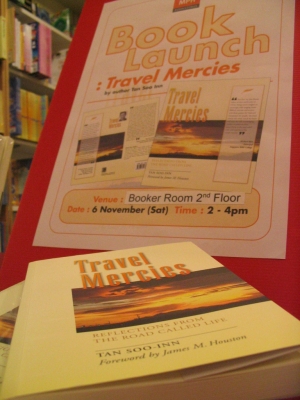
John See beat me in posting up something on the book lauch at MPH 1 Utama, he even throws in a short except!
Anyway, I was there too ... and was deeply encouraged by the turnout and most of all delighted to catch as much as I could from Soo-Inn's talk. Here's a cute picture of him doing an imaginary flag raising motion while telling his first story from schooldays ... which indirectly brought back some memories of my own.

I had to leave early to teach/facilitate some sessions on Evangelism. But even now I can still feel the "grace at work" (and not finished yet) when he was sharing and it somehow spills over to me. I suppose this is exactly what I needed at this time. Maybe there's an extra blessing because it's always a double bonus to not only read the book but also know the author personally in some way.
My thoughts are still hovering over some of the words that saturday, "complexity", "pain", "lessons", "loneliness", "protected", and of course "grace", there's much more. I suppose that's why the ministry of Grace@Work has this central value permeating every aspect from the e-commentaries, the seminars to the books, it's very much what's being experienced and embodied in Soo Inn's life and ministry.
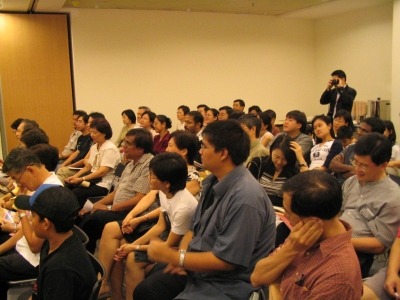
It was good to see a substantial turnout in support of the book launch and Soo-Inn personally. I guess, in some way, through his sharing we are all invited to taste the Travel mercies he talks about so honestly all this while.
Thanks Soo-Inn for giving me some space to have a better view of my own travels while listening to yours.
November 04, 2004
Shaped by God's Heart

In year 1999, I first came across the book Missional Church I was captured by the theological vision of church offered in the book. Now, of course I also recognized the differences in context where the book emerged from i.e. North America, but the theological reflection provided me with some framework to explore what concerns me here in Malaysia as well (especially increasingly we import often the best and many a times sadly the worst from outside of our country.).
Interestingly a couple of weeks ago, I managed to get a hold of a kind of "practical version" in the form of Milfred Minatrea's book Shaped by God's heart: The Passion and Practices of Missional Churches and it kind of brought me full cycle (or the center) to where I started from when I envisioned a church I'd like to be part of!
Here's some quotes from the Missional Church Center where the author is the director:
"A missional church is a reproducing body of authentic disciples being equipped as missionaries sent by God to live and proclaim His Kingdom in their world.
Mission is the essence of the church, the reason for which His body exists. The mission is His, not ours. Each Christian is called into relationship with Him and sent as His emissaries. The missional church understands; every Christian is sent by God as His missionary."
October 27, 2004
Books from Amazon

Thanks to a nice birthday present by a wonderful family (you know who you are!), got four books from Amazon. Their arrival came much sooner than I expected and I've already started reading two and look forward to read the other two once I plough through 6 hours of pre-masters programme entrance exam.

Here are the goodies in no order of priority:
- Christianity Rediscovered by Vincent J. Donovan (which I was delighted to find out that Lamin Sanneh wrote something at the end of the book)
- God Sense: Reading the Bible for Preaching by Paul Scott Wilson (I read two of his books on preaching and found them excellent especially The Four Pages of the Sermon: A Guide to Biblical Preaching)
- The Logic of Renewal by William J. Abraham (again partly because I was really challenged and stretched by his other book Logic of Evangelism)
- A Theory of Everything : An Integral Vision for Business, Politics, Science and Spirituality by Ken Wilber (this one is not a Christian book at all ... but I got it due to Brian McLaren's recommendation, so far it's quite an engaging read and sparks my mind in some useful dimensions especially when it comes to seeking a more integrated vision of life)
I think someone asked me how do I find time to read ... I read when I'm waiting for the green light during traffic (that's a little dangerous so usually I do articles), I read in the a-hem toilet, I read during advertisement if I'm watching TV (which nowadays I seldom do), I read before I sleep, I read when I wake up after my "solitude" with God (of course, the Scripture part is during the solitude), I read whenever I'm waiting ... and of course, I also set a side some time for more focused reading.
But it's more than just the reading, it's the reflection, it's about the inner reactions and responses that the reading facilitates. It's I think about the burnign questions baffling my mind which there's a strong urge to find answers or at least some directions - a voice calling for resolve I suppose .. I'm grasping for words ... something like that.
October 26, 2004
A Generous Orthodoxy ~ Review
Thanks to Organic church for this book review ... I think Glad Sounds Malaysia might bring some copies in :-) for a preview with the help of the review ... read on ...
_________________________________________________________________
A Generous Orthodoxy
Brian D McLaren
Graham asked me to post this review.
As this is a biographical book in many ways, reflecting Brian’s own journey, I open with a few comments about myself, since I have approached the book as a check list of my own journey. After ‘gettin saved’ I moved through a Baptist church to an Elim Pentecostal church. During my time there I discovered Calvinism, and at the end of 92 moved to a Calvinistic Baptist church, where I spent 12 years in membership, and the last 2 1/2 as the interim minister. I majored in Calvinism, but there was a minor undercurrent fed by my pastor which included CS Lewis, John Henry Newman, Therese of Lisieux, and the Eastern Orthodox Church. Although these influences enticed me at times, I always returned to the fold. Calvinism gave me a stronghold in which I could examine and learn from other traditions without ultimately beng swayed by them. Though my orbit around the sun of Calvinism might have wavered at times, it remained an orbit. It was something else that proved to be the decisive factor in plotting a course out of orbit, although I didn’t realise at the time; that was Richard Lovelace’s Dynamics of Spiritual Life, a case of Johnathan Edwards and John Wesley meets Sojourners.
During my last two years where I was those influences developed into tangible drawings away, and eventually at the beginning of this year those drawings resolved into a new sun that came through the system I inhabited, and the realisation that, as it drew away I was now in orbit around another sun, and in a new church, where these influences would develop. It was in this frame of mind that I read McLaren’s book, and now comment upon it.
This is a good book, well written (Mclaren is an English major who moved into Christian ministry). It’s as much a credo as anything, definitely a personal book reflecting his own journey rather than a systematic survey of the field.
The book opens with an introduction by John Franke, in which he quotes Tolkien from The Lord of the Rings:
“The world is changed. I feel it in the water. I feel it in the earth. I smell it in the air. Much that once was, is lost, for none now live who remember it.”
Galadriel’s words reflect that bitter sweet longing that Tolkien’s Edwardian generation were heir to after WWI, and although it has its’ place in the introduction, it does not reflect what is the spirit of optimism that actually pervades McLaren’s book. He look back is vigorous, grateful, and respectful, but his gaze is forward, as is his stride.
The book falls into two sections:
Part One - Why I am a Christian, in which McLaren reviews his understanding of Jesus Christ as he has encountered him in different (7) traditions, briefly summed up as:
The Protestant Jesus - He saves by dying; the sacrificial Christ
He reviews the four models of the atonement about Christ’s death: Forensic, Ransom, Representative, Victor. He notes what he sees as the major failings of the protestant view: its’ concentration on our being saved from hell to go to heaven, and to forget everything in between, and the marginalisation of Jesus’ life that this might promote. (He is self-acknowledgely more critical of his own traditions than of others, but I found his criticisms here and in the rest of the book to the point, and balanced by an appreciation of their strengths, even of Calvinism).
The Pentecostal Jesus - He saves by his Spirit; the present Christ
Similar issues to the Protestant one, since it too partakes of the hyper-individualism, the concentration on my experience, my needs, etc
The Roman Catholic Jesus - He saves by his resurrection; the Living Christ
The Eastern Orthodox Jesus - He saves by his incarnation; the cosmic Christ
The Liberal Protestant Jesus - He saves by his teaching; the wise Christ
The Anabaptist Jesus - He saves by his example; the ethical Christ
The Liberation Theology Jesus - He saves by his overcoming the powers that be; the radical Christ
Three chapters deal with the matter of being a Christian, and what salvation means, of which McLaren favours an holistic view that encompasses history, culture, society, politics, rather than the ‘traditional’ view of saving from hell. These are good chapters, and should be expanded into a book, if he hasn’t already done so, since their worth might be missed because of the nature of this book.
Part two consists of brief chapters outlining the influences upon him, and this is where I found help in clarifying my own journey, how far I had come, what the road ahead looked like, what I had missed along the way, and of course, what dangers I should avoid. It is to be noted that he is not promoting a one size fits all ‘Generous Orthodoxy’ orthodoxy; he isn’t writing a Systematics. Some of the chapters reflect how my own thinking is going, some point further down that road, such as the ones that reflect thoughts on my own constituency of Protestant, Evangelical, Calvinist, Liberal/Conservative. Some are directly challenging, esp the chapter on inter-faith conversation and incarnational mission, but also the one on Green issues. His criticisms throughout I thought were well balanced, although I won’t be adopting his new TULIP any time soon LOL . I was challenged, not doctrinally but practically by the chapters on the Charismatic/Contemplative, and Mystical/Poetic areas; I do not have much to do with them, being an INTJ, and I guess I should; prayer can get so mechanical at times. The Emergent chapter was an eye opener on the movement, with the nice image of young trees growing on the forest floor, waiting for the huge trees to fall so that they could grow - it may get discouraging at times being part of the small movements that are around, Cell, House, Emergent, etc, but he is confident their time will come, and that this is God’s provision for a witness when the old trees die.
I would recommend this book, he is an engaging writer, and it presents a good checklist of where you think you might be if you are shifting your ground. I don’t suppose anyone is likely to read this book who hasn’t already set out on the journey, so it is not likely to rock your world - probably his other books do that - and it might be better to wait for the paperback edition, as £12 is a lot to pay for a book that probably tells you what you knew already.
_________________________________________________________________
September 21, 2004
Jesus Asked

Nowadays, it's not surprising to first read the blog before the book, and I was first introduced to Conrad Gempf by Jason Clark. When I saw Conrad's book at SUFES bookstore I couldn't resist the temptatation to get a copy. I thought about it before - i.e. how Jesus always had interesting questions and the way he used them. And now there's a really fun-serious-witty-wise book that invites us to enter this "questioning" environment in the Gospels. Here's a free sample chapter! Plus I think the cover is fantastic :-)
______________________________________________________________
Jesus was a bit different from other religious teachers. Moses wanted to tell you the Law of God. Prophets were always telling you what the Lord was saying. But apparently, if you met Jesus on the street, he was more likely to ask you something than to tell you something. Even when other people asked him a question, he often replied with one of his own. ~ p. 19
______________________________________________________________
I asked a few questions to a group of "thinkers" and was delighted with the response.... made me think of more questions!
September 14, 2004
The Millennium Matrix

I remember mentioning about the book and the articles before , here. It's a useful way of looking at the present scenario of cultural shifts and ongoing changes in our world. MPH 1 Utamahas copies .. I got mine there yesterday (and made my confession to May Chin later...)
Here's some quotes for tasting after a quick glance through its pages (Miller's words in bold, my immediate bite-size reactions in italics):
_____________________
Most people sense that something is different or even wrong, and everyone seems to have a theory as to why. Few of these theories, however, offer a real framework for navigating change." p. ix
Any "framework" won't be perfect, but some are more useful and others or helps us see reality better. I was thinking of a particular solution someone passionately is advocating which is build on some interesting observations but faulty analysis because of a less-than-helpful "framework." So, even though the solution project to the problem is a start but needs severe revision and tweaking.
"... Many churches and denominations are isolated from the realities of their community and the larger culture. In fact, they have moved to build support services and a culture cut off from the larger community." p.xii
This is so so true ... and even though we might be using the most modern techniques or tools or even trendy ideas ... we might look similar on the surface but are actually miles apart from the realities and thinking of those we are trying to reach. And worse, is when we just pump in more energy (with some guilt) doing the same old thing, thinking the same old thoughts ... when it;s not really touching lives in a deeper level ...
"... Many churches are so fragmented and activity-driven that they have little opportunity to develop strong relational bonds." p. xii
This is one thing that I've been hyper-sensitive about coming from the kind of background mentioned in this quote. Of course, the danger of over-reacting and being totally clueless, lazy and no direction is there too. But, we in Malaysia need to seriously get our act together ... and STOP! Learn to "love" and develop strong relational bonds again before we charge into another project.
"The church is not losing ground. On the contrary, we're simply awakening to our true condition." p.12
So often, I wonder whether we as leaders really know what is our true condition ... are we folloing our own illusions or chasing human-made dreams which sound grandiose but are actually distracting us from REALLY putting our full resources and gifts into proper use. Time to Wake up folks!
"We have a rising hunger not only for leaders we trust but for leaders who lead by trust rather than by fear or coercion." p. 149
This is part of the reason I felt drawn to the conversation catalysed by Emergent (or the emerging church). Looking back the past years, and especially the last 4, I've seen this kind of leadership by trust being modeled excellently and seen the opposite leadership by fear and coercion rampant in our setting (lord have mercy!). I guess, this is why I'm pretty excited to see where our "little" learning community that's somehow forming (or already in existence) can blossom in due time. We need to be aggressively patient :-) in our learning of a kind of leadership that will truly benefit those who are following and further God's agenda on earth in the church, in families, in educaitonal insitutions, in the marketplace, and beyond!
_________________________________
September 08, 2004
Generous Orthodoxy (a sample)
Thanks Jonny Baker for a sample chapter (pdf) of Brian Maclaren's new book A Generous Orthodoxy
I think I can use this to start off some reactions and reflections for http://agenerousorthodoxy.blogspot.com/ before the book arrives :-)
Following Jesus ... Revisited
I couldn't resist the nudge to pick up this book yesterday. Being someone who wants to communicate the "grace" of God in the Gospel, I realize it's a delicate task to share the demands of genuine discipleship without turning it into some form of "legalism". Dietrich Bonhoeffer (for another good site check out Bonhoeffer's Cell) has always been one model of just doing it so beautifully. His other book Life Together really turned my understanding of Christian community upside down and inside out ... for the better.
Here's some stuff from the preface in the revised and updated version of the book on "discipleship" that's touched me thus far:
____________________________
" ... It is not ultimately important to us what this or that church leader wants. Rather, we want to know what Jesus wants.
... It is not as if our church's preaching were no longer God's word, but there are so many dissonant sounds, so many human, harsh laws, and so many false hopes and consolations, which still obscure the pure word of Jesus and makes a genuine decision more difficult." (p. 37)
"When holy scripture speaks of following Jesus; it proclaims that people are free from all human rules, from everything which pressures, burdens, or causes worry and torment of conscience. In following Jesus, people are released from the hard yoke of their own laws to be under the gentle yoke of Jesus Christ. Does this disparage the seriousness of Jesus' commandments? No. Instead, only where Jesus' entire commandment and the call of to unlimited discipleship remain intact are persons fully free to enter into Jesus' community. Those who follow Jesus' commandment entirely, who let Jesus' yoke rest on them without resistence, will find the burdens they must bear to be light. In the gentle pressure 0f this yoke they will receive strength to walk the right path without becoming weary. Jesus commandment is harsh, inhumanly harsh for someone who resists. Jesus' commandment is gentle and not difficult for someone who willingly accepts it. "His commandments are not burdensome" (1 John 5:3) Jesus commandment has nothing to do with forced spiritual cures. Jesus demands nothing from us without giving us the strength to comply. Jesus' commandment never wishes to destroy life, but rather to preserve, strengthen and heal life." (p. 39)
"Where will the call of discipleship lead those who follow? What decisions and painful separations will it entail? We must take this question to him who alone knows the answer. Only Jesus Christ, who bids us to follow him, knows where the path will lead. But we know that it will be a path full of mercy beyond measure. Discipleship is joy." (p. 40)
____________________________
August 18, 2004
Faith, Health & Prosperity
I found this book edited by Andrew Perriman to be an engaging read as I'm preparing in re-looking at "Faith, Health & Prosperity". I found the whole treatment on the history and teaching of the "Word of Faith" Movement to be both informative and insightful. Thus, I munched 5 chapters yesterday.
The discussion on "Prosperity and the law of Moses" had some parts that caught my attention this morning over breakfast cornflakes and coffee :-):
"The basic rule is very simple: if the people kept the law of God, they would enjoy a comprehensive prosperity that included both health and wealth: ... (Deut. 7:12-15; cf. Ex. 23:25-26; Deut. 6.-3; 15:4-6; 28:1-14)." (p.158)
"This is not a prosperity to be claimed by faith. The focus is quite different: it is bestowed upon people in response to their obedience to the law. the basic formula is: keep the law, please God, do justice, and you will be blessed. Prosperity is not so much a goal as a by-product. Jesus' argument about seeking first the kingdom of God (Mt. 6:33; Lk. 12:31) is a natural develoment of this principle." (p.158)
"There is no doubt validity in the argument that the ideal lifestyle consists in an avoidance of both extremes and their concomitant dangers: 'Remove far from me falsehood and lying; give me neither poverty nor riches; feed me with the food that I need, or I shall be full, and deny you, and say"who is the LORD?" or shall I be poor, and steal, and profane the name of my God.' (Prov. 30:8-9), But the more powerful ideal is probably that of the righteous individual who, with his family, is blessed by the Lord with abundance and security and who gives generously to the poor (cf. Ps. 37:25-26; Ps. 112)." (p. 167)
What made me buy this book and read it immediately when I saw it in Evangel Bookstore? The reasons are a mixture of autobiographical-historical factors and pastoral-theological necessity:
1. I recall how much I devoured Kenneth Hagin books when I was a teenager, first, they were more affordable and of course the way he wrote and brought out a more "triumphant" and "victorious" faith was attractive to me then. I even bought some and gave it away as presents. I've seen a number of books critique the movement and Hagin's writings specifically and even though now I shifted away from much of the "word of faith" movement teachings ( "prayerfully" more towards what I believe is the core of Christian faith), I felt it's a good time to re-look at it with the help of this book.
2. The mere mention of Morris Cerullo in the introduction and the little episodes that ignited the need for this book also drew me in. For at least a year, I used to go every Saturday to MCA hall and sit under Morris Cerullo & friends' teachings. We had our workbooks ready, we rode two buses to get there. We were younger and we were hungry. And again, I changed due to many factors (cf. some good theological training, practical ministry problems arising from the teachings, personal faith-doubts struggles, fresh reading of the "common texts" used, etc). But, how the Evangelical Alliance of UK handled the situation was interesting ...
3. I haven't seen much of Hagin's or Cerullo's books lately ... but, there are many who preach on "Faith, Health & Properity" within a wide spectrum here in Malaysia. We still have loads of guest speakers from overseas who carry the mantle of proclaiming this "Word of faith movement"-influenced message. some conciously, other maybe unconsciously ... many churches and pastors seem to have a strong "emphasis" on "success" often seen through achieving their desired potential, purpose and of course prosperity. The whole "formula of faith" is also a much emphasised aspect. So in someways especially within those of us who are connected more to the "pentecostal-charismatic" flavour of Christianity here in Malaysia, these dishes are constantly served in our roundtable of spiritual feasting. How shall we deal with this? And do we have a TINA syndrome - There is No Alternative?
4. I've been reading and reflected with interest for some time now how some have been "burnt" in churches or environments fed much by this kind of emphasis. They range from individuals (who sincerely want to follow Christ!), to groups of people often leaving existing structures (which they often feel aren't plugged in enough to God's purposes and success plan) to form new churches. I found some interesting email conversations and comments on blogs sparked by issued sometimes related to traditional controversies like the place of Charismatic gifts but often to high profile individuals or churches connected to the "Word of Faith" movement. There are some undercurrent "questioning" going on ... and it's real and authentic. But, I haven't seen much discussed in the public discourse involving the higher folks in power and position. But, then again, I understand, it does appear unkind and rude to raise question about those who are "successful" in ministry - there's a who am I a small congregation pastor to say anything about a more than thousands of member mega-church practice or teaching kind of reservation. How can we proceed?
5. And of course, as always .. I'm interested in alternatives ... and let's say we get a better grasp of "Faith, Health & Prosperity" as it should be and could be, how can we see all this worked out in concrete forms and models. I was listening and observing to two worship services from two famous churches websites yesterday afternoon - one full one which lasted about 2 hours, another one more of excerpts to 30minutes. The music still moves me here and there, the speakers are "powerful" communicators, technology is used to the fullest, etc. Of course as far as content is concerned, it's a mixture of what I'd agree with and also a big chunk that somehow doesn't sound right. So it's a delicate process and tiring too ... It's obvious that these churches have become a "model" for many here in our country ... I was listening to a local preacher online and felt "hey! it's like a Malaysian copy of what I saw online! wow!", the tone, the moves, the style ... so, like it or not the influence is here to stay ... and maybe this kind of Christianity might become the mainstream (I don't know and also hope not). But sitting with like minded people and complaining is not going to help, more constructive work is needed, good articles and books written, not so much to attack the "Word of Faith" movement (I think there's quite a substantial balanced critical work done in the Perriman edited book), we need to sit down and reflect .. yes! and then resolve to get on with "excellence" in providing what we perceive to be healthier alternatives which are Biblically grounded, theologically sound, historically informed, reasonably constructed, spiritually vibrant and practically engaging! Phew that was a mouthful .. (often smart people or those with sound theology have a poor way of communicating their thoughts *grin*) we dont have to be fluffy and flamboyant, being faithful doesn't have to eliminate the fun factor or creativity ...
So, this has been another long post .... now back to getting ready for the "Rich Dad, Poor Dad"sermon this week ...
August 10, 2004
A Generous Orthodoxy
During the flight back from Germany with an overdose of "Luther" and spending time with Lutherans from 25 different countries and cultures, I was thinking back about the conversations we had and the influences that shaped us. And I found a fresh appreciation of my own unique journey thus far with much gratitude to God. During one talk with my new Hong Kong friend the last night before we left, I found myself freely sharing the interesting theological and spiritual traditions and a variety of individual authors that I drew from. The whole conversation was actually quite energizing for me! :-) And it somehow helped me to know myself better and be open for new developments because one becomes more secure in ones identity.
Thanks to Pomomusings for getting some excitement sparked on Brian McLaren's possibly most anticipated book this year. The reaction to this book I suppose might be as engaging as the content of the book, we'll see.
June 23, 2004
Recalling Our Own Stories
I "accidently" saw this book in MPH 1Utama and "intentionally" got it and am reading it side by side with Calling & Courage. As usual good books are hidden somewhere in those bookshelfs that just need to be "discovered"!
I like these insights on spiritual renewal and much much more:
________________________________
Spiritual Renewal is finding a fresh, novel, and creative way of allowing the call to reorient our present lives so as to bring replenishment and hope. Spiritual renewal is a process of connecting our original motivation for ministry, and then moving systematically into examining areas of our lives in light of that call. (p. 4)
A basic assumption in spiritual renewal is that the call is ongoing. consequently, the project of existence -- the dominant story of our lives -- is being renewed by God each day. Connecting with this trancendent activity brings renewal into our lives.(p. 5)
... Perfection refers to flawless performance. Realism refers to performance that is permeated with a grace-filled acceptance of our limitations and flaws (and our strengths). (p. 8)
... those of us who deny our vulnerability and woundedness and who, consequently, walk around as wounded people seeking to hellp others. Instead of achieving good enough emphathy, we become dangerous to ourselves and to those we seek to care for. (p. 9)
... The biblical and theological roots of the call go back to the prophetic tradition of Israel, yet they influence our understanding of the call today. This prophetic image of the call is not rooted in perfection. It is based on God's transformation of the ordinary person into a servant of God. Thus, the origin of ministry is in God -- not in the caregiver. (p. 11)
...Our task is to reedit, or reauthor, our own mythologies where they make it difficult to carry out our call. In reauthoring the myths of our lives, we assume that the call from God. God's call is like an unfolding drama in which new meaning is disclosed daily, and as the called we are invited to participate in these new meanings and possibilities. (p.13)
____________________________________
June 09, 2004
Evangelism for "normal" people

I found this book hidden somewhere in the 1 Utama MPH bookstore. The price was good, the footnotes showed we had common influences (e.g. Clark Pinnock & Robert Brow, Brian McLaren, Lesslie Newbigin, C.S. Lewis, David J. Bosch, N.T. Wright, etc). That was enough for me to get the book and begin browsing through it a while ago.
I like what he says in the intro ...
"My hope is to show that evangelism is, or at least can be "normal" for all those who consider themselves followers of Jesus. After all, Jesus, the archetypal evangelist, is also the most normal person who ever lived, in the sense that he most fully illustrated the Creator's intentions for human life." (p. 16)
June 01, 2004
The Bible Jesus Read
While preparing for my book of Job messages, I found some interesting info and insights in this book that helped me along the way. First, the interesting bits.
The book of Job so fascinated John Calvin that 159 of his 700 sermons centred on it. p. 47
I mentioned Job here and there and this is the first time I've really based two messages on Job and realized its not enough.
When Robert Schuller compiled the Possibility Thinker's Bible, he found only fourteen verses to highlight in the book of Job) p. 48
Now that is an interesting observation ... and now the insights ...
“If the Book of Job reaches across two and a half milenium to teach anything to men and women who consider themselves normal, decent human beings, it is this: Human beings are sure to wander in ignorance and to fall into error, and it is better – more righteous in the eyes of God – for them to react by questioning rather than accepting. Confronted with inexplicable injustice, it is better to be irate than resigned. ... I started my journey into this book with doubt in my faith and have come out with faith in my doubt.” ~ William Safire summary of the book of Job in The First Dissident (quoted by Yancey p. 60)
The book of Job represents a step beyond the “contract faith” assumed in most of the Old Testament: Do good and get blessed, do bad and get punished. p. 47
For a significant episode of my Christian journey it was very much a “contract faith” model. The turning point came especially when my mom was admitted to hospital during my first year in seminary, that I believe put me in a situation where for all honesty's sake I seriously rethought what kind of “faith” Christians are called to respond to God.
The second important episode is when May Chin & I (as well as many in my previous church) journeyed with a 20+ year old sister bed-ridden in coma state for 18 months with prayer. That was a time when I was introduced to Philip Yancey's crucial books Where is God when it hurts? & Disappointment with God. I was also writing a theology paper on theodicy (the problem of evil) during this time of intense involvement ministering to her and learning to walk with her family. I didn't do well in the paper, a lot of emotional involvement went through the reflection process.
Seen as a whole, the book of Job is about faith,the story of one man selected to undergo a staggering ordeal by trial. His response presents a message that applies not just to suffering people, but to every person who lives on planet earth. p. 49
I saw all sorts of responses ranging from prophecies of miraculous healing to severe spiritual warfare often sincere attempts (which viewed “faith” more as believing she's walk out of hospital.) One unforgettable one after she died 18 months after being in a coma state, is how one person who persistently prayed for her healing couldn't accept this fact and in contrast how her mother stuck with her belief in God.
It helps to think of Job as a mystery play, a “whodunit” detective story... we learn in advance (cf. Chapters 1-2) who did what in the play, and we understand that the personal drama on earth has its origin in a cosmic drama in heaven – the contest over Job's faith. Will Job believe in God or deny God?p. 49
The book does not provide answers to the problem of pain -- “Where is God when it hurts? -- for the prologue has already dispensed with that issue. The point is faith: Where is Job? How is he responding? p. 53
Will we believe in God or deny God? This existential questions forces us to look beyond the more rational-laden “Why God?” I've learned that we will ask the “Why?” questions and I suppose that's just part and parcel of our human quest for meaning. But the “Will we ...?” question keeps me connected to personal God – my creator (whom I believe is truly interested in our well-being in totality), and it gently nudges me to the “What's next ...?” questions.
The core plot: the best man on earth suffers the worst calamities, which poses a test of faith in its most extreme form. p. 53
May 10, 2004
Whose Religion is Christianity?

After more thinking since my email reply to Hwa Yung, I skimmed through some this book by Prof. Lamin Sanneh whom I heard last year and was more impressed by his interaction with the questions than his presentation. You can get a taste of what I mean here.
Allow me to just post some stuff that caught my attention so far from my quick glancing:
Responding to whether the growth and renewal in World Christianity (with specific reference to Africa for example) have been all gain and no loss ...
"... on the gain side the churches have grown: membership has increased, in many cases exponentially; and communities of hope have come into being in areas of strife and despair . But on the loss side, false prophets have appeared, schisms have spread, the simple and ignorant have been taken advantage of, ethical standards have slipped with political corruption. ..." (p. 32)
On a succint & precise definition of "conversion" ...
"Conversion is the turning of ourselves to God, and that means all of ourselves without leaving anything behind or outside. But that also means not replacing what is there with something else. Conversion is a refocusing of the mental life and its cultural/social underpinning and of our feelings, affections, and instincts, in the light of what God has done in Jesus." (p.44)
April 30, 2004
Courage & Calling

It's quite an akward week to start our "spiritual friendship" group. For me, it was in and out of hospitals with Mom last week and May Chin this week. Both are doing alright now. For our big bro who initiated the process down with Denggi and his son admitted. But, thankfully it was a better week for the third person especially when it comes to setting boundaries in work.
Our first meeting face to face with all three of us was yesterday morning.We'll be meeting monthly and I really looked forward to something like this. I was hoping to start one myself (which I think I'm doing something a little different with Emergent Malaysia). But I suppose, it's better for me personally to just enjoy accountability, support and spiritual formation with these two brothers.
Our Big Bro was kind to give us this particular book to guide our reflections and thinking. It's nice to receive gifts not just in the form of books (which I don't mind) but more in the form of acceptance, openness and mutual discernment.
Looking forward to personally work through these questions in the coming months:
# What is my calling?
# How do I live it out in the midst of difficult relationships or moral challenges?
# Will my vocation change as I enter a new stage of life?
# As I cope with competing needs and demands, how can I craft a balanced, ordered way of living?
# Where do I find the courage to follow God's call?
April 21, 2004
Stories of Emergence
At the end the SUFES bookstore beat the rest in bringing in the EmergentYS stuff. I read Todd Hunter's chapter first simply because he was very kind and encouraging to me during my "tough" time trying to figure out who I was and what I'm called to do, and of course the kind of direction I felt "led" to pursue (a personal contact or relationship really makes a difference in how we read something).
I did a strange thing as well ... I read Mike Yaconelli's Introduction and Brian McLaren's Afterword and will be working through the stories in random.
From Yaconelli ...
"... I've never lost my love for the church, the glorious odd collection of unimpressive, ordinary, flawed people who make up the community of God, the body of Christ." (p. 14)
"... our stories are the workshop of faith." (p. 19)
"... what we remember -- how we put it together -- speaks volumes about who we are." (p. 20)
"Stories, are the most effective way to combine complicated and difficult-to-explain truth into simple, understandable bites of reality we can grasp." (p. 21)
From McLaren ...
"... people, including Christians, never grow up ... Our Stories never end as long as we're alive." (p. 222)
" ... it's good to remember that we're talking emergence here, not exiting or expiring. The stories in this volume represent an ongoing ... no, more than ongoing ... growing and passionate commitment to the Christian faith, to the local church, to the ongoing message and community and revolution begun by Jesus Christ. That's good news!" (p. 224)
" ... these storytellers share a common hope that their struggle (which is far from over -- remember, we never finish growing up) will be worthwhile, that their reaching and aspiring and seeking and finding and learning/unlearning/relearning will be fruitful, that their stories will somehow advance the story of a mystery articulated by Jesus, a mystery called the kingdom of God, a story of God's will being done on earth as it is in heaven." (p. 225)
April 19, 2004
How to Read the Bible book by book

I must admit, I had difficulty ploughing through How to Read the Bible for All its Worth
(though I think it's also a good book). But this one is wonderful. Especially as we are reading chunks of 20-25 chapters of the Bible this year sharing in our LiFE Groups. I felt the Guided tour by Fee & Stuart is excellent and the special advice they give I'm sure will help many of my members too! For Malaysians, we have a special OMF edition which is more affordable! I saw it in Glad Sounds bookstore! Here's an excerpt to wet the appetite!
_______________________
" ... despite the way many of God's good people handle the Bible, it is, in fact, no mere collection of propositions to be believed and imperitives to be obeyed. Rather, the essential chracter of the Bible, the whole Bible, is narrative, a narrative in which both propositions and the imperatives are deeply embedded as an essential part." (p. 21)
______________________________
April 14, 2004
Spiritual Mentoring
I just realized that I stopped at chapter three of this book, which is a good book on Spiritual Mentoring from a Christian (or 2 authors combined actually!) point of view (I was surprised after I "googled" and found out how New Age and so called self-proclaimed "pagans" are using the term as their own)
Here's their definition of spiritual mentoring:
"Spiritual mentoring is a triadic relationship between mentor, mentoree and the Holy Spirit, where the mentoree can discover, through the already present action of God, intimacy with God, ultimate identity as a child of God and a unique voice for kingdom responsibility."
The Big three questions have helped me a lot:
1. Who is God?
2. Who am I?
3. What am I to do with my life?
All this sparked by a young friends question at the discussion forum on "What do you think of spiritual mentoring?" which has some replies already.
April 03, 2004
Healing Spiritual Abuse

When I read these words, I bought the book and worked through it page by page ... a good amount of healing came out from it. (For Malaysians it's available in SUFES I think ... unless I bought the last copy for my church library)
"Many of us have gone through bad church experiences that have left us feeling like failures. Blaming ourselves, we asked for God's forgiveness, but felt distant from the church and sometimes from God too.
Often, however, the fault is not ours but that of Christian leaders who abuse spiritually. How can we recognize the signs of spiritual abuse? What can we do to gain healing from the wounds we have experienced?
With clarity and refreshing honesty, Ken Blue answers these questions and offers hope and healing to the victims of spiritual abuse. In addition he shows Christian leaders how to avoid abusive patterns and instead offer Christ's gospel of grace to every casualty of bad church experiences."
Maybe some of our cases are in different degrees of seriousness but the Gospel of Grace must be heard once again!
March 27, 2004
Attitudes to the Poor
Read and reflected on “Attitudes to the Poor in New Testament Times” in preparation on a message based on John 12.1-8.
Somehow reading the article coincides with our visit coming up this afternoon. We're visiting the NGO led by a friend I got to know better at the Asian Mission Conference in S'pore. The NGO is focused on working with the poor.
On top of that, I just got my copy of Byrant Myers book below. Is it coincidence, or an accident, or is it providence that all this is happening? It all depends which lens one chooses to look through, isn't it? :-)
 >
>March 26, 2004
March 17, 2004
Da Vinci Code?

I haven't read the book, I'm not interested, but I think I saw it somewhere in a Malaysian bookstore ... apparently it's a bestseller. And yet I stumbled on this sermon "The Bible Code: My thoughts on the da Vinci Code and more" so those interested might want to take a look. I'll read it during lunch ... I'm not eating anyway. (BTW, I meant reading the sermon ... time is precious)
January 07, 2004
God—The World's Future

Picked up this "Systematic Theology for a New Era" authored by Ted Peters just before Christmas and started reading it last night & this morning (He's more well known as an expert on the theological implications of the new gene science and the author of many books, including "Playing God?: Genetic Determinisn and Human Freedom").
.
December 17, 2003
A Is for Abductive
I think we Asian Christians can learn from the efforts of this Sweet, McLaren & Haselmayer collaboration.

For example, there are many important insights I've gleaned from the recent Asian Mission Conference and of course more and more reading some of the "Transformation" Journal articles especially in matters of development, culture and other religions. But I believe to go one step further, we need to write more for the church (starting with church leaders) to resource the change that we envision for the Emerging "Asian" Church. One interesting comment by one of the presenters in the conference is how we Asians is often overwhelmed with the material produced by our western Christian brothers & sisters. We all laughed at that comment. I appreciate those efforts of course, but we need to start working out things for ourselves not just at the macro level (cf. producing home-grown Asian Theologies, Bible commentaries or study guides, and Missiological reflections & proposals, etc) but also at the most micro level (cf. One of the hopes I have is for pastors like myself to not only engage on these issues on a personal level but intentionally seek to work in out at the most grass-root local congregational level. For now, as far as writing is concerned I can merely blog *grin*)
A is for Asia ... A is also for Africa ... :-) A is for ALL of us!
December 01, 2003
Ordering Your Private World

The first time I read this book was when I was in my late teens. I somehow grasped the general idea. I read it again in my twenties, I think I got a clearer idea what Gordon McDonald was trying to convey. Now, I'm Thirty-One (phew! time flies) and I'm still reading this book (again! this time it's an updated version and I'm using the study guide!) - it's a life-long struggle.
And more and more I feel Christian leaders MUST work through the concerns and concepts in this book. In fact, humans must struggle through with what he's highlighting here. The past few years, the chance to be in touch with numerous "crashes" in people's lives, marriages, work, etc, convinces me that the cultivation of the "inner life" is critical and crucial. It saddens me again and again when one is engrossed in so called "busyness" (which is a symptom of something deeper) it's like termits eating away the "hidden" structures of our lives quietly but surely. There are warning signs. There are ways to prevent (and recover from) such "disasters" (read about the Sinkhole Syndrome) and it's got to start now.
Consider the maturity of McDonald's thoughts: "Now, there is a busyness that reflects a plan of activity, a pattern of priorities, and a sense of purposefulness. It is good and satisfying busyness through which one grows and increases competence... But there is also the busyness (destructive busyness, actually) that reflects a chaotic way of life - a way of doign in which one is simply responding to the next thing in the day. The next thing! It makes no difference whether or not it has significance; it's just the next thing, and one does it because it's there to do." (p. 1)
But, of course the whole issue of "busyness" is just scratching the surface. The deeper concern lies beneath the surface inside us!
November 30, 2003
Out of the Salt Shaker

"Christians and non-Christians have something in common. We're all uptight about evangelism. Our fear as Christians seems to be How many people have I offended this week? We think that we must be a little obnoxious in order to be good evangelists. A tension builds inside: Should I be sensitive to people and forget about evangelism, or should I blast them with the gospel and forget about their dignity as human beings? Many Christians choose between to be aware of the person but then feel defensive and guiltyt for not evangelising" (p. 11)
I think Rebecca Pippert does a pretty good job unearthing the voice of many Christians I know. I too struggle at times with this tension (even though I'm a pastor) On one hand, I can't and won't forget about evangelism. And yet, i want to be sensitive to where my non-Christian friends' are in their life journey. I recognize impatience does not help genuine evangelism but I also feel that inactivity and apathy is not an option.
I've always loved the title of the book Out of the Salt Shaker: And into the World. It kind of captures the essence of Evangelism as a way of life in a ordinary daily life metaphor. I managed to work through the book (the revised IVP UK edition - which i think has great improvements, especially the addition on "the witness of community" & reworking her thoughts using "the three ways to witness" as a framework!) for the first time in preparation for three sessions in the SUFES D'Nous Academy (new youth camp) based on the book.
Her stories, humility and honesty really encourages even the most timid. And I think she's done a wonderful job bringing together sound theological reflection and practical application (i.e. the "how tos" which is helpful to get us started and be clear of the stages/process involved as long as we don't "fossilize" methodology). Her comments on "How do we work in sync with the Spirit of God in bringing a person to Christ?" is noteworthy:
" ... conversion is a profound mystery ... conversion is beyond our control. Again, it's a mystery and 'mystery,' writes Flannery O'Connor, ' is a great embaressment to the modern mind. Ernest Becker concurs: 'Moderns try to replace vital awe and wonder with a "How to do it manual." ...The mystery and the paradox of conversion is also seen in the fact that God doess all, yet he chooses to save us in and through human decision and obedience." (p. 184)
In my quest & pursuit for a model of evangelism that is "natural" (I can be myself so can they!)-"relational"(more human!)-"conversational" (which is more fun & enriching) -"long-term"(cures the impatient bug)-"communal" (glad I'm not alone in all this) & "spiritual" (i.e. genuinely trusting in the work of the Spirit) I find her contribution a blessing to me to move forward! And move forward we must!
November 28, 2003
Six Action Shoes
What Action Shoes do You Wear?. The danger of enjoying the whole thinking hats process with no action is very very real. We need hats and we need shoes! Reflection & Action ...
Six Thinking Hats
How about some Parallel Thinking with some fun?
“The quality of our thinking determines the quality of our future.”
-Dr. Edward de Bono, creator of Six Thinking Hats®
Try out De Bono's Six Thinking Hats! (A useful chart here and powerpoint presentation)
I might try it out in in the sub-regional pastors meeting afterwards :-)
November 23, 2003
Walking with the Poor
I was delighted when World Vision Malaysia (associated with World Vision International) was going to do a couple of training classes facilitated by Mrs. Grace Goh at the office. It was so timely, as we had just begun the "seed" processes on becoming more involved in our witness through the social dimension. I was attracted to the who series partly because I knew we were going to work through the framework and ideas found in Bryant L. Myers book Walking with the Poor. WV Malaysia included the outline in the invitation email and i was immediately "caught"! It was just good to be a student and listen to someone from another location and perspective.
I left the 1st sessions "shaken" by what I believe are areas that I need to change - especially faulty and hurtful mindsets and even existing behaviours and decisions (or non-decisions) that contribute directly or indirectly to injustice. In short, I was convicted. After that, I talked with May Chin about some things that need to change. Not that the seeds for change were not planted, they just needed extra water, fertilizers and sunshine. And this opening session gave me that.
A noteworthy ending to the half day training was the emphasis on the awareness if my own poverty in the light of all this, i.e. the Poverty of the on-poor. And that sparked me into a couple of directions. Now, it's focusing all this into daily practice and daily "repentance" (to use a more Christian term) and ongoing "renovation" by the Spirit and the Scriptures.
The "Bigger Picture" was so timely, as I'm also in the process of "refocusing" BLC's journey inthe light of GOD's Big Picture. I'm encouraged thought it's difficult but we are on the right track! I believe GOD is saying to us "Walk on!"
For more reflections from Myers, check out the MARC Newsletters
November 16, 2003
What I've Been Reading or Read Lately?
Books ...
1. Making Sense of the Church by Spencer Burke (just finished it last night, I loved especially the chapter on "Metaphor for life" and am starting to think of what metaphor captures who I am)
2. Models of Contextual Theology by Steven Bevans (a review here Started this because I wanted to really have a sharper focus on what "contextual theologys is about, paused for a moment, now back to it again.)
3. Once and Future Church by Loren Mead (Finished it in a couple of days, gave me some hope that renewal is still possible in an institutional church like my denomination and we can work towards it.)
4. The Meaning of Jesus: Two Visions by Marcus J. Borg & N.T. Wright (I must admit Wright was more of the reason I bought this book than Borg but reading the different visions of Jesus expounded by them clarifies my own perception of Jesus and more importantly the meaning he brings to my life as well!)
5. The Divine Drama: Biblical Narrative & Our Narrative by Harry Wendt
6. See Through the Scriptures by Harry Wendt
(I'm a picture person and the Discovery Seminar with Harry Wendt was liberating! So, I've been working through some of his pictures in the above three manuals ... the pictures opens up my imagination for transformation!)
7. New Horizons in Hermeneutics by Anthony C. Thiselton (wow! this is really heavyweight stuff ... I got stuck at the Intro & chapter 1, plan to get back to it soon. This Transforming Bible Reading framework is worth working through ... need time!)
Blogs ...
http://www.jordoncooper.com/
He always has some worthwhile interesting posts and links ...
http://futuremargins.com/
Fred Peatross' recent discussion on Spiritual & church DNA 1, 2 & 3 caught my attention ...
Stuff I got Online ...
1. Social and Bioethical Statements from the Lutheran Church of Australia
2. Articles from Fulcrum
November 13, 2003
We are what we read?
Again a link from Jordon Cooper where he actually has some comments which are interesting, click here, here's the orginal article Pastors’ Picks: What Preachers Are Reading. Interesting ...