September 22, 2006
Am I Emerging/Emergent if I'm ...?
I laughed and laughed the first time I saw this You Might Be Emerging If… Apparently Brian McLaren has strong opinions on this. Hamo from Oz did his version here You TOO might be emergent… which inspired me to join the fun :-) I will take great liberty to rephrase whatever I want - as a form of self-examination.
___________________________________________________________________
Might I Be Emerging/Emergent if…
I am a Thirty something Chinese Malaysian (Ok I'm not too sure about how Chinese I am .. but that's another story). Can never get that mustache grown in time (dont' even talk about a goatee!) Defintely no sign of body piercing and tatoos.

from

a short while lingering in (I'm cheating here ... I spend 5 wonderful Childhood years here)

I use a Compaq Presario X1000 (Note: I don't own it, the church loans it to me)

Without me giving last names (in some cases first names), I still know who these people are:
Yoon
Lesslie
Hwa
Ng
Brian
Siti
Wong
Sherman
Jason
Herman
Alwyn
Scot
Mahatma
Boon
Hsi
Tony
David
D.T.
Tan
Abdullah
I like to drink

and reading or discussing one or more of the following:




and of course ...

with a liberal (at times conservative) dose of
Lor ... Lah ... Ah? ... Aiyo! ... What.... Changgih! ... Wahlau ...
I'm listening to:

on my (ok I confess I do have an IPOD but most of the time I use the notebook to listen)
I use these words in a positive way:
Contextual, Christ, Creed, Post-colonial, Conversation, Asian, Resonate, Authentic, Missional, Catalyst, Center, Journey, Partners, Local, Global, Lutheran, Jesus, Quest, Random, Blog, Emergent, Emerging, Learning, Culture, Social Concern/Justice, Open, Scripture, Heritage, Theology, "Jamban"
I use these words in a negative way:
Legalism, Arrogance, Heresy-hunting, Judgmental, Trends, Hype, Busyness, Imperialistic, Insensitive, Rationalistic, Technique, Formulas, Religious, "Sui"
I have

on the windscreen and

stuck on my rear view mirror
on my (which in reality belongs to my wife!)

-or- (my son would have prefered)

I have to look at these pics twice because it might be me:

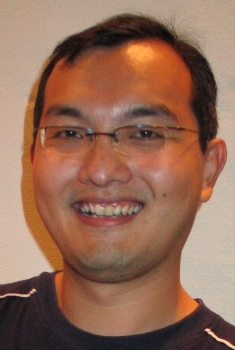


(actually once will do!)
Our worship service looks like

-or-

-or-


-or-

-or-

This is my leg:

I see this on a website and know exactly what to do:

I do quite a sense of humor,I'm not REALLY that tad irritated with this post.
* This “list” is neither exhaustive nor exclusive. No single one of these traits indicates that I might be part of the EC, but at some point, a cummulative weight will let me know if I am Emerging or Emergent.*
___________________________________________________________________
On a more serious note, it took me quite a while to do this post. Dan Kimball is insightful here after walking us through Origins of the terms "Emerging" and "Emergent" church :
"What all this word origin discussion means in the light of world problems, people suffering, wars etc. is so incredibly insignificant and even silly..."
September 21, 2006
Emergent Echoes
Yesterday it felt good to send in a article entitled "A Quest for Authentic Faith & Community in the World Today: Eavesdropping on the “Emerging church”/”Emergent” conversation" to a local Malaysian Christian Publication. I will post it up after they publish it :-)
Being excited I sent it out a "sneak preview" to see if there would be any responses. Here's some edited versions of what they said and my immediate (slightly unrefined) reply. I'm posting up these conversations between us Malaysians to give a glimpse on themes and concerns (their words and questions in bold):
___________________________________________________________________
Are the words used to describe Emergent movt and Emergent churches ours (i.e. Malaysians speaking that same language)?
Some of us find "resonance" with the words used like missional, conversation, friendship, and the characteristics mentioned in the Emerging Churches book. But I can only speak for myself and some of us (which to me is a minority). Thus, I don't "see" this movement here (as compared to the cell church movement, etc) .. it's too early to tell. I would suspect that some of us might find some convergence with the themes discussion in the more theologically oriented Emergent Village related conversations ... (cf. McLaren, etc). At least I do, whether or not postmodern is used. I talked about it in my book review on the Church on the other side here years ago (before Brian was making waves and facing with criticisms)
Personally, I don't like the term "emergent churches" (sounds too much like a brand) .. I can bear with emerging churches as a descriptive term (in short I don't like branding)I did not hear you mention what words some of those at the Emergent Malaysia might use to describe why they came together.
good question .. we tried to hint at it here and there in the last part .. an article is always limiting. I'll try to send an email to the Yahoogroup and see some response.
I think it would be good to get a local perspective - local stories / narratives of the issues people are having about their churches. If not we still follow a trend began in the US or in the West and so may be seen as being Western-influenced.
I think we are slowly working on this .. but with caution - because we want to handle with care some of the stories ... and allow some space for constructive processes to take place .. so when the stories are shared, some angst have been worked through.
Like it or not, because of how we are already so influenced ... it's not suprising, we have similar results with what is happening in the US and west. One person did comment to me .. our "angst" is more respectful :-) and less deconstructive.
Personally, I have consistently insisted right from the start ... using the phrase "conversation partners/friends" to differentiate that we are NOT merely "following a trend" imported from the west (cf. in contrast with "whole sale imported" programs?) I think this distinction is important.
Anyway good piece to get people thinking about it. Now will they begin to look at themselves and their churches and learn to be self-aware and self-critical? May our Lord move us to reflect Him and not ourselves.
Thanks, I had the impression people wanted a kind of primer and intro about it. and then a little on any thing in Malaysia :-) Appreciate your participation in one way or another.
__________________________________________________________________
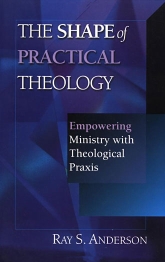
Thanks for the preview. I have enjoyed reading the article. It will be a good introduction to readers on what the emergent church and movement is all about. It will also introduce readers or even make known that there is Emergent Malaysia. Good work.That was what I think was expected so, we went along that drift. Notice, we never used the term "emergent church" in the piece. It was quite deliberate. Persoanlly, I don't like the term (because it's tends towards a branding mentality I'm uncomfortable with). I'm still ok with emerging churches, and Ray Anderson's use of "emergent" theology (see attached excerpts from what I think is his useful contribution theologically to the whole jazz - here (preface) and here (chapter 1)). In my mind, I think I would generally follow Anderson's way of seeing the whole phenomena and what is possible.
At this stage I don't "see" an emerging church movement in Malalysia (cf. compared to what we felt through the cell chruch movement for example) and it's very much still a conversation amongst a small group of us. I may be wrong.
If I may offer some comments ... you have not adequately addressed the issue why so many mainline churches are wary of the emergent church movement. I know you have touched on it briefly. As a reader, as I read your piece, it sounds as if the emergent movement is the coming revival. Then I would wonder why so many church leaders are worried about it (and it is not the generational gap).
Perhaps as one who is not an "objective" outsider, I can't hide some of the excitement because of how being part of the conversation has generated for me personally. But I'm not sure "the emergent movement is the coming revival" was what I intended. I think it's a needed conversation, I think we need to allow for some space for it.
As for critics, if you read the 9 Marks link .. I think the authors there have articulated themselves pretty clearly. It's interesting to read the one Bio datas of the authors.it is not so much from mainline churches (e.g. Anglican, Methodist, Lutheran - in fact according to Diana Bass she is welcoming of the developments) One of the early participants (and still is) of the emergent village USA coordinating group is Rev. Karen Ward (who encouraged me to blog by the way) She isl inked with the Lutheran and episcopalian denomination in church planting. I see the emerging church movement and emergent conversation (notice we try to distinguish it a little without dividing it) as part of the bigger move of the Missional Church emphasis (which I STRONGLY feel has relevance in a contextual form in Asia)
This link captures the deeper theological currents underneath (Emergent is mention at the end of the article).Where did the initial definition of the emergent church (the not flattering one) comes from?
I think you have brought out a good point (an earlier draft included it - maybe I should have put it in) - but the piece was getting longer. It's mentioned in Brian's Book A Generous Orthodoxy. But Dan Kimball tells us about it here and here
The article reads a bit choppy. The flow is not really therePerhaps we were trying too hard to sqeeze too much in there. And then again, it might actually reflect reality of our "choppy" conversations :-)
___________________________________________________________________
"... The problem I have is that in this conversation, I am just learning to speak. I have not spent enough time to make any comments of significance in terms of trends and the thoughts of writers. so sorry, I can't comment much on the academic aspects of the article. However I must say that if really pushed for why I would then want to align myself with a "conversation" that is generally badly maligned and misunderstood, it would simply be the attractiveness of the godly spirit in which the whole "movement" is set and the generally uncharitable spirit in which other camps which fight for truth seem to have.... people are more receptive and open simply becasue they know you genuinely respect and love them - even if you might disagree with them strongly etc."
__________________________________________________________________Posted by sivinkit at 01:40 AM | Comments (7)
September 19, 2006
Voice of Asia from Malaysia
Sherman has been offering some dishes for us to taste and see whether it's good for all - especially those of us in Asia. I'll pick out some samples (in bold) and throw in a few comments.
Voice of Asia (Prologue)
"A friend of mine - a journalist by training, presently working as a writer for a mission organisation and also a student of the seminary I teach in - has been engaged in a series of conversations with me concerning Christianity in Asia, and more specifically, in Malaysia. This conversation arose from his interest in understanding the present ethos of Asian Christianity and how the Church in Asia may seek to mature in her faith and proclamation of the gospel."
Indeed we often clarify ourselves better in conversation with "another".
Voice of Asia (1)
"Let me begin with what is not (and if I may emphasise, what should not be) a primary influence of Asians coming to Christ - arguments, no matter how logically coherent they may be. I think many well-meaning western-influenced apologetic-inclined Christians are culturally very insensitive and disconnected from the local paradigm of life and religious faith. They think that if they come with a nicely charted out linear-logically constructed argument about why Jesus should be embraced as Saviour and Lord, then people are obligated to accept the faith. Eventually, they find themselves becoming little more than pedlers of a historical faith that has been reduced into a series of simplistic propositions about the Christian faith. In their process of gospelising the Asian society, the heart of the gospel itself is somewhat lost.
... To sum up, I would say that a solely propositional proclamation of the faith (represented by logical arguments, also called "apologetics") is deficient in representing the heart of the Christian faith. The faith must be presented as a relational one, where God is demonstrated as the personal God. For the fulfilment of this requisite, I believe power encounters have been very instrumental in the propagation of the gospel in Asia. This case becomes self-explanatory when one contemplates on the way in which the Pentecostal-Charismatic movement has grown in Asia in the past several decades."
Voice of Asia (2)
"I think our understanding of the Christian faith needs to be restored into a communal paradigm of life and faith before Christian discipleship can take place effectively. After all, the community of faith is the interpretive community for the revelation of God. Much of Christianity here needs to rise beyond an individualistic paradigm. Local Christians need to learn to live within community, for community, and be accountable to community for the way they choose to express their faith in their lives. Only within such kingdomic relationships will Christian discipleship take place in an authentic and effective way."
Voice of Asia (3)
"What I'm trying to say is, deeply etched within the Asian cultural paradigm is a narratival way of communicating our values. Why should it be different for the communication of the gospel? Look at the way Jesus communicated with the Asian crowd (just so we're reminded that Christianity IS an Asian faith!) - what method of communication did he commonly use? Stories! He narrated his theological principles in the form of stories. Stories have a powerful way of impacting people, ranging from the most intellectually sophisticated to the most simple-minded people. Stories have a way of penetrating through psychological and emotional defences that people erect to guard their reluctance to change."
and even our cultural vocal chords are no longer "pure" but may sound "hoarse" after the pounding of foreign influences for better or worse and has evolved into what is before us now (and not we nostalgically we may want it to look like?)
Voice of Asia (4)
"We also need to re-examine our foundations. Within our tradition, this preceeding statement itself would provoke a fear of slipping into the clutches of liberal theology. But to not re-examine our foundations is to embrace the equal folly of misrepresenting the heart of the gospel, which may constitute an equal wrong. There are those among us who have emphatically affirmed that as Asian Christians, we have to move beyond the colonial Christianity that we have received. In the same breath, it is emphasised that this enterprise has to start with the word of God. But isn't our understanding and handling of the word itself (our hermeneutical exercise) also colonially conditioned? Do such realities not need to be acknowledged? If so, does it not also present the imperative of examining, deconstructing, and reconstructing our foundations? Are we culturally as unperceptive as many well-meaning colonial missionairies were? If the Christian faith has in all these past decades and centuries been presented as a faith based on a linear-logical foundation, perhaps it is time for us to recover the circular-logical and parallel-logical dimensions of the faith as Asian Christians. If it has all this while been based on a propositional foundation, perhaps it is time for us to recover the relational and intuitive dimension of the faith as an authentic Asian faith."
perhaps we are working with a kind of "rationality" that includes reasons (while recognizing it's limits) and relationality (which perhaps may have been neglected and needs renewed emphasis) as a key enviroment in which we reason, experience, feel, guess, explore, etc.
Voice of Asia (5)
"For as long as Malaysia does not have an intention to develop a theology that is grounded upon our own contextual realities and be willing to pay the cost for that belief, I don't think we will be anywhere near being ready to send missionaries on a large scale into the missionfield. We will merely continue living on a borrowed faith and subsist on teachings from the West which aren't very connected to our context of ecclesial life and theology."
Voice of Asia (6)
"We need to see, as a Malaysian Church, that we are "called" into different vocations based on our personalities, our giftings, our competencies, and our dispositions. These vocations are the very platforms for us, as Malaysian Christians, to be salt and light in the world. Our vocations are the vehicles for our being the sacramental presence of Christ in the world. Only when this theological value is ingrained in the Malaysian mind that it will "make sense" for one to desire to establish the presence of Christ through his/her vocation in a less developed nation."
I think more posts are on the way.
September 18, 2006
Emergent Carson?
* Andrew Hamilton (Hamo) did us a great service by posting up his recent conversations with D.A. Carson - and confirms to me the need to be quick to listen, slow to speak and slower to publish. That is partly why people like me in Asia have been pretty silent and cautious on matters regarding emerging church movement or emergent conversation unless I'm asked. Hamo did ask me to give some thoughts which was nice - and I said I'd try to do it after an article i wrote on "the emerging church movement" for a local monograph/magazine. For now, I'll pick out the stuff Hamo wrote that caught my attention.*
The Carson Conversation I
"I re-read Carson’s book on the day before and as I did got quite angry at the criticisms he levelled which just are not true of most of those I know in the Australian scene. I found myself needing to stop and pray that we would listen to each other and not just fire a bunch of bullets, because I was not impressed."
... In his book Don comes across at times fair and reasoned and at times ’spiky’ and harsh. He does not sound at all impressed with the emerging church crew. However in person (as is the case with many authors) he was personable and easy to speak to once we got past the small talk. I appreciated that he asked questions of Geoff and I that sought to understand who we felt we were, what we were doing and how we were using terms (”church/mission/pastor/missionary”) Without actually stating it, I think he was able to gauge from our conversations that the ‘emerging church’ in Australia as we were speaking about it was a somewhat different beast to the one he was critiqueing in his book.
We share similar but also different theological positions, however the common ground would be a comitment to orthodoxy and the central tenets of the faith.
.. I would have really liked to address some of the issues surrounding Carson’s comments on Brian McClaren, as I don’t believe he has been entirely fair to him, but given the brevity of time we needed to let those issues drop and simply speak of how his criticisms looked in the land of Oz.
... One thing he did stress was that he felt the EC in Oz (at least as defined by Geoff and I) would not be considered EC in other parts of the world. Hmmm… And therein lies much of the problem.
the Carson Conversation II
"Those who know me would know that I haven’t always sat comfortably with the term ‘emerging church’, because it has such different meanings around the world and I don’t want to sign on to some of those definitions.
If it’s the next clever trick out of America to make your church grow then I sign off now.
In Oz we choose to use the term ‘emerging missional church’ to emphasise the focus of our attention – the recovery of a missionary identity in the west."
... I am not worried that most here will believe me a heretic because of Don’s book – those who know me certainly won’t – but I am concerned that those who are new to the area will accept the word of a respected theologian over and above a local missionary they do not know personally. And I am concerned for the shadow his book may cast over those seeking to experiment and explore new ways of being church and doing mission.
... My understanding – (please correct me if wrong) – is that there was no actual face to face interaction with emerging church leaders or interaction with specific ‘emerging churches’.
The sample group for research were the writings of a limited number of texts which may or may not have been read accurately. (At this point I was ‘gonged’ giving me 3 minutes to wind up my talk. I wanted to address some issues related to B Mc but just didn’t have the time…)
As well as being limited to the writings of Americans (Chalke excepted) it does not explore the variety of nuances of the Emerging church around the world. It seems to define what is happening around the world by what is happening in America. This is problematic.
... Not everyone is down on propositional truth. In fact I don’t think I know too many EC Aussies who would dismiss propositional truth at all. A more humble approach to scripture is not a denial of its truth, simply a recognition that we do not know completely.
Our primary concern – as with all missionaries – has been how to live in the culture and yet not embrace its negative aspects.
... As we engage with people we do risk syncretism – but we are already syncretistic and I believe we kid ourselves if we think we are untainted by our context. We just don’t see it as well.
... Ironically we don’t speak a lot of the whole post-modern deal over here. It was talked about 5-10 years ago, but it doesn’t seem to be the primary issue. We just accept that this is the world we live in and get on with it.
... In conclusion I would like to think we are as concerned for biblical fidelity as I am sure Don Carson is concerned for seeing the gospel transform our world.
We may come at these questions from different angles and that may shape our understandings and perceptions.
We need each other and we need to listen to each other. We need quality biblical scholars to help us read the Bible more effectively and we need earthy on the ground missionaries who can keep the scholars honest.
... A large part of my concern with what Carson had to say was related to the fact that I don’t know any theologically aberrant ECers, but the book seemed to suggest they were the norm."
The Carson Conversation III
"Someone asked me if I still see myself as part of the emerging church, given Carson’s critique and his statement that ‘we may not actually be considered emerging in other parts of the world’. My response is to say ‘Yes I am.’ Not because I subscribe to all that he critiques, but largely because I am not about to allow him to define me out."
The Carson Conversation IV
"He did however mention yet again that we seemed to be of a different breed to the North American scene and that he was not concerned that we drift off in eccentricity. That’s an interesting comment because (as much as I am ignorant) I would assume there is great diversity in the US scene also."
The Carson Conversation Final Reflections
"Perhaps the critique that is offered of the EC would be better received if it were not given (by some) with the implication that many of us are probably no longer Christians. In the face of those kinds of comments I do get tempted to sign up for a crazy liberal theological position just out of frustration. Usually its only the more wacky ‘reformed’ bloggers who make these suggestions, but others sometimes walk a thin line too."
Sivin makes the point that even if there is some validity of this stuff to the English speaking western world, there is still Asia and Africa to consider. Do they fit the critique also? Sivin - I’d love to hear your take on it all.
"If I had to choose some issues to say ‘yes’ to, then I’d sign on to the final warning about sectarianism. There is always the danger of creating divisions and polarising, not what we are about (see Geoff’s section) Of course the publishing of the book actually contributed to a further marginalisation of the ECs as churches became somewhat more skeptical and other significant leaders (Piper etc) began to speak out also. So in a sense the sectarianism was actually foisted on us by the critique."
eMo 2006.9: And What Have You Been Reading?

Funny thing is this was the first time we've met at a Starbucks for an emergent Malaysia open meeting (eMo for short) . I think it's also a first for using Sunday as well. It was a small group of 9 of us this round (would have been 10 if I didn't miss seeing an SMS sent to me earlier) but good to have those who were missing for quite a while make their return.
As usual Alwyn is the fastest blogger to "craft" a post out to reflectively report our meeting yesterday afternoon here: And What Have You Been Reading?
___________________________________________________________________
Stepped for the first time into Bangsar Village. New mini-mall: low ceilings, cool clean ambience, perfect for family shopping, a date, a comfortable meal and catching up with friends.Met up with Sivin, Alpha, Reuben, Don, Kia Meng, Yew Khuen, Joanne and Jade at the Bangsar Village Starbucks. Kinda interesting how books led the (informal) agenda.
Got a copy of Stanley Grenz's Renewing the Center, generously bought for me by Sivin (can't wait to take that with me to the train-station!) Flipped through it and one of the first sub-sections I saw was Rethinking Calvinism. Ahh. Like I said, can't wait.
Jade talked a little about her latest N.T. Wright book, Simply Christian. She contrasted it with C.S. Lewis' Mere Christianity, noting how MC had a more rationally oriented bent compared to SC which used worship as a launching pad for thinking about Christian coherence, spirituality, mission from both individual and communcal perspectives.
She highlighted Wright's triple perspectives on the integration between 'heaven' and 'earth', the first being pantheistic (where nature is worshipped as God), second the deistic view (where God is absent) and finally the (presumably) Christian view with God being the creator yet suffering for His creation and creatures. (Note: Wright also talks a lot about the dualistic view - where nature is ignored or degraded - in his other books and how the Gospel is meant as a subversive challenge to both pantheism and dualism - deism is more of an Englightenment add-on to these two ancient worldviews).
Simply Christian is out in paperback, at least in the UK. May it make it's way safe to our local bookshops, if it hasn't already.
Then Yew Khuen and Joanne told us how their cell-group was studying Philip Yancey's (who's actually a proto-Emergent, in someone's colourful phraseology) What's So Amazing About Grace?, particularly their delight at how their cell members began pouring out their stories bit by bit. Yancey, like many good authors, gently carves out a pathway in our hearts for further questions, deeper authenticity and awe from the "scandal" of grace and overall more sensitivity to the world and God's heart for it. [Disclaimer: These aren't their exact words, but I hope I won't be seen as just making things up! *grin*]
Somewhere between 3.30 and 5 o'clock we re-celebrated Alpha's wonderful quote about nurturing the hunger for God - surely one of the best gifts we could offer to seekers, to struggling disciples, to the younger generation.
Reuben then told us a little about SoulAction. He also shared about how Raj, pastor of CLGC, announced to the church a scientifically proven method for selecting a cell-group: Go to the buletin board, take a look at the faces of the cell leaders, and choose your cell! This was part of a discussion about how there is a "hierarchy" (often unspoken, at times oft-spoken) that a Christian must progress along in his life of discipleship, and about how there is a lot of suppressed pressure and anxiety by many Christians about 'moving up' the ladder.
(Urgent: We also need to stop right now and pray for Pastor Raj's little boy who's suffering from dehydration of sorts and as at this afternoon was warded. His condition is stable but let's ask the Spirit to heal him and be with Raj's family.)
We then more or less rounded with Alpha and Kia Meng briefly mentioning their leafing through M. Scott Peck's People of the Lie and James KA Smith's Who's Afraid of PostModernism? respectively. I was intrigued by both. I haven't read a word of Peck (except in a few of those motivation books), only know him for The Road Less Travelled and didn't even know he passed away last year.
As for Smith's book, Kia Meng briefly touched on Smith's selective dealing with aspects of Derrida ("There is nothing outside the Text" - everything has to be seen in context, not that there is no meaning or objective reality outside language), Foucault (discipline isn't always a 'bad' thing and in fact breeds true freedom, especially in a community like the church) and Lyotard (we needn't be concerned about Christianity being a meta-narrative because it isn't one[!], hence the possibility of full-blown declaration and proclamation of the Gospel). For an on-going and very scholarly conducted discussion of Smith's book go to Church & PostModern Culture: Conversation.
Two hours. Half a dozen books and more than a dozen conversations. Loads of laughter, learning and comraderie. What more could one ask for?
___________________________________________________________________
September 16, 2006
eMo 2006.9: Because We Miss Each Other?
Here's the invitation I sent our via our yahoorgroup.
___________________________________________________________________
... we also don't have any "big" thing or agenda for this round. The fact is some of us miss each other, or have new friends to introduce to one another, or are trying to keep up with our reading, etc. So, probably the main accent of this coming meeting is "friendship" and charting the remaining part of the year. Exploring some possibilities for Brian McLaren's visit for 2007, and how we can "get ourselves organized" :-)?If I can manage a little topic I will try - but I dare not make any promises yet. It's been a fruitful time of ministry from a local church perspective and personal end like my experience with SIBKL's E06 conference. So, there's a lot on my mind. And lot's to throw out for all to consider. I know Raj and CLGCPJ has something coming up with I think is good in November.
WHEN?
September, 17 SUNDAY
3pmWHERE?
Bangsar Village
Star Bucks (got free wi-fi I heard)WHAT?
Catch up .. and whatever I can manage to get us going.Raj did an excellent paper on Ecclesiology .. which I'm very tempted to have him share a summary of his paper (rumor said *grin* it was very well done!)
It may be good to use his thoughts as a center and then others chip in ..I know Kia Meng has been reading Jamie Smith's book on Who's afraid of postmodernism?
Yew Khuen on Volf's Free of Charge
Jade owe's us her thoughts on Wright's Simply Christian(Or cant we meet simply Because we miss each other?)
__________________________________________________________________
Of course, it's more than just wanting to meet up ... it's a chance to enrich and sharpen each other ...
August 28, 2006
2nd Asian American Emergents Skypecast (Recorded)
Thanks DJ for offering us his recorded conversations. I think this is a good example of what the emergent conversation is about from our "limited points of view".
Here's the downloads for part 1 (mp3) & part 2 (mp3).
There were some "robotic sounding" moments perhaps because of the internet connection (mostly when I was speaking *grin*). Listening through the conversation again was helpful because I think I did miss some of it here and there (must get a better quality headphone/mic)
I resonate with what DJ is saying here:
"I felt good that I’m no longer the only Asian face interested in the emergent conversation. It’s also fascinating to hear how the emerging church conversation in Malaysia started up and has many similarities (far as I know) to how it started in the US. It really is best labeled as a conversation."
And the closing comment by Tim Liu (sorry I missed linking you in the last post) is great supper for thought tonight.
"In my experience, AsAm churches tend to be even more conservative in terms of practice than American churches. They tend to be slower to adapt to changes and are rarely forerunners in ministry innovation. Many people (such as Dan Kimball) see the emerging church as a response to the contemporary worship movement. But in my (Chinese) church, we are barely contemporary. We still have those who feel that drums are of the devil. So I think the Asian churches maybe just need more time to catch up. Also, I wonder if anyone else notices the overlaps between the postmodern culture and the Eastern/Asian worldview? For example, preaching in narrative and in non-linear flow of thought is normal for Asians. When I preach to the 1st genearation adults in my church, they love to hear stories and narrative. Its already part of how they communicate. Another example is the emphasis on community and relationships in the Emerging church. Its already is a central part of asian culture. So in a lot of ways, I could see the AsAm church very welcoming to some aspects of the emerging church if it is presented in the right way."
2nd Asian American Emergents Skypecast
Thanks to DJ Chuang for inviting me to 2nd Asian American Emergents Skypecast. As you can see my "link" to the conversation was due to the words "Asian" and "Emergent". But more importantly, because DJ Chuang and I have been in touch with each other for some time. So, at heart it's this friendship that opened up this possibility.
Nice to hear and get to know new people (All in the USA): David Park, Ben Pun and Peter Ong. I thoroughly enjoyed it when they were talking about how this whole emergent conversation connects or has nuances in relation to the Asian American Church context. In many ways, some of the issues are similar to where I am at or what I'm hearing bow in my interaction with Young Adults and College Kids :-) My hope is that they can contribute in some way to the wider conversation specifically through emergent village which would be an interesting dynamic. While some of us are figuring out how all this relates globally through Amahoro
Overall this is my first experience of doing a Skypecast. And within the limits (as well as the possibilities) of internet technology, I found it an enriching experience - especially to connect with others.
I'm looking forward to see/hear how the Mp3 come out when DJ is done with it :-)
August 07, 2006
eMo 2006.8: Joy's Conversion, Al's Confusion & More
*Updated from previous post: read further down below*
Thanks Al again for being the fastest writer and blogger to post the "raw" stuff of our conversation thus far. I think the impression one will get as I am is that the issues are complicated and one needs to perhaps "slow down" and chew on the ideas before forming uninformed opinions without due consideration. And yet the reality is that our emotional attachment to questions of religion, identity and many of the issues surfacing in the consciousness of our country lately is deep and personal. A detached totally objective standpoint is almost impossible to achieve.
But being aware of what's the feelings and fears underneath any discussion of a given topic is needed. And I think we need to give space to "acknowledge" those feelings and fears with openness. That's why, my comment back to Alwyn's post was the following:
"I suspect if we can create space in our minds that "Are these touchstones also untouchables?" does not mean that touching these topics mean immediate unthinking change or revision, but coming to a better grasp of the issues and context. This would include being open on how that process can either deepen us, and/or lift the discourse to a higher level of sophistication and/or allow for moving forward together for mutual and perhaps better solutions. So the art of distinguising this difference (i.e. touching on these topics aren't kidnapped for unthinking revisionism or rhetorical manipulation, etc) I think is important."
My immediate reaction when Al mentioned how much of the "details" were like going over his head during our recent conversation (and he's a secondary school teacher!!!). I wonder how much more ordinary folk when they hear about how the complexity of the issues surrounding matters of religion, consitution, legal arguments, socio-political context. It's a lot of hard work and require some patience. This also means a commitment to engage in civil respectful listening and conversation with the "other" person whom very likely has opinions which require as much unpacking as ours.
But now back to the original post Joy's Conversion, Al's Confusion
"Now what is Article 121a again? And Yew Khuen said that Article 3.4 is a good 'counter' to 3.3? And wow those guys are using "Article 11" like a proper name, lemme check: Ok it's about freedom of religion...it's an issue today because, wait lemme see, right, because this lady - Lina Joy (nice name, btw) - wanted to remove the "Islam" code on her MyKad, National Identification Department (NID) said you have to have an "Exit Order" issued by the Syariah Court...Syariah people said no so Joy escalated it to the High Court (or is that the Federal Court - ok, it's the Federal Court), so Joy brought it up to the Federal Court citing Administrative Law to say that the NID shouldn't bring Syariah into the picture since a change in her MyKad should depend on what religion she says she embraces...didn't work for Joy, so she and her lawyers brought it higher to the, err, High Court, this time bringing up Constitutional Law - and Article 11 (right, got it!) - and a Malaysian citizen's right to freedom of religion."
(Such were the state of my thoughts yesterday at the very informal EMO get-together at BLC...like I told the rest, it was all over my head but still exciting...anyway, so, alright, there's Article 3.3, 3.4, 11, 121a, Syed Hussein Farish Noor, KOMAS and it's about freedom of religion, there are some ties to the National Economic Plan, class struggles in Malaysia, the ethnic debate as a 'smoke-screen', and...)
It's not so simple because the Syariah Court has jurisdiction over all legal matters Islamic. And the High Court isn't about to just 'take over' this case because its judges are Muslims (and the last thing they'd want is to legally sanction apostasy within Islam - even if they didn't fear for their lives it's unlikely their conscience could be clear before Allah). The repercussions could be critical because, so it seems, there are about 250,000 post-Muslims seeking official confirmation of their allegiance to another religion.
On the other hand, Article 11 does seem kinda "clear" on this issue. To bar Lina Joy from converting out of Islam implies BOTH that Malaysia is an Islamic state AND there is no real "freedom of religion" for Muslims (yes, they are 'free' to be Muslim but at least a few people might see this as an arbitrary extra-constitutional curtailment of one's freedom).
It looks like a damned-if-you-damned-if-you-don't scenario. Joanne mentioned that a Statutory Declaration might be the only way to resolve it i.e. grant the NID some kinda special authority on the MyKad issue and NID uses this to refuse Joy's request (I'm not even sure if I'm grasping this right). Ah. So constitution "upheld", conversion refused.
What's the relevance of all this for Christians who, for now, have nothing acutely staked on the whole Joy vs. Syariah thinggy?
The obvious issue for Malaysian Christians is that the decision one way or another will cement people's fears and/or hopes regarding true "freedom of religion" in the country. It will be hard to find many non-Muslims in the country enthusiastic about the idea that Islamic laws have a one-up on non-Islamic ones. "Is Malaysia An Islamic State?" may no longer be an open question (for more information, goto Kairos Research Center).
Another thing to think about is how communities protect their boundaries and how Christians might proceed if they were the minority group (as is the case now) compared to if they were the dominant one. Is nothing sacred? Can everything be raised?
It seems that Malaysian pro-Islamic politicians are unwilling to even DISCUSS the issue of Islamic conversion. It's a no-no. Don't even go there. Nip it in the bud before it even starts. On one hand the desire to "protect one's sacred boundaries" is a vital one. But this crashes head on with publicly declared principles which USUALLY do not come with "exception clauses" about what issue can or cannot be highlighted. As Christians, we have have non-discussables (in addition to non-negotiables?)? Yes we've got touchstones. The question is: Are these touchstones also untouchables? (At this point someone mentioned that discussions ARE happening, but behind closed doors, which is bad because of the fait accompli feeling when things are revealed i.e. where's the transparency?)
My own view - and I think that of an increasing number of Christians engaging the Emergent conversation - is more No than Yes. I don't think the things of God need to be barricaded against counter-views, criticism, open challenge and so on. I see that over-protection in the face of serious and sincere questioning transforms our sacred doctrines into sacred cows.
Sivin, though, highlighted how important it is to bear in mind the situation of those in the dominant group. Even as we ask probe and push, we must demonstrate empathy to how the boundary-guards feel. We cannot ignore their fears, their trepidations. Respect and compassion are the order the day, everyday.
And, well, maybe that's a key for the future. When self-sacrifice and love and giving are the "barriers" of a community, then perhaps this not only transforms the individuals within, it also refreshes those without and, hey, even put a good twist to the very idea of barriers.
Because wasn't the Cross God's way of "keeping evil out"?
*Update: I think this is an important comment from Yew Khuen on Al's blog worth putting in part of this post. At least to show how we "converse" and "clarify" with each other*
Hey Al.. thanks for the quick and fairly detailed sweep of the discussion points. Just a few points to make note (not sure if it's worth updating your posting):
1. I would say that Article 3(4) is a "balance" for 3(1) [prefer that word rather than "counter" which seems to imply some contradiction in our Consittution]
2. The progression of the case was from High Court - Appeal Court - Federal Court. The case was fought on administrative grounds in the High Ct and Appeal Ct, but for in the Federal Ct, the lawyers used the constitutional grounds.
3. Jo-Ann's point was that it will be interesting to see on what grounds the Fed Ct will say "no" to Lina Joy (assuming that's the decision) without opening the door to the application of Islamic law interpretation of the constitution - if indeed that is possible. One possible way to sidestep the thorny issue is to rule on administrative grounds again (e.g. the NRD had the right to request "exit order" from Syariah Cts) but that would be unlikely given that the grounds being debated this time round is the constitutional issues (and the admin stuff had already been decided).
4. The correct reference is 121 (1A) an amendment made to the constitution in 1988 (?) which more or less states that the Civil courts have no jurisdiction over matters which the Syariah courts have jurisdiction over.
I think as God's people we need to constructively work towards a way of reconciliation for our increasingly fractured communities. May I suggest that as our first step - we, the people of God, repent of our own chauvinism and continue to grow in our agape love for our neighbours - through acts of kindness, service and (toughest of all) friendship.
Yah... maybe given all the "heat" at the moment, I'll agree with you that a "moratorium" on talking about the A-word might just be the right thing for now.
God bless
YK
August 04, 2006
eMo 2006.8: Free Flow Sharing
Sorry for such a delayed announcement ... many are away this Saturday but the coordinating group still felt it was good to "not give up meeting together" (we've fixed it pretty much on the first Saturday of the month). It's a free flow kind of meeting where we are mainly sharing current concerns, where we have been, the books we are reading, insights & questions bubbling in us.
What?
emergent Malaysia open meeting
When?
August 5, Saturday 2006. 4 - 6pm
Where?
The Father's House (Bangsar Lutheran Church premises)
Looks like a smaller group but then usually that means more in depth conversations. :-)
August 02, 2006
Emergent Village

the website re-emerges ... excellent work done on it!! Looks like the website itself has been in growing and generative mode. :-) very much like those who have been involved in the conversation thus far.
July 06, 2006
Emergent Comebacks
What (again) is an emerging theology?
"The whole idea of an ‘emerging theology’ is nebulous, which is probably unavoidable and probably a good thing. But every now and again I feel the need to sketch some boundaries, contours, intentions, commitments ... " Like it or not, sketches like this is inevitable. Hmm ... The metaphor of "sketch" suddenly looks very significant here.
Is there a distinctive approach to theologising for the emerging church?
"Whilst the traditional church continues to battle between the conservatives and the liberals, and between the catholics and the evangelicals, the emerging church has been emphasising the need for right engagement in context – or what has been called orthopraxis (right action) rather than orthodoxy (right thinking). It has avoided getting involved in this tennis match over orthodoxy. The emerging church has been focusing on ‘doing’ church in a post modern context, which is all about being and doing church in our liquid modern times, which has created a new context of a culture of the spiritually restless and spiritual searching, or the openness of many to be spiritual tourists. Many emerging churches, have sought to draw on the best of the old and reframe it for our current post-modern context, in what has been called ‘ancient-future’." Just replace the word, "post-modern" with "post-colonial" or "global" and we're creating room for the possibility of much mutual learning. Because there are some of us here who are also seeking and exploring "A way of doing theology in which one takes into account: the spirit and message of the gospel; the tradition of the Christian people; the culture in which one is theologising; and social change in that culture."
An Emerging Story
The details maybe different but the themes of questioning, belonging, solitude, settling, moving on, community, relating more to “non-believers” but knowing “somehow that Christianity is my home”, etc. makes people like me who are pastors in local churches sit up and listen.
The challenge is after listening and even seeking to respond by attempting to “change” to amend what is perceived to me the inadequacies of the “church”, one still needs to “let go” of being “controlling” in expecting more predictable results.
An Emergent Village Affirmation of faith?
I like what what Scot says here, "I suggest that more folks take a gander at this before tossing rocks at EV folks. What some seem unwilling to accept is that EV has no statement of faith, since it a safe place for exploration, but these leaders seem to agree on these very typical doctrinal ideas. Let the conversation continue; learn where you are as you converse." So now we call them EV folks ... cool.
Emerging Kids & Communion: The Kids’ Table
The moments we begin including kids in the conversation we're moving in the right direction.
June 26, 2006
eMo 2006.6 Notes: Orthodoxy in the Shadow of Theotokos
There goes Alwyn again ... with a quick follow up post Orthodoxy in the Shadow of Theotokos. I'm still very much in a Sabbath posture right now - thus no intensive blogging. I'll just repost Alwyn's post for the benefit of those who come to this garden for refreshment :-) For graphics, italics, etc go to his link. I'll just copy and paste his excellent text - "unplugged" ...
This is the second part of the notes on the EMO Meeting held last Saturday at BLC. The first was on post-colonial orthodoxy as outlined by Sherman. Now I'd like to share a bit about Father Daniel Toyne's brief (though still almost 1.5 hours!) explanation of the Eastern Orthodox Church and its uniqueness.
Father Daniel began, as a sound theologian might, by explaining the Orthodox's source of authority which, according to him, was epistemically superior to the Reformed position which relied on Sola Scriptura (which more often than not produced far less agreement on doctrines other than Sola Scriptura which itself is not unambiguous - cf. my thoughts on how greatly evangelicalism reflects the Derridean myriad gush of meanings, interpretations, etc.) and also the papal authority of the Roman Catholic church, whose universal juridiction was decided at a point in time - what then of authority before the pope?
Therefore, one is ineffective in producing consensus, the other historically dubious. The best option would be, failing direct divine revelation on a regular basis (smile), a return to apostolic continuity in the form of the early Church Fathers. Hence, Father Daniel's talk was sprinkled with names like St. John Chrysotom, St. Basil the Great, St. Gregory of Nazianzus, St. Athanasius and so on. Don't even try to keep up (grin).
This, really, is the capstone of the Eastern Orthodox Church: Whilst the Fathers themselves were not infallible, their consensus (on doctrine, on ecclesiology, on the liturgy, on Christian spirituality, etc.) is deemed to be. "We believe in the holy apostolic church," has, I suppose, never been more crucial in a theological thinking as the early Fathers are usually recognised as the right successors of the 12 (minus-1, plus-2?) apostles.
Which leads us to the issue of a core element of the faith which should and must be independent of culture (and here Father Daniel delightfully affirmed his belonging to the English culture but also his conviction that this culture simply cannot be said to be "Christian", what with legalised abortion, war-hungry politics and football hooliganism). This is also why Eastern Orthodox churches have a similar look regardless of time and nation-state. It is believed that such worship and liturgy constitutes the one true apostolically inspired/ordained manner of doing so, allowing only for variations in icons and maybe the music. And if I heard Father Daniel correctly, any other form of worship (including the addition of musical instruments) would imply a poor incarnational theology.
Whilst nobody pushed the point, I think it'll be only honest to say on behalf of most of the non-Orthodox participants that this is one of the element that will be hardest to accept, not least because the forms of worship are simply not prescribed in Scripture, to say nothing of how an under-ground church could take such form. I also wonder if incarnational theology might be expressed in ways other than a strict requirement about the appearance and feel of the inside (and outside) of a church, for the sake of appealing better to the contemporary experiences of ordinary folk, thereby connecting better with them. Nevertheless, such reverence for apostolic continuity in all expressions of the faith is certainly something worth admiring.
I'm certainly not the best qualified to write about the Orthodox Church (those interested can find far better material on sites like Orthodoxinfo.com, Wikipaedia, etc.) but there was at least one more point from Father Daniel's talk worth taking to heart.
I was touched by his sharing of how the Orthodox Church has grown in missions and how they've grown throughout the world. At least anecdotally, it can be said that there is now no country which doesn't have an Orthodox Church (they even have churches in North Korea and Cuba! Praise God for that!). And it isn't just sanctuaries they've planted but schools, clinics and welfare institutions.
I would like to think, and I'm sure Father Daniel wouldn't mind someone saying, that such a wholistic program of mission reflects their holistic theology in which every 'piece' in Orthodox theology is related to each other. One cannot understand God without understanding the Trinity, which doesn't make sense without the Incarnation, which would be diluted and devoid of full significance with the theotokos (a unique view of Mary which, like that of Church authority, charts a strong path between Mary the Mother of God, a'la Roman Catholicism, which could mean too much, and Mary the ordinary humble carpenter's wife and nothing more, a'la evangelicalism, which means too little). Mary's identity, in fact, is almost the capstone of Orthodox theological and ecclesiological construction, as it serves as the key to unlocking the links between theology and worship, between between heaven and earth, between spirit and matter, and (I think) between God and Man. Remove the theotokos and one could confidently say that you would have no Orthodox Church.
The Incarnation and theotokos, then, is the soil from which is nurtured liturgical worship (which includes incense and iconography, all of which reflects the beauty of holiness - no shortage of "multi-sensual" worship here!) which provides the backbone of an understanding of the church (or ecclesiology) whose duty it is to manifest sacramental and pastoral ministry, an important element, I suspect, of what it means for God to be "in the world" and loving it. And so we've come full circle.
Father Daniel also talked a bit about the gift of tongues (including a fascinating story of how two people speaking different languages could communicate with each other, each thinking that the other was speaking his own language!), fasting ("We empty ourselves in order to be filled with the Spirit"), being a spiritual father to his church members (which included the task of passing on Biblical teaching as distinct from his own opinions i.e. "I think" is not something a preacher/teacher of God's Word should use), all of which I won't elaborate on here, as even he stated that he didn't consider these very unique to the Orthodox church.
It was refreshing to learn, however, that even within such a robust theology, Father Daniel admonished that we must never forget the element of mystery in the faith. He and Sherman were one in suggesting that maybe the phrase, "I don't know", should be used more often in theological circles.
How fitting for an incarnational way of life, one which not only embodies God's Spirit and presence on earth but continually seeks to plug-in, ponder and receive from the Way, Truth & Life. I feel privileged to have heard from someone who has undoubtedly done so.
Once again thanks Alwyn for being our fast-blogging and deeply reflective scribe!
June 25, 2006
eMo 2006.6 Notes: A Post-Colonial Kind of Christian

Alwyn Lau is always the fastest and well-articulate participant and blogger of our conversations thus far. Here is his blog post A Post-Colonial Kind of Christian for yesterday (check out the comments too).
"Well, that's two firsts for me today at the Emergent Malaysia meeting in BLC.
I've never met an Orthodox monk before, so it was a pleasure to hear Father Daniel Toyne's succint outlining of the Orthodox position and distinctiveness. I plan to blog more on this later, but this post will be more about the second 'never before' of my Saturday: Listening to Sherman Kuek speak on post-colonial orthodoxy.
Post-colonial orthodoxy is about rethinking what it means to live, think, work and witness as Christians in post-colonial territories (there was one British and two Americans among us, which added to some of the humourous dynamics cropping up here and there), yet doing so within the acceptable bounds of Christian orthodoxy.
Sherman explained upfront - after showing some eye-catching slides of depictions of Jesus throughout the world, very nice! (see the Chinese and African depictions above) - that he intends to raise more questions and problems than give concrete answers and solutions, given that post-colonialism is very much an evolving consciousness far from any hint of a final form, especially in theology. He also noted that post-colonialism is itself not exclusively Asian i.e. African and South American theologians will doubtless think differently. And even within Asia itself, we find a kaleidoscope of beliefs and worldviews (which forms the basis of why Sherman thinks that focusing on post-modernity may be somewhat premature in Asia: How can one talk about what comes after the phenomenon called "modernity" when this phenomenon is as superficial, "washed ashore on Asia's coasts" as Sherman puts in, as it's manifestations are manifold?)
But to get straight into the discussion, Sherman offered three guiding principles to rethink theology within an Asian context (and at this point I'll note that whilst I wish to see how "Asian post-colonial theology", as Sherman has introduced it, differs from "Asian theology" or the significance if these are in fact two synonymous terms, I still appreciate the term and look forward to its further development) :
1. The first principle is pluralism, almost a 'bad word' in evangelical traditions, but a necessary (missional?) trajectory if one is build bridges to Muslims, Buddhists, Hindus, Taoists and Confucionists with their unique understanding of monotheism, karma, enlightenment, cosmic balance, social order and so on. If nothing else, perhaps this is a call for us to frame our questions and answers in ways which makes sense to the worldviews (and worlds) of our listeners.
If I could throw in a pence or two here, I recall reading Joel Green and Mark Baker's insightful Recovering the Scandal of the Cross: Atonement in Contemporary Contexts, where the authors suggest that the 'Western' account of sin would have received far less attention in Japan, than would the Asian idea of shame. Pitching Anselm, Calvin or what-have-you in the Land of the Rising Sun may be akin to trying to convince sushi-eating people that fish-'n-chips is what they really should be going for (maybe that's a bad analogy but I think you get the idea).
I'm manipulating (helpfully, I hope) some of Sherman's thoughts here, but I'd like to suggest that the call to incorporate (cautiously, no doubt) pluralism into Christian theology resonates well with the call to reexamine evangelicalism's evangelistic paradigms and scope of engagement (two of four points on 'Evangelical Shifting' blogged by Sherman earlier).
Over against an over-emphasis on conversion, numerical growth and factory-like efficiency which tend to objectify persons as mere 'souls' to be won, Sherman proposes a comeback to dignifying people. I recall a non-Christian friend telling me many years ago that he doesn't want to become an evangelistic project. Wow. That such terminology could arise from people outside the church ought to be cause for reflection and, maybe, repentance on our part.
The Christian offer of salvation also should go beyond, well, the 'Christian' offer of salvation which has usually meant being saved for heaven and little else. Reconciliation with God also entails reconciliation with creation and community. Positive moves here might include combining a talk on Jesus' Lordship and the call to surrender to it with a strong ecological message? Or moving social, health or political concerns (instead of personal sin) to the top of the agenda of an evangelistic rally?
2. Sherman then talked a little about the multi-faceted nature of Asian thinking. This is the part which resonated most with my post-modern explorations (despite the dissimilar priorities he and I have regarding post-modernism). Western thinking is more linear, either/or; Asians think in circular, parallel manner, accepting both/and. The West treasures propositional dogma and system over and above relational authenticity and intuition. Asian values the latter over the former.
Whilst such pairings are controversial and doubtless some would say that Sherman is dealing with false dichotomy here, I found myself nodding, especially given the boundary-making tendencies prevalent in Western theological mindset: "A Christ-like life isn't worth much if you don't believe the right things, we'll still consider you a heretic." (along with the requisite appeal to Galatians, no less) On the contrary, I suspect it'll be difficult to find Buddhists or Hindus ex-communicating each other over a matter of doctrine, as long as the requisite rituals and festivals are observed. (And yes, I am over-simplifying matters somewhat but I think often one must ZOOM OUT in order to get a good view of the differences, even at the cost of sacrificing some granularity and detail).
I think this factor aligns well with the rexamination of evangelical epistemology. A milestone suggestion by Sherman here, IMO, is that truth is universal whereas truth-claims are not(!). I think this creatively emphasizes the post-propositional nature of truth and how little attention evangelicalism has given to it, whilst acknowledging, as Sherman did throughout his presentation, that logic and proposition are necessary even in proposals to go beyond this).
As an example, Sherman echoes my views on the near-irrelevance or non-necessity of the doctrine of inerrancy, which he believes dies the death of a thousand qualifications (to be fair, he limits this to an Asian context whereas I think it plays throughout the world. I'm also beginning to think that what Sherman says about Asia I tend to view as more or less true globally given the advent of post-modernism. But this is another story...*smile*) Yet, thank God, an Asian Christian like him doesn't NEED this doctrine for him to accept the authority of Scripture. It's intuitive i.e. no strict logic or proof or argument needed. The certainty arises from the community - why insist on less secure footing such as logical argument?
3. The third factor a post-colonial orthodoxy should bear in mind is what Sherman called the Great Tradition. I suppose this is the 'anchor' to ensure that however far one explores the territory away from one's historical roots, one ought to remember the value and contributions of not only one's predecessors, but also the others who have ventured into new paths of their own. We journey to the ends of the world, but we do not severe ties with Judea and Samaria, much less Jerusalem.
I think this is another way of saying that whilst we're living waaaaay ahead in the story of God, we would do well to remember that we're still IN and PART OF a wonderful story and so our lives must reflect all the beauty, power, love and truth of God's people throughout time i.e. all the characters since the first chapter. The spiritual life is a storied life and the storied Christian life is a dramatic unfolding and pushing forward to a glorious climax of God's victory in full learning and humility about what came before, what promises were given, and what it means to 'progress' along the narrative.
Post-colonial (or Asian?) orthodoxy is about digging deeper (into our culture and our spiritual history) to find new resources we need to navigate the world's challenges and fulfil our God-given mission. This can be scary as it often requires rethinking and reconstructing our identity, the core of who we are in Christ.
At the very least, it's a strive, almost a pilgrimage, towards authenticity. And this, one hopes, is always a good thing, no matter where you are. East or West."
thanks Alwyn for being our "official-unofficial" emergent Malaysia scribe.
June 23, 2006
eMo 2006.6: Post-colonial orthodoxy & the Eastern Orthodox Jesus!
I don't have a fancy picture file for this round. But here's the basic info. In short, we're meeting tomorrow.
Date: Saturday, June 24, 2006
Time: 2.00pm - 4.00pm
Venue: The Father's House (Bangsar Lutheran Church)
23, Jalan Abdullah off Jalan Bangsar,
59000 Kuala Lumpur
http://blc.net.my/
I'm excited because our good friend Sherman Kuek is kind enough to nudge us further to explore "post-colonial orthodoxy" (My translation is - Exploring Jesus and what it means to be a Christ-follower in a post-colonial context). We definately have more questions than answers here. But I suspect it will be an interesting start to get our conversation moving in this direction.
An added bonus is we should have a couple of friends visiting who are from the Eastern Orthodox Heritage (which many of us are unfamiliar with) and this will be a good chance to hear and understand how Jesus is understood in their tradition and broaden our horizons.
So, welcome.
May 23, 2006
Belated Post eMo 2006.5 Notes
*warning* - Long post ahead ..

I thought I better quickly put down my thoughts before it's too late:-) Alwyn has already captured his angle of the meeting in Four Portraits, One Lord, I think it's worth while to re-post in full (BTW, emo = emergent open meeting):
"Saturday's EMO meeting started with Kia Meng taking the platform to lead the worship. I haven't heard him sing and play the guitar since college days - I'm sure I'm not the only one who thinks that all of us haven't heard him lead worship enough. Period (smile).
Then came our four views of Jesus.
Collin presented his conviction (heavily resonant with Roman Catholic teaching) that an encounter with Jesus begins with the Eucharist / Holy Communion. In this sacrament of grace we partake of and be joined in remembrance with Jesus the bread of life, Jesus the bread for the poor, Jesus the bread for others, Jesus the wine of His saving blood. The Eucharist is a constant celebration and a proclamation of the gospel, a sending forth in service and love to the outcasts and marginalised.
It was quite extraordinary to witness the abundance and richness of practical other-centered theology flowing out from the meal our Lord gave us. How we need to listen more carefully to what Jesus' Roman Catholic disciples can teach us.
David's address was a welcomed reminder of the key tenets of evangelicalism and its portrait of Jesus, also my own tradition ever since I can remember. His ten minutes or so could've passed as a summary of just about every sermon I've heard (and/or paid attention to!) in the past 15 years. Jesus is worshipped as a grace-giving Lord and Saviour, He is either Lord of all or not at all, an understanding not only in continuity with history but also generative of deep intimacy with Christ. The Jesus of our faith encompasses both the sacred and secular and resists/transcends our attempts at compartmentalisation.
I laughed at David's take on the popular evangelically-inspired "hierarchy" of professions (from the most respectable to the least), beginning with Missionary, then Pastor, following by Full-Time Worker all the way down to Lawyer and Jazz Musician! We were also told that among evangelicalism's ugliest sides was the use of social action (and even personal friendships, I might add) as a means of evangelism, in addition to an over-emphasis on an overly private faith perhaps tempting the evangelical to leave one's convictions publicly irrelevant.
(Speaking from within this tradition too, I'd like to add the little nuance that maybe it's an individualistic faith that we must guard against even as we seek to grow in [private] intimacy with our loving Father. Maybe evangelical Christians require a more community-oriented praxis and theology.)
This was the first time I've heard David speak and I must say I appreciated the short hour-plus of warm-hearted sharing, honest challenging and (of course!) hearty laughter (*big grin!*).
Pastor Raj (who replaced Pastor Luke, who couldn't make it) then gave us a snapshot of his experience pastoring a Pentecostal congregation. He noted how he would like to see more Charismatic leaders and churches talk about the humanity and suffering of Jesus, to complement their emphasis on His power, victory and gifts in/of the Spirit, especially speaking in tongues. He also alluded to an extreme form of AOG-ism in which the sick are told that their healing is guaranteed, failing which the fault must lie with them.
Nevertheless, the experiential, viscerally impacting and ultimately life-changing dunamis of the Holy Spirit is something our Pentecostal brothers and sisters are leading the way in. We would look to them for more learning of and partaking in this power.
I then took the soapbox in a rather rough tumble of a summary of N.T. Wright's historical/eschatological Jesus (I can barely imagine how Wright would feel if he could hear what I half-shouted in a mega-hurried manner). How do you condense an ocean into a pond? I'm making it worse by summarising my summary(!), but for what it's worth:
Wright portrays Jesus as a prophet who believed that he was embodying and bringing in the kingdom of God which connotes the victory of God over His (and by extension, Israel's) enemies, the return from exile of Israel and the forgiveness of her sins. He attacked Israel's cherished symbols (Temple, Sabbath, Land, Family, etc.) and sought to replace them with redefined ones. He wanted to reconstitute Israel, invite people to be part of the "new Israel" with new badges of God's people (cf. the Sermon on the Mount), a new praxis. Jesus went to the Cross, then, as the ultimate act of God's judgment on Israel's enemies, Israel herself and His triumph against suffering via suffering. The Resurrection was God's vindication of Jesus and the confirmation that God's new world has come, a new dawn was breaking through the darkness.
We, as God's true humanity, are then called to reflect the glory of Jesus by 1) telling the story of Jesus, 2) challenging the ways and symbols of false humanity and 3) subversively and lovingly issuing a counter-empire declaration to the world that "Jesus is Lord!". That is what the Gospel means.
Sivin then closed us with a worship celebration of the Lord's Supper, a fitting (and embodied!) ending to the meeting, a worship service with a difference.
And maybe that was the best point of all: That our theologies and our perspectives find harmony, meaning and validity in our worship and coming together as a people, as a family.
So when's the post-modern Jesus making His appearance?
We didn't have a big crowd (as usual *grin*) plus some regulars couln't make it. But we still had a good mix (and a number of first timers). There was a comment we are still very much male-dominant (which we need to work on for the next meeting!)

I think it was good to "jump start" our open meetings again. We've been laying low for a while partly because of the crazy schedules of the coordinating group. :-) I think it was one of our most focused meetings and most worshipful ones as well. When Yew Khuen and I were finalizing the contours for this partcular meeting with the title "The Jesus we never knew" both of us had a strong desire to see us move beyond just having some "conversations" (which I think we do well), we wanted to have a "worship" dimension to it (thus integrating spirituality intentionally in our meeting). Thus the opening with liturgical and praise elements and closing with Holy communion.

I was delighted by the fact that those who spoke on the respective Jesuses - Roman Catholic (Collin Nunis), Evangelical (David Chong) and Pentecostal/Charismatic (Raj - when are you going to start a blog?) were speaking from within these traditions.
In hindsight it's humorous too as Collin read from his script (quoting S.J behind the names of some authors he highlighted, while mentioning Ireneaus, Cyprian, Tertullian here and there with ease), David used powerpoint (with Bible references under the relevant propositions) and Raj (who was a replacement last minute) happily took the microphone and speak spontanously (admitting his lack of preparation due to a crazy schedule) :-)
There was plenty of giggles and laughter (which I later felt I needed to clarify especially for the newcomers less they think we REALLY are a bunch of crazies!). Now, none of the above claim to be experts and none are scholars. They are regular guys whom responded to our "call"/invitations to share - of course, Collin is really close with a number of Jesuit Fathers, David is a key initiator in the Agora Ministry, and Raj the pastor of Christian Life Gospel center. So, they are people deeply engaged in ministry as well.

What I liked about the whole exercise was not only were we give a glimpse as much as possible the more obvious distinctive views of how their respective traditions viewed Jesus (and thus the Christian life etc). There was a humility to acknowledge the "at our worst" moments (weaknesses?) as well. E.g. it was interesting to hear of Collin talk about Vatican I and Vatican II and how different catholics would respond to the initiatives arising from the second council, David mentioned the danger of Evangelicals when emphasizing the personal relationship with Jesus easily falling into the temptation of privatising him as well, Raj candidly shared about the lack of emphasis on suffering and the amnesia in terms of church history and continuity of the Spirit's work.
After some Q & A for the 3 guys above Alwyn stepped in and attempted to give a "condensed" version of his more than 1000pages of N.T Wright reading moving us from the more confessional stance above to a more historical/biblical appreciation. I could sense many in the crowd wanted more. I thought placing his presentation at the end this way was a good move ... because indirectly, we were challenged once again to look at the Biblical material and appreciate the 1st century historical context. For me, it helps to not only have the Roman Catholic, Evangelical, Pentecostal/Charismatic Jesus in mind (which often is the first impression maybe to some), we now have moved to first widen our perspectives and then move back to the "roots" (thus a little Historical Jesus exercise).
Time wasn't on our side, and I think that's why for our upcoming open meeting there are voices calling us to continue on where we left (partly because we couldn't work on the discussion questions given - and that would have been even better).
Ending with Holy communion was a wonderful climax, and in many ways a wonderful picture of what the Eucharist does for us ... bringing us together as a family and as a body of Christ. It became a time of prayer, thanksgiving, and sharing which is not bound by our opinions and theological articulation or spiritual expressions. We were united in our worship of the Triune God - Father, Son, Spirit. We stood in a circle receiving bread and wine. The presence of God was at the center. We were bound together with a common mission of being sent back into our worlds to share the love of God and be a blessing to those around us. And with hands joined together, we were blessed and sent once again.
The conversations would continue (I heard there were some eureka moments for some), others would be serving in their churches, many went home with new questions and fresh answers, I was encouraged that we had a good "jump start" again. There's a long way to go ...
May 17, 2006
eMo 2006.5: Reminder
Here's a clearer write up from Yew Khuen the more organized one in the coordinating group.
*************************************************
THE JESUS WE NEVER KNEW
Date: Saturday, May 20, 2006
Time: 2.30pm - 4.30pm
Venue: The Father's House (Bangsar Lutheran Church)
23, Jalan Abdullah off Jalan Bangsar,
59000 Kuala Lumpur
http://blc.net.my/
Summary:
The Christian religion is definitely far from monolithic if one considers the numerous and diverse traditions that have evolved over its 2000 year history. Yet, Christians of all ages and traditions agree that the faith is constituted around the person of Jesus, and that knowing him and interacting with him is fundamental to living as a Christian. Join us for an afternoon of listening and sharing about how the different traditions view and respond to Jesus - the one under whom all things in heaven and on earth will be brought together.
Reasons to come:
More than a purely intellectual exercise, the overarching aim of this meeting is WORSHIP: to come together as followers of Jesus to know him better, perhaps by learning new ways of seeing him or relating to him. In fact, we will begin with singing songs of praise and end with Holy Communion.
This meeting is also for EQUIPPING: In addition to adding depth to our own discipleship, the insights may help us to introduce Jesus to inquiring friends in fresh new ways. This is timely given the current Da Vinci Code climate where many are exploring the question of Jesus' identity & ministry and the appropriate response.
So come on down and you might just discover something about the Jesus you never knew!
Program:
Music worship
Presentations:
- Catholic
- Evangelical
- Pentecostal/Charismatic
- N.T Wright's Eschatological Jesus
Group Discussions
Holy Communion
coordinated by a group of friends currently known as emergent malaysia
May 13, 2006
eMo 2006.5: The Jesus We Never Knew?!
It's been quite a while since we've last gathered together. Lots of excuses and explanations for that :-) For, now I'll just post up an invitation for our meeting next Saturday so those who are interested can book the time.
May 05, 2006
aGO 0.2: A Generous Refund
 Ok let's continue where we left off.
5. I understand Brian's "accumulating-opinion style of orthodoxy" to mean that the focus is a "know-it all" or "know-more-than-you" approach where the accent is very much on the intellect (perhaps at the expense of other dimensions like experienceal or the less rational-cognitive stuff). It also makes one think we need to have lots of right answers. I find myself having a strange reaction right now to it. On one hand, I enjoy the whole process of "accumulation" in terms of ongoing learning - and the search for right answers is a powerful motivating and enriching factor in one's discipleship. But, when it becomes about winning or losing then I find myself resonating less with this style. It fact, it slowly becomes suffocating. I too don't advocate a "know nothing" approach (thus I'm not anti-intellectual, it's more of I find it's limited value and necessity)... perhaps it's more of "what are we doing with what we know" and "where are these answers affecting me?"..
6. Humility is admiting my limitations and fallibility and willing to revise my formulations - taking seriously (with some humor) my humanity. Charity is considering others better and smarter than me, this involves appreciating insights I would have missed (and often do miss). Courage is the energy to stand firm and stick with what we're convicted with (keeping the humility & charity part in check of course) and to move forward in the midst of suspicion or criticism. Diligence is the persistent determination to keep on the pursuit of truth and be willing to enter an ongoing cycle of learning, unlearning and relearning.
7. Brian's view of orthodoxy "as a tool and means to achieve orthopraxy" pushes one to ask "so what does all this mean in terms of our life and ministry here on earth?", "So what's next? What needs changing?" So the our understanding on the Trinity has much to say about how we relate to each other or exist as a communty. Our understanding of Christ has relevance to who we can become. Our understanding of sin makes us pause to relook at at the mess we're in. The pro is that we don't just focus on the abstract nitty gritty of doctrines or it's fascninating coherence or logic. .. we may enjoy that but we're know it's unfinished or incomplete unless we link what we think with what we do. The flip side is the same we back track from what we do to what we think. And this back and forth process clarifies our doctrine and sharpens our practice. The con might be that if we see orthodoxy merely a tool or means then we may be tempted to value the doctrine on our immediate assesment of it's usefulness in our perceived definition of "orthopraxy" .. perhaps when we cannot see it's immediate link to right action it's a sign we need to pause. Another con is we might miss the beauty of orthodoxy and it becomes to utilitarian.
I would have prefered "orthopathy" to be put n the equation or at least broug
h up to light. I sense it maybe assumed. But if spirituality - heart matters is thrown in I see less the temptatio to be either/or .. then we don't have to have a more"sequential" metaphor (due to the language of tools and means) ... to a more "music-like" (using the language of music and songs) where orthodoxy - right thinking - gives the lyrics, orthopathy right feeling or experience - the melody/harmony and orthopraxy - right action the rhythm. We could just look at a lyric of a song (we could do the same for the melody and rhythm) and there's some use but it doesn't convey the total picture of the whole piece.
I'm a little tired so maybe that's why I may sound not that coherent above. This is a blog ... and it's very much a "beta" thinking (constantly in revision mode). There's one more question but I'll try another day.
May 03, 2006
aGO 0.1: a Generous Refund
When this book first came out, Jen Lemen graciously sent me a free copy so I could participate in a group blog, aGenerousOrthodoxy.com. The excitement generated by the reception of the book can be felt here (back in 2004). Brian McLaren has been a welcome conversation partner and friend in my own Christ-following journey and feeble attempts to be a reflective practitioner/pastor (my 32year old birthday thoughts can't hide this). I must admit that when we were supposed to be contributing to the group blog I had difficulty organising my thoughts and working through my fears (and lack of confidence). This irrational fear was probably intensified because of the controversy revolving around the book, the emergent conversation (and the wider emerging church discussion specifically in the USA), as well as Brian personally and as a small fry young pastor in Kuala Lumpur, Malaysia - I didn't want to get pulled into a whirlpool and thus spending unnecessary energy engaged in debates that may or may not concern me (which is often the case IMHO for Christianity in Asia). I confess I may have been a coward or plain over-cautious. My involvement was limited to personal email exchanges, some blog posts and face to face conversations with those directly connected to the emergent conversation in USA & UK. Of course, even being associated with Brian McLaren and the what-does-this-mean term "emergent" or "emerging church" has brought both blessings and frowns.
Anyway, I saw a paperback version of the book today with a new epilogue and discussion guide at Borders Berjaya times Square (they are offering 15% for all books). The discussion questions looked helpful to get me thinking and articulating again. Furthermore, I owe Jen Lemen this (many thanks for the book again! BTW, it's amazing that Holly & Ryan Sharp who were on the creative team for the book actually came to Malaysia and we had some good times - they signed on the book *grin*) This will be my fresh attempt to move beyond random thoughts and posts to a series, I'll skip typing the questions and go straight to my response using the numbers (Ok! I'm lazy to type the questions *smile* - or you can guess the questions yourself).
allow me to jump into the questions and fear later ...
1. I was drawn to read (or re-read) this book because of (a) the reasons mentioned above. (b) it's 2006, 2 years after some "heat" generated by the book and I hope this season I can reflect on it in a "cooler" environment. (c) reading Brian's new epilogue inspired me where he shared,
"A Generous Orthodox felt more pastoral and personal. I think I was working on chapter 20 ("Why I Am Unfinished"), the last chapter, when the word confession came to mind -- confession not in the sense of a deep, dirty, sinful secret, but in the sence os Augustine's famous Confession (the margins of whose pages I am not worthy to mark), which would perhaps be better translated testimony. A confession is a personal testimony: here's what I believe, here's my story, here's my heart -- exposed with vulnerability and honesty"
This is important because when I first read it that was exactly how I felt and understood the book - not as a systematic treatise (with all the arguments ironed out) that I would swallow uncritically , or a kind of manifesto that I need to sign, or a formula that would solve all our problems in Christianity - I read it as a conversation with someone who's willing to open and "confess" his journey and hopefully through this interaction think about my own. Sorry for the 2 year delay, my mind has been processing all of this. Only now, I'm disciplining the fingers to key the thoughts down (at least for myself).
2. I would be under the catergory of "a Christian leader who has heard terms like postmodern and missional". This goes way back to 2000 when I was exposed to discussions revolving around these two terms though sparks from Bob Brow, conversations with Todd Hunter, early articles from Next Wave, The Len Swet classic Soul Tsunami, The Gospel and our Culture Network series - starting with Missional Church, and all things Lesslie Newbigin. As an audience for the book, probably I'd best be described simply as a Christians who's part of a sidelined mainline denomination refocusing what is frontline ministry in this time and age. :-) who has not left the ""institutional" church and consciouly chooses to remain in my present context (prayerfully to be a blessed catalyst for good).
3. When Brian tries "to be provocative, mischievous, and unclear." in this book, the playful and the creative side me thoroughly enjoys it. The part in me that needs challenging, rethinking and not taking formulaic answers or thinking processes shouts, "Great!". The more cautious side of me would be on the edge of my seat and more then once I've heard myself saying, "He might get into trouble for saying this.", or "I'm not as daring as he is to use that way of communicating his ideas", then there's the "This is very helpful to spur thinking, I hope some wouldn't take him out of context for their own personal agendas". After reading someone like Rober Farrar Capon I can take Brian's style but many wouldn't.
4. My initial reaction to the definition of orthodoxy as "What God knows, some of which we believe a little, some of which they believe a little, and about which we all have a whole lot to learn" is ... "This is honest! And it's true isn't it? Who (as in humans) can claim to have very bit of knowledge especially with regards to God all sorted out?" I don't think it's a classic definition where I'd expect some talk on Christ, the canonical scriptures, the creeds, the ongoing contextual engagement of the Gospel in and through the church with culture (often shown through the wider church tradition). But it's a "creative" directional definition where on personal confessional level it takes a lot of pressure of me and frees me to learn. It's kind of an "ethos" or an "attitude" where beyond a personal level multiplied communally would help us as Christians first to live together and then further work together. Not just tolerating but genuinely respecting each other - it's hard - but I think the body of Christ right starting from the local congregation needs hold this "creative confessional directional :-) definition" to take the unnecessary pressure off us to have "space" to grow at a variety of paces while still connected to one another, and for some minus defensive postures adding on learning postures which must lead to "orthopraxy of love of God and all God's creations" Whether its classic (faithful to where we're come from), creative (not just in an artsy sense, but in a constructive sense), confessional (which springs from personal ownership and authenticity) - the content of this kind of "orthodoxy" is indeed rich and enriching!
I can only manage until 4 today. So aGO 0.2 tomorrow. Non-virtual important stuff awaiting my attention.
April 22, 2006
Emergent Easter Eggs
The truth the whole truth and nothing but the truth
Yes ... it's out in the open ... emergent doesn't mean "I am a relativist!".
Church Emerging by Brian D. McLaren (pdf)
So that's why Brian doesn't like the term "emerging church". :-)
this is emergent
this is good ... I like the botanical metaphor.
Origin of the terms "Emerging" and "Emergent" church - Part 1
This post brings back some memories of the days I saw this development from afar via the internet.
Origins of the terms "Emerging" and "Emergent" church - Part 2
This following paragraph might actually summ up what many of us feel ... "It is confusing and I get confused thinking through the terminology sometimes as they mean so many different things to different people. But it really is not important to be making any distinctions of the terms "emerging" or "emergent anymore. What is important is whether or not our churches are faithful in serving Jesus on the mission He sent us on, and whether we are seeing the gospel of Jesus change lives and make a difference - not whether we are "emerging" or "emergent" or anything else for that matter."
An Interview with Brian McLaren (Criswell Theological Review pdf)
I think Brian does well in interviews. A number of us here in Malaysia are looking forward to a face to face conversation with him when he comes to our humble home.
An Interview with Brian McLaren - Circuit Rider
Another interview here .... I like his last answer which is not the final answer :-)
March 23, 2006
Postcolonial Orthodoxy: A Response
>My friend Sherman wrote an excellent post here Postcolonial Orthodoxy I thought I'll use it as a point of contact and stimulation for further conversations in terms of praxis. While distinguishing orthodoxy and orthopraxis might be helpful in terms of conversation or reflection, but in actual day to day reality or ministy personally I think the interaction is much more dynamic. My 2 cents in bold
________________________________________________________________
In the context of Asia, evangelicalism very much represents the body of faith propositions that has historically been bequeathed in all its orthodoxy by missionaries who arrived on our local shores during the colonial era. It very much consists of that which has been enunciated by the western community of faith.
To some people being an "evangelical" may mean you are safe or you are REALLY a Christian. Most Christians in the pew as far as I know might not be that aware of the historical-ness of evangelicalism in Asia. This would be the same like if I say I'm a Lutheran. There's no way we can rewind the clock as far as our colonial past is concerned (or as far as how western Christianity has shaped us or still continues to shape us). But I think recognizing the dynamics that led us to where we are now as far as our theological and ministrial models is concerned in some sense critically is a good place to start. And we must start somewhere ....
There is nothing wrong with a body of propositions that has become a time-honoured legacy of Christianity in one's nation. And yet, at some point of maturity, a community begins to question the absence of its own rhetorical constructions of the faith. It finds itself to have inherited much of the language, together with the resulting theological battles, of a community that lies yonder. And it wonders if perhaps it can find a manner of enunciation of its faith that is more resonant with its own cultural realities. Whilst most find greater security in persisting with familiar rhetorics and delineations, an increasing dissonance is seen emerging.
I think space is needed to re-examine the "constructions" or "formulations" (Thanks to Dr. Vinay Samuel for this helpful insight) of the Gospel we have inherited. And for me personally, the journey had begun when I re-examined my "Pentecostal/Charismatic" formulations of the Gospel, and then to some degree the "Evangelical" formulations ... maybe a little bit on "Liberal" formulations (I recognize these "labels" may mean many things to many people but I'll just use them as short hand descriptions of my journey). The immediate gut reaction is .. are we heading into an abyss of uncertianty and cutting off our "foundations" which the past has given us? but perhaps it's more of a desire to move into some kind of maturity where we begin to shed some "formulations" and construct fresh "formulations" while engaged in our contexts. This might mean new language and thought forms and models of ministry or at least it will be a more nuanced understanding of past formulations. The will be some ambiguity in our quest but it's a necessary valley to pass through ... we simply cannot ignore it. This ambiguity forces us to place a greater trust in God, the Spirit's leading and the relevance of the Scripture, the need for an accountability in community. While some may not see the necessity of walking this path, some of us are walking it anyway.
It is for this reason that some of us have now begun speaking of postcolonialism in our theological exercises. I would like to distinctly contribute a new concept to this enterprise: postcolonial orthodoxy. In skimming through much of postcolonial literature, it may appear that much of its ideas constitute replicated articulations of postmodern thought. As a result, this has caused aroused much suspicion within the circle of those more comfortable with familiar classical evangelical rhetorics. In the light of this reality, I am advancing the term postcolonial orthodoxy to emphatically point out two arguments: 1) that postcolonial theology and theological orthodoxy are not mutually exclusive; and 2) that orthodoxy is not a claim that belongs solely to evangelical theology. Furthermore, while the articulation of both postcolonial thought and postmodern thought may seem to employ similar ideas, there exists an undeniable and indelible historical context in which each of these moods arose. We are, inevitably, products of our times.
Taking seriously the critique of postcolonial and postmodern thought is in some ways scary because where does the critique end. Does that mean that there's nothing left for us to hold on to (after the critique of modernity and colonialism)? However, the fact that "we are in the world and not of it". We need not fear allowing some of our "treasured" formulations or rhetoric to fade away or in some cases take a back seat. e.g. just because my formulation on my trust in revelation of God through the Scriptures and how the theology discovered in 66 books of the Bible is not articulated in certain "evangelical rhetoric" like the classi inerrancy debate does not mean that I don't take the Scriptures seriously or I have thrown it away as far as the norm of our faith is concerned. On a personal end, I find myself reading, studying, and meditating more of the Scripture than I had during the "safety" of previous formulations. I've also found myself more enriched by the interaction of the "text" with my current "context" widening my more "spiritualized" reading in the past. But, then seriously here's my confession, I only knew about the "inerrancy" debate while in seminary. So, while I am beginning to understand why this an important discussion at some point, I believe in a variety on how we understand Scripture and it's relationship to our theologizing and ministry outworkings not bound by the boundaries set by the above debate is necessary. My confidence in Scriptural revelation is not affected by this questioning. Of course, I found that putting a strong emphasis on the person of Christ and the ongoing work of the Spiritin community and history keeps my reflection anchored and not going off tangen (at least from my point of view).
Western evangelical theology is by and large the result of the western community's experience of and engagement with the being of God. It is confronted by the sheer self-revelatory nature of God and seeks to speak of this confrontation by means of its cultural rhetorics. We in Asia must seek to do the same. This is essentially even more so when the Asian culture finds within its history a legacy of religious paradigms that speak of following a person rather than a mere body of propositions.
I think in my less organized way, I tried to allude above that I agree fully with Sherman's statement here: "We in Asia must seek to do the same. This is essentially even more so when the Asian culture finds within its history a legacy of religious paradigms that speak of following a person rather than a mere body of propositions." (emphasis mine). In my own preaching, teaching and ministry I found this most liberating from a spirituality level as the "personal" dimension of faith is accented strongly (without denying the body of propositions of course). I think this emphasis is crucial as I see it as a move that causes us not just to be more in touch with our humanity (and it's sinfulness) but more so in touch with the reality of a personal God specifically in Christ. This move also affects how I relate to the people around me as well as the cries of the world. Perhaps it's not so much of denying "content" as far as our following Jesus is concerned, but more of accenting the "relational"-ness more than the "rational-ness". Or better, it's a relational rationality. This helps me when I'm sitting in a Bible study and my young Christian friend is still learning to grasp the riches of the Scripture and see the value of their struggle and trusting in the Spirit's work in this study process. Perhaps it's plain patience and no hurry to have all the answers sorted out too quickly.
This is of course not to say that propositions are redundant. I am also not advancing the claim that western faith propositions are irrelevant for the Asian Christians. The primary concern here is that the western methodology of theological language has often been taken to be universal beyond question. Whilst propositions are gradually inevitable in a community's engagement with the person of God, my concern is that we may have been riding on borrowed propositions as a way of evading the more tedious enterprise of constructing propositions that are more truly consistent with the Asian paradigm of faith. This problem presents the need for us to recover the Asian religious inclinations towards a relational faith so as to enable us to subsequently progress towards an authentically Asian propositional expression of the faith.
As Asians, it's a start in reclaiming our heritage perhaps in terms of our paradigm of faith. Of course, in a global world, I also see my Western friends seeing the inadequacy of their own formulations and they are in some sense engaged in an enterprise of constructing propositions that are more truly consistent with their current context. This is where we as Asians must be careful not to become insular (in reaction to the our past or current influence from the west) and have confidence to engage our brothers and sisters from Africa, Latin America as well as Europe and North America (let's not forget the Aussies and New Zealanders, etc). There's no need to impose any of our formulations on anyone but we can share them as our gift to each other and see what happens.
Perhaps this lingering intimidation within some segments of Asian Christians arises from the fear of pandering to heresy if they were to embark on a creative journey of Asian theological constructions (which are often mistaken as "postmodern" efforts). This fear could perhaps be partially mitigated by the concept of postcolonial orthodoxy, that the almagamation of the two terms need not be perceived as being oxymoronic after all.
I applaud the need to "embark on a creative journey of Asian theological constructions" and I think part and parcel of this journey involves constructions (or even structural and concrete expressions) in terms of church life and engagement with the world because close to my heart at least I see a close relation with postcolonial orthodoxy and postcolonial orthopraxis. To me it's more of I'm aware of how we inherited some of these structures or expressions but I'm also open to change them as I engage in my time and place of ministry more. This is not change for change sake (or some pomo fad!), but a desire to take ownership of how the Christian faith can be rooted and grow in our soil (or better to be claimed by God allowing God to plant us deeper where we are at here and now!).
__________________________________________________________________
February 14, 2006
Emergent Box of Chocolates
emeRging::conneXion
wow ... a site dedicated to "aggregating global conversations on the emerging church"
The Future or Fad? : A Look at the Emerging Church Movement (pdf)
It's good to see the final edition of Scot's sympathetic and careful piece.
Resonances with the Emerging Church
Two paragraphs that stand out for me:
"... my participation through the years in the evangelical church had left me with the impression that it was believed we pretty much had all of our theological i's dotted and doctrinal t's crossed. But in more recent years, I've come to the conclusion that my personal theology is generally an outline and not an exhaustive encyclopedia. There are known items in the outline but there's much that's not filled in.... I've come to believe that spiritual change only occurs in the context of relationship - either vertically with God or horizontally with others or - perhaps usually - both. This is not, of course, an apropositional context, but it is a transpropositional context. There is something conveyed in a hug, a shared meal, the sharing of service experiences, the presence of another, that is not entirely capturable by lexical symbols. This, of course, has large implications on question of praxis, leadership development, and spiritual formation."
Seven Habits of Successful Emerging Discussions
I'll pick two paragraphs again to highlight:
"... in spite of his readership and influence, try not to equate Brian McLaren’s nonfiction and fiction with exactly what he believes and exactly what that is, is exactly what everyone, young and old, far and wide, here and there, who considers himself or herself connected to the emerging movement or emergent believes exactly. This is unfair to Brian and to everyone else.... please do not assume that everyone, everyone, everyone in emerging circles is postmodernist in epistemology, or assume that all postmodernists deny truth completely, or assume that postmodernists deny all metanarratives, or assume that metanarratives include the gospel, or just keep saying that emerging folk deny absolute truth. This in spite of many, many, many who have said over and over that none of this is accurate."
emergent does not equal postmodern
Interesting two paragraphs:
"... the term 'emergent' is in no way synonymous with 'postmodern.' emergent is a spirit, and (more specifically) that spirit embodied in conversation(s). it's a new (or at least re-embodied) idea that longs for a church that is emerging, not stagnant; for a church that embodies the gospel and lives into the kingdom in fresh ways as culture changes and as new challenges present themselves. the spirit of the movement calls us to grasp our own culture lightly, that it not become an idol as we seek to perpetuate it at all costs.
... if postmodernity is not something that you feel you are dealing with, leave it alone. it's emergence has little to do with you. don't feel like you need to be doing what pastors and christians in the states are doing. do the things that you must do. emerge where you are."
A pre-trip interview with Brian McLaren
now this is from South Africa ... so it's getting exciting now.
"... I am always glad to be in settings where people are less polarized, more open, and committed to being more diligent to preserve the unity of the Holy Spirit in the bond of peace.... Christians in the West need to hear the stories of "integral mission" that are emerging from the global south. They need to see how the formerly colonized are making Christian faith their own and are dropping some of the Western trappings - most notably, the Western dualism between "spiritual" on one side and "almost everything else" on the other - sociological, justice, peace, psychological, economic and related issues.
... A lot of conversation about theology, ministry, and mission is taking place through blogs, and it makes global conversation instantaneously possible.
... the first few people who became my mentors introduced me to spiritual disciplines or practices - from "practicing God's presence" to keeping a prayer journal to spiritual direction/friendship to tithing to solitude and silence. These practices have sustained me and are part of my life every day, helping me make room for the Holy Spirit in my heart and helping me, to use Jesus' beautiful image, be like a branch which abides in the Vine. As Jesus said, apart from that connection, we can do nothing. But with God's empowerment, all things are possible."
February 12, 2006
More from Emergent Theological Conversation 2006
volf-ing emergent, emerging volf (part three)
Loads of gems here ... I'm looking forward for the podcasts! Check out the following notes:
"... surely one of the most controversial and dramatic moments was on the second day when mirosalv went off a bit, sounding like john in revelation, critiquing christians for being lukewarm and indifferent to the treasure of faith and relationship with god. he thinks too many christians are lousy embracers, and he finds the indifference of believers towards god more troubling than atheists who are angry with god and thus deny god but in the process are passionately engaged with god. he said one can learn this from neitzche here, but also average people who have dismissed the church and reject god via complaint and lament.
... in a powerful response, miroslav said simply that is heresy. there is no 'third party' who is punished on our behalf. the guilt is not 'transferable'. it is god in jesus who takes the evil and sin of the world and by taking it in, then can transform it once for all, and marking the deepest reality of the future glimpsed now--no place for retribution, for suffering, for tears and pain and death. and by our participation in the sufferings of god in christ we also die to such sin and are reborn a new creation, ready to move towards gods future of reconciliation. and he finished his response by saying that the church has never settled on a view of how christ saves (the meaning of the term atonement). while there is not debate about the trinity or the two natures of christ, we have provisional and multiple views of christ's saving work. that does not mean any view is possible--he quite clearly ruled one version out--but it does mean there is not ONLY one view possible of christ's saving work.
... towards the end in a passionate plea miroslav distinguished between the church and the gospel in what amounts to a riff on paul in 2 corinthians 4:7. he said more or less that he is saved by grace, by the power of the gospel, and not by the church, even if it was through the broken vessel of the church that the gospel came to him. the church, therefore, is never ultimate. it deserves our energy and commitment not for its own sake, for the priority is on god; rather, there is a priority of the gospel over the church. this is not meant as an encouragement of individualistic spirituality shorn from the discipline of community nor is it meant to offer license to trash-talk the church. it is simply and clearly a marker of priority, of which comes first."
miroslav volf, part 1
miroslav volf, part 2
Another set of helpful notes. Some sentences that stood out for me.
"... Volf argued, especially in light of our current world circumstance, we need to make space for the "muslim other".
He cautioned that this "making space" should not be some sentimental, "we're the same" dreck that seems to permeate so much of the "official dialogue" in religious circles. We need to embrace, but not fake it when it comes to real disagreement.
He spoke of how through the eyes of a Muslim, he can re-discover and enrich his own understanding of God's holiness, how God is categorically other/different and awe-inspiring. To hear from a Muslim as Volf reads the Bible, he claimed an enlightening of his own convictions and faith. (note: not a changing or a modifying, but an enlightening of HIS OWN CONVICTIONS). He mentioned a need for a hermeneutic of charity that authentically deals with our own texts and gently articulates differences.
... Miroslav spoke of the human limitations on their capacity to grasp truth--we are finite, God, who is Truth, is infinite.
But he spoke of how Truth is not diminished in the mind of God. So much of the concern over Truth relates to the question of "How do we navigate ethical requirements if our ability to fully access all Truth is limited?"
For Volf we start with humility and an acceptance of moral requirements as a reality (because God is reality--my own addition).
He went on to say that we do not "possess truth" as if it is some kind of commodity that can be owned and therefore controlled. We must see ourselves as seekers. We are all seekers. So we must be open, humble, with the honesty of "I could be wrong".
He was asked then, "Where is our confidence in our faith?"
Unapologetically he said: IN GOD and the knowledge of our limits.
He then described 2 modes in which we live:
Reflective--"I cannot fully know within the confines of my human limitations"
Active--The risk of faith, the "wager" enacted.
... People want certainty, not nuance and openness.
(but we need to retain our humility)
Volf was asked how do we balance epistemic humility with confidence in God?
We celebrate the story, not the commentators. We radically trust in the revelation of God in Jesus. We must remember that the primary purpose of preaching is proclamation of the work of God, as opposed to highly technical teaching that can find a home in the Sunday School class."
Lots to chew on .. much that's worth chewing on.
February 11, 2006
Emergent Theological Conversation 2006
Emergent Theological Conversation, 2006
great pictures by James Mills and he gives a list of Conversation bloggers… and More conversation bloggers… and his on notes on the event on his blog!
Emergent Theological Conversation - Miroslav Volf Day I
Emergent Theological Conversation - Miroslav Volf Day II
My friend Jason offers some notes here.
volf-ing emergent, emerging volf (part one)
volfing emergent, emerging volf (part two)
Can't wait for part three ...notes that leaped out for me
"... primary research and theological systems are of some use, and one needs to think about how various commitments regarding one doctrine (say, one's view of christology) impacts the others (say, one's view of ecclesiology) and so on. but if theology is not also and primarily an integrated whole and grounded in practices that make up a way of life, then it misses its most important purpose. to make his point, he quoted his mentor, jurgen moltmann, who says "theology has become marginalized because theologians are afraid to deal with the difficulties of real life."
... the issue of epistemic humility is intimately tied to the question of embrace and it amounts to the challenge of acting while nonetheless holding an openness to the possiblity that we are wrong. to have such a view, for mv, simply means having an appropriate view of humanity. we are not absolue, and our horizon is limited. thus we cannot fully know and defend without a doubt my view of what right belief and action should be. how then can i act with confidence? in a marvelous moment (one among a handful of times this happened), mv's love of martin luther showed itself. he said quite simply that our confidence comes not from our conviction but from our faith, not from our holding truth but because of our being held by truth. at this point he quoted luther's heidelberg disputation #28: "the love of god does not find, but creates, that which is pleasing to it. the love of [hu]man[ity] comes into being through that which is please to it."
ETC Day 3 Pix
ETC — A Day Two Real Post
ETC Day 2
Diversity in the Emerging Church Session
ETC: Monday Evening Wrap Up
Thanks to Jay for the pictures and notes.
In short ... I wish i was there :-) I admit it's a little far. Perhaps some day ...
February 04, 2006
Emergent Ang Pow
Unbundling Christianity: An Attempt to Define the Emerging Church
a more US-centric view, that's ok. :-)
What I Mean When I Say "Emerging-Missional" Church
a wider perspective from the tall man!
Amahoro
Now if we could really get this global conversation going then it's going to be REALLY exciting ... I hope to play some part in that. Or maybe I'm already doing something ... well, trying is the better description.
Emergent Malaysia
ok finally I'll try with the help of many others to get this site going properly. Nothing much yet .. but next week, check again! This is a genuinely local attempt ...
February 03, 2006
eMo 2006.1: Learn, Question, Pray, Hide

This is a very delayed report of the recent emergent Malaysia open meeting. Mine is is work in progress but thanks to Alwyn who's been pretty good being the first one putting up stuff on his blog. I decided (with some minor editing - more of corrections on names and info). There's a lot I took down and we're in the midst of compiling the scribblings from others groups and try to put it into some coherent form :-) or picture :-P For now, enjoy AL's post.
Thursday, February 02, 2006 Learn, Question, Pray, HideTree. Petrol station. Mid-Wife. Jesus as the Question. Jesus as Provocateur.
The first Emergent Malaysia Open (EMO) meeting of 2006 was filled with cute, enduring metaphors for Emergent. Participants shared how they were more than cosy with the (sexy) ambiguity of the network i.e. how it might be less helpful to fully define and formalise it. Kinda reminds me of prayer gatherings where maybe a 'structure' (I start, you end) unnecessarily complicates things and stifles spontaneity and flow.
Sherman insightfully suggested that Emergent is the kind of group whose value is felt in a trickle-down manner, whose life-changing impact might never be credited to itself. The spring performs its quiet drip-drip-drip magic on the rock which, after some time, erodes, breaks off and gives birth to new landforms. Kia Meng compared Emergent to a mid-wife, undeniably the pivotal part of the childbirth process. Everybody remembers mother and baby - nobody remembers the mid-wife (except God, remarked Pastor Luke, *smile*). John, perhaps with CNY traffic in mind, personified Emergent as a petrol station: a refreshing stop to get fuel, take a leak, have a drink, stretch one's legs, and from which one leaves reanimated (both man and machine) for the continuing journey.
Emergent shall be glad to serve in hiddenness.
John, his second time at an Emergent meeting, also shared a vision of a tree, spreading its branches to give shade and fruit, its roots to bind-up the soil and nourish itself. (I can't recall if he said all of this, but the Geog teacher in me is firmly in charge here...)
Speaking of nourishment, it was also reiterated that Emergent must be a learning network where the instruction, insights and inspiration are multi-directional.
Jack Said brought out the theological goodies, suggesting that Emergent aided the sanctification process via observation, learning and experience. Sanctification is the Jesus way of saying "self-improvement" - began, continued and perfected by a more powerful Self other than self.
There was a sweet reminder from Vicky (a Korean student at STM, worshipping at BLC) that, whatever happens, Emergent has to be a network in which its participants pray for each other, for the places in the community most in pain (I recall Yew Khuen sharing about this at the previous meeting, how we have to be most giving, most caring, most sacrificial, most humble in the most needy and pain-filled spheres of life).
Prayer. Nobody needs attend a course to begin, yet which defies rational explication. There is no absolutely 'correct' or 'right' way to do it. Yet not to do it is like a spouse not talking to you, like a network with no terminals, like a hotline never called, or hands unused. Explain to the satisfaction of everyone its impact and effects - if you've got eternity to spare. But the lack of an explanation won't alter the fact that billions have gotten on their knees throughout the centuries, and how in the depths of one's heart, one knows that life is changed with prayer.
Kia Meng, one with no shortage of metaphors, proposed that we ponder why Jesus is today often viewed as boring. Perhaps it's because the church has too often pitched Him as the "Answer" to questions people don't care much about anymore. Maybe it's time to see Jesus as the Question, the Provocateur. "Who do you say I am? And why? And so what?"
A hidden, praying, learning, questioning, organic, emerging community. Something delightful for 2006, we hope (smile).
Posted at 01:17 pm by alwynlau
January 18, 2006
eMo 3-in-1 Meeting
3 in 1 because we didn't have a Christmas party or New Year's Party the last 2 months plus many of us will be away for the Chinese New Year. So let's all gather with tid-bits, food, drinks and frienship old and new and whatever this Saturday. And we'll celebrate all three in one :-) this weekend.
emergent Malaysia "open" (there fore eMo!) Meeting
Date: 21 January 2006, Saturday
Time: 10am to around 12.30 (or 1pm) officially!
Venue: The Father's House (or Bangsar Lutheran Church Premises). Map here
What are we up to? What's happening?
well ...
"This time round we will spend some time reflecting and sharing:
(i) Reflecting on what we've done/where we are as EM
(ii) Sharing ideas, plans, hopes and dreams for EM going forward"
With so much happening the past weeks, I'm looking forward to catch up with friends and get to know new ones and hear ideas and insights tossed around in conversation.
December 01, 2005
Emergent Ripples
*updated*
Emerging Church Hammering - Intro
"if you say something critical about the emerging church, there is a legion of web journalists who will quickly back you up and help you graffitti your criticism on the wall of the blogosphere." Insightful.
Emerging Church Hammering 1.0
TSK says, " there are 2 questions that bug me:
1. Is the emerging church REALLY a dying quasi-denomination of 200 gotteed, gripey, grungy, groups of protesting, post-everying, peed-off Christians lighting candles to Derrida and trying to convert the mainstream church to the idol of postmodern relevancy?
2. Is there REALLY only 200 of them?"
On Defining Emerging Church (updated)
TSK gives us a sampling on how "A lot of people are trying to define the Emerging Church at the moment".
Assessment of the Emerging Church - Part II
Food for thought ... thanks Jason, "I don't follow Jesus because I have the absolute truth about him, I follow him because he is the truth. It's a relational epistemology."
Restless Spirits: Emerging in the Lehigh Valley
watching a fellow Lutheran across the ocean ... work things out!
Emergent, Methodism & Calvinism
I did Methodism as an elective in seminary .. so this interests me.
t + 5 Years | Will the Emerging Church be a Denomination?
not for Malaysia IMHO ... thus I'm saying Amen to Kester's comments, "To be honest, I hope that the Emerging Church can break this cycle. As I've written in the book, what I'd love to see is a new 'emergent church' evolving... with local incarnations as different as need be."
a southern response to a southern response
10 brief responses from the land of the "Lord of the Rings" who actually did a PhD on emerging church :-)
November 27, 2005
EMo Meeting ... Crossroads ...6 Hats

*Updated (especially Kia Meng's section to reflect his statements and feedback from the floor) and check out a nice youngest (?) perspective from Doulos*
Thanks to Alwyn for inspiring me to revisit de Bono's Six Thinking Hats to try to capture a pretty good emergent Malaysia open (eMo) meeting.
 (covers facts, figures, information needs and gaps)
Thanks to Pastor Raj from CLGC for the usage of Crossroads Community centre at SS2, PJ.
There were 17 of us, from 8 different churches. 4 ladies and the rest gentlemen :-) 3 Pastors, 1 Seminarian, 1 Future-emerging-on-the-way church planter(?)
Basic flow of the meeting was as following:
- I welcomed everyone & we went round introducing ourselves ... sorting chairs here and there to include those who came later :-)
- I scribbled a basic "agenda" that would keep us along the same track ... everyone said ok ...
- Then with a smile I shared a little bit about how Emergent Malaysia fumbled into being, and what's been going on thus far. I went on then highlighting what hooked me into the "conversation" - "Emergent is a growing generative friendship among missional Christian leaders seeking to love our world in the Spirit of Jesus Christ."
The topic for the morning was "Emerging Concerns & Possible Solutions in Malaysian Christianity" (which I mentioned was kind of inspired by an upcoming Dialogue with Prof. Hans Kung organized by the Council of Churches Malaysia)
Then I went on and shared my report from my participation in the recent 7th National Christian Conference organized by the Christian Federation of Malaysia with the theme "National Integration and Unity".
The main plenary sessions I mentioned were ...
(1) Harmonous Co-existence in Religious Pluralism.
- Interesting to note how some see improvement in co-existence but an interesting counter reaction is that though on surface it may be so but on the grass root level it may not be.
- I shared how I left the session feeling how "not informed" I am and overwhelmed with the information and urgency due to my ignorance as a pastor and as a Christian.
- When a respondent talked about the need for us to speak up and speak up wisely and intelligently REALLY struck me.
(2) Our Journey toward National Integration.
- the phrase "social contract" stood out through out the session for me and what I further was drawn to was how our mindset has changed or have been "conditioned" without even realising it.
- This session made me want to read the Constitution of Malaysia and ask why some amendments were made (an extra question was .. how are we involved or not involved in the process?).
(3) Sustaining and Enhancing Integration through strategies of change.
- the question of what does partnership means was crucial and where are the areas we may have neglected as a church is striking.
- I was drawn especially to the challenge to create space for discussion on fundamental issues.
- of course, "commitment" and "counter-cultural" are still ringing in my head.
some questions and comments emerged after I shared.
- ‘being committed to the country as a church” – what does this mean?
- “our church today is spending too much time within 4 walls, a little time with family, no time with society to build the country…”
- is there a danger of paralysis of analysis…?
- Some words and phrases that cropped up were "heart of God for kingdom", "ministry of total person", "holism demands focus on social justice", "too much energy spent on prayer, overseas speakers, events organized around personality – what about coming together for sake of nation?" "imagination", ‘organic’… "butterfly-effect" ...
Next Alwyn who needed to stand rather than sit to speak shared on his take on the date with the NECF Research Commission some of us were part of.
He mentioned ...
- perhaps it's not very helpful to be overtly focus on distinctives. Should look at how to help the Church.
- does Emergent caters for a particular segment of youth who are “doubtful” of slogans, and “definite” answers?
- he took note of one of those present admitting perhaps the older generation failed to mentor the younger ones …. and yet he was glad that younger people are thinking through such issues and thus challenged the “older” generation to take up leadership.
Feedback from the floor was ...
- Continue to engage with NECF. God given opportunities let's respond.
- the impression of people in NECF Research Commission are quite different from people in the Prayer Commission.
- People might think that Emergent has a unified theology. But that is inaccurate. Probably, methodology is common. (Check out Scot McKnight’s articles)
- Why did NECF invite us? Out of interest to find out. Not so much out of concern of heresy.
- Continue to believe that Emergent has a role to play in Christianity in M’sia. We must BELIEVE it and take ownership
Kia Meng then shared while sitting with his notebook on his lap. He was surprised by the circle seating arrangement of the "date" and the informal atmosphere. He then went on sharing his reflection then merely reporting ...
o are Youth today shallow? Is those conversing in Emergent an anomaly? [but NECF Research Comm is also an anomaly.] Pastors seem to be more concerned on methods & programmes. Emergent and NECF Res Comm shd look for “common enemy”
o Capitalism/consumerism is a likely enemy…. Hence, lack of time…
o 80-90% of our lives are determined by the economic climate. The kind of Gospel that we preached is det by the current economic climate. Are we willing to destabilize the “wealth status quo”?
o Ellul: Truth in the bible held in tension. God’s sovereignty – Man’s responsibilities.
o Emergent more comfortable with ambiguities
o We need to bring in sociology, psychology & other social sciences. But not to supercede theology.
o Current marketplace forum ASSUMES that everyone wants to be a particular breed of Christian. But how about those who prefer a more altenative view?
o Everything about society is always about techniques/means. Less about the goal.
- felt that his generation is more aware of our limitation to know Objective Truth. Less sanguine about KNOWING the Final Truth We may feel that truth can be oppressive.
§ we must show that Truth (Jesus) is loving, personal etc etc. Embodiment of truth
§ Most mega churches are inculcating a self-interested experiential spirituality (narcissistic) amongst the youth.
§ Common dissatisfaction with modernity (autonomous self as the final judge of truth), consumerism etc.
§ How do we move forward?
· If ppl see truth as oppressive, how do we present the Gospel as freedom?
- Don’t assume older generation already knows the age-old questions & answers.
Feedback from the Floor ...
§ Probably we must show that Emergent is more than style; but the key is content
- When The Normal Christian Life (Watchman Nee) was published: not enough people practised it, hence it was perceived as abnormal.
- Emergent did not come with an agenda. Not to sell anything. We are journeying together.
After that we talked about a 3 in 1 party in January 14 Saturday .. post-Christmas, New Year and Pre-Chinese New year thus 3 in 1!


We broke into two groups with one for pastors and the other for what we called "the rest of the world" (lay leaders). We were supposed to email our discoveries to the yahoogroup.
Some lingered in duets or triads.
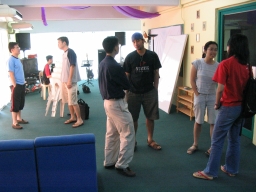

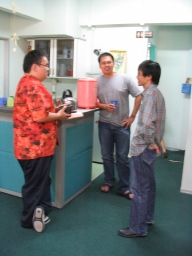
Usually the "lingering" conversations are very valuable and suprising.
After that some of us "sold out" and went to the Burger King next door for lunch and continued until around 3pm.
 (covers intuition, feelings and emotions)
I felt happy that we had some new people today. and there were some fun bits here and there ... like an imaginary "bell" as a jargon buster for some of us when we ramble with words (we assume people know). Another "bell" to remind us this is a safe place .. so say what you need to honestly.
I was moved to hear of stories on sacrifice and commitment and risk especially before the meeting officially started.
I felt genuine acceptance of people and some humour to help us hear less comfortable remarks. "Ting" this is a safe place!
There was a sense that ideas can be experimented. Complaints are ok-lah! Frustration with abuse of the past and how our histories affected us were evident.
I mentioned if we called ourselves "Rumah Goreng Pisang" whether we would be noticed.... we all laughed!

(covers judgment and caution)
- we need to be cautious of expecting more on others than ourselves and begin working on baby steps in our own spheres of influence.
- we need to be watchful of not "negating" the good even in models or approaches we are no longer comfortable with or see no relevance
- there may be a lack of confidence at times and a sense of so what can we do?
- we lacked time for the small groups to REALLY work .. time was a factor.
 (covers the logical positive)
I think having some guide or "agenda" was good ... we covered quite a wide range of issues.
The "selling out" lunch was good for further more informal conversations.
 (covers creativity, alternatives, proposals, what is interesting, provocations and changes.)
- how about a "agenda-less" meeting?
- what about a safe place for "pastors?
- the "jargon buster" was REALLY a great idea.
- Keeping a "head, heart, hands" paradigm will make us work on areas we may neglecy.
 (covers the overview or process)
Building on current events we participated allowed for some immediacy and relevance for the conversation. Furthermore these were close to heart Malaysan issues. As always, I'm uncertain whether we "lost" the 1st time newcomers (or those who've just stumbled in) and perhaps will need to consider how they can be more "included". and yet, perhaps seeing some continuity from one meeting to another is important to build momentum and interest. Part of the effort to quickly jot down these notes today on the blog is to put things down while it's fresh not only in my thinking but also in the feeling! And many thanks to Jade and Alwyn for keeping pretty good notes on which I could use the 6 hats thinking tool to help to reflect on the meeting.
November 25, 2005
A Date with NECF Research Commission


*Updated: I respaced the paragraphs after realising how unpleasing to the eyes they are - the medium is the message*
Thanks to Alwyn for being the faster one to post his thoughts here on NECF-EMO Chat and David-hedonese sharing his feelings on That's Not 'Generous'...
I'll start by trying to work on a Disclaimer :-) first:
Disclaimer: The views on sivinkit.net do not represent the opinions or positions of Bangsar Lutheran Church, the Lutheran Church in Malaysia & Singapore or Emergent Malaysia. The views represented here are solely the personal views of the author. Please contact me via email at sivinkit@gmail.com if you have any problems with any of the content.
Now that wasnt too hard ...
And I shall begin with a story ...
Actually, I wanted to go and play frisbee during a break at the recent NECF Youth Workers Consultation 2005 but then I landed up in "conversation" with Siew Foong from the NECF Research Commission and we had a fruitful discussion on a wide variety of issues ranging from Brian Mclaren to the state of pastors in Malaysia, etc.
The next thing leads to the leads (in terms of emails) and we're sitting with the commission members for a nice cup of coffee having a in my opinion a stimulating dialogue (by the way I enjoyed the lunch conversations too where we talked about the latest craze on apostles - I'll leave that for another day).
Anyway, prior to the event on 16 November 2005, Saturday morning. I asked for some questions to spur the mind to focus a bit more ... and the following came back under the theme ""Church and Christian Living in the Postmodern World"":
"
1. What does it mean to be an authentic Christian/church?
2. What is the true role of self? Does right living means denial of self?
3. Is the Church being irrelevant?
4. should Christian conviction (belief) be secondary to compassion?
5. Does current theology restrict rather than free?
Came across the phrase 'postmodern Christian,' it may be referring to Christian living in the postmodern era, or Christian with postmodern ideas or something else, regardless what are the opportunities for evangelism and provisions for authentic Christian living in these pomo ideas? "
To start with we had some prelimary introductions (there were Alwyn, Kia Meng, Yew Khuen- the non-blogger- and myself from Emergent Malaysia - a informal network .. a young friend who claims to be a modernist came along to add spice!) and then trying to share how we landed up (or fumbled into) being called Emergent Malaysia. :-)
The facilitator felt we were spending a little too much time on "us" rather than what we thought and what were our concerns then we went into loads of free flow discussions revolving somewhat to the questions above.
I actually did a Mindmap of ideas but didn't manage to go through the, systematically as the conversations, back and forth clarifications and responsed were very dynamic. I think a lot centred on question 3 as we also tried to warp our minds around another question is how we viewed "Malaysian evangelicalism"?
Here are some areas and comments that surfaced in no particular order: (Someone/Another one = NECF commission or observer, one of us = take your guess who?, I = definateoly me .. I own up!) :
- Someone said that we didn't come with an agenda to sell anything or to provide solutions but just to share what's on our mind and how we are dealing with it. This is absolutely *grin* true ...
- Another one encouraged us by saying it's good to see younger folk wreslting with issues about being and doing church in our generation.
- One of us shared how the "gospel" he was introduced to left him dry and beign shown a wider vision of the "Gospel" (here names like NT Wright, and Jacques Ellul, and René Girard came in)
- someone noticed the words like "conversation", "missional", "praxis", "story" etc. that keep popping up and asked how does that relate to where we are and what we're doing.
- one of us talked about the "mode" of discourse and how we tend to favor a more "conversational" approach as opposed to a more top down lecture style and how that reflects the predisposition to listen first ...
- I was suprised when the name Pannenberg came into the discussion :-) Brian McLaren was mentioned less than 4 times, Dallas Willardat least once :-) Stanley Grenz a couple of times, Kevin Vanhoozer,/a> and Michael Horton definately at least once. Sneaked in Robert Jenson's name at the end when we are asked to widen our reading *grin* I think I mentioned Luther and Lesslie Newbigin here and there (maybe a little too much Luther from me until I had to do the Benediction!)
- At some points I felt that there were obvious differences in the way we view how we should look at the state of the Malaysian church especially when it related to the emerging younger generation. There was a sense of "us vs. them" where as I would have prefered (1) a more "we" approach (2) seeing the wider picture of our existing church cultures - from leaders to families, etc.
- I also shared my frustration with the lack of integration of theology, spirituality and ministry from the perspective of a pastor ... too much "talk" tends towards mere discussions on methodology.
- Someone asked whether the way we are questioning the status quo of popular youth ministry methods is abnormal and the majority actually don't even ask these questions.
- one of us shared .. at times we do feel alone .. but the there seem to be others who are on the same journey .. perhaps we are a minority (no stats to show for this one .. just a gut feeling)
- Someone gave affirmation that at least there are some among us who are "thinking" and "wrestling" with issues in a more reflective manner - and the Agora was mentioned side by side with Emergent Malaysia in the same sentance :-) .
- someone mentioned we shouldn't throw away the old language ... one of us replied we are not ...
- one of us talked about the need for propositions and not denying it but seek to see and present how the story is encoded in the proposition.
- one of us talked about theological boundaries and then the centred set and bounded set terminology cropped in a little.
- one of us talked about how the "gospel" could be misused to oppress ..
- Someone mentioned the threats we are facing increasingly these days and talked about urgency.
- one of us :-) tried to bringout the difference between a sentence and proposition.
- Someone highlighted the effects of modernity and how he's come through bruised and tired of modernity.
- one of us mentioned the consumerism we see in the church today.
- Someone clarified that ours is a cultural critic.
- I shared how as a pastor I operate with a variety of languages ... and different levels of discussion and even though I enjoy times like this where stimulating back and forth conversations which as more than one syllable words come up .. most of the time while being aware of this I talk more "normally" in a church setting. I think I mention Francis Schaeffer somewhere here.
- we mentioned postmodernity in passing here and there but interestingly and thankfully (IMHO) it wasn't the main thing in our discussion.
- there was talk about the Gospel being embodied, there was also talk on how we "perform" the Gospel, there was mention of the wider catergory of "witness" in relation to "evangellsm"
- one of us shared on how many sermons in the pulpit has little relevance to the week from Monday to Saturday. Or often being good at work is merely a means to hook others to Jesus by having a change to "evangelize"
- Someone mentioned I may not be able to find a job in a megachurch (and that was a compliment!) hehehe
- There's lots more ... I'm getting a little tired typing.
Overall, i felt it was a good meeting ... and there were very encouraging affirmations from all quarters. The facilitator congratulated the research commission for their best behaviour (I wonder why?). As for me, I think those of us who so called represented "emergent malaysia" did well in honestly sharing our thoughts.
It was a nice date... there was laughter, some heightened excitement here and ther, some flatter moments where patience was required, there was a genuine effort to listen and understand, some good moments where thoughts and concerns connected, other times we flew by each other ... after being in a variety of settings in my personal experience this was one of the more memorable ones I've been part of.
after that, a decent lunch ... and some extra overflow of conversations (as usual) nice to catch up with old friends and new.
Nothing fancy ... I think we might have some "dates" in future maybe in different forms and different ways.
Another "eMo" Meeting ...TOMORROW!
as you can see we're very much trying to get organized *grin*
Date: Saturday 26 November 2005
Time: 10am-12pm
Venue: 43 Meazzanine Floor SS2/64 47300 P.J
(It is in SS2. Same row as Salvation and Evangel. Just one floor up from the
England Optical outlet. )
For those who are not sure how to go call me at 013-3507246
Topic: Emerging Concerns & Possible Solutions in Malaysian Christianity
(our focus is to pay attention a little bit more on what's happenign in our country socio-political-economic wise... and how Christians are responding at different levels - of course our focus will be back on the personal and local church level for starters)
This topic will be based on some reports from
- simple report on the recent CFM conference (Sivin)
- some interaction between some of us with the NECF Research commission (Kia Meng & Alwyn)
that would be at least 60minutes worth of stuff to be introduced to. and then we'll have smaller group discussions. and have some practical ideas sharing that would take another 45minutes then eat!.
November 24, 2005
Emergent snack!
Movable Theoblogical: AuthenticChurch Archives
"WE ARE CULTURAL ADDICTS AND WE CANNOT BREAK THIS ADDICTION ALONE" .. not strictly emergent but ... I need to read these posts .. keeps important things in perspective!
something different thanks to Prodigal Kiwi(s) Blog
How Can We Sing the Lord’s Song in a Strange Land?
"There are two other main options for Christianity faced with the secularising, pluralising challenges of late modernity. These are deductive and reductive options. Deductive options tend to be the conservative ones, turning to tradition and scripture and away from today’s cultural agenda, while reductive options are the more liberal ones, trimming the content and expression of faith in fidelity to today’s culture"
The Emerging Church: Mature, Mystical and Militant
"Today’s forms of these deductive and reductive approaches are evident in the (equally) post-modern options of fundamentalism (everything is deduced from a certain reading of scripture) and thoroughgoing liberalism (everything is reduced to fit culturally-subservient needs and expectations of the moment). Beyond fundamentalism and liberalism, however, lies a third way that Berger called inductive, involving a return to the roots of religious conviction, reclaiming the ancient core of Christian tradition in critical conversation with present-day realities—restoring, re-invigorating, re-inventing."
Liturgy: Secret Weapon of the Emerging Church
"If the Church’s aim is to establish a Christian world-view in the face of post-Christian culture, the resources provided by this universal cultural fact of ritual transformation and symbolic reinforcement should not be dismissed. Liturgy as a drama of world-making serves as a carrier of this ‘new creation’, where a congregation tells again the story of God’s universal purposes made concrete and personal in Jesus, liberating the worshipper and empowering an embodiment of that vision as the assembly departs ‘to love and serve the Lord’."
Best Book on the Emerging Church
Let's see which Malaysian bookstore is the fastest to bring this in ... on your mark - get set - GO!
Facing Opposition: An Open Letter to Emergent Christians
It's been a while since I got an hand written letter ... I havent written an Open letter before ... perhaps I should (on other matters of course!)
November 20, 2005
Emergent Supper
Emerging Church/Theological Education Caucus Audio
Thanks to Adam Cleaveland for making this available ... I'm downloading away!
Loyal radicals
Great summary and notes. These words from Karen Ward struck me as she shares on how their congregation relates to the denomination as a whole --> “Emergent leaders in the ELCA talk about relating to our denomination as the mothership,” she said. “We emergent leaders are a dinghy brigade. We’re totally in relationship to the mothership, but we’ve jumped into the water,” not jumping ship but “going overboard to explore the missional culture.
“We’re loyal rebels. We like splashing around in the water but we also go on deck and report to the captain. We don’t want the ship to run aground. We see ourselves as scouts. And the mothership is beginning to take the reports from the field seriously.”"”
Martin Luther: Emerging?
Now let's take out the beer and celebrate!
Emerging Church and the Holy Spirit [1], [2], [3]
Kester's challenge is well taken ..."I want to propose that we need to radically re-imagine our language of the Spirit. It is unfortunate that the charismatic wing of the Church have hijacked the concept of the Spirit and taken it hostage to the power-evangelism agenda... It seems that one cannot talk about the gifts of the Spirit without it being taken as meaning healing, speaking in tongues, prophecy etc."
Holy Spirit in the Emerging Culture & Church
Good to follow a concrete response to the issue at hand ...
Emerging Church Critics (Updated)
Thanks to Andrew Jones for updating us with those who aren't too excited about stuff relating to "emerging" and more specifically "emergent".
November 12, 2005
Emergent Stirrings!
Ethnic Diversity Within the Church That Is Emerging
So this is not just "for white guys with two books under the arm and a budget to travel around to conferences. " :-) I've more than 2 books, and I don't have much of a budget to travel around (I'm usually dependent on sponsors!) Any, I like Rudy's piece partly because he put me on the list! ... BUt more so because I agree with him when he says ""Why did Rudy go and put me on this list?" They all fit the bill because they are discussing, or re-examining, ways of doing and being church in a manner that resonate with the broader emerging church conversation, even if some might not agree with the direction of particular theological discussions." So even though, I can't say there's an "emerging movement" (to use Prof. Scot's term) in Malaysia (I may be wrong) but I think there's are some "unemerged" conversations emerging :-)
Talkin’ with Tony Jones about Postmodern Ministry
I think the discussion on the word "Postmodern" is getting more refined but what's caught my attention was the little comment on seminary education, i.e. "Tony hopes that a new seminary education will emerge that will replace the Germanic research university model of education and the "theological encyclopedia" division of studies (biblical studies/systematic theology/church history/practical theology) that we now have. He also wants to see seminary education done at the local level—as students are doing ministry and immediately applying their education in the transformation of the world and the lives of the people to whom they minister." As one who's participating in a curriculum review at a local seminary as well as attempting to "catalize" or "midwife" my onw denominational lay leaders training programme .. these thoughts are relevant and resonate.
Scot McKnight on the Emerging Church
Bob does us a great service by providing a synopsis of Prof. Scot's insights. I'll pick out some glaring points for me .. with some mini feedback relating to Malaysia.
"... One of the reasons so many are frustrated with the Emerging Movement’s definition is found here: it is a movement concerned with praxis and not simply theology. If the older fashion was to define others by their theology, the Emerging Movement wants to be defined by its behavior. This is a dramatic challenge to the Church.
In Malaysia, I see a tension here ... I think there some good praxis already (e.g. there aren't too many fiery debates over doctrine because we're all busy doing ministry) and to compliment churches who are doing well in this area there's a need to strengthen the reflective part together
So, as EM reacts or responds to emphasize praxis in the USA for example, we might see a healthy convergence in the constructive efforts we are all seeking to head to!
"... Fifth, it wants individualism absorbed into incorporation: that is, the Emerging Movement encourages personal redemption but solo-Christianity is not what Jesus wants. He wants to form communities of faith not individual Christians.
I think we have a good "potential" environment in some of our churches in this area with many already emphasing small groups and social concerns (and increasingly more dialogue and conversations on beyond personal issues like national concerns) in one form or another ... however, our challenge lies in how to reform our paradigms and theological catergories because much of our "talk" is still very individualistic especially at the grass root level or even at the local church leadership level (still having the debris of pop evangelicalism blown here to our shores?) I hear "vibrations" of disatisfaction with solo Christianity here and there .. but it's not wider spread yet *help us Lord!*
"Sixth, the Emerging Movement’s mindset is against marketing the gospel.
This is one of the key reasons that drew me to this whole conversation in the first place. I'm sick and tired of "marketing" the gospel ... I've STOPPEd going "some seminars or meetings that provide "solve all your problems" solutions and I've STOPPED easily falling prey to empty promises (or prophecies). I'm not anti-business and I appreciate those who work under the category "marketing" but it's when the work of the kingdom is distracted that's what upsets me.
"Seventh, the Emerging Movement despises the idea that Church is what takes place on Sunday Morning...the work of the Church is what occurs during the week as the local community of faith performs the gospel.
I think for me there's a balance here. I agree with the main thesis of this statement. And I've been advocating this view and hope people see how their Monday to Saturday is valuble in God's sight and meaninful in God's mission. The reality is sometimes, at least in Urban centres and amongst young adults they are sucked into a "work culture" that tires them out from even thinking about performing the gospel. so, though Sunday Corporate Worship (or whatever day) is not where all the work of the Church (i.e. people of God) occurs, it's still IMHO a "means of grace" to recollect our corporate conscioussness that God is at work and there's a place of worship (and simply gathering together is a counter cultural or cross cultural witness - The Muslims gather on Friday, the Hindu's either weekly or specific festivals, now the Buddhist resurgence too has weekly Dharma meetings) so we need to not so much of forsake meetings - but focus them and turn them from barriers to bridges of God's grace, and not a burden but truly a blessing so we can go in the world and to the work of the church!
so, let's stop debating whether we should have or don't have a worship service on sunday or any other day. Let's not get revolve ourselves around whether we have to or don't have to "go to church". Let's talk about what REALLY matters - i.s. what and who is this church? and how can we participate with otehr believers to embody the gospel, express it and engage our worlds as a group (beyond individual efforts). where there's existing structures we could fully participate in let's faithfully get involved, where there isn't perhaps we could initiate new ways.
"... I am pleading with the critics of the Emerging Movement to accept that not all Emerging folks are hard or even soft postmodernists. To equate Emerging folk with postmodernism and to say that postmodernists deny truth so therefore the Emerging folk deny truth is unfair, libelous, and scandalous to how Christians ought to operate with one another...
...only God is Absolute Truth and all our articulations of truth partake, to one degree or another, in that Truth but our articulations do not strike home as as full grasp of Absolute Truth. Only God is Absolute Truth and only God can genuinely know Absolute Truth. All our knowledge is tinged. To assign Absolute Truth to God alone does not ruin our confidence, it just means that our confidence is in God."
I'm also growing tired of the warings of the slippery slope of relativism (though I appreciate it) when the discussion is being framed in new categories and terms which allow for more fruitful forward interaction rather than retreating to age old battle lines.
What''s important is God is in the picture ... and truth is not "left behind."
"... First, the EM is pro-missional in thrust. The term “missional” is a favorite among many in the EM because it goes beyond the older Christian terms like “mission” and “missionary,” and because it is being defined holistically. To be missional means to embrace a holistic gospel – it is for the whole person (heart, soul, mind, and strength), for the whole society (politics, economy, culture, environment), and for the whole world.
Before the word "emergent" became part of my vocabulary, I was captured by the word "Missional". JOhn 20:21 is kind of my life verse. I find it helpful to intergrate many "dichotomies" e.g. evangelism/social justice, marketplace/family, theology/praxis, ministry/spirituality, institutional church/parachurch, leadership/servanthood, etc.
There's many emphasis in town these days on single issues above, and are all helpful. But as a Christian and local church pastor, the word "missional" helps me relate them to each other and connect them into a wider framework.
"... Second, the EM is pro-Jesus. (Reformational) theology is often abstract, systematic, and rooted in logic and reason. The EM wants to root its theology, which is more practical than it is theoretical, in the incarnate life of Jesus himself. It wants a theology that is shaped by personhood and relationship rather than just rationality and systemic thinking. (Let’s not use simplistic dichotomies; instead, this is an issue of emphasis.)"
as one who has drank deeply in the Charismatic/pentecostal stream in Malaysia, and also growing to appreciate how the understanding of the Spirit is also more inclusive then I'd imagine. I'm still drawn back to Christ as the center of my mind, manner and ministry. I'm kept on the ground to the down to earth realities and also challenged in expressing my love for God and others in concrete ways.
"... Third, the EM is pro-Church. It is not ecumenical in the classical sense of the Ecumenical Movement, which was set on a course of finding a doctrinal basis among sets of Christians who could not agree, but in the sense of being missionally focused. Because it is missionally focused, it finds it much easier to cooperate with other Christians with a similar missional focus and to cooperate with other Christians because its own theological agendas are less central...It is also pro-Church in that the Church is designed to be a community. "
This reminds me I need to kick myself to get my MTheol work stared "visibly" not virtually! I think I'll be working these thoughts in detail there.
(at the mean time I too highly recommend that we read Scot's posts in detail)
October 31, 2005
Emergent latest ...
An Interview with Scot McKnight
Hey thanks Scot … I saw a familiar name in the interview :-)
How Emergent Are You? McLaren's Seven Layers of the Emergent Conversation
Layers makes it sound like some onion … I like onions! I’m getting hungry …
James Macdonald and Emergent
Caricatures tend to distract us from the real people we are engaging ... hmm ... I know it works both ways.
Blog-debating
I've been a little out of touch with the debate ... but eavesdropping here helps clarify what's going on ... the following is pretty good, "Because emerging is neither neo-orthodox nor neo-liberal, and not even simply old-fashioned evangelicalism, it will have features from each of the movements behind it — including (God be thanked) classical creedal Christianity. The frustration of many in trying to define it is, in my judgment, the fault in part of emerging itself for it is both in process and unwilling to let itself be defined by a theological system.
Instead, it seeks to be faithful to the summons of Jesus to live as followers of Jesus, to live out the Kingdom in everything we do and say, and to let the chips fall where they may."
Emerging Solutions—and Problems
Prof. Gibbs words here are worth a pause, “… in a post-Christian and increasingly neo-pagan society, people need to see the gospel in action and to be included. Thus they will experience the impact of the message as part of coming to believe. The distinction between Carson and emergent leaders may lie in the difference between the faith as a "bounded" set, one that defines who is inside and who is outside, and a "centered" set, which is more concerned with the direction in which people are traveling, toward or away from Christ.”
A Brief Snapshot of the Emerging Church
Interesting ..
September 28, 2005
More from eMo meeting ...
I realize that many have not yet been initiated "carefully" into the subject of modernity and postmodernity in our Malaysian context (as well as what all this means to us) ... this is so true after observing and listening to some reaction at a session in the latest youth consultation organized by NECF (more on this important consultation in another post) . It's still very fuzzy for many and even totally unknown. Hmm ....
after that in hindsight I think Alwyn did a pretty good job trying his best to communicate what he understood as he grappled with the word "postmodern" and all that surrounds it. Here's some of his powerpoint slides and extra thoughts on Mo vs Pomo?
"... Anyway, I'm pasting two of the slides presented at last weekend's EMO/Pomo meeting. I find such comparisons helpful, if a little far from exactly 'reality-depicting' i.e. it's only generally true and all thinkers of whatever stripes would have surely some bones to pick with at least some of the pairs.


As I mentioned during the session, the asterisk-ed items are those pomo elements I find particularly helpful/beneficial for church, spirituality, theology, etc. This is not to deny the value and extent of "modernity's" contribution, only to suggest that maybe in this 'new world' we're in, it may be wise to go beyond them."
I'm glad that Kevin (a first time new comer for a meeting) gives us a feel of his impressions and feedback from this post My First EMO Meeting!
"So finally I become a participant… Well, still not really a participant! I was more trying to listen and see what I could learn from it rather than sharing my thoughts and views (not that I had much to say anyway, knowing nothing much about philosophy or postmodernism). I’m a little too shy for that! Plus, having all those pastors and seminary students around were quite intimidating for a first timer layman like me! But it was good to finally meet up with some of those bloggers in person! I also learned a few things about modernity and post-modernity, especially on their respective histories and contexts in which they came about.
One thing that really struck me was how the discussion would always be dragged back into our own context and practice as Christians here in Malaysia. Someone would always remind the group, “How do we apply that here?” or “How will that affect us?” I think this is a good way to go about these discussions, because they are always in danger of becoming detached from Christian praxis, or from our own Malaysian context (both of which I have been guilty of countless times in some of the discussions that I’ve been in!). It’s good to see Pastor Sivin and Emergent Malaysia moving towards that direction. I'm looking forward to the discussion on post-colonialism.
September 26, 2005
After "Mo-Pomo" eMo Meeting thoughts ...

(is there something subversive about this picture? *just in case some are wondering ... I'll note the Cross is still central ... grin*)
I'm not sure whether I'll have time to blog about a fruitful feeble attempt we tried last saturday at the emergent Malaysia open (eMo) meeting. so I'll let one of the presenters Alway share from Henry IV, Leaves & JFK
"I think the EMO session on Saturday was helpful to everyone. Whilst there was maybe some slight discomfort with the postmodern-oriented deliveries and 'agendas' (smile) of both Kia Meng and me, I think people generally brought home a richer perspective of post-modernity, its context, its implications, some misunderstandings of it and one or two ways the Church can 'milk it' for the kingdom. (Of nice added value was perhaps the fact that our EMO venue was also used as a trading-point for book enthusiasts, a 'den of wisdom' as Sivin strategically phrased it, hehe).
Some of the words post-modernity sparked in the participants are worth recalling: "Duh?", "Huh?" Yes. Very pomo: conceptually vague, but spot-on in 'embodying' the favour/mood/spirit of people!
I certainly benefited from Kia Meng's introduction to the historical events surrounding Descarte's (the 'big-time' philosopher who dominates many an elementary Maths textbook!) thoughts, Henry IV's preceding reforms and the impact of his conspiracy-soaked death. I confess I'm a nut in matters of medieval European history. Thanks, Kia Meng, for showing its link to "I am thinking, there I exist" (and for correcting the more popular, "I think, therefore I am" - he also noted how D.A. Carson today's society as one built around, "I shop, therefore I am"!).
Minor tension arose around Kia Meng's expressed rejection of the Basic Life program. But I think we can hold together both the value of a Western program transplated/imported to the East its occasionally uncritical use by over-enthusiastic (but no less God-loving) practitioners.
General principles are probably indispensable in our world and Church, but caution is needed to avoid blanking out completely the differences and individual uniqueness among and of particulars.
I'm glad Kia Meng highlighted this as it was then easier for me to explain Nietzsche's gripe with thinking during his time. The concept of a 'leaf' violates all leaves. And if our Basel professor had a problem with that, imagine his quarrel with the categorisation and 'grouping together' of ideas like God, Man, Society, Knowledge, etc.
My session was a blur to me (as it usually is whenever I 'evaluate' my own presentations). Most people looked as if they understood(!), but I didn't get many questions and I had to leave early so I couldn't quite gauge how most people felt.
I hope, at least, the books I put on the slide were helpful. Maybe I'll try to get an outline out soon. (Those interested to see the outline of my Hell talk can find it here).
Lots of work needed, surely, to reap spiritual fruit from these exchanges. The main issue is whether or not we live in a substantially 'new' world from that mainly characterized by modernity, what this new world considers important, worthy of attention, how this new world thinks, lives, feels, etc. and whether our former approaches need to be rethought and even replaced. Sivin and Yew Khuen's responses cum rejoinders to me and Kia Meng focused, if I'm not wrong, on the need to reconsider how and why we do what we do, in light of the whole pomo debate, whilst giving full credit to the contributions modernity has bestowed (and continue to bestow) on us.
Looking at my students, my church, my community (even in 2nd-world Kuala Lumpur), I certainly think the time is ripe for a new paradigm of truth and life (sorry if this sounds corny, summaries always do, don't they?!).
And if you're STILL wondering what the JFK pic is doing there, well, watch the movie and ask yourself: Is it a 'motion picture' or a documentary or what? Is it truth or fiction or some kind of hybrid? And, most importantly, do these distinctions matter?
Okay. There's a multi-player Half Life session going on around me. Time to party (grin)."
A new comer college student Doulos had these interesting to say from pomo which has an insightful twist at the last sentance ...
"Went to BLC today to listen to a discussion organized by the Emergent conversation of Malaysia headed by Ps.Sivin Kit. The topic was on Modernity, Postmodernity and what it means in Malaysia. More than two hours of hard stuff I must say. Understanding history and culture is important and I must say I got out of the session much more enlightened. Postmodernism is a very engaging topic. Introduced to this word in the beginning of the year and it continues to grab my interest. The only problem is that I have not fully understood what is modernity. So I will turn backwards a bit. hehe"
more when I can sqeeze some time ... I'm off to Genting at 12noon .. very little time.
September 20, 2005
Post Mooncake "EMO" meeting

When I mentioned "EMO" in a recent meeting with a bunch of varsity students I heard some "Aws" and "Ahs" :-) so when i realized what we've been calling our emergent malaysia open meetings can be called EMO meetings I thought that would be fun. But seriously, the guy who works with the National Bank wrote the following (I think he does a better job):
__________________________________________________________________
Postmodern Investigations
What is postmodernity? Where does it come from? What has it got to do with the church & Christianity? How are we to respond? Some believe it is a scourge to be challenged at all cost. Others welcome it as an opportunity to engage with today's culture. Yet there are those who think it is the latest fad in a series of methods to increase church attendance.
If these are some questions that you've been thinking about, come on down and join us in exploring this theme and its possible implications on the how we view and live out our faith.
Date: Saturday 24 September 2005
Time: 10am-12pm
Venue: Bangsar Lutheran Church, 23 Jalan Abdullah, 59000 Kuala Lumpur.
(For a map to the venue: click here)
We will listen to some sharing on the following areas, after which there will a time of interaction and discussion:
- History of modernity & its development
- Reaction of the church to modernity
- History of postmodernity & its development
- Reaction of the church to postmodernity
- Responses on what does all this have to do with us (or doesn't have to do with us)
Organised by a bunch of friends known as emergent Malaysia :-)
(as you can see I had a hand in the last line on organisers)
__________________________________________________________________
we were discussing about since often people associate "emergent" with the word "postmodern" .. we might as well give it a try engage this topic ... it will be a feeble and honest attempt by a bunch of Malaysian Christians (admitting all biases right from the start *grin*)... I'm looking forward to listening to how Mr. Gmail Theology and Mr. Appreciate Coconut Tree can help us get started.
Hopefully next we can engage with the word "postcolonial" in November before Christmas ... Sherman and I will have a trial run at a local private university setting on this :-) I'll leave that for the next "EMO" meeting ...
September 17, 2005
The Conversation continues ...
“What is Emerging?: A Conversation about a New Kind of Church”
I've downloaded all the mp3s ... looks good .. I'm listening to Brian's talk now, glanced through the powerpoint of Dr. Mike Wittmer this afternoon while I was downloading the rest. Interesting.
Brian McLaren and the Emergent Conversation…
Steve Argue lists down the questions he used to facilitate a panel discussion .. good questions. I liked his brief summary of the event, "The conversation, in my estimation, was really a conversation rather than a debate. What I experienced were three people, passionate about the gospel of Jesus and the church sharing their dreams, concerns, and critiques. Something was communicated beyond the “presentations” … a message that Christians of all types can truly dialogue with one another. I hope that spills over into all corners of Jesus following communities."
McLaren, Wittmer, Dobson...
an insightful comment on the audience in contrast with the presenters, "Really? Is this what God has called pastoral brothers and sisters to be? We are either for or against one another based on the writings of McLaren, Dobson, and Wittmer? The frustrating irony was that these guys were not the people who were trying to drum up the ranks to choose sides. It seemed more like acid reflux. Some of those within the audience couldn't help themselves."
September 15, 2005
"Emerging" ... emerging again!

What Is The Emerging Church? (mp3)
Brian McLaren starts by saying why he doesn't like the term "The Emerging Church" (I like the emerging edge *grin*)... so it's not about church, it's about mission ... these two words (church & mission) came up in a conversation yesterday I had in my discussion about my Masters :-) it's good to hear what's more important - i.e. following Jesus! counting the cost ... losing our lives ... etc. I'm looking forward to following this series.
What is Emerging?
Here's an earlier attempt to try to put words into what's "vibrating" inside many ..."Do not be surprised if you discover the emergent conversation includes thoughts and feelings that have already occurred to you. Perhaps we forget that when we talk about “the” Reformation, there have been many reformations in the Christian church, and its nature is self-reflexive and committed to correction and renewal."
The Emerging Church circa 1970
Interesting to hear what the recent author of the book "The Emerging Church" Dan Kimball says here, "Emerging in 1970, or emerging in 2005. I hope we are more concerned about Jesus and His thoughts of our service to Him than anything else."
Emerging Movement
I'm still trying to catch up with Scot McKnight's profilic blogging and input. The recent "Purple Theology" posts are adding "colour" to the discussion.
AN EXPLORATION OF THE EMERGING CHURCH IN THE UNITED STATES: THE MISSIOLOGICAL INTENT AND POTENTIAL IMPLICATIONS FOR THE FUTURE (pdf)
some hard work went into this ... thanks Aaron!
Immersed in emerging
Interesting Aussie-in-USA immersion.
How is Emerging Church different?
a U.K point of view ...
The Emerging Church: Ancient Faith for a Postmodern world
"Emerging church evangelicals comfortably draw on the rich traditions and practices of the diverse streams of Christianity, believing that by genuinely living where our common faith intersects, we can surpass the efforts of even the most successful ecumenical programs." ... this comment came in 2004.
12 Tension Points in the Emerging Church
A good checklist to keep us on our toes ...
September 03, 2005
Catching Up with Emergent Stuff and more...
I haven't been posting a lot relating directly to the Emergent Conversation lately ... but I'm still catching up with the it myself after quite a busy few weeks :-)
Unraveling Emergent
here are some of Doug's phrases that caught my attention:
"As Christ-centered people, many of us understand the Gospel in terms of Jesus’ radical, profound, and expansive message of the kingdom of God. "
"Within many of us there is a desire for the Good News of Jesus to really be good news for the people of the world and not just the promise of a world to come."
"Emerging churches often speak of themselves as if they were a family where the love and commitment to one another is deep, meaningful and essential"
"More than seeing their role as setting forth a bold vision (mission statement) and asking God to bless it, we seek to join God in the work of the kingdom wherever it is found. "
"Emerging churches believe that friendships change people. They stress that Jesus welcomed the original disciples into a warm friendship with himself and one another. Through the centuries the church has been an extension of this friendship through space, time, and transition."
"Emerging churches are often vigilant in their assertion that what they are about is not merely changing the methods of their faith; they are seeking to be full theological communities. "
On Emergent
So it's more than just about relevance ... read on ... "... providing a space for the conversation is messy and feelings get hurt. But for the many youth pastors who suffer angst over what they are doing -- that it falls short, that there must be more than simply a relevant church service with a large stage, candles, painters going at it, tables, videos, and irreverent banter, Emergent provides hope. ... Emergent provides a place for these travelers to tell their stories, to deconstruct, and yes, eventually to reconstruct their faith. For those who listen carefully and long enough, it is not about Christians losing their faith, but finding it once again as well."
Knight Ridder Piece on the Emerging Church
Stephen is right on this, "I think I read once that when you are deeply involved in something and then the news media covers it, that you see how sometimes major news media miss the nuances." That's why second hand news even if it's in print (and especially if it's on the web) can be misleading ... but we need to rise above these weaknesses and limitations in media with mature discernment. After reading a news piece (or even a statement which troubles us), sending an email or giving a phonecall to clarify first before jumping into conclusions (or before fossilizing our views on others) isn't that hard nowadays isn't it?
Brian McLaren is the real thing...
Ryan Bolger does a good scan of Brian's books and shares his admiration for the man.
There's A Bigger Story: Brian Mclaren
Here's a cool quote, "one of the amazing things about the Bible is that it does not try to say, “Either choose our story or choose the other guys story.” What the Bible does again and again is it outflanks the competing stories and in some ways tries to redeem them."
McLaren: 'Finding the Right Words Is Difficult'
""I don't like the term 'emergent church,' " says the pastor of the non-denominational Cedar Ridge Community Church in the Washington, D.C. area. "It sort of sets up a division like there is this church or that church. I like to talk about an emergent conversation."" Now that's a fantastic opening which I fully say AMEN ! to ...
A Generous, not Suspicious, Orthodoxy
On A lot of people have trouble explaining or understanding what the emergent church is. (*note*: personally I'm still uncomfortable with the term "Emergent Church" here but Brian's reply is pretty consistent with the word "conversation"), "The reason people have trouble is because all of us have trouble with this. There is a lot of diversity of opinion about any issue you could raise. People feel I am being evasive when I say this, but a conversation is the best word for it. In a conversation you have people saying different things about the same thing. A statement, a counter-statement, a question, an answer. Everyone is not just saying the same thing, but they’re dealing with the same set of problems. And what the emergent conversation is about is people dealing with the problems of living in a post-colonial, postmodern, post-enlightenment and maybe post-denominational world."
and more ....
"It’s not just having conversations, but about practitioners who are trying things and talking about what’s working and not working and trying to tell one another about some advice about how to deal with this. So it’s people engaged in church ministry, working with the poor, working internationally, and that sort of thing. So we’re sharing in that practice of theology."
Who Has the Last Word? An Interview with Brian McLaren
This is an engaging interview ...
"Dan Knauss:
Does loving one another as Christians across confessional boundaries mean never discussing or taking seriously our differences, or even acknowledging they exist?
Brian McLaren:
I would never say this. My books are attempts to open up space for respectful dialogue about our differences. In fact, it is our differences that give us a lot to talk about. The key, it seems to me, is that we do so not as enemies but as brothers and sisters … and that we do so not in attack but in mutual edification."
August 26, 2005
Make the Emergent Founder Bishop!

what lies ahead for us as a denomination? how will the election go? who will be the new Bishop? how shall we play our part - in voicing as well as in voting our concerns. This is an important convention for us for it will mark our entry into a new phase of the corporate church life as Lutherans here in Malaysia. Will it be like the picture .. all clear ahead?
anyway, maybe that's why it was funny when I heard the statement, "make the emergent founder bishop" in the context of whether anything will happen further for as fas as the emergent malaysia conversation is concerned. First, I'm not sure whether the person saying it was refering to me, I suspect he was (anyway, I've never seen myself as a founder ... I just link people who are interested to talk - that's why someone asked me to change my blog title to Linking Park rather than a Garden). Secondly, I don't want to be Bishop ... there are people who are up the coming exciting elections! But, back to the subject matter ... "Emergent" again ... :-P
The word "Emergent" came up the last one week more than usual in some conversations at the camp in Seremban and today at Kairos Office. I think Brian is and has been wise to keep insisting the word "conversation" over movement or "emergent church" ... I had some opportunities at least to comment on how I see the conversation so far in USA and UK and more importantly in Malaysia.
I laughed when someone mentioned about the "emergent" view on a particular subject. Because even as the so called "coordinator" of the conversations here in Malaysia - I said I'm not aware of the view. At this stage, we are opening up space to work on how we could think about theology, spirituality and methodology in close relation to church and mission in a more integrated manner - so I don't see myself and my friends who are part of the emergent conversation (or any theological-spiritual-ministrial conversation) here in Malaysia hurrying too quickly to give an easy answer.
I think that if there is an emergent view or approach ... it's to first pause and re-examine the question, take seriously the context in which the question is asked, refer to historical resources, plunge back into the Gospel of Jesus, consider the way of Jesus, get back to the Scriptural narrative, ... intentionally working this through not just personally but also in community ... and of course, keeping in mind how all this will be for the good of the world - thus the missional dimension. Now that was a mouthful :-)
Today, I had a chance to clarify my own thinking even as I tried to "tell my story" how I landed into the emergent conversation especially with friends in USA and UK specifically. And I think I've been consistent in this right from the beginning that I DO NOT see "Emergent" as a kind of "we here to come to save the day" - church movement. I don't even tell people the church I'm pastoring is a sample of an Emergent Church (as if it's a new brand). With Kia Meng also part of the conversation, in fact much of what we are talking or in "conversation" at our level has already been in discussion perhaps in some academic or theological discussions in the past. So, nothing is new ... but it's new to us and we're enjoying it and find it helpful :-)
Being part of this "conversation" no doubt has helped me see things clearer as far as what's important to me personally, and corporately as a church, and it's helped me think in more integrated terms. I find myself also enriched by the interaction - sharpened in some aspects and softened in other aspects especially when I'm quick to make judgement. So, I do find some relation there to how I serve and lead and wrestle with all things church and mission in my specific context.
and in addition to that ... haging around those in the "conversation" helps me to intentionally keep the rhythm of how theology, spirituality, and ministry dances in my journey.
So as far as I know, for those who are looking for an "emergent" church (as a kind of special brand) in Malaysia I think will be disappointed. But, if you are looking for a bunch of freinds who enjoy engaging in theological reflection which is not divorced from ethical and ministry realities and hoping to do all this with an authentic spirituality ... then, I think and I hope they would find that in the so called "emergent conversation"-Malaysian style. And if you are interested ... let me know.
Oh yeah ... notice ... that I have not been mentioned "postmodern" until now :-). I can start with "postcolonial":-P ... but then ... we're all still in the beginning stages of seeing how this journey can be a source of encouragement for those who want be a bit more conscious in our thinking and intentional in our efforts and more integrated in our approach. I think there is a road ahead ... more details after the elections ...
August 13, 2005
Introducing : The Postmodern Postmortem
My good friend Sherman has been blogging away until I need to wait for Monday to catch up and engage in conversation with him from my side ... this series of blogs has been insightful. I'll pick out some statements that jump out for me .. read the rest for yourself. I hope to "interact" with him more in the coming days ... at least Sunday evening ...this "post-colonial" approach/frame looks like a good path to go my smarter friend (you can put up the doggie pictures as intervals!) ...
*UPDATE: for a condensed version check The Postmodern Postmortem (An Asian Construction of a Generous Orthodoxy)*
The Postmodern Postmortem (Part 1)
"So there is much conversation taking place in matters pertaining to postmodernity and its host of variant expressions. But what does this mean for us, people of Asia? Do we have a postmodernity of which to speak? My take on this issue is that we have no postmodernity.
In the first place, we possess no firsthand historical reality of the Enlightenment, and therefore, no modernity. The modernity we do have is that which has been swept onto our shores as a result of the colonial era. What we have is, as it were, the debris of modernity. And even so, this debris has mutated over the past decades as it took root in the local context. And yes, the onus is upon Asian Christians to delineate our own understanding of our local modernities..."
The Postmodern Postmortem (Part 2)
"... The colonial period lasted for several centuries, duringwhich the economic, political and religious impact on local soil constituted the defining reference points for the colonised locals. As was to be expected, Western Christianity took root in the same manner. And thus was the commencement of organised Christianity on local ground in the replicated manner of the traditional Western ecclesiastical life. It was no surprise that after a prolonged period of its existence, the people of the land could not identify with Western Christianity. This is not to say that the Church failed to grow. Far from it, many were drawn to the gospel; but together with that, they were also obligated to embrace the cultural imperatives of the imperialists. Also, there were many others who declined to accept “the faith of the white man”. .."
The Postmodern Postmortem (Part 3)
"... am not talking about a simple repackaging of the Western gospel to give it an Asian face. If theology is the language of the Christian community, then Western theology (with all its rationally constructed categories) is the language of the Western Christian community. If so, I am in effect proposing the construction of a theological language that emerges from the Asian Christian community..."
The Postmodern Postmortem (Part 4)
"... I cannot emphasise enough the case for which I am arguing above – that our struggle is a post-colonial one, and not a postmodern one. In my mind, even a marginal deviation from this emphasis poses the unfortunate prospect of a digression in my efforts. And because our struggle is not postmodernity but post-colonialism, we are not herein reckoning with the tension between theological liberalism and theological orthodoxy as is the case in the West. In fact, such an insignificantly marginal segment of the Christian community here is theologically unorthodox that their presence poses almost no concern to the rest of the community. Our battle is, however, against the unthinking Evangelical imperialism which suffocates the prospect of authentic expression in our Asian Christianity. It locks theology up within the confines of Western cultural realities. This cultural imperialism, as I have mentioned, has shifted from high-culture imperialism to low-culture imperialism. We are therefore endeavouring to emerge with a “generous orthodoxy” of another kind..."
The Postmodern Postmortem (Part 5)
"... Perhaps attempting to develop new Asian theological categories does not necessitate a rejection of Western theological categories after all. It just requires that I move beyond such familiar categories. Just because I seek to move beyond Western theological categories does not mean that I am herein rejecting the propositional and confessional claims of Western Christianity...."
Clearer ...



Here's a progression of "Haze-related" pictures from yesterday morning, to yesterday evening, to this morning which is much clearer and better :-) Both Gareth and I are feeling much better too ... he still with a slight cough, my headaches gone and no longer sneezing ...
Perhaps I could relate this a little to my reading of some "stirrings" that surround the writings of Brian McLaren, especially when i read some blogs or comments even by more "heavy weight" Christian personalities. Again and again I found it strange that why is it that I don't see what they see especially at some point a claim that Brian has "abandoned the Gospel"? Ok .. perhaps I'm biased, or I could be blinded ... but then, if we are honest .. maybe just maybe he's really being misunderstood ...
So, that's why I appreciated Brian's Becoming Convergent Series Part 1, part 2 and part 3 (here's all thre combined pdf form). Hopefully, it gives most people who may have not read his writings in full (especially his earlier two excellent books on church, and finding faith), or bits and pieces here (usually without sufficient context), or just what they get online (in article form) to get a "clearer" picture as opposed to a "fictional" or "straw man" character from our imagination or others. Of course, some may still hold on to their conclusions and/or opinions. That's just reality.
I've been very slow to be drawn into this matter. This is partly to avoid abusive comments - I must admit I got shocked and tired by what went on the emergent-us blog. I further didn't want to be sucked into tiring debates which I see little relevance for us here. And this is definately not about whether one agrees with all the details of his writings ... and not whether one agrees with his critics in total ... which nowadays has become quite a "hazy" situation.
As far as I'm concerned, I'll just echo Scot McKNight's Thank You Brian --> "All I want to say is this. Brian, I am grateful for what you have done to me and for Evangelicalism. I see your work to be rhetorical wake-up for Evangelicals to start thinking about how to become a missional community for the world in which we live. Even when I disagree with you, I am glad you have brought up the issues you raise." and John Fyre's Getting to Know Brian McLaren --> "I am grateful that Brian McLaren took the time to tell his story. I consider Brian a pastoral artist; a creative, story-telling evangelist who is passionate about the "good news" of Jesus Christ truly sounding like good news to the ever-increasing postmodern West.".
I think at least in Malaysia we can learn from someone like Brian and I would also add learn from people like Scott and John (in their generous responses). Of course, we can learn from those who disagree with them or us. Too often, we are tempted to operate with a "guilt by association" mentality which makes situations even more "hazy". And this is the case not just about Brian McLaren or whatever that's linked with "emergent" (which for me is very much still a "conversation" first and foremost!) ... we need to move beyond face-less (often devoid of relationships) kind of engagements. In short, are we growing up as Christians in the way we handle theological conversations/investigations or more immediately pastoral or ministry situations as a group of post-colonial Malaysian Christians?
In addition to the above, we still wrestle with "uncritically" jumping on the latest "trendy bandwagon" whether it's so called church growth or revival-promised movement or we usually in fear or combate mode (depending) retreat into a "fortress" mentality with our so called perceived "safety modes" (or "defensive" postures) and miss the beautiful scenary and open possibilities of doing our own contextual, creative and constructive work of thinking, being and doing. Is there risk involved? Sure! Are there dangers? No doubt about it. What about the opportunities? Just open your eyes to see, and ears to hear ... but all our endeavour aren't just individual exercises - there's more to just our individual questioning or search.
I prayed for rain and wind during these past few hazy days - especially when it became hazardous. Yesterday morning it rained a little - I jumped for joy, then paused when it stopped raining. Later, I could feel the wind blow gently and took some photos of trees swaying a little ... there was hope. I'm reminded of two signicant metaphors for the Spirit in Scriptures - rain and wind. Perhaps in days like this ... we can have a greater confidence and trust in the work of the Spirit guiding us in community through immersing ourselves in God's story in scripture (and understanding ourselves backward in history) - to live forward increasingly clearer day by day in our present day context - surely for the benefit of our worlds and the world. That's my prayer especially for those of us here in Malaysian church and of course, beyond.
July 25, 2005
Emergent Latest ...
Review Written by Paul Harrison
The last two reviews in this amazon page really brings a further twist to this story ... (via Dashhouse)
"What I can say about McLaren and what he taught of the past few days is that he believes in the authrotiy of Scriptures and that they are true. Our interpretations, however, may not always be. A woman asked, "How is someone saved or born again?" McLaren answered, "Through grace, by faith, plus nothing." He gave a clear presentation of the trinity, a clear presentation of the deity and lordship of Jesus and the importance of being His disciple as opposed to being just a "convert."
He spoke cleary against relativism and defended the concept of truth being known, and I can honestly say I didn't get one red flag from anything he taught in those six hours. His position on homosexuality was that it is not accepted as a biblically valid lifestyle, but that we are still to love and embrace them in community with us. His position on "belonging before believing" was clearly that we are inviting people to follow Christ and know Him by doing what he says. There is a distinct difference between those who are saved and those who are not yet, but the seekers are invited to walk in the way of Christ with us to see that He is Truth. They can then receive Him and make Him Lord. He by no means taught that people are saved by following Jesus as a guru, but must make a confession to receive Him. "
Reviews Written by B. Mclaren
A statement like this, "
I didn't want Dr. Carson to be misrepresented by the other review on this page." has made me wonder whether others have offered Brian the same grace ... "straw men" are easier to get upset with ... "real men" now that's a different matter. "Straw men" don't post reviews on other people's reviews. Fascinating development :-)
D.A. Carson and the Australians
I found it helpful to see how the "dialogue" in the comments progressed (my contributions were minimal)... there's REALLY a lot of dynamism in this conversation.
The Emerging Church, Part One
The Emerging Church, Part Two
Although this is more "focused" on the USA context, it's a good and useful intro to the subject matter, what are the issues raised, the concerns that have emerged, the criticisms, and the hints of the way forward ... The interview transcripts are really the gems in these two pieces.
I hope to "enter into conversation" with some of the content the next few days ... I'm not much into offering "critique" (though there's a place for that), I found that I enjoy engaging in "conversation" what energizes me more :-)
Responses to Recent Criticisms
the link starts with saying, "Dr. D. A. Carson has written a critical review of emergent, and of my work in particular. Dr. Al Mohler and others have praised and quoted Carson's book in reviews and articles of their own. Unfortunately, in a number of ways their reviews misrepresent and misjudge my writings, thinking, and beliefs - and those of my friends." How do we respond when another person considers themselves being misrepresented and misjudged? This does not mean there can be no disagreement but how can we better "represent another" even if we disagree? In more than 40 email exchanges with a friend on a number of important issues of faith, theology and ministry in the Malaysian context ... I'm learning how this is ACTUALLY possible ...
Rick's plan to study the "emerging church"
wow! there's someone actually having a Sabbathical to do this? Richard Laribee has a blog that describes his thoughts as he visits "emerging churches" (I was really delighted to stumble on to his blog and thoughts).The following comments struck me ... if I replace the words "postmodern world" with "the context we live in today" or "21st century Malaysia" it's still applicable. This is basic "missionary" thinking.
" I think the question at hand is not about "postmodern Christianity." Christianity should not be considered ancient, medieval, modern, or postmodern. God became human and spoke with a Galilean accent, ate Galilean cooking, sang Galilean songs, danced Galilean dances, and laughed at Galilean jokes. The incarnation was within a particular historical and cultural context. But never have I thought that to "become like Christ" was to become Galilean. So I think it is with the Church and culture. The medieval Church would live and serve within a medieval world, clothed in medieval clothing and speaking with a medieval accent. Particularization requires contextualization. But to lose its medievalness when it modernized was not intrinsically a loss of anything eternal or essential. Always we wrestle with what is essential and what is coincidental. Always we will live and move within a culture, but it is in God that we live and move and have our being. It is not readily apparent which is which. So the question is not about how Christianity will become postmodern or resist postmodernism, but rather about how Christianity will best flourish and minister within the postmodern world."
July 14, 2005
Post conference thoughts from Singapore & Malaysia

I managed to take this picture while sitting on the bus to cross the causeway from Singapore to Malaysia. It's interesting for me at least to note how different Singapore and Malaysia is even though we are so close as neighbouring countries.
It's interesting to read the post pomo youth ministry conference responses from the blogs and to see what people from either Singapore or Malaysia got from Tony & Dan's sessions.
I'll just pick some quotes (avoiding any comments)
and now 2 posts from Singapore ... I think both are pastors ...
- Postmodern Youth Ministry Conference
"The correct answer is correct, and an incorrect answer is incorrect, whether we believe it or not. The actual truth is true, even if not one person anywhere believes it is true. If an objective reality stands behind life, that reality defines the way the world functions. Attempt to bypass this reality should carry the surgeon general's warning: "Ignoring truth is hazardous to your life and sanity." I do not want to drive across a bridge designed by an engineer who believed the numbers in the structural stress models are relative truths. Things follow rules, or an authority structure. Chemical element do not change the way they interact without good reason. It works because we can trust in the absolute authority of laws governing reality. Absolute truth empowers us. Once we learn what the truth is as well as its structure of authority, we can move out confidently, trusting in the authority structure that governs life. Functioning in a world without absolute truth and the authority behind it would be hideous experience. We could then trust nothing. We must understand that truth matters and that ultimate truth makes all the difference in a person's life."
- Postmodern Youth Ministry
" ... To sum up on Tony, I felt he is, indeed, a very well-read and passionate person who is deeply convicted in his postmodern theology of youth ministry. I actually wished he had more time to speak more on the issues at greater length. I think in its brevity, he may have rushed past the important thought-process of grappling with postmodernism and jumped too quicly to the conclusion and "answer" of the matter, i.e. that we are to rejoice that our Christian God is greater than any modern theories or prepositional truths about HIM. To be fair, the spectrum in PM (Postmodernism) is pretty wide and i had actually secretly wanted him to speak more on the French philosphers and the other Big names (Nietzche, Sartre, or even Kierkegaard, whom many believed to be the father of postmodernism, a brillant and progressive Danish theologian and philosopher) who had influenced this "fad" today.
... i really like Dan's sessions very much, just like almost everyone did at the conference, for he provided us what we wanted to hear all along, the how of postmodern youth ministry. But what impressed me most about Dan was not his hair nor his experiences in emerging churches, it was his humility which caught my attention the most. Maybe it's his shyness but I think beneath that shyness hid a true humility of a simple and faithful Christian servant. I remembered him in his first session, without any presumption of our culture, repeatedly reminding us that his culture is different from ours, and we should contextualise them to our needs accordingly."
and some posts from my friend Chris from Malaysia
Impressions from YS Post Modern Conf. - Singapore
"I think the discussion on post modernity does not end here. Each of us must have a firm grip of our culture, be deeply immerse in the Scripture and workout what all these means and how they interrelate in our present time."
Contextualization
"It would not be accurate to say that post modernity does not affect the east. In recent years, phenomenon such as globalisation, the influence of media, the growing use of internet has made the East share the many struggles that exist in the West. For Malaysian, you only have to take a look at a local video called ‘Sepet’ to understand this behaviour.
I believe, the group that is mostly affected by a new world where there is the merging of various ideas, cultures and traditions are the youths. I have noticed certain new ‘mind-set’ developing in the lives of our youths. The difference between the youth in the east and those in the west: the content of their behaviour. The youths in the west are reacting, responding to their culture, where else in the east youths are being influenced and imitating the belief & practices of the west."
I've already scribbled some thoughts on ...
- my first impressions on the conference
- how the word "Glocalization" caught my attention
- the importance of asking basic questions on "the kind of atmosphere" (cultural climate) we are living in
- a needed corrective on how we worship corporately
- it's not just about information but moments for transformation
- so how do we embrace the messiness of our world and move beyond a mere yes/no & black/white response
Personally, I felt it was good finally to have a chance for our friends from USA to interact with us here ... in South East Asia ... a bonus for me also is how we in Malaysia and our friends in Singapore will be working out our answers in the midst of the messiness and massive changes in our world.
Beam me up Scotty ... Part 2
The name Scott McKnight turned up on my conversation with a Malaysian NT scholar today ... in matters regarding New testament studies and also the Emergent conversation while extended time reflecting on our own Malaysian context together. (I really find times like this so stimulating and motivating)
I thought it will be nice to continue following Scott's recent "POST" posts :-) which actually resonates with a lot of what I've been thinking about the past 5 years ... but he articulates it so well ... I just try to "sing in harmony" after his insights and echo some of my own impulses.
"Post" as in Post-Evangelical
"I believe this to be the case for many within the Emerging movement, some use "post" Evangelical for those who are transcending the foundations upon which, or the intellectual ground upon which, the distinction between "liberal" and "fundamentalist/evangelical" was founded. In other words, they see the possibility of a Christian faith that is neither liberal nor fundamentalist/evangelical, but which takes from both expression, and moves on. In this sense, it adheres to an articulation of the faith that takes as its primary conversation partner the Bible as Word of God but which knows that in this day the expression of the faith will no longer be what it was in the days when liberalism and fundamentalism/evangelicalism held sway."
I've been interacting with some not just through books but in person and find this expression of faith refreshing. The first time I actually heard of the term "post-evangelical" was actually through Rober Brow in his article Evangelical or Post-Evangelical and David Tomlinson.
Post-Certianty
"what the Emergent Christian denies is not that there is truth but that our articulation of that truth is always limited. Truth is personal and therefore our knowledge of God as Person in Jesus Christ through the Spirit and the Church limits our grasp until the Eschaton. And, to compound the whole discussion, genuine truth is the story of God make known to us through Christ and the Spirit in the community where that story is performed in such a manner that humans can grasp the true story of the true gospel."
Accepting one's limitation to me is a strength rather than weakness ... and isn't that just being plain honest!? (this is definately not about fake humility... just to sound subdued or humble...)
The Post-Evangelical "Crisis"
"If we wish to be advocates for our faith, we have a much better chance of being such if we find ourselves in a story that emerges from a community where the gospel is performed and lived out in such a way that questions are asked and welcomed and responded to with integrity and humility."
So, the immediate response to "crisis" is not necessarily packaged answers but actually being connected to a "community" where the questions that arose from the "crisis" can be worked out ... amongst fellow pilgrims along the journey of faith.
Post Meta-narrative?
"the Christian faith or following Jesus, whichever linguistic turn you prefer, is a meta-narrative. But it is not a modernist meta-narrative that is the result of scientific research, objectivist analysis, and indubitable certainties. Nor is it a postmodernist construction, but a "proper confidence" in the work of God in and through Jesus Christ who invites each of us to walk into the story of God and become a character in God's story in this world."
Now this is getting more sophisticated than some would like it to be ... but then again just because it is doesn't mean it's not significant ... I'm happy to be walk into the story of God ... I find myself growing in confidence these days :-)
July 11, 2005
No Easy Answers ...

(Just for those who think I'm still in Singapore ... I'm not. I came back last Saturday evening. All these thoughts are slightly delayed *smile* ... there's so much in my "being" ... now.)
Back to this post ... Yes folks Tony Jones actually did speak from the Bible .. the Gospel of Luke specifically chapter 20 verses 20-26.
After helping us re-enter the narrative with the historical context highlighing the differences between the pharisees and herodians during Jesus tiime, and then helping us see question they posed to Jesus about taxes was kind of "a sneaky question" to trap Jesus. I loved the way Tony helped me see how Jesus answer breaks the "bi-polarity" of the situation given to him. So on one hand, Jesus is not trapped .. on the other hand Jesus points beyond the image of the coin which displays Caesar to the Creator who actually owns all things. Good stuff ..
Here are some phrases I scribbled down ... in the context of the message and how all this relates to our world today .. these are not word for word from Tony but what I caught and perhaps paraphrased .. (Tony if you are reading this please make the necessary amendments!)
There are no easy answers (that's the bad news) ... even in the Bible
The good news is for those who are living in community with Jesus and as they immerse themselves in the Gospel trusting in the Spirit .. there will be better answers.
The Scripture is the perfect response to the life of ambiguity & ambivalence in our world. The Scripture does so not as a systematic theology but with a variety of genres such as poetry, narrative, epistles, Gospels even the weird apocalytic book at the end.
The Bible is so full of richness just awaiting for us to mine its depths.
We must be cautious with the word "Just .." using it after the Gospel ... as if the Gospel is just this or that ... often reducing it to formulas .. the Gospel is way more than that ..
Truth is a person ... Jesus!
this rings very close to my weekend... after a fun and stimulating time in Singapore. I was shocked to come home finding out that Gareth was admitted to hospital for an Asthma attack (I wasn't able to be contacted because I didn't have a roaming line). I felt terrible as a Father who wasn't there for my son, wife and family during this emergency. thankfully, he's better now and discharged by the time I cam back on saturday. There is also in the midst of the backdrop of the bombing in London where many of us are also shocked again by such acts of destruction.. so, life is full of ambiguity & ambivalence ...
and there are no easy answers .. we are often tempted to look at life very simplistically ... we are often afraid of the greys .. and prefer clear cut black and white solutions ... but life is messy. Acknowedging the reality of no EASY answers doesn't mean there is NO answers .. it's an honest call for us to discover BETTER ones ... for that to happen we would need to allow fresh questions to surface and be in community with Jesus and conversation with others in humility trusting in the Spirt to DISCOVER the answers. And even without neat and tidy answers we live on ... refining them along the way!
July 10, 2005
Memorable Extras

In conferences it's easy to be in a state where it's a lot of input whether in theology (teaching) or methodology (training) - it's a breath of fresh air when Dan asked us to write down names of people whom we know who are not yet followers of Christ on these post-it notes and then one by one stick them on the stage area. For many of us coming out more than 3 names (especially as paid-staff in churches) is a challenge ... then we need to ask what are we actually doing. This act was so so necessary to keep all we're discussing in perspective and priority.

I really liked the idea of using the clay and forming our own mini-sculpture based on one of the beatitudes (Matthew 5) - during the session while listening to the talk. At the end, one by one we brought our "expressions" to the stage. Lots of creativity ... not just creativity .. but creativity connecting with a truth expressed in the texts.
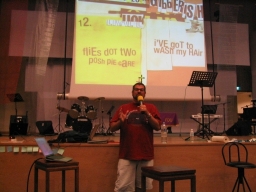
I liked Marko's games with 5000 points even for each victory :-) and his energizers are really workable after lunch to wake us up! He teached me some "fist" greeting thing ... which is actually pretty alien to me but it was fun! I'm growing to accept (even in the midst of my cheekiness) I'm actually VERY serious!

One thing that struck me is when Tony said how they are increasingly growing uncomfortable as being seen as the ones with the answers & authority (especially as the ones holding the mic) - this Q & A session was meant to model "conversation" and "interaction" - in short mutuality in learning along this journey in our respective contexts and together. It was nice to see how each of them responded to the questions - seeing how they embody and express what they are wrestling with ...

In my limited experience I've learnt to "engage" those who present talks or ideas at two levels ... the more formal presentation level and my prefered personal conversational level - I thoroughly enjoyed both with these guys and of course, I found the "conversations" at a personal level tremendously stimulating (even more than the formal sessions). Understanding the personal narratives of each person behind the words and ideas presented allows me to "understand" better and re-look at what's "generating" those words and thoughts from my newly connected friends ...
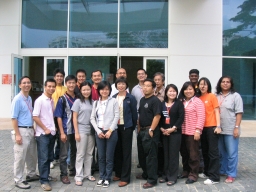
Though this was a primarily meant for Singapore conference ... we Malaysians took the chance to come and see what's going on ... and I guess, some of us are surprised as well as not so suprised who turned up. I also was delighted to meet a Malaysian teaching in Singapore and will be doing more research work on South East Asian cultural & thought forms historical development - sounds great hope to see more Malaysians rising up to help us understand our socio-political-cultural-religous climate ... as for the rest of us mere mortals trying to serve Jesus with our own gifts ... I hope we Malaysians will seriously work constructively - beyond individually but also together. One of Tony's insights stuck with me ... and it's about immersing ourselves in the Gospel in community to discover the answers for each concerns that we face.
Beam me up Scotty ... Part 1
Scott McKnight has been really energized in putting up loads of "POST" posts ... which are helpful. Somehow, I find these posts affirming and beams me up ... beyond mere polarities or misunderstandings set by others or even myself.
A Post on "post-" in the Emerging conversation
yes ... it's not about being "anti" and his comment on "family" is spot on (at least for me) I found Scott's use of the "baton" imagery an interesting "complement" to our discussion on 2nd Gen Christians ...
The Foundation of being "Post"
Scott says, "The "post" in the "post"modern and the Emerging movement among Christians all over the world is a "post" that says they want to get beyond a kind of evangelicalism that is rooted and shaped by and characterized by "truth claims" to a kind of Christianity that moves beyond "truth claims" to "truth proclaims." A kind of Christian faith that is centrally a kind of Christian life, a kind of Christian gospel that is proclaimed by performance. A kind of Christian faith that sees its focus in the mission to incarnate and embody and perform the gospel in the local community because the call of Jesus, found eloquently in the Sermon on the Mount, is to "be" a people." I say yes to all that and the part about church!
The Goal of the "post"
Check out stuff like - "teleological" thinking - a discovery in newness of an old category - perichoretic love - Doing church means a community absorbed with kingdom vision
Beyond speaking & singing ...

one thing I like about Dan Kimball is that he's not here to give us a bag of tricks in his sessions so we can go back and say "Wah! Lah! kazoom ... let there be creative worship!". If that's what we got from him sessions (i.e. just tricks and techniques) then I think we have missed the whole learning that was intended.
I also think there's also a sense of insecurity we can leave behind when we begin to introduce richer variety of expressions beyond spoken words and songs sung (that is the trademark of almost all of today's worship in churches even here in Malaysia). It's beyond words and song, not no more words and no more music ... it's not just about feelings and experiences and tastes and all that.
it's about how we can worship corporately with all the gifts of communication/expression given us .. and bringing not just a balance but actually also a corrective in especially affirming the non-verbal as aspects of "doing theology" or "reflective learning" - if it's just a gimmick sure we miss the point .. but if it's a gateway to encounter God and be in touch with truths that transform us ... now that's a totally different matter.
I found it amusing how as a "Lutheran" observing Dan who's from a more Bible church evangelical background appreciate the liturgy, asking the whys behind the order of worship, and also embracing ancient practices that we mainliners often chuck away. It's like I felt "Hey! to him he sees treasures for worship ... why did we see it as trash to throw away? Sorry Lord! sorry those who've gone before us. Some repentence of pride is appropriate here"
But then, it's not just blindly picking and choosing ... it's first going back to the practice, then the history and deeper into the meaning (i.e. theology) then coming back to the surface into our ongoing story today and practices here and now. Fascinating.
One thing for sure ... there's more to Dan then just practical tips.
Read this article From Methodology to Theology: Become Worshiping Communities of Missional Theologians we may not be professional theologians in the university or seminary ... but we are missional theologians in our local churches and ministries! I'm happy to see one in practice in the person of Dan and hope to see more ...
July 08, 2005
Atmosphere
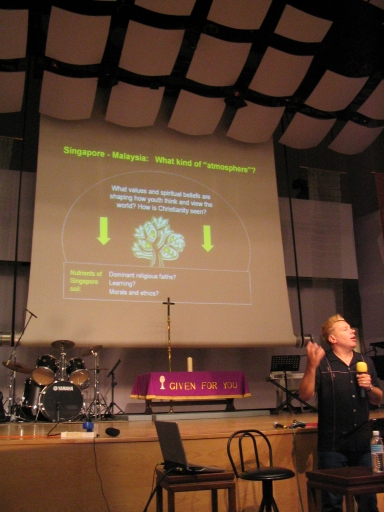
In many ways I suspect that most of the participants would find Dan Kimball's session on "Postmodernism: how it impacts youth ministry and youth leaders" easier to follow. :-) perhaps it's the way we are educated most of us find dealing with more "abstract concepts" harder to digest, we tend to prefer the concrete and the visual. And Dan played his part well in doing this.
One thing I appreciated is that being very well aware of such a "different" context he's coming from (i.e. USA) he communicates his oresentation with an inherently dialogical approach - not so much we did a Q & A (which in this session perhaps was too early) but more in his way of speaking and trying to facilitate our thoughts in the process.
I found his little line under the question "What is Postmodernism?" quite cheeky and yet thoughtful ... i.e. a word that is misunderstood, misused, feared, embraced, talked about, ignored, cool to use and uncool to use.
I think he accurately paints the scene on how ordinary folk in the church or even leaders use the term. I've heard of "postmodernism" seen as the big bad enemy we should resist and I've also heard of "postmodernism" as the latest "trend" in youth and young adult ministry. Both I think are unhelpful.
What for me I get is this ... that at least at the more"popular" and "grass-root" level in ministry especially in local churches we talk about culture again .. not just culture as in our Chinese and/or Indian culture, but also a more "dynamic view" of culture/s in Malaysia that are at work. another way of putting it is "How do we view the world we live in?"
So often, Christians in Malaysia are tempted to jump to easily on the latest bandwagon (from the latest church growth technique to even the latest philosophy) without first considering the "climate" in which gave birth to the specific solution offered by the above. And then second step of seriously considering our climate and in Dan's word I picked up our "Atmosphere".
I like the question Dan posed to us ... adapted from the questions he asked in his context of Santa Cruz USA.
What kind of Atmosphere do we have in Singapore-Malaysia?
What values and spiritual beliefs are shaping how youth think
and view the world?
How is Christianity seen?"
And this can be done at a more micro level even in my own small group. as well as the local congregation and wider Malaysian church scene.
Considering what are the dominant religious faiths? how do we learn values and beliefs? what are our morals and ethics? most of us think these are questions for scholars when it's actually questions that need to be grappled with ourselves too at all levels perhaps with different vocabulary!
I read a news paper report (trying to find a link) and even though we may pride our so called "asian values" according to the survey most kids are more interested in money, the latest gadgets and trends and their jobs more than relationships, personal learning and social justice. The report did talk about their desire for world peace though.
I was talking with a youth yesterday and he said he wanted to leave his country because people are just working to death here. And he wants to go to a place like New Zealand. I found our conversation very enlightening.
So, on one hand .. I need to read up .. on the other, I need to just ask questions and listen. And somehow in that process come to an understanding of where people are at and the kind of atmosphere we are living in.
"Glocalization" & more

I found Tony's starting point to invite us to think about our current 21st century context helpful during the Youth Ministry in a Globalized world talk. Globalization is a big word but with some unpacking and what he terms as a more sophisticated (for me more indepth) view of it we also see the flip side of "Glocalization" a kind of reverse effect of what is commonly perceived as "western cultural imperialism" (e.g. Mcdonaldization) to the creation of the possibility of the "local" being more "global" (e.g. even Mcdonalds has local dishes).
And this excited me because now ... in many ways, people like us here in Malaysia for example has "space" or a "chance" to allow our voice to be heard, our food to be tasted by others, our concerns to be presented. And from a theological and ministry perspective not only become aware or even influenced by "western developments" but actually now also rise up to "contribute" and play a more significant role in the "Global" development of thinking, doing and living of the Christian faith ...

when Tony walked through a simple timeline for western philosophy I was thinking about eastern philosophy and how confucianism, taoism, Hinduism, Buddhism, Islam. etc played their role in the shaping of our mindsets here and even how colonialism and modernism/secularism has affected us. I've read some stuff still need to work on my "work in progress" interpretive framework.
And putting these two side by side is a fascinating exercise and allows for some fertile ground for interaction. And indeed the gospel is unique in how the gospel incarnates into different cultures, adopts and adapts, or even transform or rejects a variety of aspects and yet has a constant about it - in Christ, the movement and leading of the Spirit and the mystery of the creator!
It's interesting to see how "postive" aspects of the discussion on "postmodernism" actually opens up one to reconsider how often our thinking is less Biblical and relational than we perceive it to be ... and can actually bring one to appreciate the gospel better and in my view more faithful to we are called to interact with the person of Jesus here and now especially in community.
most of us have a simplistic view of "postmodernism" and I found Tony opening up my mind further on a more "sophisticated" view of "postmodernism". of course, with qualifiers through out that we need to think through how all this applies to Asia etc. But, painting it as a big monster we need to battle to me is not very helpful. perhaps it depends how this issue is discussed ... my introduction to the word five years ago was more positive than negative thus I have less "jitters" when I'm in the discussion today. I do recognize the more radical (or even destructive) aspects of it (e.g. nihilism,absolute relativism *who actually REALLY believes this?*, etc) ... but then that seems to be always the case in any philosophy or religion or any pursuit of knowledge. I recall hearing critiques on Enlightenment and Modernism during seminary days that highlighted the dangers of rationalism but that didn't make me not appreciate the role of reason. So, I think we can at least become less alarmist and have confidence in our ability especially in personal humility and community to work through our thinking, doing and living ... again together!
Emergent in Singapore?!


technically this was not a "Emergent Conference" , it was promoted as "Postmodern Youth Ministry Conference" organized by the Board of Youth Ministry, Chinese Annual Conference. We met gathered at the Bukit Panjang Methodist Church which had an interesting neighbor the Salvation Army .. cool building next door that looks like a ship!

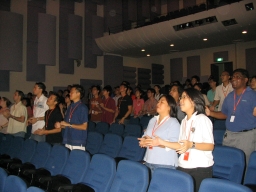
It was not a "big" conference ... a substantial group turned up. I was delightfully surprised to see a small group of us Malaysians that were present. I overheard quite a variety of churches represented. And it was good to connect with some people whom I've heard from a distance ... strange place to meet but I'm grateful we did connect.

Rev. Poh is the risk taker, forward looking, humble man who initiated this event and made it possible ... I REALLY appreciate his efforts that many of us could be blessed by a "space" and "time" and "environement" where we could wrestle with questions perhaps sparked by our involvement with youth and young adults but actually has wider concerns of theology, philosophy and culture that needs the hard work of asking "questions" (something we here in Malaysia or perhaps even Singapore are less prone to do because of busyness or bombardment by quick-fix-knee-jerk-reactionary answers)
From a Youth Ministry Conference point of view this is one of the best (and definately meaty and sensitive) ones I've ever been to ... Thanks for the good work "the Rev." (we affectionaly call him*grin*!)
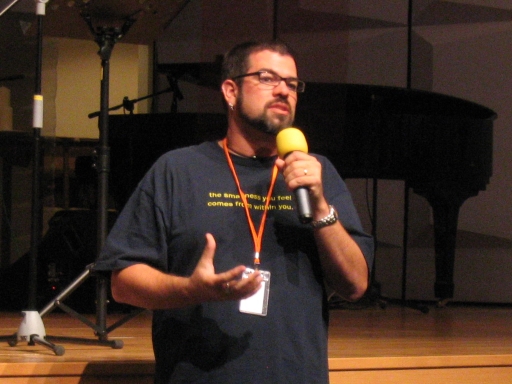
This is the first time I'm meeting Marko and he's also very instrumental in bringing the next two guys whom I'm surprised that we could meet so soon. he's indeed as how the Sharps (whom visited Malaysia recently) described him to me - a very engaging person. I loved the question game he played after lunch which was not only fun but also helped us to know him and the speakers better.

So, perhaps it wasn't an "Emergent Conference" technically, but for me it was relationally :-) because finally I could meet my conversation partner who's the named recently as the EmergentUSA coordinator Tony Jones (sitting on the left) whom I read his blog and I think some articles before I read any books written by him (Fresh with an interview with Next Wave Ezine).
This is the more than 5th time I'm meeting someone I've just known from a distance from blogs and some emails. And it's again amazing how we just "connected" immediately and just engaged in conversation so easily. He's indeed smart and intelligient as many have said he is. There's loads of energy and deeply thought through insights flowing out from him. One very memorable impression I found was his closing "benediction"-filled prayer at the end of today's session demonstrated a very pastoral side of him not so frequently mentioned so far. Tony, if you managed to read this before you leave Singapore. You are right I managed to "blog" about today tonight!
The other person commonly associated with the conversation Dan Kimball (standing on the right) one whom I read his book before I read his blog - who's really got not just stylish hair but what really matters is he's got this gentleness about him that invites the people to "journey" and "process" his thoughts and reflections with him.
Both of them are so different ... but it was nice to see how individually and together they created a "space" for us to "think through" our own context and have a fresh appreciation of the Gospel. I really appreciated the genuine desire for dialogue, conversations, mutual learning demonstrated in the main sessions and personal interactions. For people like me who've eavesdropped for all these years and also participated in some way in the "emergent" & "emerging church" conversation. It was great to do this "Live" with the guys!
As for Marko and Poh - I feel we need to appreciate people like them who often work behind the scenes to make the connections and make events like these possible. If this is how partnership can look like ... there's great hope for the future .. together ...
July 06, 2005
EM04 Crunchy Questions

*Note: sorry for the delayed report and reflection*
In the last Emergent Malaysia "Open" Meeting we decided to use the issue of "2nd Generation Christians" as a starting point for discussion. This matter was raised in one of our threads in the Yahoogroup.
So, I pulled out some ideas from this paragraph I found to describe an upcoming plenary session on "Building 2nd Generation Christian Youths" from an upcoming Youth consultation that I'll go as a participant. It says,
"The first generation of Christian youth of the yesteryears has become parents with teenage children today. This is an emerging generation that has passed through our Sunday Schools into our Youth Fellowships. But, are we passing the baton of Christian faith to them effectively? And, is the emerging generation of young people taking up this baton of faith personally? Is this the responsibility of the family or the church?"
one thing I noticed during the meeting, even though talking about "2nd Generation" Christians was the starting point ... many questions, issues and/or even reframing how we ask the questions arose - and they arose around the lens of "Church" (so not just about the youth specifically), the nature of "Mission" (it's not just about fancy methods), even Theology (passing down the faith or recontextualizing the faith), etc.
I thought I'll just try to capture some of the concerns I heard in the form of "Questions" in random and no particular order
- How are we "bringing up" these kids to develop some indepence in thinking (e.g. critical thinking)? or are we expecting them to swallow everything from the past generation? should we at all expect that?
- have the parents "consciously" examined their own faith journey and how they work out their own faith? (this is not so much of a complaint but a genuine question) Are there aspects of the "parents' faith" that maybe more tied in to a certian (for example Chinese) cultures more than Christian concerns/values?
- how about the whole idea of "keeping face" in Malaysia where one is prone to "pretend" to be ok or perfect in order to fit in and lack the space to "be real" and allow heartfelt struggles to surface or even doubts?
- What is the relationship between friendship, leadership and personal authenticity in the relationship between those who are older as well as younger?
- Is there a place for "We don't have all the answers to all the questions"? is that ok? Is yes or no, then how?
- How can we facilitate a genuine listening to the question "Where is God in this situation"? or "What is God doing in this generation"?
- what is one's relationship to the world we live in? how do we wrestle with a "anti-world" mentality and what about "certian forms of Christian subcultures" already in our midst?
- What does it mean for those who come from Christian families to take ownership of their faith? How can we facilitate that? Is it not so much about passing on the form but actually passing on the hunger?
- how do parents and others in the church support each other in the upbringing of youth? How do we avoid a "police-state" mentality and yet not slip into "anarchy"?
- how about social justice? Is this faith just spiritual and has no relation with social realities that are before our eyes? Where is the church in all this? how do our words and deeds match?
- What kind of "baton" are we passing on?
- what about bringing people to the church verses bringing the church to the people? How does this affect those who grow up in Christian environments?
- How to we wrestle with the more organic dimensions of community life as well as organizational aspects? are we too program-driven that we miss internal community and external society needs?
- what are we doing about the increasingly "consumeristic" attitude not only in the world but also very "alive" in the church (adults included!)?
- what about temptation of the "success" mentality driving many churches that cause us to slip into a quick fix strategy? and thus, we look to "successful churches" adopt similar programs and expect to boost success? what does this communicate to the next generation or this generation of youth?
- What is the "gospel" this generation is hearing? What about the Kingdom of God? what about the understanding of mission for today?
- What are the models available for 2nd generation Christians? whether individual examples of how one grows into faith? how about models of "Christianity" or churches that are unseen or not popular but seriously engaging in nurturing faith in the long run?
Some questions to crunch for now ... we'll see whether we can chew on some meat later in another post ... please feel free to comment and put your thoughts down .. especially if you are a 2nd or 3rd or more ... generation Christian.
June 27, 2005
EM04 Vegetarian Appetizer
I'm very thankful that the Emergent Malaysia "Open" Meeting went well with its load of surprises here and there with lots of food for thought as well as areas that causes me to think deeper (more on this later) :-) I'm amazed that this is actually our fourth time we've organized this kind of meeting.
I decided to start off with a more vegetarian approach and leave the meat for later. If you can't wait then you could check out Al's post You Ain't What You Eat and some thoughts here from from Ryan (a visiting friend who's actually been to emergent conventions)

We had a diverse group ... apart from Malaysians, we had friends from Ireland, USA, Korea & Japan giving this meeting quite an unexpected enriched international flavor. Of course, we were also very different as far as church background and where we are at along our journey at this point.
One thing was constant - based on how we introduced ourselves - we came because of a relationship with another person present. Our connecting point first and foremost is RELATIONAL first before some curiosity about what this "Emergent conversation" is all about as well as mutual concerns about being & doing church in Malaysia & beyond.

We had some good food to start off ... some new connections formed, old connections rejuvenated, small talk and more in depth intros took place.


After food we jumped straight into 5 small groups to have some "conversations" revolving around the whole issue of "2nd Generation Christians". Later, summaries & highlights of the discussions were shared with all. I was a free agent to move in and out of the five groups to get a general feel of where the "conversations" were going. MISSIONAL & CHURCH-related concerns came up all over the place.
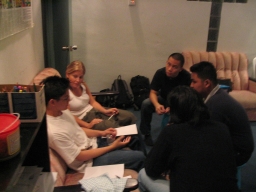

I cheekily used some questions and assumptions of a paragraph from an upcoming Youth consultation I'll be going to ... and was not suprised as well as surprised on how different people perceive the images and issues revolving around the topic of "2nd(or 3rd or 4th) Generation Christians"


as usual, there was always interesting post-meeting conversations ... and some managed to finish off the Durians!
June 23, 2005
Postmodern Youth Ministry Conference
Special Thanks to Rev. Poh and those at the Board of Youth Ministry Chinese Annual Conference (The Methodist Church in Singapore) for making this event possible.
Date: 7-8 July (Thurs- Fri), 2005
(please contact Rev Poh --> heowlee.poh@methodist.org.sg for more info)
Tony Jones (author of Postmodern Youth Ministry) and Dan Kimball (author of the Emerging Church) will be the main speakers.
It's side by side the CORE Part 3 Certification Training by Youth Specialities with Mark Oestreicher.. which is on 9 July, Saturday.
I think I should be able to make it for the Pomo Youth Ministry Conference (now working on funds) and have some "conversations" with the guys!
Here's the conference topics I saw in the brochure:
- Youth Ministry in a Globlized World
- How Postmodern Culture Shapes Youth and Youth Ministry
- Designing Multi-sensory Worship gatherings
- Moving Worship from performance and celebrity to participation and community
- Developing a theology of pop culture
- The recovery of ancient practices in youth ministry
- Starting an emerging worship gathering in an existing church
- Dialog session with the team
Of course, my main reason for going down is to connect face to face with the guys who are part of emergentUSA and engage in more indepth conversation - this is a good chance for some one like me from Asia to have some fun with my American friends as far as all things "emergent" or "emerging church" is concerned (plus all the youth ministry related issues from the conference).
June 17, 2005
Emergent Malaysia Meets Again ...

To any one interested, we're organizing a simple dinner and conversation at the Father's House (BLC).
Date: 25 June 2005, Saturday Time: 6.30pm
(please contact me if you are interested to come)
Here's what's up:
apart from food and the infomal stuff, we hope to intentionally hear the stories of a couple of "2nd Generation" Christians (especially those who grew up in a so called Malaysian style Christian subculture - if you can call it that) and then move on to issues relating to this reality. It's going to be nice because we'll have some friends from USA visiting us that weekend. I've felt convicted lately that there needs to be more intentionality and coordination to open up "space" for conversations, reflections and possible directions to emerge in our context.
I'll be away from blogging a couple of days .. so I thought I'll leave some transition thoughts here:
I love this tree in the picture above which stood out for me in Tioman Island. And it makes me think of the Tree analogy useful to think about one's journey of faith as well as embracing the best of our Christian heritage. I heard of how Richard Foster uses the metaphor of "streams of living water" to capture the renewing streams of the church down the ages, Robert Brow uses the Garden image. And here Brian McLaren uses a Tree Analogy which is elaborated here in A Generous Orthodoxy: Why I Am An Emergent Christian.
"The meaning of “emergent” is an essential part of the ecosystem of generous orthodoxy. A simple diagram can illustrate what we mean by emergent thinking. Think of a cross section of a tree. Each ring represents, not a replacement of the previous rings, not a rejection of them, but an embracing of them, a comprising of them, and inclusion of them in something bigger. The tree’s previous growth is integrated into, and in fact is essential to, the tree’s continuing growth and strength.
... Emergent Christians look at the world as “our Father’s world.” We stand wide-eyed, trying to take in what’s going on here, understanding it as an unfolding story, an emergent family drama, with birth, growth, struggle, maturity, death, and resurrection. We see God not as a potentate trying to keep serfs under control in the stasis of perpetual childhood, but rather as a parent inviting us to grow and mature, to become as good and beautiful and true as we can become…to emerge.
To return to our tree analogy, God is the air that surrounds the tree, the soil in which it is rooted, the sunlight and rainfall that beckon it to grow and become, season by season, ring by ring. In God we live and grow and have our being. In God’s wind we sway and our leaves dance."
Posted by sivinkit at 08:39 AM | Comments (1)
June 15, 2005
My recent Emergent Reading Updates
Emergent Church: Filled with creative, energetic potential
I hope the title won't confuse things even more because I'm finding it now more useful to not use "emerging church" and "emergent" interchangably though there's an intimate connection I do feel a distinction will be helpful. Having said that, I found many insights, cautions, encouragements, and guidance here.
Report From Emergent Summit - Part 1 of 4
Can't wait for the other parts :-) Tony Jones responds here to the new appointment.
Why I Support the Recent News From Emergent (or why Tony Jones is not the antichrist)
Jay Voorhees is pretty amazing to articulate the stuff he's saying here that would be relevant to any discussion on organic as well as organizational aspects that comes when people begin to work together in a "network"-kind-of framework.
'Emergent' Christians seek spirituality without nasty theological squabbling
It's nice to read something positive and paints an encouraging + "fun" picture of what's happening with my friends on the other side of the earth.
Understanding the Emerging Church: D. A. Carson
Moody Broadcasting Network "opens" a line for Dr. Carson to express his views (I think I'm putting it mildly here) - I think it's up to the listener to determine whether there's true "understanding" on the issues at hand and the people involved. I wonder how the interview would have been if the line was open for callers to call in?
Post Modernism & Emerging Church with special guest Craig Hawkins
I was not suprised that this was not "friendly" to all things "Post-modernism" and trying to be "fair" to whatever that's under the tag "emerging church". But, it was the way this whole discussion was conducted that really made me wonder even more about "American Evangelicalism" and the other factors involved apart from mere theological and philosophical disagreement.
On Emergent
Ryan Bolger says some really encouraging words here ... and with some insights thrown in - I resonate strongly with this paragraph --> "Emergent provides a place for these travelers to tell their stories, to deconstruct, and yes, eventually to reconstruct their faith. For those who listen carefully and long enough, it is not about Christians losing their faith, but finding it once again as well."
Affirmation (A Response to Aaron)
I like Andrew Jones ... he actually is willing to take the time to "respond" - and here he does a pretty thorough job answering in-your- face-line-drawing kind of questions - such as - Do you publicly affirm penal substitionary atonement? Did Jesus take the punishment we deserve? - Do you publicly affirm eternal punishment / torment / hell?
Traditionalists now have permission to talk to Emergent types
Two things stuck out for me ... one is Jollyblogger's thoughts here, "So what happens when a controversy arises which you don't have the time to investigate thoroughly enough to form your own solid, well grounded opinion? You listen to people you trust. You depend on their opinions to form your own opinions. So, if you are in a group that thinks that N.T. Wright is a wolf in sheep's clothing, the TNIV is the devil's bible, and the emerging church is the apostate church, then by golly, it's time to form up lines and resist all of these wolves, devils and apostates. My point is that it is the opinions and actions of our trusted leaders that usually guide us in our responses to these controversies, rather than our own investigations." The other is Andre Jones comment here, "we really need good criticism and and invite the sharpening of iron when we can get it. The only time i get really defensive is when people make blanket criticisms about the emerging church worldwide when they are only talking about one or two networks or churches (usually in USA) but dont realize that they are endangering new church plants in Portugal and India and Malawi that are sprouting up in the emerging culture in their country - these EMC leaders may be teenagers, brand new Christians and have no idea who Derrida is - and are about to have their funding pulled (or worse - their trust) all because of what someone said in America."
Horton on Emerging Church & Michael Horton Replies
I personally think the White Horse Inn engagement with "the emerging church" issues were one of the better ones. But, the fact that Horton replied and Andrew Jones had a chance to respond makes me have a higher respect for both of them. And the exchange definately is helpful.
What IS Emergent?
I'm thinking of a very helpful email exchange that I had yesterday and today ...I'm sure some of the words here would have been helpful .. check it out:
"I think what is appealing about Emergent and people like Brian McLaren or Don Miller is that I and many of my friends reject the false dichotomy of absolutism v. relativism. On one hand, I think most evangelicals do reject moral relativism. Yet, many of us are often repulsed by the arrogance and anti-intellectualism of many absolutists.
I'm finding as I get older that I am less confident in my own "rightness". I'm more than willing to admit my own lack of understanding or certainty on various issues. This doesn't mean that I don't believe in absolute truth; I do. I'm just not sure that I can always know it in its fullness.
My friend Josh Jackson replied to this thought:
"I think you hit the nail on the head. What's appealing to me about
the emergents, particularly Don Miller (only loosely tied to the
emergents, as far as I can tell), is in the wake of my 15-year
encounter with evangelicalism was the arrogance of certitude on
every minor point of theology, even when different denominations
held differing views. I mean what percentage of evangelics belong to
the denomination of their parents and are convinced that it
coincidentally is right about everything. Emergent doesn't assert
that there is no absolute truth, just that we're unlikely to get
everything exactly right on this earth.""
Dear Dignan: an Answer on the Emerging Church
Thanks Brother Maynard for this effort to respond to the above question. His four points are useful (I'll probably easily exchange the phrase "postmodern culture" in point 2 to "Asian-Malaysian-non-christian-post/neo-colonial-secular-globalized-add-to-the-list-21st century culture" (in short the context we live in here and now. So, here's a non-exhaustive list of characteristics he offers:
1. Something’s wrong with the way we’ve been “doing church” — it’s become, or becoming, ineffective and irrelevant.
and therefore,
2. Christianity must be re-contextualized for postmodern culture.
3. The church must be missional.
and based on these,
4. It’s time for a re-examination of what is really central to the faith and a re-consideration of what the best structure for church ought to be.
June 04, 2005
Emergent Response to Critics
I appreciate that this response is not done individually but rather collectively (i.e. Tony Jones, Doug Pagitt, Spencer Burke, Brian McLaren, Dan Kimball, Andrew Jones, Chris Seay) ... I like this sense of community and accountability and humility reflected in this piece. More comments later ... for now read for yourself and allow your own response to emerge :-)
Our Response to Critics of Emergent (PDF here for download.)
May 23, 2005
Emergent Convention 2005 - Input
Of course, I'll carry on my "imaginary conversation" slowly .. because it's going to be a busy two weeks for me .. I'm trying to be an "unbusy" pastor ... but I will fail upfront these two weeks as far as busyness is concerned. Loads of repenting and realignment after these two weeks :-) after a good few days in an Island for holiday (yippiee! more on that later)
Here's some blogs I'll be checking out ... for glimpses of the convention and whatever that will spark from there..
Adam Cleaveland - nice chronological approach.
Dan Kimball - one of the few emergentYS line authors who blogged about the convention.
Susie Albert Miller - I think my first link to her was something related to intergenerational concerns ... will check her out more.
Aaron Klinefelter (Aaron also has worked hard so we could listen to the podcats provided by conversatio fide)
Will Samson - he threw in some interesting reflections which I hope to engage.
Mark Oestreicher - facinating insider view.
Jay Voorhees - loved the Kitty photo he posted up .. and I think I'd introduce him to my Methodist friends :-) and the Gregory of Nyssa Quote he has on his blog really rocks!
Emerging God - a new blog I've been following.
Latina Liz - with a recomendation from Rudy Carrasco I realize I need to check this blog out for a wider perspective!
Preference: Critique or Conversation?

I've always found it hard to enter into a "critique" mode ... I find it hard to do a book review and offer a critique on the authors ideas. By this I don't mean I've tossed out the need to be criticial or as a person I don't easily dish out criticisms. What I'm saying is it's just "hard" and in some way a more "draining" exercise for me. I know we can't swallow everything we read or hear. And we need to be on guard especially when in our Malaysian context there's a greater tendency to just follow the crowd, ot the trend or what pragmatically works. So, there is a need for IMHO some kind of "healthy critique" mode we need to operate at some point. And thus, "Critical thinking" is not to be eliminated. But, somehow ... it's not as energizing for me ... necessary at times but not so prefered most of the time. If there's something I disagree with, there's a tendency that I'd "critique" it in general (as in not personal) and probably just focus on what I find "connection" with ... and put more energy there.
That's why the whole "conversation" mode appeals to me so much. For stuff I'm ignorant I'd rather be silent, or ask questions, or wait and give some time before I say something. And then, at times even suspend judgement for a while (I know that's hard because internal battles go on in my mind during this stage), learn some patience - give the other some space to continue. When engaged in "conversation" mode ... I think the "critique" element is there but not so much at the forefront .. so as not to stop the "flow" of conversation. A lot of restraint is needed so there's meeting of minds, ideas, and possibilities at some point. There's a kind of "safety" in this kind of environment ... and yet there's definately potential for "change" to happen ... not in a head on collision way often when one is in a "critique" mode, but more in a subtle way where it's not the other pressurizing us to adpot their view point .. but the listener given space to make adjustments or alignment themselves. Very likely, it wouldn't be exactly as expected from the speaker but it's "change" nonetheless.
So, I prefer "conversations" without ignoring the need to "critique" when needed. But I suppose it's more about what comes to the forefront ... a more level ground "conversation" marked by much restraint, space and patience - allowing the "critique" mode to be more subdued while not extinguising our critical faculties .. emphasizing the relational dimention of truth-engaging, or knowledge-exchange with a strong accent on the human face than just dabbling in the exchange of ideas and disembodied knowledge.
I'm not sure how much sense I'm making here ... but ... it's therapeutic I must say. :-)
with all the above off my chest, I'd like to continue with much appreciation to many bloggers who blogged their notes, feeings and insights ... from the recent Emergent Convention 2005 in Nashville. As one who was unable to make it for obvious reasons of distance, I find myself in no position to offer "critique" but it would be fun to pick some aspects and have an "imaginary" conversation with stuff that just "resonate" or "connect" (that's the fun this whole internet and blogging experience offers) so, on with the conversations ...
May 21, 2005
The 3rd Postmodernism?
Increasingly the term "postmodernism" or "postmodern" is cropping up in our conversations here in Malaysia or a recent seminar in Singapore actually had a workshop on it. When words are used to "exclude" or as yardstick of whether you are ok or even as a "trendy cool" word then it's harder to engage in genuine interaction... but if it's used to invite participation, generate thought, stimulate further discussion, then bring it on ... why not?
This made me check out some links and especially relook at Brian's article on "The Three Postmodernisms: A short explanation" and see how he tries to bring it to a level where some engagement is possible.
Of course, I'm hearing a pastor-evangelist or even a missionary posture speaking here more than a scholar (though Brian's stuff is always smart and thoughful) using the final part to keep things in perspective and on the ground:
"As a follower of Christ, I am less interested in articulating the ideal definition of this movement in words than I am in helping contribute to what the postmodern world becomes in reality. I am hoping that many people of faith and vision can play a formative role in what will happen beyond modernity and adolescent postmodernity: seeking to be salt and light, seeking to do good works, seeking to do justice and love mercy and walk humbly with God.
In other words, the best answer to the question, “What will happen with the emerging postmodern movement?” is this: “It depends on people like us.”
When I look at the postmodern landscape, I see “fields ready for harvest,” as Jesus said. But so far, in spite of so much being at stake at this critical moment in history, those willing to get out into the fields and do the hard work of seizing the moment are too few. There are plenty of critics who stand at a safe distance on the modern road that runs beside the postmodern fields, shouting their criticisms and warnings. Instead of joining them, you will, I hope, pray to “the Lord of the harvest” – so that more workers will become willing to jump into the action and get their hands dirty in the postmodern fields, making visible the good news of Jesus."
May 15, 2005
The Brian McLaren Blog Tour which I missed
Sometimes these things happen ... *smile*
When Brian McLaren was "internet-trotting" having a fun time (I think) with his blog tour for his latest book. I actually missed it because I was at the Lutheran pastors retreat in Cameron (with a ministerium meeting thrown in plus I was unable to get online - more like no time!)
Oh yes .. I think it's good to go on record that Brian has grown to become my friend (an impotant friend told me the word "Friend" is a powerful and we shouldn't underestimate it :-) - just in case some might wonder whether I'm a Brian McLaren groupie or Malaysian fan club chairman! *grin* --> on both counts I'm not - I was never drawn to read Brian's book because he was hip or popular. When I first picked up his first book ... it's more of - "hey! That resonates with me!" and apart from the intuitive dimension - there weren't many English books in the Christian market that kind of "opened up" some space for my thoughts to interact with some ideas in my mind safely without being shot down - too quickly. So, I appreciated the "intellectual" dimension where I could think about issues related to church, Christianity, evangelism, spirituality, the recent one on "hell" etc. in a not so stuffy "academic" flavour (though I do appreciate that as well - it's just different). We all know friends don't agree on every single detail in life - that's assumed. But the conversations of friends who are genuinely open to share and receive from one another does allow for possibilities for encouraging constructive ways forward and gentle critic to keep us in check ..
Anyway, back to the topic at hand. Here's what I could manage to cut and paste (for more click on the links for a wider context of the questions and comments). Thanks to all the bloggers (and those who left comments) who made this possible- take a deep breath - this is one of the longest posts I've put up thus far - read on if you like (I guess ... I compiled it more for me *smile*):
From Andrew Jones: The Blog Post of Brian McLaren
Thanks, Andrew, for getting the ball rolling on some important dialogue.
I love Andrew's post on "does the church believe in heaven." I just finished a paraphrase of the Gospel of Luke, and being immersed in Luke's gospel for several months ... it was very clear that Jesus wanted his followers to be willing to risk all for him and his gospel. Confidence in heaven made them willing to risk.Some of you may know that I'm very involved in trying to get action and protection for the people of Darfur, Sudan. To me, the test of my faith in Christ, the gospel, and heaven is whether I'm willing to risk my life for people who suffer ...
Meanwhile, I recently read that among the most committed Christians, "tithing" averages under 3%.
The language of heaven and hell is intended, I believe, to push us to see that ultimate things are at stake ... that we need to "wake from our slumber."
Posted by: brian McLaren | May 9, 2005 12:29 PM
Re: Joe's comment above - that no adult has been scared into the kingdom ...
I'm sure there are exceptions to this, but I find that a scare tactic turns more adults away from God and the church than attracts them.
I wonder if this might help explain that commonly quoted statistic that hardly anyone in most churches became a Christian after the age of 14? Maybe our "scare tactics" are designed to appeal to children and not adults?
When I read Jesus in the gospels, I see him using very strong language ... there's no language stronger than hell language ... but not as a scare tactic. Rather, he's trying to wake sleeping people to the realities of choice they face at this moment.
Posted by: brian McLaren | May 9, 2005 12:35 PM
Great comments, everyone! Thanks - comments on specific questions below ...
++++
brian,
...i wonder if it is possible to address some of the issues without changing one's view of hell (and other things). does the fruit or bad fruit of the "doctrine" necessarily condemn the "doctrine"? ...how do you respond to the accusation that your "new" ideas are only responses to cultural shifts and the incompatibility of traditional christianity with postmodern sensibilities?
+++++
OK - for the first question, I try to include a character in the book - Carol - who represents exactly the option you ask about: not changing her view on hell, but being open to other new insights. Yes, I think this is possible.For the second question, this sounds like you have read D. A. Carson's book on the emerging church (which Andrew has blogged on here in helpful ways). Can I recommend you read David Mills' (Cedarville College) helpful response to Dr. Carson? I think he addressed this question well and in detail. (Maybe somebody can put up a link here - if you google on "David Mills McLaren" it will come right up.)
Bottom line: my new ideas are in response to reading the Scriptures, and especially the gospels, and trying to take the Scriptures more seriously than the systematic theologies I was taught ... NOT that I'm against systematic theologies, but I believe they can obscure our reading of Scripture as well as aid it.
+++++
I just finished reading "the last word and the word after that" and I am fearful of being branded here as "someone who just doesent get it." While I agree with much of what Brian wrote about the Gospel being much more comprehensive than just filling the pews in Heaven and that the Kingdom of God is here; I am still left with the big "E" on the eyechart wondering well what do you believe happens when we die? I mean I know we can go round and round talking about how this is not the question to ask, but people do and they are concerned about it, so just wondering what you do think about this Brian.
thanks,
++++Ryan - that's certainly a legimitate question. The reason I didn't go too far into my own views on this is that I thought I was doing enough in one book to raise issues and stimulate people to think on their own. I didn't want to impose my views but rather to stimulate thinking - so people will look at the Scriptures in a fresh way.
I gave a better glimpse into my own thought on the afterlife in "The Story We Find Ourselves In." In short, I believe we pass from this life into the presence of God, where all our sin is judged and eradicated, and what remains (I'm thinking of Paul's phrase "gold, silver, precious stones") constitutes the beginning of our ongoing identity. There is real possibility of tragedy - wasting one's life, so there isn't much to carry over beyond this life. There is also a great possibility for joy, because every cup of cold water given in love is not forgotten.
I should add that resurrection - not a disembodied state in heaven - is the Biblical vision of afterlife as I understand it. I like John Polkinghorne's way of describing death and resurrection (quoted by N. T. Wright): at death, God uploads our software onto his hardware, and then at the resurrection, downloads our software into new hardware.
Posted by: brian McLaren | May 9, 2005 03:01 PM
Hi, everybody - I'm really frustrated because I'm supposed to be at suddenly seminary but have been trying for 40 minutes or so and can't get checked in the hotel. Arrgh. Sorry for all those who are waiting for me to show up. Maybe we can reschedule for later in the week, after I have overcome whatever is the problem in getting in. (Apparently habbo doesn't recognize shockwave on my computer.)
I'll answer a couple quick questions ...
1. I have a question for Brian. In your first comment you said that Jesus uses hell to push us to see that "ultimate things are at stake" - in your mind, what are the "ultimate things" that are at stake?
-- Whether we waste our one and one life, or we invest it in what really matters: loving God, loving our neighbors in the way of Christ. If we waste our lives, we will have to stand before God and face this reality. I can't think of anything more serious than that.
I also think (following NT Wright) that Jesus had a special message for his Jewish people: "you stand at risk of losing your identity as the people of God who were called "to be blessed, to be a blessing" ... if you reject me, you are rejecting God." Serious indeed!
Today ... our world is in such deep trouble, and so are we individually. If we turn from Jesus and his message of God's kingdom ... what are we going to do with our lives? Buy more stuff? Trust in more weapons? Smoke more dope? I hope that gives some idea of what I think is at stake, in this life and beyond.
Posted by: brian McLaren | May 9, 2005 08:39 PM
Back to David's question ...
Let me paraphrase it.
The conventional idea of Hell is unpopular in our culture. If I'm questioning the conventional idea of Hell, does that mean I'm accommodating to our culture, watering down the gospel, etc? Even if I'm not, am I not in danger of doing so?
(Let me know if I've missed the meaning of the question.)
First a couple of provisos:
1. I am not questioning Scripture, Jesus, or his teaching. I am questioning the conventional understanding of them ... this is an important distinction.
2. I am being very Protestant and Evangelical in this ... I am going back to Scripture to test what I've been taught.
3. I didn't begin questioning the conventional understanding of Hell in order to be hip, conformist to culture, etc. I began questioning because I more deeply engaged with Scripture and felt that my conventional understanding flattened and oversimplified some of the richness of Scripture and created logical and spiritual problems for me and others.Now to your specific question ... I am calling people to follow Jesus. That means calling them to repentance, sacrifice, faith, service, worship, reconciliation, character formation, spiritual transformation, commitment to the poor, willingness to suffer, courage to be misunderstood and persecuted, prayer, obedience, humility, confidence, and love for enemies. These things are not terribly in vogue in our culture.
By the way, conformity to a Christian subculture is also an issue. It was hard for abolitionists to question the conventional doctrines regarding slavery and race ... sometimes we must be as concerned about conformity to the religious subculture as we are the secular culture. Many of us are more afraid of breaking step with the former than the latter.
But at the end of the day - we all stand in danger of conforming to this world. Which is why we must seek to be transformed by the renewing of our minds, having given ourselves as living sacrifices to Christ.
Does that help clarify?
Posted by: brian McLaren | May 9, 2005 08:49 PM
From Jen Lemen: to hell and back with brian mclaren (Jen even throws in a superb interview for starters! )
Hi, J.J. - I spoke a bit about the Eastern Orthodox idea of hell in A New Kind of Christian, but not extensively. In its favor, this view says "There is nowhere you can go to be separated from God's presence." (By the way - the oft-quoted idea that "death is separation" - is, I think, on the same level as "God helps those who helps themselves." It's not in the Bible, but many people think it is.)The view raises other problems ... like, "How could heaven be a pleasant place if many or most of the people walking around were in agony?"
What I really like about the view is that it focuses attention not on whether you have the right "bar code" of having said the "sinner's prayer" or not ... but rather, it focuses attention on what kind of person you are becoming here and now.
That, I think, is Jesus' concern. The Pharisees could be highly religious - but they had become vicious people in the process. Their piety covered ugly things. Judgment (very important in my mind!) means the truth is told about what's hiding under the skin of piety ... The truth comes out; the masks and lies are torn away.
If we believe we will face this kind of judgment later, we can choose to face reality now. Pretense, hypocrisy, spiritual cosmetics don't make sense if they're ultimately failing, self-destructive strategies. So we choose to face the truth now ... and seek to live accordingly.
That will change the direction of our lives (i.e. repentance) and set us on a course of living in harmony with our beliefs about God (i.e. faith) and as a result - we will become a different (better) kind of person than we would have otherwise been. As that happens to more and more people, the trajectory of the world's future shifts from self-destruction to hope (kingdom of God). Jesus, I believe, came to accomplish this very thing.
Posted by: brian mclaren at May 9, 2005 08:08 AM
Hi all - here are some responses to some of your questions ...
Q:
Brian, thanks for the courage and gentleness in addressing some very difficult issues in your recent writings. I think one of the major contributions you're making is a gentler tone of voice for Christian faith dialogue.I'd imagine it was quite challenging to do the metaphorical archeological dig for the history of hell, and your latest book might be perceived as doing too much to decouple the notion of hell as eternal conscious torment from the Gospel's more holistic message and intent, rather than presenting an answer or prescription for how to live out the Gospel for the sake of the Kingdom.
Perhaps it's too much to ask for in one book to do both? Or, to say it another way, might some of your readers be asking for too much, for you to both deconstruct and to construct in the span of a book?
Posted by djchuang at May 9, 2005 08:44 AMA: DJ - thanks for your kind words, and for recognizing this limitation. It's hard to do one thing reasonably well in a single book, much less everything! Your question encourages me ... because the book I'm working on now is about the Kingdom of God - an attempt at reconstruction. I hope it will pick up where this one left off. But without addressing the hell question, I fear that changing "fine print" on the theological contract won't make much of a difference.
Q:
Brian, Why do so many western Christians behave the way they do and focus on law rather than the great commandment? If I understand you correctly you are saying that a major factor is their undestanding of hell. But couldn't the real problem be our understanding of what it means to believe instead? That we have never figured out what James 2:18 was saying? One of my concerns with your emphasis on hell is how it balances grace and works. Isn't there a danger of devaluing grace?
Posted by Tom at May 9, 2005 10:14 AMA: My friend Dallas Willard says that many of us are not only saved by grace, we're also paralyzed by it. Grace, as I understand it, energizes us for good works, and good works have nothing to do with earning ... they have to do with creativity, fruitfulness, joy, life, giving, caring. You're right - nobody needs to go back to Pelagianism, etc. I hope nobody gets a sniff of that in my work. But I do hope that my work encourages people to see that good works aren't a bad thing - they're actually one of the purposes of the gospel (I don't have a Bible with me - but maybe someone can post that beautiful verse from Titus in this regard ... )
The Eastern tradition didn't seem to become so preoccupied with a) legal metaphors for salvation ( preferring medical ones), b) original sin as an ontological blot that must be removed, c) determining who's in and out in eternity (though it's very clear who's in and out in the true church for them). Their focus (as I discern it - and it's hard for an outsider to be accurate) has been more on Christ as the healer of the cosmos ... he assumes humanity and heals it, he enters history (like medicine) and heals it. We live in the outworking of that healing. No, more - we're part of it.
Q:
Brian--really enjoyed the book, it has helped me deal with some of the fundamental baggage I've had for a while about hell and evangelism. I especially liked the list/categories of the scriptures dealing with hell in the book. My question is more on the practical side--how do we raise these questions in our conservative churches without being stoned. I am still working out my own views on hell and the gospel--and it is like a fresh new wind in my life, but in honesty, it's been difficult to share this or translate it in my faith community. Any thoughts?
Posted by brian orme at May 9, 2005 10:17 AMA: Based on my experience, I don't recommend you raise these issues in your church ... unless you feel a special calling and empowering from God to do so. First, you could hurt the church - it may not be able to handle dialogue on this. (Many of our Protestant churches have a sociological unity based on uniformity of opinion and can't yet handle the more difficult unity based on love in diversity). Second, you could get hurt quite badly yourself - people can be quite vicious when these kinds of questions are raised! So far, nobody has used literal stones on me, but there have been some hard verbal rocks thrown, and they can leave bruises.
Instead, I'd find a few close friends with whom you can have honest dialogue and work this out with them. Then, get on with living well.
Q:
Question: I'm a pastor in the United Church of Canada, and I've noticed that a lot of the time, when I read about the emergent/emerging church I find myself saying "Hey, that's us!"As a denomination, we in the UCC:
--try to draw on to the best of the traditions and experiences that came before us.
--we try to learn from past screw-ups.
-- we try not to be bound by "we've always done it this way"
-- we strive to be inclusive, basing that theologically on the life of Jesus.
-- we try to speak a relevant Word in creative and meaningful ways to a searching world.The question: Are we emergent????
A: Sounds like it, Sue! There's a lot of room in this conversation, and there's a lot of work to do together, so I'm for welcoming everyone into the journey who wants to learn and contribute.
Q:
"Salvation by grace, judgement by works. There's nothing in the Bible clearer than those two realities. Of course, you have to define salvation in Jesus' way, not just modern Western Christianity's."and
"I didn't realize that being judged isn't the same as being condemned and that being saved means a lot more than not being judged."
In Banff you spoke of justice and mercy. Now, I see a link. I've always been perplexed by the legitimacy of me being a good Christian - that is, to "follow" a deity who obviously cared about the poor, the oppressed, the widow and the orphan, the ignored and overlooked - while not doing any of the same.
The notion that we will be judged by our works makes intuitive sense to me, as long as we broaden our narrow Western Christian definition of "judgement". While recognizing that this probably falls under the "I don't know" category, can you elaborate a little on this idea of the judgement of believers?
A: First, thanks for noticing those sentences. I felt they were pretty important when I wrote them. The biggest thing that comes to my mind is how little this subject comes up in our conventional understanding - but how real it is in the NT. Maybe somebody would like to post some of the Scriptures that speak of judgment of believers. Again - it doesn't mean condemnation: it means giving an accurate assessment. Let me think on this some more and see if I can add something - but I expect other people in this conversation will add something better than I can.
Q:
Brian, what does that in-between space look like? Right now, I don't get and don't particularly want to get Jesus. But I also don't want to go elsewhere? Where in our current Christian culture is there room for us "between people"?(p.s. when I say I don't particularly want to get Jesus, maybe what I mean is that I really don't want to get the evangelical cultural Jesus. I'm so tired and sad that it just doesn't seem worth it)
Posted by Lisa at May 9, 2005 01:39 PMA: Lisa ... I have a special place in my heart for people like you, because I think you probably get Jesus a lot more than you realize, and maybe a lot more than the rest of us. What is making your tired and sad is probably the same kind of thing that would make Jesus feel that way ... and maybe those are some of the things he had in mind when he said, "Blessed are they who mourn."
Here's a thought: what if you were to try an experiment - assuming that God was no less with you in the in-between place than he is with anybody anywhere? And what if you were simply experiment with following Jesus in the in-betweenness - not to earn anything, not to prove anything to anybody, but just to try to live in his way ... say, working with the Sermon on the Mount (Matthew 5-7). It would be especially good if you could do this with some other friends who felt the same way ... and maybe you could all post your experiences over a month or two. I think that would be a worthwhile experiment.
Q: My unending challenge is to find ways of incorporating progressive, "emergent" thought into my teaching and theatrics, while never coming right out and saying... such and such. It must be subversive. Subversive teaching certainly makes for engaging drama, but as a spiritual lifestyle, it is painful - like a little butter spread over too much toast.
A: This wasn't a question, but it sure was well said!
Posted by: brian mclaren at May 9, 2005 06:16 PM
From Jason Clark: Talk with Brian McLaren
Hi, all - Thanks for your interest and good discussion ... Here are a couple of replies to some of the questions you raised ...Q:
I do have a couple of questions for you. The quote that Dan gets from Markus I quite like that. But if it is only all about making the world to a better place, it can seem like we are just doing what the NGO's are doing. You can argue that they are also doing Gods work also, so is there any difference between the work of the NGO's and the work of the church, and what would that difference be?A: I'm comfortable saying that NGO's are doing work that pleases God ... but if they aren't proclaiming the good news of the kingdom and the truth about Jesus, that means there's still more to do. And of course - if we proclaim the good news of the kingdom and the truth about Jesus without doing "good works" ... we're not doing the whole job either! I think we should rejoice whenever people are doing good ... and we should do what Christ has commanded us to do, which is an integral holistic mission of proclamation and demonstration.
Also, I never say it is ONLY about making the world a better place. I'm just saying that is a BIG PART of the good news and it shouldn't be left out. An important distinction, I think you'll agree.
Q:
An other question relates more to the whole triology. I suppose you can say that a new kind of christianity is about a more inclusive christianity. But would there in your understanding of it be a bounded set and centered set or would it only be a centered set, and how do you define the bounded set - especially regarding leadership.A: Thomas - great questions from Denmark! I talk about bounded, centered, and dynamic sets in A Generous Orthodoxy and More Ready Than You Realize. In short ... of course, there is a sense of boundaries that we must maintain. For example, a hospital needs to know who its doctors and nurses are. They can't let just anybody come in and try to perform surgery! But the purpose of being "exclusive" regarding staff is so they can be inclusive regarding sick people who come in needing help. This is a very different kind of exclusion from an elite club, for example. I hope our churches resemble the former.
Q:
I agree that our understanding of hell and salvation must be redescribed and refound in a postmodern context. I remember an old Danish professor I once heard speaking on this topic, I think she was a bit like Ruth Mitchell in the book. She said, that the doctrine of hell especially develloped with the reformation and the enlightenment and the modern era and the extreme focus on humans. She said something like this: Who are we to think that we have more power than God and can decide for ourselves if we want to be saved or not? He didn't ask if we wanted to be created - did he? Creation was an act of love from God not something we could choose or not - so it is with salvation as well. It's the continuation of the evolving creation of God.
Posted by: Lasse (DK) | May 9, 2005 11:51 PMA: Lasse - this is a very different approach from most approaches I hear, which emphasize free will. Interesting point - we have no free will in being created. God "imposes" this good gift on us. You've given me something to think about!
Q:
Have you ever heard of Ken Wilber (non-christian, American, post-post-modern philosopher)?What do you think of his Integral work ("A Theory of Everything", "One Taste", "Sex, Ecology and Spirituality", "Grace and Grit", Commentary track on "The Matrix" etc.)?
Can/should there be any highly visible conversation with him and Integral?A: Whitewave - I refer to Ken's work in my book "A Generous Orthodoxy." I think he's doing important work. A friend of mine is an acquaince of his. Perhaps someday there will be some contact. I don't agree with him in everything (that would apply to just about anybody for any of us!) ... but his work has helped me in a number of ways, especially A Theory of Everything, Marriage of Sense and Soul, and Boomeritis. Jay Gary (jaygary.com) is a committed Christian who studied with Wilber and is applying Wilber's work to Christian mission. Great fellow!
Q: Ok now I am the third person from Denmark who comments on this post (I don’t that has happened before). I am also glad to have finished the book! It actually made me think (like the two other books did).
I have had some discussions for two years a go with one of my friends (Thank God that he still is my friend (I was not really old at that time and not that mature in my Christian life)). Well I was an exclusivenist. I told him that I thought that he would end up in hell. In the last two years many things have happened with my theology. You can say that I have become more inclusive and stuff like that. Well, that was a bit of the context. After the conversation about hell my friend and me haven’t spoke much about Christianity. He got scared away (looking back in the mirror I don’t blame him). I have a difficult but beautiful responsibility to tell him about my new thoughts about Christianity. But I am not sure how (but that is my own problem). My problem is that I don’t know what to tell him. Because the Good News can’t just be that I have chanced opinions. What is the Good News for my friend – if it has nothing to do with eternal life? And what is the Good News – if he does not people in Jesus? And if he starts believing in Jesus does it mean that he has to stop smoking pot (which is one of the only things he is really enjoying)?
And what is the Good News for the people in my church, who have always believed in bringing people to Church/Heaven being their only purpose? The only thing they are doing. I don’t think it is Good News to tell them to stop doing the one thing they have done and believed in all their life.
I think I have used my space on this site for now!
Posted by: Simon (DK) | May 10, 2005 04:42 PMA: Simon - great to hear from Denmark today! First, I wouldn't want to swing to the opposite extreme - from an overemphasis on afterlife to an underemphasis or denial of afterlife altogether. That would be a terrible mistake. The message of the kingdom embraces people alive on earth now and those who are not now visible to us. It's a both/and thing ...
As for your friend, I would tell him this good news: life in the kingdom is available to all - including potsmokers from Denmark! God invites all of us to rethink our lives and consider joining in the life and work of the kingdom of God. (This might not be the best language to use ... but that's another story.) When we begin living in the kingdom - many things will change. He may just find that there are better things than smoking pot, just as consumerists discover there are better things than consumption, etc. But that will come in time - with the Holy Spirit's work.
I like what the other commenter said ... part of our witness is admitting when we've made mistakes. I think God's grace flows when we're humble in this way. Your humility shows through beautifully in your post.
Q: I guess my question is why reformulate the concept of hell just because some people focus on eternal in an overboard way? Couldn't the Gospel of the Kingdom not contradict the Gospel of Salvation? Part of God's grace is that we deserve judgement. Couldn't it be that we send ourselves to hell not God? Jesus says if you don't believe Me you are condemned already in your sins. "It is appointed unto man once to die and after this the judgement." To me it already seems consistent. I don't understand the need to reformulate. It doesn't make sense to me.
Posted by: dh | May 10, 2005 05:24 PMA: DH - As I said above - we shouldn't overreact to some people's improper balance by creating an equal and opposite improper balance, so I agree with you in principle. But the situation is more complex than it appears.
If you aren't having problems with the conventional doctrine of hell, I wouldn't worry about it. If you do someday have problems with it, my book may be of help to you.
Those of us who are questioning the conventional formulation aren't doing so to be trendy or cool or compromising or reactionary, etc., but because we're trying to be faithful to the Scriptures, and we're concerned that the conventional doctrine doesn't do full justice to the Scriptures.
Thanks again, everyone! Maybe Jason and I will meet some of you in Denmark next year. Warmly - Brian
Posted by: brian McLaren | May 11, 2005 02:36 AM
From Adam Cleaveland: "Conversations About Hell" with Brian McLaren
Hi, Adam - OK, first the confession: I don't have an iPod. If I did, I don't think I'd have time to download songs into it. Pathetic, I know. Maybe someday. I am a huge lover of music, though, and have just been listening with delight to my friend John Mortenson's mostly live CD of Irish music called "Plays Well With Others." Irish music is good for my soul. I'm also a fanatic Bruce Cockburn fan (when's the next CD coming out?) and love just about anybody who's a singer-songwriter ... Steve Bell (who's working on an album of Cockburn songs - but he's a splendid songwriter himself), David Wilcox, Bob Bennett, Michael Kelly Blanchard are "old" favorites, along with Sheryl Crow, Alanis Morrisette, Jewel, Bonnie Raitt ... but there are so many great new talents coming along too. I can't keep up with them all.Now to your first question ... For me, things really started happening when I first heard the term "narrative theology." I can't remember where I first heard it, but it may have been Jim McClendon's work. Anyway, N.T. Wright (for the NT) and Walter Brueggemann (for the OT) have probably helped me more than anyone in reading the Bible narratively.
When you have a sense of the Biblical narrative, you stop reading the Bible so much as a source of proof-texts for a systematic theology ... and you read it more as a conversation taking place in an unfolding story. (This is really the point of "The Story We Find Ourselves In" - Book 2 in the trilogy, and in many ways, its centerpiece.)
As well, when we enter the narrative imaginatively, we start asking, "Why would Jeremiah say this? Why would Jacob do that? Why would an editor include this story in this way, in obvious tension with the way the same story was told in that other version? What was Habbakuk trying to get his readers to feel, do, think - in their specific historic/political/religious context?" That's when things - for me, anyway - get even more interesting.
Of course, all of this brings us to look at our world - Darfur, Congo, North Korea, the Religious Right, the global economy, Bill O'Reilly, American Idol - and ask the right questions here and now. What dangers do we need to expose and confront? What sparks of hope or virtue do we need to fan? Who is suffering and forgotten? How does God want us to respond?
I hope that's helpful. Feel free to follow up, as this is such an important question, and I may just be rambling.
Posted by: brian mclaren | May 9, 2005 08:32 AM
Just wanted to stop by once more to see if any other questions came up.
Joshua - thanks for your comment. it's interesting ... I'm less sure that we MUST have a system; I wonder if for some people in the future (as in the past) the narrative itself will carry the freight that systems carry for us in modernity. If the system is an attempt to extract from each story, poem, law, etc., a timeless statement that can be integrated with other timeless statements into a timeless system ... some of us think that the desire for timelessness is itself a somewhat (not exclusively) modern thing. A narrative approach seeks timeliness more than timelessness, I think ... its goals are more modest, maybe echoing Deut. 29:29. We need to know what to do to be faithful to the Lord, as our children will need ... and their children, and so on.But I suppose we humans are constantly seeking coherence and comprehensiveness, and if that's what you mean by system, I don't disagree at all.
Thanks, all, for good conversation here at pomomusings. Keep up the good dialogue!
Posted by: brian mclaren | May 10, 2005 10:49 PM
From Jordon Cooper: Brian McLaren - guest blogging
Hi, all -Thanks, Jordon, for the chance to visit! For some reason, I'm unable to log in, so I've asked Greg to post this for me. I'll check back later this afternoon.
OK ... why evangelize?
1. Jesus told me to. That's reason enough.
2. People are like sheep without a shepherd. They aren't living the abundant life. If they follow Jesus, they'll find life.
3. The world is in a mess. Without good news, it's going to self-destruct. Jesus teaches and exemplifies the way to a better life, not only for individuals, but for the planet.What about "weeping and gnashing of teeth?"
The possibility is real that people (and groups of people) can waste their lives, play on the wrong side, fight against God, frustrate God's grace, get in the way, cause others to suffer, miss out on life's best joys (like the joy of giving). One of the primary meanings of hell language is regret over wasted potential, missed opportunities. I'm NOT a universalist in the sense of saying, "Look, everybody is going to heaven, so it doesn't matter what you believe or how you live." I hope that my line of thinking leads to a greater sense of accountability (especially among those Christians who seem to think because they have the right beliefs it's impossible for them to face regret for how they've lived their lives).HTH - Brian
By Greg, at 8:18 AM
Hi, all - here are two more replies ...
1....however, I am challenged to more tightly integrate this with other Bible basics, ie. sin, atonement, final states… otherwise I get a sense Jesus becomes reduced to a dr. phil, oprah, self-help, make-the-world-a-better-place guru.
How would you articulate the necessity for the work of Christ, beyond his teachings, and its relationship with our response and eternal states? Hope that makes sense.
By Lon, at 9:57 AM-- Good question. I try to answer this a bit in "A Generous Orthodoxy" in my chapter on "seven Jesuses." Let me sum it like this. As a trinitarian, I believe Jesus is God incarnate. So, the kingdom of God has Jesus as its king. A king doesn't rule by teachings alone. A king rules by presence, involvement, example, action, intervention, motivation, etc. So Jesus is absolutely essential, not just for one thing (whether his teaching, his shed blood, or whatever) ... he is essential for all things that he is and does as our king. He is everything to me.
2. Bonjour Brian,
Thanks for stopping by today. You certainly force us to dig right into thinking deeper about issues.
I am really challenged by what you said about hell. Are you saying there will be NO definite demarcation between righteous and unrighteous?
-- NO! I'm not saying that at all! In fact, I'm saying the very opposite! Thanks so much for asking for clarification here. I'd hate for anybody to have this misconception!
How much can we soften up Matthew 25 : "41"Then he will say to those on his left, 'Depart from me, you who are cursed, into the eternal fire prepared for the devil and his angels. 42For I was hungry and you gave me nothing to eat, I was thirsty and you gave me nothing to drink, 43I was a stranger and you did not invite me in, I needed clothes and you did not clothe me, I was sick and in prison and you did not look after me.'
-- I don't want to soften that up at all! But here's what's interesting: Matthew 25 doesn't say, "Then he will say to those on his left, 'Depart from me ... for you never prayed to ask me into your heart, you never confessed me as your Lord and Savior, you never said the sinner's prayer, you never walked the aisle, you never identified yourself as a born-again-Bible-believin' Christian."
--So the conventional view doesn't really deal with this text as well as I do, I'd say!!!
Are we not to take into account all the other passages mentioning hell, eternal fire, eternal separation from the presence of God, Hades, etc.? Isn't salvation a demarcation, made visible by a life bearing fruits of repentance?
-- I took a whole book to answer this question ... We need to take every one of those passages seriously. I don't think the conventional view does so. And yes ... salvation is more than fire insurance: it is being healed from a sin-sick life so that we can live a healthy, fruitful life, just as you say.
HTH everyone! More later ...
By brian McLaren, at 2:01 PM
Jordan asked ...
You allude to the 'abundant life' and that it is a reality here and now.
My difficulty with that is where?
Where do you suggest we look to find this and learn it? I know that Jesus presented it...but what does it look like now in North America in 2005?-- Jordan, this is an incredibly important question. This is what "spiritual formation" is all about ... helping people be formed into the kinds of people who experience and practice and convey abundant life. This is what I've been learning, little by little, for about thirty years.
I think it looks like justice (seeking justice for the poor, needy, oppressed, in whatever small or large ways we can - as Mother Teresa said, little things done with great love can change the world), peace (living in reconciled relationships with others - Christians, nonChristians, atheists, Buddhists, Iraqis, everyone we can), and joy (which flows from gratitude and other spiritual disciplines) in the Holy Spirit. A lot more could be said. Maybe others can chime in on this.
Sadly, too many of our religious institutions aren't focused on answering this important question!
By brian McLaren, at 2:05 PM
Hi, all - I just stopped by to see if there were any more comments today.
Thanks again for the good dialogue. Keep up the great work, Jordon. You've got a great site and a great group of people gathering here.
Shane asked ...
Do you believe in Hell?
-- Shane, I believe in Jesus, and I believe in everything he said, but I don't believe that we all (myself included) accurately understand everything he said, including what he said about hell. That's what my book tries to explore.
Do you believe in the accuracy of Luke 16:19-31?
-- Yes, of course! But I wonder if you believe what this passage seems to teach - that rich people go to hell, and poor people to Abraham's bosom? I raise that question to point out that these things aren't as simple as many people make them sound.Are you a universalist?
-- No.Also - someone remarked about the irony of writing a book on hell saying we're overpreoccupied with hell. That is ironic, you're right ... but actually, the book isn't really about hell primarily. It's about our view of God, and our understanding of the gospel. Thanks again, everyone, for some great dialogue!
By brian mclaren, at 8:02 PM
From Dwight Friesen: Brian McLaren's post
Hi, all - thanks for the great posts. A few brief comments ...Alex, I appreciate your concern about upholding the right boundary lines. I have no right (or desire!) to change anything God has laid down as unchangeable. I have no right to change or disregard Scripture. But I think you‘ll agree, we all have the responsibility to test what we hear against Scripture. That‘s what I‘ve tried to do regarding the conventional teaching on hell. I am trying to be more Biblical, not less - more faithful to God, not less.
Martin Luther had to do this regarding issues in his day (not that I‘m comparing myself to him!). Martin Luther King Jr and Desmond Tutu had to do the same. Whether it was indulgences or racism ... both were accepted and even defended as being essentially Biblical, and those who questioned them were called troublemakers, heretics, rabblerousers. These reformers questioned the conventional understandings, not against Scripture, but based on it. So please be assured - I‘m not trying to change the meaning of Scripture: I‘m seeking to find and understand it.
Just one example for those who haven‘t read the book ... why do we assume that condemn, judge, not enter the kingdom of God, and send to hell all mean the same thing? What if they mean different things? By equating them, we run the risk of misunderstanding Scripture.
So many Christians quote verses from Matthew, Mark, and Luke about hell ... but they are careless when it comes to asking, "What sends you there?" They believe in a literal hell, but they don‘t preach what Jesus preached would send you there; they tend to preach that not believing what they believe will send you there. Again - this isn‘t an attempt to be untrue to Scripture; it‘s an attempt to be true to it. In the book, I have a pretty long table listing the various consequences of various bad behaviors from the gospels ... I hope this demonstrates respect for Scripture, not a cavalier attitude.
Dwight - I loved the way you put issues of judgment in relation to the relationality of God. This is a very different picture from either a) the idea (amazingly common among American Christians) that God chooses some people to be saved from hell but tacitly chooses others to be forever tormented there, or b) the idea that God hates people who sin and can not rest unless they are tormented eternally.
Ryan - your question about the idea of Satan is interesting, but I‘m rusty on the historical background. Can I recommend you read Walter Wink?
Rob - I‘m sorry you feel that I treat Scripture and the Christian tradition in a cavalier way. I hope you‘re wrong, and I hope that if this is your opinion of me after reading two of my books, you‘ll at least keep praying for me ... even passive-aggressive people need prayer, you know?
Everyone - thanks for your kind words. I‘ll check back later this week to see if there are more comments/questions.
This is a great group of people gathered around the table with Dwight! - Brian
Written by: brian mclaren at 2005/05/10 - 00:46
Ron - about your dog. Don‘t shoot him. Just don‘t let him bite the neighborhood kids or make a mess on your carpet. He‘s protected you from some mean intruders in the past, and it sounds like you‘ve trained him pretty well. If/when he dies, keep a picture of him; he‘s part of your life!
Written by: brian mclaren at 2005/05/10 - 00:49
Brian - thanks for your honest response. Dwight and I both teach at Mars Hill Graduate School - so I think it would be a great one to look into. There are a number of other good options too - more and more ever year, as I think (thanks be to God) that more and more seminaries are breaking out of some old ruts.
Written by: brian mclaren at 2005/05/10 - 03:49Hi, all - I just wanted to check in once more and see if there were any other questions. I‘m glad I did - Sky, your post was helpful to me. I‘d love to know where the first quote came from - if you have an author or reference. Strongly stated!
My sense these days is that the Western church got off track way back there somewhere (largely becoming preoccupied with "juridical" imagery, as Sky‘s quote said, and losing or downplaying all the other rich Biblical images of salvation - healing, rescuing, marrying, welcoming home, etc). To find our way back to the path, we are wise to listen to our Eastern brothers and sisters. (We also need, I think, to listen to our brothers and sisters from cultures that were trampled by colonialism, but that‘s another story for another time.) Maybe this is one of God‘s clever uses of our schisms, a way that (as Ecclesiastes says) two are better than one ... when one person (group) falls, he can be lifted up by his companion. Woe to the one who falls alone (or who won‘t accept help from anyone outside his little tribe!).
Thanks again, everyobne, for good conversation. Thanks Dwight, for hosting a safe and interesting place.
Written by: brian mclaren at 2005/05/11 - 03:15
From Chris Monroe: Guest Blog: The Last Word and The Word After That
Hi, all - great questions! Here are some brief replies ...Q:
Brian,
Do you think there is still an appropriate way to talk about hell without it meaning what most churches today intend it to mean. Would it still be appropriate to use it to imply God’s judgment on things that are unjust in today’s world, and things that are in need of restoration?
If not, Do we need to find a different way to talk about the need for justice in the world?
-Shane
Posted by: Shane Pavlak | May 9, 2005 07:36 AMA: Shane - great question. Here's an analogy. We need to teach the passages of Scripture that talk about slavery. But every time we teach them, we also need to teach how they have been abused, and we need to give some narrative context so people understand what they did and didn't mean to their original hearers. I think we need to do something similar today regarding hell. Meanwhile - yes, we need to talk much more (in my opinion) than we've been doing about judgment - that we all are accountable to God, and that right now counts forever.
Q: Brian - what sort of response have you had or do you expect from the Catholic community?
Posted by: Lorrie | May 9, 2005 08:00 AMA: Lorrie - the Catholic community has a wide range of people, just as the Protestant community does. There are "religious right" Catholics, left-wingers, liberals, moderates, etc., etc. I've heard from a few conservative Catholics who respond very much like Protestant fundamentalists. I've heard from many Catholics who appreciate what I'm doing ... one priest, for example, wanted to take a character from The Story We Find Ourselves In and create a parallel trilogy for Catholic folk.
Q:
In dialoguing with Reformed (Calvinist) friends, how can I discuss hell/heaven and get around their insistence on God only "saving the elect"?\
Posted by: kristen | May 9, 2005 08:39 AMA: I think this is risky. For some reason, there seems to be a higher percentage of highly aggressive people among Calvinists (in my experience, at least.) More temperate Calvinists need to urge their brethren to become less pugilistic and more charitable, imho. But if you have Calvinist friends who are open to rethinking ... I'd begin with the idea of election. I discuss this a bit in "A Generous Orthodoxy."
Lesslie Newbigin (the great British missiologist) used to say that the greatest heresy in the history of monotheism is a misunderstanding of election - namely, that election is to elite, exclusive privilege. No, he said - election is to service and even suffering: we are chosen to serve for the benefit of others, not to the exclusion of others. We are chosen not just to be blessed (in this life, or the next), but we are blessed to be a blessing to others. All this flows from the original calling of Abraham. (See "The Open Secret" for more on this.)
This radical rethinking of the meaning and purpose of election opens the door to a lot of other ideas. N.T. Wright writes helpfully about this too.
Q: Brian, thank you so very much for all of your work, it has helped far more of us than you will ever realize. I have enjoyed certain things about each of your books, but what I really appreciate about this new one is that it is a topic almost everyone is interested in. Although I wanted to recommend the other 2 to others, not all of them would be helped by them. With this newest book, you don't really have to explain anything about postmodernism or emergent, you can just the book out.I recenly watched a documentary on the history channel on the history of hell,which really helped a lot to go along with your book.
As you have discussed this topic before, what seems to be the biggest or most common criticism that you have received? Thanks again.
Posted by: Benjy | May 9, 2005 09:46 AMA: Thanks, Benjy. I saw that history channel show too - I wish it had been available when I first began my research - it was hard to find anything on the subject! The most common criticism ... "Who do you think you are to question something the church has held without diversity of opinion forever?" The assumption behind the question, by the way, is flawed - there has been, from ancient times to contemporary times, a persistent "minority report" on hell. I'm not the first and won't be the last.
Q: Brian, I think the book will indeed open up the dialogue re: hell. It's a concept that is sorely in need of deconstruction. So, I have two questions:As people grapple with various understandings of hell, justice, judgment, etc., how can we encourage them to embrace the inherent theological 'tensions' associated with these themes and avoid seeing them as being mutually exclusive?
The book's character, Dan, (probably like most folks), tend to want things 'nailed down', yet scripture repeatedly seems to underline the mysteries of our faith, bidding us to trust more deeply. Learning from views other than our own goes both ways, right?
Posted by: Chris | May 9, 2005 01:10 PMA: Great questions, Chris. I think Paul's writings on "eating meat sacrificed to idols" (Romans 14-15, I Cor. 9-10) are very instructive. I'd begin by having people grapple with those passages (especially interesting when correlated with the Jerusalem Council in Acts). Paul doesn't require uniformity of practice or opinion ... he does require common commitment to love. (I Corinthians 13 wasn't really written for weddings - but for churches with diversity of opinions, practices, and gifts!)
If we acknowledge this diversity and learn to hold both our opinions and our communities in love ... I think we'll be able to learn more, appreciate mystery, and maintain humility.
Q:
So far (I just finished chapter 21), this book is a lot more challenging than the others I've read (the first two in this series and Generous Orthodoxy, which introduced me to you). You wrote that you'd like to know the most difficult and helpful (or in some cases, both, I've found) things we've encountered in the book.I am humbled to admit that Peter's use of Tartarus was a shock, and I found myself wishing that I didn't know that. ....Posted by: Eric | May 9, 2005 02:15 PM
A: Eric - ah, yes. This is the downside of education. It leads us into discomfort at times! Some describe the move from naivete to disillusionment to a new, higher, tested, wise simplicity (the second naivete). I hope you'll find a straight path to the second naivete as you continue to pray, think, dialogue, etc.
As an analogy ... I have an oft-quoted article that talks about Dorothy and the Wizard of Oz. This doesn't imply that I believe they are real historical people, right? Can the Bible writers similarly refer to stories or concepts from their times and not be expected to be affirming of their complete historicity?
Q:Brian,
my friend desertpastor asked that I stop by and say hey.
Hey. overall i've really liked your stuff. I must say I was surprized by Generous Orthodoxy (how much i really liked it) and a little disappointed in The Last Word.
I just really think the exchange between Neo and Dan where you have Neo explain to Dan
"But what about when Job says something about knowing that his redeemer lives and asserting that he will see God in the flesh?"Neil replied, "I think Job is saying that he believes he'll recover from his terrible illness and be vindicated--not as a soul in heaven but in this life, in his own body. At least that's how I see it."
Is so incredibly lame. And that the bad part is that EC and POMO folk will now use Neil's answer to Dan as some sorta Dead Sea Scrolls way to explain away Hell.
You usually talk about the question being more important than the answer, and that answers arn't all that neat. You must have forgot that pages 46 thru 50 something.
Overall you say some really good stuff. But you need to be more careful. I mean some of the folk I know treat your words like they're inspired.
Sigh.
If nothing else you are making Christians think.
God knows that needed to happen.
Love you in Christ.
I'shalom
SeraphimA: If we had time, I'd like to know why you think that Neo's response is so lame. Be assured - I believe in resurrection! But I don't think that is necessarily what Job was talking about. Taken in context of the whole book - he's not very exccited about saying, "Yeah, it's OK that I'm suffering because in heaven it will all be better." Don't you agree?
But listen - if you hear anybody taking my words as more than just one guy's honest thinking - which is tentative, fallible, and never to be taken as more than that - please tell them I don't approve!
By the way - please be assured that I'm not trying to explain away hell! I'm trying to properly understand it's history, meaning, and use by Jesus and the apostles. An important distinction.
Posted by: brian McLaren | May 9, 2005 05:17 PM
May 05, 2005
The Harambee Podcast
Thanks to Rudy Carrasco for making this podcast available where Andrew Jones talks about "emerging church". Some notes by Charles Wear. go ahead and click on and download this MP3
April 27, 2005
Comments on Emerging Church or Emergent
I've been leaving comments quite a bit lately on other people's blogs .. I thought I'd just share some while linking the original posts.
while I was driving to work today .. my mind was thinking about how all this may translate in Malaysia.Karen does wonderful job highlighting the incarnation and the trinity. I lean along the same lines.
I was thinking how I found it helpful to start with Jesus - thus incarnation - life, death, resurrection and ascension.
then consider the Spirit especially in the creation of the church. And then back into how all this is realized in the world and benefits the world - thus like going full circle back to the Creator. It's walking through the apostle's creed but starting with the second article, then third and then back to the first.am I making sense or just rambling? :-)
I agree that history is important .. much has gone before us. My concern in a place like Malaysia for example that there are some who advocate a "calvinist" or "reformed" agenda maybe too tighly (as if it's timeless) where as I'd prefer to respectfully engage whether it's our Lutheran, Reformed or methodist heritage (that came with the missionary package)not that rigidly taking seriously the timeliness of the context of the reformation for example.I think then I don't have to uncritically accept everything, and not throw all of their insights out and act as if I'm starting from scratch. because the reality is I'm not!
On Emergent divergence
Sivin Kit said...
This is another crucial point, I'd shout yes! My first intro to Brian McLaren was "The Church on the other Side" and some personal emails. Then after having better online access, I discovered a much wider discussion on the "emerging church" - like in Australia and New Zealand, and of course UK. I think being "conversant" with the others like Dan Kimball (liked his charts!), Andrew Jones (awesome blogger), Tony Jones (enjoyed his practical theology bent), Doug Pagitt(I'm less familiar until I read his book) is paramount ... then there's Jason Clark in the UK (who has become a personal friend). I find the dynamism of having them as "conversational partners" to be very helpful. At least, to keep the global feel of my personal reflections.But then again, because of the profilic publishing (traditional as well as internet) in the west, we hear more of you and you hear about what we think here in Asia, Africa or South America :-) Hopefully that will change soon.
another spot on observation!
On Missional and holistic
sivin kit said...
Thanks for your excellent interaction with Carsons' upcoming book. As an Asian (more specifically Malaysia Chinese) 33year old pastor in a mainline Lutheran denonimation :-) I was first drawn into the emergent & wider emerging church conversation because of the "missional" & "holistic" emphasis and posture. I was aware of the "postmodern" context discussion and I've eavesdropped quite a while and found it helpful. But when all is said and done, the discussions on epistemology though are important are not what I relate to the most. Thus, I think your point in this post is spot on!
April 23, 2005
The Emerging Church: The Old Church Made New
Thanks DJ Chuang for this article by Tim Dearborn, The Emerging Church: The Old Church Made New. It's encouraging to read from a western American perspective how the emerging church in Asia, Africa and Latin America can impact American Christianity. So, has the age of genuine, level, equal conversation and partnership begun? I suppose both sides already have people working on it ...
Here's some statements and stories that caught my attention:
"... Obviously, the world is messy and the church complex. Any generalizations are suspect. To attempt to categorize and distinguish Western evangelicalism with the emerging Christian movement in the two-thirds world is laden with hazards. If there are indeed two streams, at times they flow together and at times flow in divergent directions. Much of the world church is flowing in a stream toward the Western church, attracted to American evangelicalism with our affluence and technology, our emphasis on individual freedom and fulfillment and our entrepreneurial zeal. Just as the world imports western pop culture and seeks to emigrate to gain access to western affluence, so it adopts western church forms. I’ve sung “Shine Jesus Shine” in 7 countries on 3 continents in the past year. The Jesus Film, Purpose Driven Life, Prayer of Jabez, Maxwell’s Principles of Leadership and Alpha are omnipresent in the world. Unquestionably God is using these tools. However, they risk imposing Western cultural and theological forms. They risk participating in the Western imperial rule. Recently a group of mission leaders met in LA to design web-based strategies of evangelism. When someone cautioned that they needed to make sure their messages were culturally appropriate, the leader of one organization retorted, “If it’s good enough for America it’s good enough for the world.”
Yet at the same time, there is a current moving away from the West—concerned about our individualized, consumer-oriented religion. There are several distinct marks of this church:
1. It is digging deep into traditional cultural forms, rejecting Western styles of church life and theology.
2. It is highly charismatic, relying on the Spirit rather than money
3. Anointed leaders guide its life, regardless of their academic training; generally with high authority and conservative morality.
4. Worship is a dramatic encounter with the power of God, rather than a passive and comforting moment of education and encouragement.
5. Its community is a gathering of people rather than a cluster of programs and activities.
6. Mission is a daily encounter with the demonic and evil, conducted through spiritual battle, suffering and a holistic engagement with the world; for all of life is deemed as the domain of God, with social, economic and even political ministry integral to church life.
... I met last year with 25 rural pastors in Zimbabwe. Their average monthly salary was $10. They carried to our meeting one of their three books, their Bible. (Their other two had recently been given to them (and most of the pastors of southern Africa) the Prayer of Jabez, and Maxwell’s Principles of Leadership. Many walked for two days to get there. When they discussed the life of the church in their region, I had the clear sense of meeting with the ekklesia theos—the people of God called by the Spirit to conduct the affairs of the community. Penniless, these pastors—Pentecostal, Salvation Army, Catholic, Anglican, Baptist, African Indigenous Church, and Adventist described their vision and the activities which were transforming their community. Their vision wasn’t merely for saving souls, but the care of AIDS orphans. They didn’t concern themselves with constructing church buildings—most met in schools, under trees, in sheds. Rather they were building wells, clinics and model farms.
... The emerging church lives under the sign of the cross—not as a source of comfort and as a protector from harm—but in recognition that it is called to share in Christ’s suffering. This church is well content with weakness, rather than pretending to coerce and conquer with campaigns and might. The gospel of the emerging church isn’t simply the good news that we’re forgiven, but that we’re called to a new kind of life that puts us in conflict with the empire. I read recently that Martin Buber, the Jewish philosopher who has inspired millions with his brilliant book, I Thou, near the end of his life, confessed Jesus as the Messiah. However, he never called himself a Christian and refused to identify with the Church, saying “I cannot see what the Christian Church as an institution has to do with Jesus Christ.” (quoted by Graham Kings, Christianity Connected (Zoetermeer, The Netherlands: Boekencentrum, 2002:270).
... A Hindu leader recently met with the village heads in a community where World Vision works in India. He warned them to watch out, lest World vision staff try to make them Christians. They replied, “if you saw how they lived, you’d want to become a Christian too.” We are called not to love in word but in deed and truth. If we say we love God, then we will love our neighbor. The world will believe in Christ by our love for one another. Taxi drivers are my favorite social commentators. Recently I was speaking with one riding from the airport. He was an emigrant from Ethiopia, having been here for four years. I asked “How is the America of your experience different than the America of your dreams”. After a few cautious remarks, he said, “the biggest surprise is that I had thought the Gospel would have made a greater difference on American life.” He went on to explain, “besides driving a taxi I’m studying nursing at North Seattle Community College and work as an orderly in a nursing home. All the staff comment on how you can anticipate by the quality of care from their family a resident will receive by their nationality. Asian residents are visited almost every day. Eastern Europeans are visited at least weekly, but we have Caucasian Americans, who even though family members live in Seattle, are only visited on birthdays and holidays. In Ethiopia we believe the gospel is about community and love for one another. America is a very religious country but it doesn’t seem to have made much difference.”
... The emerging church is dynamically creative, with new forms and patterns which she believes are inspired by the Spirit, rather than the fruit of human education and skill. A few years ago I visited The Church of the Divine Canal, in a medium size town in the Dominican Republic. The pastor received a vision of a canal of living water pouring through the church into his town. The church prayed together for weeks to discern what this might mean. Convinced that this was from God they renamed their church and prayed that the Spirit would guide them, pouring living water into their town. What were the first acts they believed God wanted to do through them to bring living water to the town? Nothing I would have ever imagined. Their town lacked a fire station. When a building caught fire they had no way to save it. So, the raised the money and petitioned the government to give them a fire truck and created a volunteer fire department. Living water to put out real fires! Their next act was to create a public park, which their town lacked, resulting in many children being injured or killed by trucks while playing in the streets. Living water in children’s paddling pools!
... Though I don’t commend their strategy I admire the passion of a group of Korean missionaries in India last year who disrupted a major Hindu festival attended by over two million Hindu pilgrims. Their loud and aggressive proclamation of the gospel in the midst of the crowds was finally silenced by their arrest and deportation. When interviewed they expressed profound disappointment, for they had hoped they would have been killed and claim martyrdom. I prefer the response Kerry and I received from the mother superior of a Missionaries of Charity center we visited in the midst of a horrific slum in Calcutta. When asked if the sisters’ lives were ever threatened during their work in the slum she said, “Of course. Always by disease and sometimes by violence. But they took the eucharist this morning. They are prepared to die.”
...
Last year Kerry and I worshiped at Nairobi Chapel on the Sunday in which their long-range plan was announced. The church gathers business leaders and slum dwellers, people from myriad cultures and even nations. Arriving only 10 minutes before the service began, we had to worship outside the walls, through the open windows—along with 100’s of others. And the vision? For a new building, more staff, a larger budget? No. The vision was that over the next decade God would work through the church to raise up Christian leaders in the 250 most influential positions in the government, businesses, media and educational institutions of Kenya. It was for a dozen new churches in Nairobi and 10 internationally. It was for better schools for children, greater justice in their nation, and end of corruption in society. They didn’t only have a vision. They outlined detailed plans. This is the life of the emerging church.
... we have an opportunity to let the emerging church in the rest of the world shape and transform our way of life and worship. I believe we need them to help us learn how to respond to the deepest hungers of people in our own western societies—the longing for a vibrant spirituality, for moral clarity, for embracive community, and for a solid enough reason to live that it is not threatened by suffering or death. Perhaps one of the greatest missionary challenges of the coming decades is for missionaries from around the world to help churches emerge in the West, at the heart of the empire, faithfully to follow our Lord. This indeed, is already happening, with hundreds of dynamic churches emerging in Western cities pastured by people from abroad."
April 19, 2005
In the eye of the Emerging Storm
Here's some not so random links for those who are following the "discussion" or "conversation", I'm eavesdropping to hear, and keeping my eyes open to see how my western brothers (and sisters) work this out .. :
The Emerging Storm: DA Carson, Andrew Jones and Scot McKnight
Thanks Stephen for a little outline
An Open Blog Post for Don Carson 1.0
We probably heard of open letters but this open blog is one unique blog ... if D.A. Carson responds that would be really cool and better on the credibility of his critique. How media has changed the speed and in some ways the rules of discourse.
The Carson Chronicles - Where Now?
This is quite a fascinating sequence of events now with Prof. Scott McKnight who's blogging at Jesus Creed entering the picture. Which reminds me if i could manage to encourage those teaching in Malaysian seminaries to blog that would be a great "achievement" in 2005 :-)
emergAnt: The Skinny on the Global Emerging Church
Andrew Jones is definately another voice (apart from Brian Mclaren) that I've been followign with interest the last five years! Both are worth listening ... of course there are a variety of voices out there ... these are the ones I've emailed or met face to face : Jason Clark, Tony Jones, Karen Ward , those on the emergent-US blog, a wider feel is found in Planet Emergent, etc.
The Emerging Conversation: Unabridged
This is a good place to begin hearing the different voices. Good questions with good answers.
what is emergent?
a sample three minute response
Just who is emergent, anyway?
another interesting attempt to give some framework for self-identity
So what is emergent?
Another attempt I stumbled into .. :-)
Emergent is not the Emerging Church
Ah .. my friend Jason Clark tries to make things clear from his angle.
It's quite exciting to see how dynamic this "emergent" and/or "emerging church" thing has become. of course, with the so called "criticism" that has come in one way or another it forces people who are involved in the conversation to work on clarity when we've enjoyed the under the radar "creative space" thus far.
when I first was in touch with this conversation five years ago and throughout, I actualy enjoyed the low-profile-ness or this whole thing, especially with the internet .. there was a kind of freedom just to listen to thoughts (especially in blogs) and also interact with people in the English speaking Christian world from USA, UK, Australia and New Zealand ... plus other surprising contacts here and there. I can see well able people "giving a reason" (or "defense" or "clarification") for why and what they are doing (as you can read in all the links above). As for us here in Malaysia, we're still very much just getting started to get ourselves a little more organized and connected.
It's interesting to see how all this will turn out in the next 5 years time. 5 years ago I didn't expect this .. much of the pleasant outcome as well as the not so pleasant ones. But then again, what's next is equally going to be surprising isn't it?
As usual the Asian, Latin American and African voices are still pretty quiet. And maybe some like me are quietly observing our western counterparts. As for me, it's still it's very much still one step at a time ... I don't want to be too distracted by this "storm" and yet I cannot "ignore" it as well.
March 31, 2005
Are we a threat to the Gospel?
Andrew Jones updates us by saying here at Are We A Threat to the Gospel? (Restored) "This is getting a little unwieldy. Can we keep in mind that this is not a matter of baptist church VS emerging church but rather Mohler VS McLaren. And remember that Mohler does not speak for all Baptists, just as McLaren does not speak for all in the emerging church."
Now, I hope we don't import any "battles" here to Malaysia. I see Brian as a friend (long before he was a big deal) and a voice worth listening to and engaging from a worldwide point of view - kind of a in between scholar and lay person way. To be honest I never heard of Mohler until this year (opps!), I suppose I'm more familiar with Lutheran giants then Baptist giants. Or maybe I've just been hanging out with Lutheran and Baptist misfits :-) I have heard Don Carson in a Bible Exposition context in Malaysia, and from the response there is an obvious hunger for what he shared during that time. I'm also more aware of a growing interest and alignment with more "reformed"-"calvinist" theology in my personal contacts. More than one I've met probably might be called post-pentecostals or post-charismatics (for lack of better terminology). So, i read it as a kind of pendulum swing for some. I suppose I was swinging there as well but had a more Arminian-Methodist theology lecturer who was also frustrated with the "captivity of ecumenical and evangelical Asian theology to enlightenment and modern categories" and a wonderful Christian Spirituality lecturer that introduced "the best of Roman Catholic contemplative traditions". And maybe in my subconscious hidden Lutheran mind somewhere, I've always been biased when it comes to Calvin and his decendants. But then again, I love to quote Calvin's "The human mind is an Idol Factory".
Of course, my deeper hope is that we in Malaysia (and Asia) will enourage more of our own to speak up and allow our voices to be heard and in the process mutually learn from the best that the east and west, north and south have to offer - we may be post-western in the words of prof. Lammen Sanneh but we are not anti-western. I know this sounds idealistic ... but there's a whole lot of realism that goes with that hope.
Whatever it's worth, Thanks TallskinnyKiwi for another alternative voice ... I was pretty fascinated also by how emerging southen baptist church leaders wrestle with this here. I find myself eavesdropping in the discussion but cautiously refraining from getting sucked into any "battles". Need the energy to "construct."
March 30, 2005
an introduction to emergent (malaysia)
here's from the point of a first time new comer to our conversation last Saturday,
___________________________________________________________________
an introduction to emergent I was at CPK's place for a church camp committee meeting on Saturday. Over satay and pizza, I posed this question to him, "How would you describe the Emergent movement in a simple concise sentence?"Seeking clarity as to what Emergent is all about is a pretty futile attempt. Brian McLaren, the author of the book A New Kind of Christian, resists calling Emergent a "movement". "Right now, Emergent is a conversation, not a movement," he says. "We don't have a program. We don't have a model. I think we must begin as a conversation, then grow as a friendship, and see if a movement comes of it." [1]
Despite its seeming lack of structure (at least not one that we normally associate with), Emergent does seem to thrive in exactly what is missing. The absence of formal boundaries does make way for open, honest conversations between fellow believers and friends about the various issues pertaining to the Christian church today.
I had the privilege of participating in one such "conversation" last Saturday at Bangsar Lutheran Church. After breakfast at Taman Tun post-Kiara, we found ourselves drawn to the informal meeting that we had heard about over the grapevine...dirty, sweaty bodies and all. Hopefully they'll welcome us in, just as Jesus welcomed even the lepers...heheh
After a brief welcoming address by Sivin Kit, the man I understand to be the main contact for Emergent Malaysia, this guy, Kia Meng shared his story and the lessons about his faith that he had picked up along the way. Later, we broke into smaller groups of 3 - 4 to share our respective stories, with the question "What Does it Mean to be a Christian in Malaysia Today?" providing some direction.
Looking around, it certainly looked like many interesting conversations were happening in the various groups. Keith and I were in the same group, together an Ipoh lass going by the name, Wan Ching (Ipoh gals seem to be EVERYWHERE these days!). Coincidently, we all share the commonality of being involved in youth ministry. With that common ground, we shared our concern in seeing the youth in our churches growing up all groomed to be "cultural Christians" (not a term that anyone mentioned that day, but one that I feel encapsulates the idea of being moulded by our surroundings and circumstances), yet not engaging in a real relationship with God.
We also heard some of the other groups share their stories at the end of the session. I think the general consensus was that the world is changing i.e. "the modern, colonial world is coming undone and a new postmodern, postcolonial world is emerging". [2] The challenge today is for the gospel of Christ to remain relevant to a generation that carries very different beliefs and values, and which requires different approaches, as compared to the generation that lived say, 20 years ago.
To quote McLaren, "Can I still call myself a Christian if I don't buy the whole package of what many call Christianity today, which includes a lot of modernity and has little to do with authentic Christianity?" [3]
Still, the waters should be tread carefully. I'd better be praying about this.
***
References
[1] Andy Crouch, "The Emergent Mystique", Christianity Today, November 2004, Vol. 48, No. 11, p. 36.
[2] Emergent Village, http://www.emergentvillage.com.
[3] Glenn T. Stanton, "The Postmodern Moment", Christianity Today, June 2002, Vol. 46, No. 7, p. 53.
jv. made his mark here @ 6:25 PM
__________________________________________________________________
March 29, 2005
Emergent - Lutherans?
Emerging Leaders Network
so this is what fellow Lutheran Karen Ward is up to with her friends! We're pretty aware of the spirit of Luther, "here we stand!" then "Now it's time to walk ahead together" Here's what they are up to:
"ELN seeks to be a community of friendship, discernment and theological conversation among emerging Lutheran leaders.
ELN connects leaders who are currious about and committed to sharing principles, practices and imagination for mission and ministry in the emerging cultures.
We seek to explore faith and life in our times, not within the familiar strictures of a modernist "organization," but within an organic and networked community of missional friendship and spiritual discernment, rooted in the lutheran theological tradition.
This site itself will be a 'living active and breathing thing...' a breeding ground which will follow, explore, and possibly lead the church into the emerging future."
Lutheran - Emergent: What can one say to the other?
I must say there's a lot worth checking out inside that cowboy hat! My "intuitive" feel is that there maybe some untapped perspectives that can be gained from how the Early German Pietist sought to bring renewal within the post-Luther-Melancthon heavily Scholastic Lutheranism ...
Here's some things I could relate to ... even though we're miles apart,
"Lutherans also have a hard time in how congregations relate to one another. We tend to be either lone rangers (as churches and as pastors) or part of/ reacting against a hierarchical, top-down driven model of denominationalism (that is thoroughly modern and business-llike, even if the model is one that is "baptized" by liturgical theology). Emergents could teach us a lot about mutual accountability, non-hierarchical networks, and "organizing from below" in ways that maintain responsibility and authority but are also extremely responsive to local conditions and promote leadership that is servant-like and committed to resourcing and supporting mission more than preserving a denominational organization (which is precisely where the ELCA is right now)."
I found Eric's comments in an earlier post, simply "captivating" ...
"One of the things that fascinates me about the "emerging church conversation" is that it shares with Lutheranism an attempt to articulate the Gospel of Jesus Christ and call people to faith in him, in ways that explode the prevailing intellectual/ theological frameworks of church life in their respective days. For Luther, it was the medieval scholatic/ Aristotelian world. For Emergent, it's modernism. In both cases, the power of the Bible's witness is seen as blunted and even twisted by the background assumptions made as it is read by the dominant expression of the church. Luther would get enraged at how his opponents would use biblical words and concepts, but in a philosophical framework that had nothing to do with the biblical narrative. Medieval philosophy had hijacked the conversation. Luther saw the eschatalogical, relational, and dialectical (law-gospel, diagnosis-prognosis, or threat-promise) aspects of the Bible's witness that were ignored by theologians of his day. Emergent folks see the consumerist, individualist, "faith as right doctrine not as right relationships vertically and horizontally" (as opposed to "right doctrine as guide to right relationship"), and the serious constraints put on the meaning of "truth" (what I like to call "truth is only what you can see on a National Geographic documentary or prove on a math class blackboard") in modernity as problematic."
March 28, 2005
Learning in Story
My friend AL has a way with words(and we always have fun how we use terms and phrases) and I appreciate how he captures our Emergent Malaysia gathering last Saturday in his own words. I fully agree with him that "Christianity is not just good for dying" ... it's good for living! Timely during this Easter Season!
________________________________________________________________
Read on in Learning in Story
If there’s something new (therefore refreshing) yet ancient (therefore less dubious than one might initially expect), it’s the phenomenon of story.At the third Malaysian Emergent gathering (what a mouthful, eh?) at BLC last weekend, it was great to see, yet again, stories taking centre stage.
The Emergent Church Movement (ECM) advocates the patient listening and validating of people’s stories. Conversation needs to take place. We must hear people out and ‘suspend judgment’ on ideas our theological systems may reject, no matter how ‘awfully false’. What for? Because there may be no other way to learn from them, to give people space to voice their doubts and experiences, to minister to them. In a word, to connect. Without genuine listening, there may be no genuine relationship.
Kia Meng’s personal story (the first story of the day) was insightful as to how multi-dimensional and wavy and fluctuating real Christian experience is. How often do you hear, within a space of ten minutes names like Francis Schaeffer, NT Wright, John Piper, Brian McLaren and Menno Simmons all juxtaposed as part of a holistic experience?
He shared how he started with (and felt disillusioned by) popular Pentecostal ‘power’ theology, particularly the view that if healing did not come to a person, it’s likely due to that person’s lack of faith. He then found some measure of theological solace in Reformed theology, with its pantheon of certainties, foundations, creeds and so on. I must say I found this rare: A Pentecostal ‘converting’ to Calvinism?
But this is life, this is real, this is as candid as candid can get. No one’s trying to fit anything into some piously acceptable and politically right scheme here. If nothing else, perhaps the ECM could be seen as a return to honesty: honest doubt, honest stories, honest fears, honest pain, honest questions.
Kia Meng has – and this is where I envy him tremendously, *grin* - personally met up with both N.T. Wright and Brian McLaren, two ‘giants’ of the faith in quite different ways. Wright is a British theologian cum historian who’s presently redefining the landscape of ‘Historical Jesus’ and New Testament studies. “If Jesus is Lord, then Caesar is not” – this was the phrase (what Wright believes accurately summarizes the early Christians’ “politics”) which, according to Kia Meng, reminded him of the power and need of the gospel to transform the world not just ‘spiritually’ but in socially redeeming ways.
As per Dallas Willard, Christians need more than 'bar-code' faith.
Brian McLaren, on the other hand, is an American pastor who’s postmodern innovativeness and deep compassion for people gradually led to the creation of the ECM. It seems he, McLaren, approached Kia Meng and Yew Khuen, wanting to know more about them, their culture and even their dialects(!).
I think McLaren’s actions in doing so i.e. in reaching out to, and being genuinely interested in, those (like him) who may be ‘minorities’ (in some sense at least) spoke more than many a theological treatise or sermon. Maybe this was a snapshot of God’s goodness expressed unexpectedly through a person.
(Incidentally, McLaren has been getting some bad press of late. His book, A Generous Orthodoxy, has stirred up more than a little fury among, primarily, Reformed evangelicals for being theologically 'corrosive' and obscure. Propositional clarity, in their view, decide the value of theological discourse. It's therefore nice to see a conservative like Craig Blomberg classifying McLaren's work as helpful to those keen on "developing the kind of community in the church of Jesus Christ that our Lord himself seems to have desired." i.e. community-building and relationships determine the value of God-talk.)
For Kia Meng, perhaps, the encounter with McLaren possibly reaffirmed his conviction that the gospel of Jesus Christ involved the ‘radical inclusion’ of those our ‘natural’ selves wouldn’t rush to accept as part of the community. Instead of 'Vampire Christianity' (Willard again, highlighting the bite-and-leave evangelistic tendencies of many Christians), we perhaps should pursue 'Guide Dog Christianity' i.e. a stay-and-care (and listen carefully!) kind of faith.
For his openness and observations and intellectual giving, I thank Kia Meng. I was reminded, brother, that Christianity isn't only 'good for dying' (smile).Posted at 02:17 pm by alwynlau
_________________________________________________________________
Links with the E buzz word
Lutheran - Emergent? Shared Realities
I'm reading this because I'm connected to both.
Church in a multicultural society
-- Emerging church in multicultural society 2
-- Emerging church and multicultural society 3
I need some stretching ... and listening to one who's on the groundmakes a whole lot of difference.
Twist of Faith: Emergent churches attract worshippers with alternative religious experiences
wow! more press coverage with what's happening in the west. It's interesting to see the variety especially when it comes to forms and yet an underlying ned to connect the past, future and present in a meaningful way.
March 26, 2005
Emergent Malaysia conversations on Holy Saturday
"Emergent is a growing generative friendship among missional Christian leaders seeking to love our world in the Spirit of Jesus Christ.
Our dream is to join in the activity of God in the world wherever we are able, so that God’s dreams for our world come true. In the process, the world can be healed and changed, and so can we." ~ Emergent Village Website
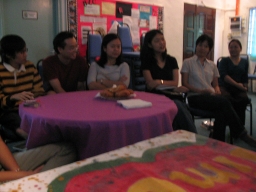

To be honest, every time we manage to organize a meeting inviting friends to come and participate it's hard to know what to expect. And then there will always be a surprise or two.
With a special "peace offering" from Jade - i.e. "Yau Cha Guai" (in Cantonese) and other goodies on the table, we stared introducing ourselves and telling in a sentence or two how did we land up here ... a couple actually said they didn't know :-), most of the others because we knew someone (or someone who knew someone), many of us are concerned with the changes that's happening in our churches as well as personal Christian lives in Malaysia, a lot of us are already on the emergentmalaysia Yahoo! group , of course there were returnees from our previous Christmas party and/or the kind of maiden meeting in 2004 last year.
It's quite amazing how it just started with 3 guys sitting in a room talking about some common concerns and the authors we've been reading (of course a number of emails to and fro). But, everything has got to start somewhere right. We honour small beginnings.
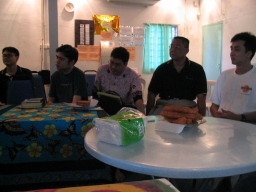

"Emergent seeks to create space where people who might not ordinarily interact with each other can gather and engage each other in areas related to theology, practices, culture and how churches and organizations engage missionally for the sake of the world. In order to do this we must assume a posture of openness, humility and desire. We must believe the best of one another. It's not that we won't or don't disagree (often vigorously) but rather we maintain the Spirit of Christ as we do so." ~ Emergent Village: Conversation
Some of us had a chance to share our stories in last years meetings, and last Christmas we brainstormed a sampling of what we thought were important to us. This round we started with Kia Meng ("our resident philosopher") to share his story and some insights he's picked up about his faith (especially the transitions, people and church communities that impacted him). When you have words like "Charismatic", "miracles on demand", "personal struggle", "questions", "losing my faith", "language to express my angst ", “Vampire Christianity”, “Barcode Faith” , etc combined with names like "Francis Schaeffer","John Piper", "Vineyard", "George Ladd", "Dallas Willard", "Brian McLaren", "Jason Clark", "Big Kahuna", "NT Wright", ""Mennonites", etc all in one interview (which I just prompted). This is one story worth listening (and still very much in the making - unfinished yet!) I think it was Nouwen who highlighted, "what's most personal is most universal" (something like that! *grin)
I was glad Liz with her advanced typing skills could record a kind of draft transcript of the interview and a number of "open" questions and interactions that emerged (*smile*) from his sharing. Once our emergent Malaysia website is ready hopefully we could post it up!
One close to heart concern was "evangelism" and how that really works out in a variety of circumstance (e.g. for "our neighbors", "children", those with disabilities, ect). This little interaction even strengthened my resolve to work on what I learnt 5 years ago from William J. Abraham, author of the Logic of Evangelism when he said, "The great need in evangelism is not for some new program, not for a fresh wave of activism, but for a renewal of theological vision and a reworking of our basic conceptuality" My intuitive sense behind the practical aspects of "evangelism" highlighted was this need that Prof. Abraham tallks about!
Later, I passed around this Missional Evangelism Booklet from another interesting similar kind of "network" the ekklesia project to a number of people (I still had some copies around). More stuff in there.
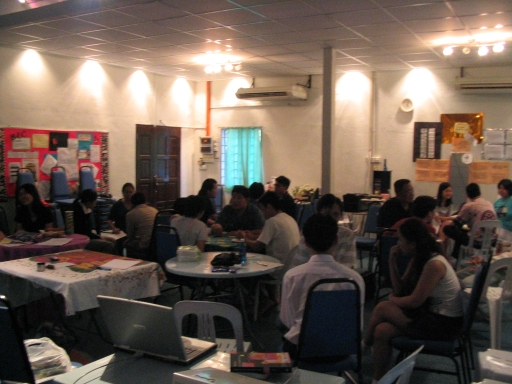
Then we broke into smaller groups to share our stories - with Yew Khuen giving us a simple framework from listening to practicing and then listening again (the cycle goes on)
Being the "facilitator" I had the freedom to eavesdrop and interuppt different groups and it was pretty facinating how these dynamics work.
Each group of at least three and not more than 4 (to facilitate closer conversations) and one person who tries (I repeat try) to be the scribe capture the conversations on paper.


After we drew the "conversations" to a close, we opened it up again just to listen to three groups share a sampling of their conversations. This included issues relating to "youth" growing up in a so called "Christian subculture" and then once "set free" (usually after going overseas for studies) realize that the faith they were brought up had no connection with their everyday life in the world.
BTW, there was limited use of lingo like "postmodernism", "postcolonialism", etc. Only a number of times with qualifiers. Due to the variety of individuals present from me as a pastor, to an "ordinary" lay person (which I think coming to a meeting like this is not ordinary!) as well as small groups leaders, worship leaders, Christian fellowship leaders and potential leaders, I strongly felt we needed to try our best to "include" all present as much as we could.
Another interesting thing is to take note of the Christian traditions kind of represented there today. We had for lack of better labels (or just using common labels) - Brethrens (which was a delightful surprise!), Lutherans, Methodists, Charismatics, Reformed, ... etc. Someone cheekily said, "semi-Lutheran", another quiped, "I'm a hybrid." And then all of us laughed because we are all pretty "Rojak" in a way (To our English speaking Global friends: Rojak is a kind of mixed vege & fruit dish). Indeed these labels carry less meaning nowadays. But it did help for humor at times.
having some form of record was very important, so we could go deeper beyond our last conversation and also trust that the time spend would somehow "change" us for the better.
I just took note in the booklet I mentioned above (which I gave a few copies out) comments on "Faithful conversation":
"Faithful conversation is multi-layered dialogue. As such it involves self-respect: a knowledge of and respect for one's own beliefs and positions, and self-exposure: an acknowledgement of and openness to the other as other, as distinct and different. And perhaps most important, a willingness to get caught up in the to-and-fro of the dialogue that participants may be profoundly changed in the midst of the process."
There's more and I think I learnt that today as I tried to discern the "language" that each person used to express themselves (I'm thinking about myself as well). The following is worth considering:
"... faithful conversation does not depend upon all members of the congregation (note: in our case participants in today's meeting and beyond) speaking the same language (whether ethnic, professional, cultural, or theological), but upon their openness to the koinonia of the Holy Spirit active and present in their midst."
I believe this happened today in many ways. And I'm thankful also for the post-meeting lunch conversations as well. Oh yes, I did manage to do my very best in describing what we're trying to do "Malaysian style" summarizing the info (and contextualizing it a bit)
like unpacking "growing generative friendship among missional Christian leaders" as well as what probably can be called the emergent order or commitments so we can move together locally as well as globally with friends on a similar journey.
On this Holy Saturday, as I remember that we're in between the Cross of Good Friday and the empty tomb of Easter Sunday, in this space of silence between two significant events of our lives, we gave ourselves to listen to one another and in the process I pray we heard God's voice for us in our time and context here and now in Malaysia. I loved what I read yesterday and I think the phrase itself is enough to energize me...
'It Is Finished' But It Is Not Over"
March 23, 2005
Emergent Msia 1st Open Meeting 2005
Well our so called emergent malaysia Christmas party was fun last year and a good opener. But we needed to get some focus. And I suppose after a few months, some of us have a better sense on how we can move forward. Anyway, if anyone in Malaysia or more precisely Kuala Lumpur or klang Valley area please feel free to pop by.
We're using a simple "title" to get us going: "Vertigo: What does it mean to be a Christian in Malaysia today?"
26th March 2005, Saturday 10am
at The Father's House,
23, Jalan Abdullah off Jalan Bangsar.
Here's a map and contact.
March 19, 2005
An Interview with BRIAN McLAREN
Well .. I suppose we better let him speak for himself. And he does so very well anyway. It's nice of White Horse Inn to give away free this complete interview with Brian. Listen and decide for yourself.
January 10, 2005
Emergent Village - Extreme Makeover!

I really like the more-than-a-face-lift Emergent Village Website (I can see more stuff added as well as revised to give us a better picture). Check out the Emergent-Us blog too!
wow! And now ... how shall Emergent Malaysia proceed huh? One step at a time ...
December 22, 2004
Emergent - Malaysian Style Xmas I
I like what Tony Joneswrote for the Worship Leader Sidebar about what is Emergent?, I think we can be seen as part of "the friendships with church leaders around the world, all of whom are on a similar quest of rediscovering the gospel in their contexts."
_______________________________________________________________
Emergent is a fairly loose gathering of pastors, artists, missionaries, church planters, songwriters, bloggers and others who are engaged in a quiet revolution within the church. Disaffected with the reified structures and theologies of both the Protestant "Left" and "Right," a dozen of us began meeting together in the late 1990's, and as our work has become more public, many more have joined in. Currently, we are forging friendships with church leaders around the world, all of whom are on a similar quest of rediscovering the gospel in their contexts.
__________________________________________________________________
About 18 of us met at my place on December 18th Saturday. Quite a number of new faces this round. Sadly, the pastors all couldn't make it except me (due to a variety of understandable reasons). And Alwyn missed it the last minute. Joel and Elise Vestal were special surprise guests who gave us some input and personal sharing on their journey and ministry which was good to avoid this turning out to be just about us Malaysians!

Of course, we started late ... but with food. There was quite a variety from chicken to duck, Pringles to fruits, curry to pasta, etc. Nice that everyone (most at least *smile*) brought food "offerings".

We did have a simple ice breaker just to introduce ourselves and sang a couple of Christmas carols. It's Christmas season! Why not? We mustn't take ourselves too seriously until we can no longer sing, right?

The flow from the start was good .. people laughing, and saying "I've been reading your blog" can be disarming. :-P
Then we got into something more serious and yet broad enough to get the brain juices flowing and some "conversation" going ... a simple question: "What do you think is important for Malaysian Christianity to wrestle with?" (something like that) and then we tried some more personal questions like "what are you passionate about (possibly hoping you can contribute to Malaysian Christianity)"? The questions were general enough to start the ball rolling. I'm sure we are not the only ones asking them or have asked them but the dynamics and the flavour of the discussions had some "Emergent" flavour I suppose (i.e. more systemic, cautious of a quick fix, very conversational, etc).
We had three groups ... a decent mix of men and women. Our youngest was 17 years old (he just finished his high school exams!) our oldest was eh-hem people in their early thirties! It was interesting to take note our many of us got introduced to what is now called the "emerging church" or "emergent" conversation through different concerns from the need for more holistic experimental woship to more conversational evangelism, from reading Brian Mclaren's books to reading one anothers blogs.

After individual groups shared with one another, we had brief reports with others chipping in. Everyone had a chance to listen what others had to say and ask questions.
I have the Mah-jong paper with me and took some digital photos of the input from these guys and gals. All the answers were in very lay-human and grassroot lingo. Nothing ivory tower here. I joked that some of those present can complicate the language a bit and send it to our Asian theologians for comment.
After the "official meeting", many still stayed back for more "conversations" which usually unearthes other goodies.
so it was not just about food and fun ... all came bringing their contributions. The contributions in the "conversations" were most precious of course, then new connections in relationships as well as insights. More in another post ... time to pick up son and wife!
December 15, 2004
Emergent Criticism
For those who have been following the conversation, I think you'd appreciate the following two pieces:
1. Emergent Criticism No.1: 7 Years of Spanking by Andrew Jones
2. The Emerging Storm by Stephen Shields
For those who haven't been following the conversation, I suppose you're always invited to join if you like. For some of us, we're meeting this Saturday 3pm at my place, we'll leave the criticisms aside for now (we haven't even started to talk and listen more yet), and get on with some fun and food.
December 07, 2004
New kind of Christian: Brian McLaren's Emergent voice
Here's a quick link before I head off to Port Dickson ... It seems Brian McLaren and "Emergent" is getting more publicity these days. Hmm.... here you go ... New kind of Christian: Brian McLaren's Emergent voice
The Emergent matrix: A new kind of church?
So finally the article we've been waiting for ... The Emergent matrix: A new kind of church? with favorable comments from Maggi Dawn (From UK) and Tony Jones (From USA)
This will be my bed time reading tonight .... (in Malaysia.)
December 03, 2004
The Inclusive Church

The Inclusive Church Conference 2004 is on the move. It's a A three-day conversation with Brian McClaren, Steve Chalke & Jason Clark exploring theology and action in emerging culture.
I wonder whether our friend Jo is the only Malaysian there ... and then She's also Chinese as well as a woman! Three cheers for Jo. I'm anxious to hear what's going on there.
Thanks to Doug Pagitt for a glimpse of Johny Baker has posts on the event too ... check out gospel and justice and inclusive church
December 01, 2004
The Lost Pomo debate
Thanks to Andrew Zirschky for making The Lost Pomo Debate: Jones, Kimball, McLaren, Duffy & Chap duke it out at YS 2003 available.
November 22, 2004
Emergent Cohort CJ "sample" meeting
Thanks to Tony Jones for the link and Adam Cleave a chance to peek into and eavesdrop what's happening on the other side of the ocean at Central Jersey, here
November 01, 2004
The Emergent Mystique & Response
I'm slow to post this up partly because of quite a crazy two weeks but here it is The Emergent Mystique and a personal response from Andy Crouch the author of the article thanks to Tony Jones (this where the Internet and blogland is fun!)
October 19, 2004
Another conversation with Brian
Thanks to Abductive Columns for the link to A Conversation with Brian Mclaren conducted by the provokingly named Church Marketing Sucks! (Will read it before I sleep tonight)
October 08, 2004
A Primer on Emerging Church?
Thanks to Chris Erdman for these insights ... (I must say the past four years has been a great ride for me in terms of re-entering the Bible and do some serious hard work theologically ... side by side with an openness to "innovations" & "Improvisations" .. I love the "Jazz" metaphor ... plus I feel not only am I not finished yet, I just got started!)
Well, understanding postmodernism is one thing, understanding the emerging church phenomenon may be another. There's a good deal being written in emerging church circles that tends to be pretty silly...that is, untethered to anything substantial. It can be terribly fadish and experimental, which is not a bad thing so long as it is understood this way. Stanley Hauerwas (theologian from Duke) once remarked to his students who so quickly wanted to depart from the tradition: "you don't know enough about the tradition in order to depart from it!" I think this can be true in emerging circles. Folks, disenchanted and disenfranchised with traditional Christianity haven't done the hard work of understanding history and theology. Luther and Calvin were reformers who understood such things and were competent to challenge the errors of what had become of the tradition.While I celebrate the new openness for the gospel that comes because of postmodernism's questioning of Modernity, I am not a postmodernist. What I mean here is that postmodernism cracks open the church's captivity to Modernity so that we can re-enter the Bible and do some good hard work theologically. In this sense I am a theological conservative. Memory of the tradition is vital, but I am also extremely open to innovation that "does jazz" on the tradition. As any good jazz musician knows you cannot improvise unless you "know your scales" and have rehearsed them over and over again. There is a "ground" necessary for good improvisation and experiment. There is much that tries to be music but is simply noise in my ears
I think understanding what the Lord is doing to birth new expressions of the kingdom today means understanding how we got here in the first place. In my mind, Lesslie Newbigin's little book, Foolishness to the Greeks has pride of place. If you're looking for a more expansive survey . . .
I'd recommend David Bosch's, Transforming Mission: Paradigm Shifts in the Theology of Mission (he does biblical and historical work and charts a course for missional renewal after Modernity).
Then you might want to understand how people critique the place the church has occupied in the last centuries. For an entry into this I'd suggest Willimon and Hauerwas' book, Resident Aliens.
And finally, reading testimonies of the experiments in newness can give witness to emergence...but these experiments must not only be new and technological; they can also be experiments like Bonhoeffer's little school for Confessing Church pastors in the 1930's, George McLeod's experiment in Iona, Scotland that began about the same time, Brother Roger of Taize's experiment that began in the mid-1940's, the Focolare movement that began around a Roman Catholic nun in France following the war, the Catholic Worker movement around Dorothy Day, and on and on...it would also be interesting to explore the monastic movements in the early church, and the organization around St. Benedict in the seventh century. All of these are expressions of Holy Spirit emergence at times when the church became to captive to the Powers. You see, emergence is not just happening among GenX and GenY, but has been happening whenever and wherever the Holy Spirit has seen captivity and has found some daring enough to try new forms of missional obedience. Among the GenX, etc. Brian McLaren and Doug Pagitt are thoughtful,and I'd certainly add Tom Beaudoin's book, Virtual Faith to the list. Len Sweet rings a hollow note to me and frankly I'm not exactly sure why. It may be that from all appearances he is merely a reporter on what he observers. He's a very capable and entertaining reporter, to be sure, but he doesn't seem to have have real and personal ties to a Christian community to which he is yielded...that is, he is apparently not deeply embedded inside living, local commuties and therefore while his reporting is interesting it doesn't speak authentically to me.
As to other able interpreters who are writing today Alan Roxburgh and Darrell Guder would top my list. But there are many others who would be helpful too--Wendell Berry on economics and environment, George Lakoff on politics.
My reply to Will on the "E" words
Willzhead asked me "What do the words 'emerging' and 'emergent' mean in that context?" (I presume our context here in BLC, KL/PJ, Malaysia)
Here was my quick reply which he said made sense ...
I think for me "emerging" is (1) more of a description of the reality
we're in - i.e. we a young four year old church is "emerging" and we
as a Malaysian church is still "emerging" (thus avoiding a static
arrived image or mindset) (2) I guess building on the first and
somehow tugged in the back of my mind is something you wrote as it
being a "value"
Now for "Emergent" - I think of it now more like a "learning space" or
posture (cf. McLaren's tree metaphor was helpful here) and applying
that kind of thinking in how we do ministry has great possibilities.
But deep down ... my motivation is more "missional" and that's the
reason why I find "emerging" church values, and "emergent" thinking
"useful" & "helpful" to allow me to explore this dimension more. As
one who serves in a mainline denomination we often maybe "missions"
minded or evangelistic but also have "maintenance" mindset at our core
... thus, reminding ourselves that we have not really "passed"
through the missionary context , even though like in Malaysia all of
the early missionaries or pioneers have left, and we're tempted to
think we are "established" churches ... I think that is not the case.
Does all this make sense?
September 28, 2004
Emergent Malaysia Notes (one more)
I'm delightfully surprised by the responses "generated" by our so called first pretty informal gathering actually. Even thoughts from some one who missed the meeting like My Tightrope had some worthwhile questions feeding our future conversations here Emergent Rising and Knees Knocking..., and I thought I was going to have a day of rest today, turned out my mind is still on overdrive! Here's an excerpt from his post:
What is exciting me most about the "Emergent" movement is the rethinking about our relationship and (to use an increasingly common word) conversations to God and to everyone. Sounds almost cliched but that is exactly what is needed. A rethinking needs, no pun intended, to be thought out. In this particular loci of time, when theology, good and bad, is becoming more prevalent among the masses, when religiosity is giving way dogmatic deconstruction and when our elders start to squirm in their seats and wonder about the good ol' days.
Where then is the balance? How do we emerge the church in the greater society while holding on to the non-negotiable commandments lest syncretism creep in? How do we balance the touchy-feel conversations and keep our relationships real and fruit bearing to other people looking in? How does the Emerging Church fit into our tapestry of cultures, filial bonds and moral-tradition codes and how can it be relevant without the frequent bumbling Christian toe-stepping evangelism approach? Lotsa questions and lotsa looking forward tos.
Emergent Malaysia Notes (dua)
"Dua" means 2 in Malay. Here's another set of notes and a comment from an overseas friend, I like the "the Church is always “emerging” everywhere around the world. " phrase which is why we decided to jump in and join the party!
From The Confessions of A Hedonese
Had a most stimulating conversation at Bangsar Lutheran Church in the first Emergent Malaysia meetup last Saturday. It's a great pleasure/privilege to meet up with Sivin and other online frens who share a passion for theology and mission
... What's Emergent?
It's a learning community.
It's about sharing resources
It's about exploring what it means to be Church in Malaysia
Some reflective, sensitive folks may wonder, "What has DA Carson to do with Brian McLaren? What is a foundationalist like Dave doing in Emergent?"
Good question.
This may evoke awkward scenes from my confession of 'speaking in tongues' before a group of cessationist-separatist KJV only folks.
My encounters with Brian McLaren were limited to the 'open letter' he wrote to Chuck Colson abt the death of postmodernism, snippets of "The church on the other side" and... stg close to my heart... 'Finding Faith' an excellent evangelistic book I plan to give to open, actively seeking friends.
Having read Finding Faith, I dun find any endorsements for relativism at all. For most parts i nod with a hearty Amen. Yes, in certain parts I wished he had not made too much concessions ie Darwinism but they are hardly worth mentioning.
He casts doubts on our perceptions of the truth but I can't find any denial of the possibility that true truth can be known.
McLaren's honest, sensitive, warm and humble 'soft' approach is something any would-be apologist could do well to emulate. William Lane Craig's apologetic may be great for a hardcore atheist but it may not be the best approach I'd take to an open, searching agnostic.
So I'm hoping that in our conversations, postmodern values towards community, the person, beauty and leaving room for doubt may emerge and converge with robust logic, absolute truth and the elusive art of smashing arguments with a touch of gentle humor.
From CS Lewis, we know these qualities can co-exist in harmony to the glory of God and the good of man!
From Steve K.
Is the “emerging church” just a Western/American thing? I think not. In fact, the Church is always “emerging” everywhere around the world. Brian McLaren has been writing some fascinating stuff about the “post-colonial” church in Africa. Another part of the world that I have a great love for is southeast Asia, and I’m excited to pass on the news that there is a growing movement in Malaysia. My heart and my prayers are with my brothers and my sisters in that part of the world.
September 27, 2004
Emergent Malaysia Notes
These two individuals just have the amazing ability to construct beautiful paragraph art pieces with words. In short, they take better notes than me! Here goes some excerpts ...
From Messy Christian's Emergent Malaysia's first meet (click the link for some cool pictures from her point of view)
Wah, sound so grand but actually it's just a couple of folks getting together to tell their stories. It was a 'safe' place to confide, hence therapy - something I didn't think the meeting could be.
Meeting people who knew who I am is a little weird ... apparently I have "fans" who read my blog in Malaysia and again, it's really weird. I just write what I feel ... I'm honoured you guys are reading. Terima kasih! :P But anyways, each of us shared our story. I think mine was really disjointed because halfway I forgot what the heck I was talking about!
But hearing the stories, I was amazed at how I could relate to so many things that they said. We laughed at our experiences, and how refreshing that was! The fact that we're not alone in our thoughts was wonderful. Apparently I share something in common with two of the women who attended - we've all been labeled backslidden and rebellious by our fellow Christians. One of them said something that really hit me: "We expect Christians to act better, but somehow they are even more cruel to each other for some reason." (paraphrase)
The fact that we could do something with our way of looking at Christianity and our faith and affect some kind of change was exciting. (The ability to create change is a big part of who I am.)
From Alwyn Lau's Story Loci
It was a lively session, facilitated by Sivin (who, if I'm not mistaken, sought to 'deconstruct' the Asian inclination towards silence! *grin*!). Met up with my Hedonese pal whom I haven't seen since, well, some time, and who introduced me to the phrase, 'evangelical Muslims' (how about 'emergent Muslims', some of whom we may be seeing at the UMNO General Assembly this past few days?). Also present were Messy Christian (who boldly kicked off the conversation by sharing how relieved she was that her questions didn't prove her 'weirdness' - in some ecclesial eyes, at least - but have in fact been pondered on seriously by many emergent authors, e.g. Kimball, McLaren), Yew Khuen and his fiancee ("I'm here because of her," said YK who also added with a grin that there's something profoundly true about the statement), pastor and church-planter Alpha and his wife (from whom some of the best lines of the day were spoken, e.g. "Emergent represents church history in the making", "We ought to care for the 2 and 3 as much as we care for the 2 or 3 thousand"). Delightfully, there was one theme constantly, err, 'emerging' which kept the stories united, giving everybody common ground, that of how drums were equated with 'revival' in some churches! (And do I hear somebody thinking of African tribal music?!)
September 25, 2004
Emergent in Malaysia ... baby steps

At first I thought could it just be me? I dont't think I'm the only guy who resonates with a big chunk of the stuff in Emergent Village right?
Then some emails exchanges transpired. The next thing is three of us young men met up - three pretty good looking I must say (all praise to the creator! *grin*) Three coming from quite different starting points but with common questions and apparently converging on a similar journey and of course one must mention some interests sparked by Brian McLaren and NT Wright and some other cross-interests here and there (actually there was a fourth one - most "cool" looking chap actually was and still is stuck in UK at the moment, we await thy return oh philosopher).
We lay silent for some time ... but began blogging (or tried to) but the emails, the phonecalls, and whenever possible face to face meetings but usually separately. A five guy somehow got "included" ... then later started blogging I had the honour of meeting him for the first time today ... we tried hard to try to meet together but then ... it was just typical Malaysian schedules (read - busy! - for all sorts of reasons) I also noticed the lack of female participation here and I was the only pastor (which I didn't mind)
And then off I went to UK and then later Germany for a month this year. Upon my return I just did a jump first, fear later and we finally fixed a meeting and asked some interested females and other friends to meet up ... had interest even coming from those who read this blog.
Some could make it, others said maybe the next round, one fell sick and others due to other reasons. I was happy three wives turned up (that increased female participation immediately together with another three ladies! Thus a total of 6) One Toddler and one baby were eaves dropping ... and the 6 of us guys
(wow! it's the number 12 for adults! )
Not bad for a start ... let's see what's going to happen when we meet again in November 6.
Now, I have 101 things I'm reflecting on ... all in all ... Thank you, Lord. My heart is full of gratitude as well as a load of questions to ponder.
September 22, 2004
Future of the People of God

Thanks Jason Clark for pointing me to download a load of MP3s here on "The main talks given by Tom Wright at the Future of the People of God conference" (a nice bonus reflection by Jason is good reading too)
Another word of thanks to all those at Open Source Theology and Church_SHIFT for making these available to many of us who couldn't make it to the conference, a Big TERIMA KASIH (thank you in Malay)
September 15, 2004
Complexity Theory and Emerging Church
Thanks Maggi the link to these timely insights:
_____________________________________________
Unlike passive components, such as water molecules, human beings presumably can direct their own interactions. Thus the connectivity of "the church" itself is a dynamic process and not a static map. How we interact with one another becomes one of the defining features in an emergent systems view of the church. If we isolate ourselves, then the church will tend toward a static or fixed attractor; if we interact with everything around us, then the church will tend to become chaotic and overextended to the point of failure. Maintaining an optimum autopoietic state requires an adaptive form of connectivity, sufficiently self-contained to maintain stability and individuality, yet sufficiently responsive to the world to benefit from the synergy of working together. In the jargon of complexity theory, the church must exist at "the edge of chaos."
________________________________________________
September 09, 2004
Emergent - M'sia ... baby steps
It's been encouraging so far ... slowly but surely some Malaysians who have shown interest in the past (on a personal basis) as well as new people whom I've never met (thanks for the emails!) are all "curious" of what the conversation is all about and would like to join the conversation on "What does it mean for us to be and do church in our Malaysian context?" (whether it's with the awareness of the postmodern discussion sparked off by our friends in Emergent Villageor even this idea of being in a post-colonnial context ... mentioned in my responseto Brian McLaren's Africa Report ... hmmm.. or just plain curious)
I read with interest The Skinny on Carson's Emerging Church Tapes 1.1 because of the critique (and possible misunderstanding?) by Carson and Andrew's steady response. This morning found The Emergent Church - Another Perspective: A Critical Response to D.A. Carson's Staley Lectures (pdf) by Dr. David Mills to Carson's critique very helpful
Personally, I find myself resonating with the vibrations of Emergent as expounded here , since "Emergent is a growing generative friendship among missional Christian leaders" and some of us have managed not only to interact online but also meet face to face which indeed has been enriching. Why not invite more to the table for the conversation? How about being more intentional about it?
September 07, 2004
The Complex Christ

I can't recall where I got the link (but thanks anyway!) I've read some of the free downloads and found them helpful to sharpen my own thinking on these matters. Here's a quote to help get a gist of what's in the book ...
"...what if the Church faced up to its fears, stepped down into the dark valleys and began to consider completely new ways of being? What if it explored the possibility of adopting an evolutionary - rather than a revolutionary - approach to change?"
The Transcript of an email conversation between Kester (the author of the book) and Ryan Bolger, Assistant Professor at Fuller Theological Seminary, covering the origins of Vaux, leadership and complexity gives some useful background and context where this book is coming from.
As I seek to explore what Emergent-Malaysia can spark or serve as a catalyst, and how all this works in a local church context such as Bangsar Lutheran Church (which is connected and part of a so called institutional denomination), this whole idea of "evolutionary" approach to change is a good thing. Plus, we in Malaysia have not really experienced what people term as "revolutions" in our historical contexts anyway (though some might have tried) .... hmmm ... brain juices bubbling ...
September 02, 2004
Emergent - Malaysia?
I once asked Jason Clark, "Who's the Emergent contact in Malaysia?" and he said (I can imagine the smile on his face), "You Are!" ... "Oh! I am? .... ok!"
After an interesting and encouraging conversation with a more senior and also wiser pastor who's serving and leading a presbyterian church, I suddenly felt the fresh urgency to maybe take steps to be more intentional about this. He even found me in the Emergent Village website whcih needs to update my contact *grin*!
Apparently, there are others like Messy Christian who has some thoughts aboutt the emerging church. I wonder whether there are more in Malaysia
Some of us are already planning to meet up on in a couple of weeks time just to get acquianted face to face better. The four of us has been in email contact, and some of us have been in touch in some other way. The common link humorously speaking is reading Brian McLaren books... :-) and the pastor I mentioned above was excited and challenged by the Church on the other side (which I think is a fabulous book and a great !) We've been sturggling for some time to try to get a kind of Emergent Malaysia co-hort get jump started :-).
So whatever it's worth ... allow me to try again ...and do a JUMP FIRST, FEAR LATER move. If there's any Malaysians overseas or here locally who's interested in the kind of conversations about how we can "be", "do" and "think about" church in our Malaysian context today and also get connected with other voices globally, please contact me..
I don't really know what to expect ... apart from surprises ... but deep down my passion and interest is to see these reflective conversations help us in constructive living, ministry and engagement wherever we are - especially in and through the church. We can all start from where we are :-)
Here are some of my sketchy scribblings and links (or just type emerging or emergent ans search the site *grin*), like all the stuff posted up in this blog ... all thoughts and feelings and reflections are not final but as always are works in progress:
We want to go far ... together!
In the church, but not of it ...
Is emerging only Western?
the new face of global christianity
Emerging Church ~ Thinking from Malaysia
Better late than never
So it's not about starting another organization .... but it's about creating "space" for us to take the first step or maybe a second step to where we believe God is leading us in the days ahead ... Emergent is about "A Generative Friendship Among Missional Christians Around The World" I like that, and I've experienced it personally especially through new relationships through the internet and more so face to face. So, I guess, what we'll do is what the following paragraph tries to explain ...
Emergent is a friendship. Becoming a part of a friendship is a quite different from being part of an organization. It's more like joining a conversation.
To join a conversation, you need to hang around and get a feeling for what's been said before you arrived. This involves listening, maybe asking a few questions (doing a little homework) at the sidelines of the main conversation. Then you wait for a good place to contribute to the conversation-with an apt question, an observation, a story, whatever. A friendship is always mutual: you contribute to influence and enrich others, and you listen and learn and are influenced and enriched too."
August 17, 2004
We want to go far ... together!
"if you want to go fast, go alone. If you want to go far, go together." ~ African saying
I read Brian's African Report with much interest. Strangely, he went south to Africa, I went North to Germany :-) I'm no Brian McLaren and have much less wisdom and insight to contribute *grin*. This humble chap has struck more than one chord in me with some of these reflections I'll pick out. I thought I'll just duet with them a little ... (Brian's words in bold, mine in italics)
__________________________
We talked about the gospel in a post-colonial setting. I truly believe that the way ahead lies for Christians in the global north (who face a postmodern transition) and those in the global south (whose transition is post-colonial) to be in close dialogue as partners. That dialogue began happening during our time together.
"Close dialogue" is going to be beautiful music. There's a place for "debate" I suppose (dissonance and tension is part of music too). But, before we get at each others throats, it's wise to listen with our ears and hearts, to learn even with so much "puzzlement" going on in our heards often sparked by "the other" and love in our words and deed the way we're called to be.
That little remark on "the gospel in a post-colonial setting" indeed resonates more with us here (at least in Malaysia) as compared to "the gospel in a post-modern setting". As a Malaysian (and Asian), I need to be more confident in working through how the Gospel is speaking into our context and articulating the way we're wrestling withthe issues that confront us. There's more work that needs to be done here especially at the local church setting to make time for the conversation on "the gospel in a post-colonial setting" vibrant.
I went to Africa with a hypothesis: that the conversation in America and Europe (and elsewhere) about the postmodern transition had a counterpart conversation in Africa - a conversation about post-colonialism. I come home very certain that these two conversations are part of one larger conversation, and that the larger conversation is the one worth having. This confirms my conclusions from similar experiences in Latin America over the last several years, and I hope to add Asia to my "research" in the next year or two.
"Your most welcome to come to Malaysia, Singapore is nearby, Brian!" :-)
I have also found a a kind of "freshness" in some of my conversations with a German pastor who's serving in our denomination as a Theological consultant. On one hand, Asians need to rise up and be heard and of course communicate clearly what are our real concerns are (either we've been too busy or too silent or both!). On the other hand, we need to guard against a kind of over-reaction and isolate ourselves in our own worlds (which is increasingly impossible) Thus, I agree with what Brian says about finding ways to get Christian Leaders from the four corners of the earth talking
The next step is to try to find ways to get Christian leaders in the global north and south and east and west talking. There´s a saying in Africa: if you want to go fast, go alone. If you want to go far, go together. I trust we can go far, together with these emerging leaders from the global south. We have much to learn from their faith, their vibrancy, their courage, and their experience. And perhaps we can offer them gifts in return.
I feel really blessed to be part of some events that encouraged this kind of "talking" whether it was the Asian Mission conference last year, or the little connection I've had with those working in the Lutheran World Federation and especially the recent Summer School (and of course the bonus of meeting up with Jason and Maggi). Just the last month alone in Malaysia there were two events which I believe is supposed to encourage such conversations namely the International Association of Missions Studies conference and WCC's Faith & Order Commission Meetings. So, all these experiences make me feel the urgency for this kind of "close dialogue". I'm grateful for these "not so frequent" chances offered to me some how ... I'm sure God has his purposes in his divine wisdom for me to have these adventures (trying to sound "spiritual" here *grin* and yet I do believe He's surely hup to something though I'm not too sure about the details!)
I guess, the challenge is how can we have something that's more long term rather than just short term "highs". And most important for me, is how can these conversations really get to the "grass root" level especially in some ways in the local churches and pastors. And then how can we involve emerging leaders from those in their late teens, to twenties and people like me in our thirties :-)
The modern western colonial gospel was a beginning, for them and for us, with many strengths and weaknesses; now we must press on together to learn what the gospel "after modernity" and "after colonialism" says to us and our changing, dangerous, hopeful, unpredictable, needy, glorious, and gifted world. All we do as a local church here at Cedar Ridge is part of a larger symphony that the Holy Spirit is conducting around the world. May the music be beautiful, to the glory of God!
I was really touched by Brian's encouragement to Cedar Ridge (his church) and how what happens locally is part of what's going on globally. That would be my prayer for our young congregation too ...as well as every local church in Malaysia and beyond ...
And I really agree with the saying Brian quoted ... if we want to go far, we need to go together!
___________________
June 20, 2004
Three Strands of Emergent Thinking about Church
I was drawn to read THREE STRANDS OF EMERGENT THINKING ABOUT CHURCH, and was happy to find there's a place in the article that encourages "soft voices". Awesome stuff here!
_____________________________
...Building church community is not just a “moral responsibility,” it’s also a formational responsibility, a missional responsibility, a pastoral / incarnational responsibility to care for and love the “sheep” that God has entrusted to particular congregations, it’s a leadership responsibility, its our responsibility because together we are church.
... Healthy church becomes people taking responsibility for maintaining an individual and collective spiritual ‘diet’ that grows and nourishes them, for allowing God to form them…it’s wayfarers on a journey home together, bringing their giftedness to a mix of theology and praxis, it’s accompaniment not duty, it’s dreams and hopes nourished by Word, Spirit, meals, and the ‘give and take’ of conversation; it’s “doing” more than speaking; it’s caring for people rather than talking about caring; it’s people nourishing, loving, praying, receiving, and generously supporting the sense of giftedness and call that rests on each other. It’s friends encouraging and creating the kinds of base ‘soil’ conditions (e.g. values, practices) within which Christian community can deepen and flourish. Friends together “carrying” and enriching the vision.
... The reality is that who we are, the ‘worlds’ we live in, our education, our competencies, our passions, and our specialisations can’t but help but shape forms and practices of emerging church. We would be inauthentic too ourselves if who we are didn’t…
... Accepting that, the challenge then becomes how we ensure that we make space for, and encourage the speaking of divergent voices, for the gifting to our respective “mixes” of voices like Ched Myers, William Stringfellow, the voices of those from Asia and South America.
... We need divergent expertise to broaden our tendency to myopia, multiple “strands” to enrich, to add ‘colour’ and to add texture to the ‘fabric’ that is the emerging church.
... The implications of the gospel are always richer and broader than my “seeing,” my experience, and my understanding. I need woven into my life the diversity of others who together with me share a dream for church.
______________________
May 29, 2004
What African Theologians can teach the Emerging Church
Thanks Geoff Holsclaw for the following posts which I've printed to read. Wonder how the Asian Theologians are doing ... heheh, and I'm in Malaysia ... part of Asia. Anyway, nice to see a North American draw from African contributions. This mutual learning (we read you, you read us, we read ourselves, you read yourselves, all reflect and move forward!) is the way to go.
What African Theologians can teach the Emerging Church
Part One: The question of relevance and identity
Part Two: The Question of Identity: Ancient Parents and African Siblings
Part Three: Indigenous postmodern Faith
March 12, 2004
Wish I was there ...

well, I'll just have to be contented for now by reading the kind efforts of Chris Monroe (love the pictures), someone new to me Bob Carlton (lookingforward to download notes) and a much needed female perspecive by Anna Aven
February 18, 2004
Is emerging only Western?
Find out what my new found friend or he found me DJ Chuang says, click here ...
Some thoughts from Emergent Village's Forum under "people of color & the emerging church", click here ...
February 15, 2004
Emergent Democracy
While thinking about Emergent & Emerging (thanks to Maggi Dawn for that distinction!) I googled and came across this paper by on Emergent Democracy (which I think helps me see things from a different angle and a bigger picture)
Emerging Church ~ Thinking from Malaysia
I haven't sat down to seriously put some thoughts on this yet from where I come from unless the one in the Emergent UK group blog is a try or warm up. But reading some issues brought up by some "sensitive" brothers helps and will sharpen what's on my mind (I decided to put some comments for them):
"where are the voices of our brothers and sisters following Jesus in the developing world? How can we best represent them if they in fact need representation, in this Emerging Church Debate?" ~ From Last one for the day I swear...
"the latin/african church, i suspect, is fairly indiginous to its culture(s), and in that sense it has been emerging (in steve.taylor's sense of the word) for many years. they are the emergent forerunners." (by the Baldman)
"The only confusion I have with the whole deal is the way in which we have exported Christianity to the developing world. I cannot speak for South America as I have never travelled there but my work in South East Asia has taken me to many churches in a few countries in that area. The expressions of church in those places is decidedly medieval Western Europe centric in terms of ecclesiology, and while I think about it, culture, liturgy, social practices et al."
~ From The Bald Man, The Emerging Church, and Voices from the Developing World...
"I don’t find much in the “emergent” conversation that helps me to understand the multi-cultural suburbs of Paris, as “post-modern” as this context is or might be. I have to go to Africa for that...or at least talk to my neighbors. It seems to me my “emergent” cyber-friends could also learn something about what God is doing in the world if they looked South (and I’m not talking about New Zealand) or simply opened their eyes to the “ethnic” churches springing up all over western urban centers and their understanding of "post-modern" phenomena."
"The center piece of our epoch in church history is that the vital center of global Christianity has moved to the Southern hemisphere. This phenomenon has been called the “browning” of the church. I am precisely interested in the point of contact between Christian Africa and Post-Christian France, the place where I live and work everyday. Can anyone help me?"
~ From the metissage of the church
February 11, 2004
Better late than never
Finally, I posted some thoughts on the emergent group blog.
_______________________
Thanks Jason for inviting me to this group blog. In Malaysia especially in Kuala Lumpur we have a tendency to be late for appointments and we usually blame the traffic (which has gone nuts lately). Anyway, introductions are necessary since I stay on the other side of planet earth and sometimes wonder why I'm attracted to the conversations revolving around the "Emerging Church" (maybe because in Asia we never managed to really emerged yet or are still emerging?!) Lines of convergence: global-urban-postmodern by Geoff Holsclaw is interesting in this regard.
My full name is Sivin Kit Hsiao Ming (here's my blog for more current thinking). Kit is my surname, Sivin is my English name (it''s origins is a strange story) and Hsiao Ming (in Chinese means the voice of a bird singing in the dawn or one who knows how to sing). I'm 32 year old Malaysian Chinese married to one wife and have a 16 month old son. My education in Mandarin, Malay & English (I spent five memorable childhood years in England). I think I'm middle class by our standards but I wouldn't consider myself affluent. In many way I would see my generation as the one who grew up in the Dr. Mahathir Era (prime minister for 22 years, phew!) and now experiencing the changes with a new prime minister (who's just completed his 100 days yesterday) - we've just been going through changes after changes & challenges after challenges as a nation and as Christians (all of us globally too haven't we?). Presently, I pastor a young four year old church ~ Bangsar Lutheran Church. Before this I served as a youth & worship pastor in the home church I grew up in. I pretty much grew up in the city, so I've got minimal experience in the rural areas personally and pastorally. I was wondering the past week what to write. I think I'll start from a personal question:
Why do I (on this side of planet earth) feel at home in some of the discussions around the "emerging church" (which some might think is only western church phenomena) and would be willing to join the conversation? Well ... let me try to answer that:
1. I felt some issues were converging. It was rare to read stuff that resonated with some (not all) the questions and experiences I faced starting especially during seminary days and since starting & pastoring this young church. We still don't have much written from an Asian perspective, so we're still dependant on a lot of material from the west. So all the Brian McLaren stuff was very refreshing (that was four years ago and still is today). For me it wasn't whether it's from the east or west, I felt many issues raised were very human issues .... first & foremost.
2. The "willingness to initiate conversation and listen" to a variety of voices is one value I feel is very valuable especially at this global level. Though in many Asian churches here this may not be the case because conformity, control and submitting to authority seem to be the dominant driving force at leadership levels. But I believe the reality is at a deeper level many would hunger and yearn to be heard and mutually work towards a solution. I see myself as one of these. It's ironic that especially in the business sector there's such a strong drivenness and yet there's also this talk about good relations ("Guan Xi") which demands respect conversating and listening.
3. The conscious effort to go beyond mere surface issues of methodology and style and get into theological thinking, and contextual awareness .. and missiological innovations. Pragmatism rules here in Malaysian churches. At seminary I could see how some of my teachers struggled to see how they could counter this kind of "framework". Every sort of methodologicial package has been introduced to Malaysia in all sorts of shapes and sizes (cf. seminars), some helpful, others harmful. The gap between the more reflective thinkers (e.g.. seminary lecturers)and the pragmatic practitioners (e.g. Pastors & church leaders) may drift too wide if nothings done about it. Thus, I appreciate what Emergent is doing with dialogues with people like NT Wright & Walter Brueggamen. It gave me some hope and ideas what could be done (I've been talking with one of the seminary's principal on possibilities, and hope to initiate a informal group of 4-5 end of this month to see where it goes from here).
4. All this not done in an ivory tower manner. The beauty of this whole thing is we're very much on the ground level trying to work things out and think things through while in the midst of slogging in out in daily life & ministry in and through the church. And since I started blogging and reading other people's blogs, i've found mirrors that not only reflect what's going on in their particular context, at times it serves to to help me see myself. We're not just looking into the sky for help, we look at one another and keep our eyes on the ground. That's valuable.
I was reading the revised and expanded version of Models of Contextual Theology by Stephen B. Bevans and found some ways to think about the context I'm in right now which is the background which the above 4 poins arose. Because it's hard to say whether how Malaysia fits into the whole modern/postmodern discussion (Wikipedia has a good summary on Malaysia) ~ maybe that's why I feel more included in the term "emerging". I've already mentioned the more personal stuff ...
Next , on a more public level, Like many other South East Asian Countries we're in the post-colonial era, and overwhelmed by the forces of globalization (whatever that means), struggling to achieve the vision to be a developed nation. Islam is the dominant religion here (60% of the population are muslim). The Chinese would mostly be nominal Taoist or Buddhist , and the same could be said of the Indians for Hinduism. Of course, there's always the mix of atheist or independent religious groups. Often religion goes along the racial lines and is still a very sensitive matter. The 11% Christians (including the Roman Catholics) have a mixture of races (except there would be few Malays who are Christians ~ that's another long story). Then there's the more "modern" or "postmodern" influenced people ... whether it's from money to MTV. McDonalds to Movies.. etc.
As for churches or para-churches, most people probably would have heard more about the "cell church" than the "emerging church". Almost all churches have Evangelical, Pentecostal & Charismatic influences (hardly any liberals here!). To many of my teachers in seminary, there's was a great concern that we'll drift more and more into anti-intellectualism here. Some groups like Fellowship of Evangelical students & Kairos Research Centre would want to encourage more critical thinking (sound very "modern" huh! *grin*) some newer churches are "emerging" inside and outside "traditional denominational structures". For example, I see the church I serve as one within a denominational structure (Lutheran), I know a friend left a Charismatic church and more like a house-church, another friend who had always led a "para-church" youth organization starting his own church (which to some might look like a youth church), and so on all of us below 40 years old. All of us are extremely different apart from enjoying each others company and encouragement once a while. That's just the surface .... a little bit about where I come from.
wow! I realized this is a long post ... it's late and it's long. Thanks for your patience & listening ear.
Posted by Sivin Kit on February 11, 2004 at 05:26 PM | Permalink
____________________
February 06, 2004
Emerging Church
Jason Clark was kind enough to invite me to join the emergent group blog. Haven't put up my maiden post yet, maybe little shy? Most of the voices on the "Emerging Church" are from UK, USA, Australia, New Zealand, and maybe parts of Europe. The "language" is mostly framed with the however-you-define-it "postmodernity" in mind. So I do feel timid and a little inferior so speak as a 32 year old Asian - Malaysian - Chinese-male (actually why should I feel this way ... just being honest here!).
I'm planning to enjoy this weekend's ministry first with our Interactive Worship gathering tomorrow and teach our first See Through the Scriptures class and then be a "contributor" to HELP Christian Fellowship's Leaders Training from 2pm -7pm, and then try to put some thoughts down.
I thought of using the questions & reflections from Andrew Jones who's been doing a wonderful job getting the conversation going with the following posts:
Defining the Emerging Church
Emerging Church Definition 1.0
Emerging Church Definition 2.0
Emerging Church Definition 3.0
Emerging Church Definition 4.0
January 14, 2004
Mayhem!!

Well ... this is another event I would have wanted to go to ... (or would have been nice if we Malaysians could try one of these!). For some taste of it, thanks to (Jordon Cooper for the links) and the rest:-
# Paul Oyler for a personal collection of pictures
# Alan Creech I could check out a large gallery of pictures!
#Jeremiah Smith for excellent notes which I read this morning with my "not-1st-choice" coffee.
There was much that "punched" me or "grabbed" me this morning!
~"Christians in the US have another problem. There is a Christian public that works against what you’re trying to do. All you have to do as a pastor is say something against James Dobson and you’ll find out who has the real authority (thank you, Christian radio)."
We have this problem here too in Malaysia - Asia (I think) and we don't have Christian radio ... just a mutated form of Christian public (or subculture)?? Kyrie Eleison (but then again it's not that culturally acceptable to say anything against someone in public ...)
~ "Whatever the kingdom of God is, it’s an environment in which genuine community flourishes. It’s the kind of community that brings together people who would never associate with each other because of race, class, or affinity. Greet one another with a holy kiss was meant to break through social barriers across racial/ethnic/social/class lines etc as a community of grace rather than a community of exclusion."
Absolutely Rejuvenating ... these words!
~ “What’s the difference between emphasizing community and emphasizing love for one another?”
Totally world-class knock-out question! And it hit me hard because I'm going to talk about "community" this week ... message adjustments immediately!
~ "when you think community you automatically think of small. But sometimes you can experience community in a large group, and not in a small community."
Hmm .... another myth on fire! A discussion time response knocked it in deeper "It doesn’t matter if you go from a big church to meeting in a house, if you go from a worship band to interpretive dance, if you don’t do it out of love it doesn’t really matter."
~ "I think Buddhists honor the Buddha better than Christians honor the Christ. Buddha found a way of life that his followers try to emulate. Jesus had a way of life that we want to learn to emulate."
OUCH!
~ "If you listen to Christian radio for any 3 hours in a given day, the 3 most important issues according to them are 1) homosexuality 2) breakdown of family 3) the existence of democrats. What would God’s list look like?"
If I listen to the majority of Christian messages or teaching today through the year in Malaysia, what would the 3 most important issues according to them be? Or check out what Christians are buying in the bookstore? talk about in their cell groups? conferences organized? So far, swimming through 12 chapters of Isaiah God's list is quite different than our list. Lord, have mercy!
~ "I think we’ll find that the existence of the automobile might have been the most destructive think for community."
I wonder would TV also be close on the most destructive list ... how about our pre-occupation with the Mobile phone? (thus I keep it on silent mode and don't mind calling back later!)
~ I hope that what catholic comes to mean in the world is “post-protestant.” There’s problems in the Catholic church, so we decide to protest them and we made the Lutherans. Then we see their problems and we protest them. So we form the Pietists. Then they protest and we have Calvinists. That sociology is possibly more destructive than the selling of indulgences we all know about."
What about a sociology that's "constructive"?! I like the tone of Emergent lately which leans more to "co-creation". How's that gonna work out here in our competetive Malaysian Christianity ...?
~ "Andrew Jones talks about a deep ecclesiology. Let’s honor the church in all it’s forms. 2 or 3 gathering in a coffee house. The most orthodox among us."
I really REALLY like this ...
~ We still think of spiritual disciplines in terms of the individual not the community. Brian’s comment: One person asks another: “Do you have the gift of speaking in tongues?” “Yes. I don’t personally, but someone in our community does, so I do too.”
Never thought of it this way before ... at least not in such a focused way!
~ "For the first time in history, the average Christian in the world is not of European descent. We reached a point in the 20th century that there were more Christians in the 20th century than in the previous 19. Christianity is the biggest religion in the world. If Christians are jerks, it’s bad for everybody. If Christians are just consumers with bumper stickers and bracelets, its bad for everybody."
I've been thinking a lot in terms of "models" for a while ... which is very helpful to focus my reflection process and set me up for imaginative experiments. But then the word "MIRROR" hit me this morning (could it be the caffine or the Spirit? probably both!) All our efforts (e.g. Models), are trying to MIRROR God's reality better, some are more useful & more faithful than others, all in all it's a fragile, humbling, rewarding & come to think of it SOBERING exercise!
November 12, 2003
New Kind of Church
I wish i could have had a chance to join the New Kind of Church conference in the UK. Sounds really exciting ... but thanks those who blogged their thoughts I get bits anf pieces of gems as well especially from the organic church blog and eavesdrop on some discussions after the conference.
here's at least three paragraphs worth chewing on!
We all particularly appreciated the attitudes of Brian and Jason. The posture of hope, humility, expectation, and grace in a time when many things are being questioned was a refreshing change. It was not a question of what was wrong with church but what can be learnt and changed. The image of learning not being linear but being maybe more like a tree trunk's rings was helpful, i.e. each new stage having to incorporate all of the previous stages to grow. In answer to the question "We don't want to chuck the baby out with the bath water" Brian said "I don't want to chuck anything out", but learn from it. Many of us are trying to chuck *everything* out, so it is a timely lesson. ~Mark Norridge
By embracing the good, bad and ugly of our church story including our own stories we can learn from them rather than simple react. It was precisely this kind of gracious attitude that Brian (and Jason) demonstrated so well throughout the course in the way they presented where we are at and began to layout thoughts for where we might consider going. ~ Dave Eadie
If I had to some up the theme of the 3 days, it would be that it is not about Christianity or The Church; it's about following Christ. That got me thinking about the fact that we used to be referred to as "the people of the Way." That carries with it ideas of movement and direction, a way of life and a community. Now we talk about "Christianity" or "Christians." This gives the impression of an institution or religious adherents. There are significant differences there. ~ Graham Old
October 21, 2003
Set Theory in Church
Another goodiie from Jordon Cooper (he always posts links that make me think, pause, or simply enjoy!). In his words, "Steve Collins posted this visualization from Liquid Church. You will want to spend some time thinking it through."
I first got introduced to this idea from the "Missional Church" book (related to Church/Ecclesiology), then McLaren's "More Ready than You Realize" (related to Evangelism) and Olson's "The Mosaic of Christian Belief" (related to Church History). After my White coffee and "Loh Mai Kai", I'll be thinking it through for a while. This spiral learning thing is quite an exercise, we never stop learning! :-)