August 31, 2006
Merdeka! Merdeka! Merdeka!
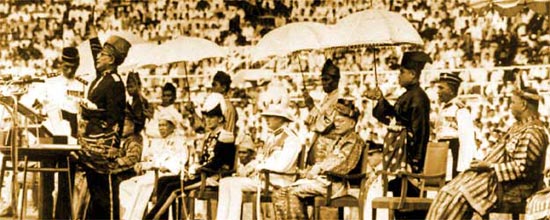
Malaysia is celebrating 49 years of independence today!

The exercise book (HT: Jeff Ooi) above gives me lots of memories of carefree primary and secondary school days. I recall when I was the head prefect in one of the secondary schools I lead the school assembly everyweek in reciting the Rukun Negara which is printed at the back of this exercise book. Considering where we are at lately in our country, reading through the principles makes one pause and pray and reconsider how one can be authentically a true Malaysian citizen.
"The philosophy has five main points. In the Malay language: Maka kami, rakyat Malaysia, berikrar akan menumpukan seluruh tenaga dan usaha kami untuk mencapai cita-cita tersebut berdasarkan atas prinsip-prinsip yang berikut:
1. Kepercayaan kepada Tuhan
2. Kesetiaan kepada Raja Dan Negara
3. Keluhuran Perlembagaan
4. Kedaulatan Undang-Undang
5. Kesopanan Dan Kesusilaan
In English: We, citizens of Malaysia, pledge all our energy and efforts to attain these ends guided by the following principles:
1. Belief in God
2. Loyalty to King and Country
3. Supremacy of the Constitution.
4. The Rule of Law
5. Mutual respect and good social behaviour."
August 30, 2006
Retreat 2006: Foreword

These were sincere words I managed to express my hopes for the days to come. My prayer is this retreat will bring us closer to where God wants us to be as a person and as a people.
__________________________________________________________________
Foreword
Welcome to the BLC 2006 Church Retreat!! Selamat datang ke Taman Lutheran Lakeview! And now the Christian greeting …
Grace and peace to you in the name of our Lord Jesus Christ …
I'm really excited about the retreat. Hoong Guit and the team have done such a wonderful job preparing for it. It's been quite relaxing for me. I've hardly done any thing so far except making contacts for Soo-Inn, Bernice and the LCMS Orang Asli Ministry :-).
This year is also special because it's the FIRST time we have a theme talk speaker. Soo-Inn is no stranger to us. He's our friend, mentor and no. 1 cheerleader. On a more personal end, he has walked with me through the ups and down of my own life and ministry. I appreciate it very much. What's exciting about this camp is Soo-Inn & Bernice will have 4 days 3 Nights to connect with us as a church community (with many new friends) through the main sessions and many conversations which will emerge. All with the view of ultimately linking us to God's amazing grace!
In this retreat, we're opening up space for ourselves once again for God's grace to be at work in us. And my prayer is, his grace will also work through us. Whether it's praying or playing, eating or sleeping, speaking or listening, laughing or even crying, we are praying for Christ to meet us wherever we are at. We are also trusting the Holy Spirit to guide our thoughts, feelings and wills to align them with the ongoing story the author of life is crafting here and now.
So, enjoy the whole camp in all it's fullness. Rest well. Enjoy the exercises. Get to know people (especially new ones). Open our horizons when we're visiting the Orang Asli brothers and sisters. Practice spiritual disciplines afresh (with the support of others – in short, group devotions are important). Sing your hearts out thanks to fresh air. Appreciate those who've planned the camp and are in charge of stuff. Participate fully. (Add to the list).
During this whole camp, I'm keeping these words close to my heart allowing them to soak me with God's goodness and presence. I'd like to share them with you. Because the Living Word – Jesus can meet us through these words.
For by grace you have been saved through faith, and this is not your own doing; it is the gift of God— not the result of works, so that no one may boast. For we are what he has made us, created in Christ Jesus for good works, which God prepared beforehand to be our way of life. - Eph 2:8-10 (NRSV)
Recaptured by Grace, Living by Grace!
Sivin Kit
Pentecost
August 31 – September 3 2006
___________________________________________________________________
August 29, 2006
Adventures in Missing the Point
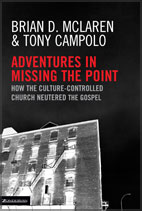
The paper back version of this book has discussion questions which is an added value. I've asked a local bookstore to bring it in. Hopefully soon :-)
I read the chapters on "Homosexuality" and "Sin" again in preparation for the workshops I was conducting and found them most helpful. One key thing I appreciate about the conversations between Tony Campolo and Brian McLaren in this book is they never discuss the issues in abstract and brings the topics to a level that is practical and personal. There are points where both the authors would disagree or would prefer more emphasis on certain aspects. And yet, they do so with respect and civility. Good stuff.
Here's a sample of how they keep the issues in check with stories and the focus on people. We start with Tony.

“When critics of my beliefs about homosexuality do not understand is that I’m trying to make up for a horrendous failure during high school.
Roger was gay, we all knew it, and we all made his life miserable. When we passed him in the hall, we called out his name effeminately, we made crude gestures, we made him the brunt of cheap jokes. He never took showers in PE. Because he knew we’d whip him with our wet towels.
I wasn’t there, though, the day they dragged Roger into the shower room, and shoved him into the corner. Curled up there, he cried and begged for mercy as five guys urinated on him.
The reports said that roger went to bed that night as usual, and that sometime around two in the morning he got up, went down to the basement of his house, and hanged himself.
On that day I realized that I wasn’t a Christian. I was a theologically sound evangelical, believed all pints of the Apostle’s Creed, declared Jesus to be my Savior. But if the Holy Spirit had actually been in me, I would have stood up for Roger. When the guys came to make fun of him, I would have put one arm around Roger’s shoulders, waved the guys off with another and told them to leave him alone, to not mess wit him, because he was my friend.
But I was afraid to be Roger’s friend. I knew that if you stood up for a homosexual, people say cruel things about you, too. So I kept my distance. If I hadn’t, who knows if Roger might be alive today.
I am not asking that Christians gloss over biblical teachings, nor that we justify same-gender eroticism. I am simply reminding Christians that we are supposed to love people – even those we have been socially conditioned to despise. I am calling Christians to reach out and show kindness and affection toward their homosexual neighbors – who number at least fifteen million in the United States. If we Christians cannot love these neighbors as we love ourselves, then we are violating the command of Jesus (Matthew 19:19) and ought not call ourselves his followers.”- pp.177-178
Brian chips in after Tony's extended chapter working through attitudes, misconceptions, key scriptural passages and possible ways forward, an interesting insight and story.

“What if my child told me, “Dad I think I’m a homosexual”? What if the child of a church friend were homosexual? How would I want the church to respond to my child?
This isn’t a theoretical question. Tony’s chapter helps people translate this from an abstract question for theologians, or from a political question for the Religious Right, into a very practical and personal issue for all of us: How do we treat our neighbors, our colleagues, our sons and daughters? Before focusing on the morality of “their” sexual partners, Tony forces us to face the morality of our treatment of fellow human beings, neighbors, people Jesus loves and to whom Jesus sends us to express that love.
This issue ceased being theoretical for me a few years ago, when I made the very worst mistake of my pastoral career. Our church has a listserv where members dialogue about faith issues. For a few weeks homosexuality was the subject of a lively discussion. A man in our church who had struggled with homosexual orientation for his entire adult life, and who had confided his struggles to me, wanted to post a message so that others could know what a homosexual feels like when he hears statements like “Hate the sin, love the sinner.” But he couldn’t break his anonymity: that would be too risky and painful for him and his family. So to preserve his anonymity, he asked me to post his message under the pseudonym Pain.
He sent me the message to post, and I did. What I didn’t realize was that, when I copied his message, I also copied the return-path information at the bottom of his e-mail. Anyone who read his e-mail to the end could read his name. I had no idea what I had done until a friend called me and told me. Mortified, I called the man, who had already seen my mistake. I rushed to his house, where I found him weeping. His wife was weeping.
I died inside. But we talked, we prayed, I apologized, he forgave me.
Still, the fact remains that a homosexual man whom I had hurt so deeply (though accidentally) was far more merciful to me that most of our churches are to homosexuals.”-pp. 189-190
Random Link 113
Why I Kissed Calvinism Good-bye
I never seriously dated Calvinism. I admit having some admiration but it's mostly been from a distance.
Bonhoeffer is a total Rock Star
What a cool title! Interesting quote here which made me think a little more: "By now Bonhoeffer had observed Christians and others, finding, as he said, that it was easier to talk about God with unbelievers than with Christians. One is reminded of the answer given by Jurgen Moltmann to the question, "are you, then, a Universalist?" to which as a good Calvinist he had to say "No!", but he added, "I sometimes suspect that God is.""
The Rise of Neo-Fundamentalism 2
I'm following Scot's series closely:
"Here’s my thesis: the core driving force of Neo-Fundamentalism (like the old) is a remnant mentality. That is, it believes the following:
1. That it alone remains true to the fullness of the gospel and the orthodox faith.
2. That the Church worldwide is hanging on a precipice and will soon, if it doesn’t wake up, fall from the faith.
3. That the solution to this nearly-apocalyptic church situation is to tighten up theological stands and clarify what is most central and most important for the Church today.
4. That the major problems are theological drift, church laxity, and evangelical compromise with either modernity and/or postmodernity.
5. That it is “Neo” because it arises within Evangelicalism today and will either break from it or seek its widespread reform — and therefore its particular characteristics are determined by contemporary Evangelicalism. E.g., it isn’t really concerned about dancing and movies and “mixed bathing.”"
Sent a Letter Lately?
Nope. But after reading this I should!
E06 Recap
Here's some pictures to give a feel of some of the moments I managed to capture on my handy Canon A70 at the E06 conference where I took 4 workshops on the same topic.
Overall the E06 conference is one of the most well organized and well thought through conference I've ever been part of specifically for teenagers, college goers and young adults, I thought the three streams gave it the speakers a good framework to focus our sessions and workshops.
On a personal note, I felt most taken care of as a workshop speaker with one person assigned to make sure I have my coffee, and the equipment or notes are always ready. Wow! I felt pampered. At first it was strange, and yet later I just enjoyed it. And Janice who was helping me out did a FANTASTIC job (a round of applause everyone). E Hoon was also a wonderful support from her first email to me until the final instructions for the closing day. There were many more people working behind the scenes. I think this must be celebrated and acknowledged!
Most if not all of the participants in my workshops very lively, attentive and asking good questions. I could see in the eyes of many - the desire to learn, and work through issues that concern them relating to the theme "How then shall we live?"
I think there was an advantage for more intimate interaction when the workshops were limited to not more than 40 people. So, there were good questions and answers between me and them, and we could easily have break-out groups of 4-5 people for mutual conversations. Later, getting everyone back was good so we could hear from other groups as well and then I did a wrap up. My focus at the end was to emphasize Grace and graciousness especially in the light of out topic "Loving Thy Neighbor: Negotiating the tension between Dogmatism & Tolerance". Closing the workshops with everyone holding hands in a circle (BLC style) and praying was especially meaningful for me whether it's the act of forming the often imperfect circle to the act of praying together.
I didn't manage to go for the plenary sessions or the concerts. I think the Carnival was a good idea getting people into the streets for some practical work. so, my comments are limited to my workshops and whenever I had contact with people before or after the workshops.
One enriching and fruitful conversation was with a more senior pastor and I . I couldnt help smiling with a chuckle or two when he said getting the few of us to do the workshops is like "outsourcing" specialists to bring our expertise into the conference. I admit I was a little shy when he said that, and appreciate the confidence and trust he had on us. For me, I merely thought of this as playing my part as friends of those who are part of the organizers, and more importantly doing my part as a member of the wider Christian family. We both desire "God's will to be done here on earth as it is in heaven" in the lives of these young adults specifically (Hey! I'm included in this bracket.. I'm 34!). We use a different "language" to describe what we are doing (I'm sure how we view ministry and process through stuff will be an exciting dialogue topic in days to come)... keeping the right focus before us in the end is what REALLY matters.
My heart was warmed when I heard one person share with some tears in her eyes how she felt re-connected to God. There were also numerous outside of the workshop conversations with participants which were very helpful. for me these are always previous times where what God is doing is clearly still in progress (and not limited to the official sessions)
During the last day, I also appreciated a low key no-hype-and-yet-reflective time of prayer, letter writing, and relooking at one's journey of faith and recentering oneself for the post-conference realities. My pastor friend smiled when he told me, "I didn't know you could use a disney song for an altar call .." It's been quite a while since I've done "ministry time" in this way. I liked the way it was adapted for this context. In BLC, this kind of prayer ministry is done during the Holy communion (and often we can't cover all the people and there's limitations of time). Listening to some of the requests for prayer and witnessing some genuine tears encouraged me to give thanks to the responsiveness that was present that day.
This "responsiveness" is one that needs to be celebrated and also guarded. And my prayer is that Malaysian leaders especially pastors like me will continue to upgrade ourselves so we can not only be fellow travellers (and often cheer leaders) to them, but also play the role of spiritual directors/mentors, and catalysts for healthy theological reflection and compassionate praxis. This "responsiveness" will need to grow in due time with wisdom and maturity so our faith will last in the long run and continue to be relevant to our times.
I believe that was the purpose of the organizers of the above conference was towards this end. And I'm thankful to be given a chance to play my part in not just the intended purpose of the organizers but more importantly what I perceive to be God's vision for the growth of a faithful community of Christ-followers in our nation. It's got to start somewhere. That somewhere is often right before our eyes.
August 28, 2006
2nd Asian American Emergents Skypecast (Recorded)
Thanks DJ for offering us his recorded conversations. I think this is a good example of what the emergent conversation is about from our "limited points of view".
Here's the downloads for part 1 (mp3) & part 2 (mp3).
There were some "robotic sounding" moments perhaps because of the internet connection (mostly when I was speaking *grin*). Listening through the conversation again was helpful because I think I did miss some of it here and there (must get a better quality headphone/mic)
I resonate with what DJ is saying here:
"I felt good that I’m no longer the only Asian face interested in the emergent conversation. It’s also fascinating to hear how the emerging church conversation in Malaysia started up and has many similarities (far as I know) to how it started in the US. It really is best labeled as a conversation."
And the closing comment by Tim Liu (sorry I missed linking you in the last post) is great supper for thought tonight.
"In my experience, AsAm churches tend to be even more conservative in terms of practice than American churches. They tend to be slower to adapt to changes and are rarely forerunners in ministry innovation. Many people (such as Dan Kimball) see the emerging church as a response to the contemporary worship movement. But in my (Chinese) church, we are barely contemporary. We still have those who feel that drums are of the devil. So I think the Asian churches maybe just need more time to catch up. Also, I wonder if anyone else notices the overlaps between the postmodern culture and the Eastern/Asian worldview? For example, preaching in narrative and in non-linear flow of thought is normal for Asians. When I preach to the 1st genearation adults in my church, they love to hear stories and narrative. Its already part of how they communicate. Another example is the emphasis on community and relationships in the Emerging church. Its already is a central part of asian culture. So in a lot of ways, I could see the AsAm church very welcoming to some aspects of the emerging church if it is presented in the right way."
Uncommon Decency: Christian Civility in an Uncivil World

"Can Christians be civil in a world falling apart?
In these wild and diverse times, prolifers square off against prochoicers, gay liberationists confront champions of the traditional family, husbands and wives face each other in court, artists attack legislators, and "politically correct" intellectuals abhor crusading fundamentalists.
Philosopher and ethicist Richard Mouw is concerned that, too often, Christians seem to be contributing more to the problem than to the solution. But he recognizes--from his own personal struggle--that it's not easy to hold to Christian convictions and treat sometimes vindictive opponents with civility and decency."
The paragraphs above invites us to look into the book. My reason was simple and perhaps existential - How do we engage in conversation with someone who holds strong convictions who are different from us? We tend to focus a lot on how to persuade the other person to accept our views of positions. But increasingly I believe we cannot pursue that process with out the practice of "convicted civility". This book introduced me to this helpful term.
The relevance of this particular approach and reflection is urgent as I witness needed dialogue and healthy debate within the Christian community (and even beyond that) often degenerating into fruitless disputes and off-tangen directions which after some time drain the resources within us for better things ahead.
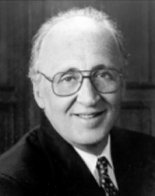
Richard J. Mouw is one self-proclaimed Calvinist who breaks the stereotype of a crusading philosopher, scholar, and author in the Reformed tradition. I found myself receptive to the gems he offers.
I'm not much of a book reviewer. It's simpler for me to share what has caught my attention and match it with my own reflections. So nothing fancy. What you see is what you get.
“one of the real problems in modern life is that the people who are good at being civil often lack strong convictions and people who have strong convictions often lack civility.”— p.12
During the E06 conference Workshop I facilitated we began framing our discussions between Dogmatism & Tolerance and the tension in between. The refreshing insight I got from Prof. Mouw is that no one needs to be "conviction-less" (that's not in question), the problem is we lack civility. I think he's right.
“Christian civility does not commit us to a relativistic perspective. Being civil doesn’t mean that we cannot criticize what goes on around us. Civility doesn’t require us to approve of what other people believe and do. It is one thing to insist that other people have the right to express their basic convictions; it is another thing to say that they are right in doing so.” – p. 20
Sometimes it "feels" or maybe "perceived" just because we allow the "other" person to voice their views we walk the slippery slope of compromise. The temptation to be quick to "defend" or to "show the fault of the other view" bubbles in us when some patience to hear them out further could clear the way better. At the end, we might all land up with different conclusions but we'd become better people as we walk through the issues and concerns - especially when we can get in touch with the deepest fears or highest hopes. We might not change our "views" but our "view" of the other person and what they stand for may change.
“When Jesus showed “acceptance” to prostitutes and tax collectors, he did not condone their sexual or economic behaviors. He loved them in spite of their unsavory ways. He called Mary Magdalene and Zacchaeus to correct their ways and become faithful disciples.
But Jesus refused to define people in terms of their present sordid circumstances. He affirmed their potential for living as faithful and creative children of God.” – p. 22
Acceptance, approval, affirmation. The way we negotiate how these words and what they represent and convey is needed as we deal with uncomfortable issues. so, often the battle is not out there but within us - our heart attitudes, the paradigms in our heads, and the praxis we are used to.
We talked about Homosexuality and Race/Religion/politics to keep the workshop concrete and not abstract. And even in the midst of that, I think conscious effort was needed for us as Christians especially to see the human faces behind the controversial issues. The temptation to be over excited about the issues and the arugments surrounding it tend to de-humanize us (both parties perhaps on the opposing end) if we are not careful.
“To be civil toward people does not mean that we have to like them… I can treat this person with gentleness and respect even if I haven’t manufactured those feelings that would count as “liking” them.” – p. 22-23
This was liberating! :-) and realistic. But I think keeping in view how we feel about the other person is one big challenge.
“Ad hoc adjustments are necessary for all of us. We are on a pilgrimage, and our favorite formulas are often nothing more than helpful summaries of what we have seen thus far. We have to be open to new challenges as we continue in our journey.” – p.164
So often, it's appreciating the limits of our perspectives and especially the limits of language for me has ironically been most liberating.
“Our fundamental allegiance is to the gospel alone. In the light of that basic allegiance, all other commitments must be tentative. … we must not be drawn into ideological attachments Convicted people are easily captivated by polarized positions, but Christian disciples ought to be very suspicious of hard-line identifications with either “left” or “right.” - p. 164-165
Even if one doesn't want to be "captived by polarized positions", the reality of being labeled by others is still inescapable. To some we are too left, to others we maybe too right, for many we may appear position-less, the list goings on. When all is said, I pause and submit my "struggles" to Christ for constant self-examination. What is true for us in our daily ethics is similar to our work in progress musings. Things look static on paper and when it's captured in words to some degree ... when we all recognize it's surely more dynamic.
“The recognition that God’s standards of truth and morality are the only reliable reference points for our lives should instill in us a humble spirit. Arrogant self-righteousness must have no place in our hearts. It’s one thing to believe that God’s revelation is the only sure and certain guide for our journey; it’s another thing to act as if we ourselves possessed a sure and certain grasp of all the complexities of revealed truth.” – p. 166
I've heard this raw expression of the above refined paragraph: "You are free to affirm your convictions, but you don't have to be a jerk doing it" It cuts both ways.
“Seeing God’s patience means being modest in what we expect of other people.”- p. 168
Sometimes, I wonder whether it's easier to be more modest in my expectations for non-Christians than fellow Christians. Partly, because the inner voice may say "We should now better as Christians!" But then again ...
“This is what civility comes to, finally: an openness to God’s surprises. What that openness marks out lives, we have learned patience – along with the flexibility and tentativeness and humility and awe and modesty that will inevitably come to the patient heart. And since none of this is possible without a clear sense of who we are, and to whom we belong, the patient heart will also be a place where convictedness has found its home.” – p. 169
Patience is rare these days. How often I have failed in this area. Hopefully after reading this post - and for some of us this book ... the atmosphere of "patience" will increase starting from those of us who proclaim we worship one who is "gracious and compassionate, slow to anger and rich in love."
2nd Asian American Emergents Skypecast
Thanks to DJ Chuang for inviting me to 2nd Asian American Emergents Skypecast. As you can see my "link" to the conversation was due to the words "Asian" and "Emergent". But more importantly, because DJ Chuang and I have been in touch with each other for some time. So, at heart it's this friendship that opened up this possibility.
Nice to hear and get to know new people (All in the USA): David Park, Ben Pun and Peter Ong. I thoroughly enjoyed it when they were talking about how this whole emergent conversation connects or has nuances in relation to the Asian American Church context. In many ways, some of the issues are similar to where I am at or what I'm hearing bow in my interaction with Young Adults and College Kids :-) My hope is that they can contribute in some way to the wider conversation specifically through emergent village which would be an interesting dynamic. While some of us are figuring out how all this relates globally through Amahoro
Overall this is my first experience of doing a Skypecast. And within the limits (as well as the possibilities) of internet technology, I found it an enriching experience - especially to connect with others.
I'm looking forward to see/hear how the Mp3 come out when DJ is done with it :-)
August 27, 2006
Random Links 112
How to Write More Clearly, Think More Clearly, and Learn Complex Material More Easily (HT: Fernando Gros)
Content is great ... powerpoint presentation so so. My blog commenting will improve too!
Top 10 Strangest Lego Creations
It's still my favorite since I was young. Looking back I think playing with Lego has shaped me somehow. I'm passing on my "treasures" to Gareth and Elysia!
The Rise of Neo-Fundamentalism
Sobering ... "There is a conviction among Neo-Fundamentalists that one can’t err if one gets too conservative, but that is the sin of what I called “zealotry.”"
Exploring the role of women in missional churches of the western world…
Discussed this in the context of the "Orang Asli" (Aboriginal) ministry on Friday.
Scum of the Church: How the drive for “excellence” is driving young adults from the church
Young adults getting more airplay these days.
Seven Thesis @ Testimony
how does "Testimony" connect with preaching? :-)
August 26, 2006
A World of Difference - between Public and Pubic Philosophy!
Sometimes we miss something, and there are those who are kind enough to point it out to us. In regards to the serious matter in the previous post on Multiculturalism in Malaysia. A nice new friend pointed out a very important missing letter which (humorously) would change the meaning of the whole sentence and send us into all sorts of unintended directions. So, I decided to post the following on The Star Online: Blog. Here's what I sent them (just in case it doesn't come out! For whatever reason)
Please allow me to point out an important "error" (albeit a humorous one) in your web version of Dr. Ng Kam Weng's article on "Multiculturalism – how can it be wrong?". Your version states Dr. Ng words here:
"I wish to stress that open debate on pubic philosophy is itself testament to the robustness of our national Constitution that envisions the task of nation building to be inclusive and open to positive contribution from all citizens regardless of race, culture and religion. "
I suspect Dr. Ng intended us to engage in civil conversations on public philosphy. That is where our focus should be.
I laughed quite a bit after thinking through an imaginary discussion if it was based on the original "erronous" quote.
August 25, 2006
Multiculturalism in Malaysia?!

I'm read this piece: Debunking multiculturalism the other day and was disappointed but was not able to write anything yet but happy to see this reply Multiculturalism – how can it be wrong?. Now the question is how do we move forward in a civil conversation on matters that concern us all. Read on and respond thoughtfully, self-awareness, fairness and compassion...
__________________________________________________________________
Debunking multiculturalismIKim Views: By MD ASLAM AHMAD,
Fellow,Centre for Syariah, Law and Political Science, Insitute of Islamic Understanding MalaysiaHAVING a multicultural society does not mean that every Malaysian must subscribe to an ideology referred to as multiculturalism.
With reference to Malaysia, having a multicultural society is a fact, but to subscribe to multiculturalism is to interpret that fact in a certain way.
Multiculturalism is an alien ideology which came into being out of a particular historical, religious, and cultural setting.
In order to understand multiculturalism one has to keep in mind the long history of religious intolerance in Europe, followed by the Reformation movement, the rise of liberalism, and secularisation. It is a history that is full of horrible tales of persecution and intolerance in the name of religion (read Christianity).
Religious pluralism is the outcome of an attempt to provide a basis in Christian theology for tolerance of non-Christian religions; as such, it is an element in a kind of religious modernism or liberalism.
Liberalism in religion and in politics is historically and theoretically related to one another. Liberalism as a political ideology that emerged in the same period and locale alongside liberal Protestantism. Both took place in the aftermath of the Reformation.
Among the political and religious liberals the attitudes toward moral, social, and political issues are often the same. They emphasise the importance of tolerance, individual rights and freedoms to safeguard a pluralism of life styles.
At the foundation of political liberalism is tolerance of different opinions about religion. Then came religious pluralism which seeks to provide a theological basis for this tolerance.
Being an outgrowth of liberal Protestantism, religious pluralism rejects orthodox interpretations of Christian scripture and dogma to make salvation attainable via routes other than Christianity.
It is sceptical towards rational arguments in favour of the superiority of Christian beliefs. It appeals to the modem moral principles of tolerance and rejection of prejudice.
Because of its emphasis on the elements common to personal religious faith, ritual and theological doctrine are considered to be of secondary importance or a personal matter.
The liberal separation of religion from social order is founded on the assumption that this separation is consistent with the tenets of all religions and sects, whereas it is in direct conflict with the very nature of the worldview of Islam.
In the first place, Islam has never been structured upon some kind of church-state relation like that of medieval Christianity. Secondly, Islam is not a culture that evolves and develops in the way Christianity does.
Multiculturalism, as understood and propagated by its proponents in this country is not based on diversity, but rather it strives to debunk Islam as a socio-political order.
The ideological components of Malaysian multiculturalism can be summarised as a cultural relativism which finds the prominence of Islam in this country intolerable.
It rests on the attitude that religion should not be allowed to “interfere” in our social and political life. Hence, it is important that every Malaysian, especially the Muslims, be made to accept “the fact” that Malaysia is a “secular country”.
The Malaysian multiculturalism’s hostility towards Islam and its repudiation of an identifiable Malaysian culture based upon Islam is augmented by a radically new definition of community, one that deviates from the traditional, religious emphasis on family, neighbourhood, house of worship and school, towards an emphasis on race, gender, occupation and sexual preference.
Can multiculturalism be a viable principle for our national unity?
Ideological multiculturalists are radical-left inhabitants of a political dreamland. These ideological divisions within our society threaten to render the nation into hostile factions.
The multiculturalists assert that Malaysia is an idea rather than a nation possessing a distinctive but encompassing identity. Hence, after almost 50 years of independence we still hear people talking about the search for a “Malaysian identity”.
It means Malaysia, as far as they are concerned, has no identity, and if we are to have one, Islam should not be part of that identity.
Current manifestations of multiculturalism extend far beyond the kind of pluralism that seeks a richer common culture to multicultural particularism which denies that a common culture is possible or desirable.
In an attempt to validate the multiculturalists’ emphasis on particularism and its concomitant subversion of cultural commonality, knowledge and facts in their discourse are consistently subordinated to the so-called “critical thinking approach.”
The dismal truth is that critical thinking in practice means subjective questioning and unsubstantiated, unreasoned, personal opinion.
Contrary to the assertions of proponents of multiculturalism that limitless pluralism enriches our understanding, the de-emphasising of specific factual knowledge in their discourse resulted in what it inevitably must have – a plague of ignorance.
Multiculturalism’s subordination of facts and knowledge to unguided “critical thinking” demonstrates its intellectual bankruptcy, since any critical opinion worthy of consideration must evolve out of knowledge and be grounded in objective facts.
Malaysia is not a no man’s land, and everybody knows that, and the fact that Islam is the religion of the Federation is also common knowledge.
Further contemplation would be enough for one to realise another fact: namely, that Islamic ethical and socio-political order is ultimately the expression of certain ideas about life and existence as a whole.
To Muslims, those ideas are the integrating principles that place all systems of meaning and standards of life and values in coherent order.
To those who live on the assumption that Malaysia is a secular country, it is the secular worldview that is supposed to be the prism through which we understand who we are and how to go about living our lives.
Of course they can believe in whatever they want to believe. But we would like to ask a very simple question: Who says the secular worldview is our common worldview?
That is surely not acceptable to Muslims, who are aware that secularism is antithetical not only to Islam but to all religious worldviews.
Leaving the ignorant and confused Muslims aside, there is no way to make conscious Muslims accept a secular interpretation of life and existence as espoused by Western culture and civilisation.
The followers of other religions should recognise the fact that their religions have many things in common with Islam, particularly when it comes to ethics and morality.
It is through Malaysia, as an Islamic state, that other religions would thrive, and that we have better chance of fostering national unity based on a common religious worldview.
A secular Malaysia would be an enemy not only to Islam but a common enemy to all religions.
We must realise the fact that secularisation can be considered a natural phenomenon only in the case of the West, considering what they have experienced in their history.
To apply their solution to our problem is to admit that we are now experiencing the same problem they used to have; which is historically baseless and logically absurd.
__________________________________________________________________
Multiculturalism – how can it be wrong?By NG KAM WENG
Research Director,
Kairos Research CentreTHESE must be worrying times for Malaysian citizens if an official from Ikim, a government think-tank dedicated to the task of disseminating Islam as a tolerant religion, can come out with an article entitled “Debunking multiculturalism” that appeared in The Star (Aug 22, 2006).
Credit must be given to the writer, Md Asham Ahmad, for his forthrightness in arguing that Islam – rather than multiculturalism – be the framework for social policy in Malaysia.
Nevertheless, it is evident that the writer’s forthrightness is not accompanied by accurate facts, given his skewed reading of Christian history.
Md Asham suggests that religious pluralism and multiculturalism is the outcome of a weak religion (Christianity) that does not stand comparison with Islam, given Islam’s strong relation with the State.
I am always suspicious of mono-causal interpretations of history that purport to explain how the existing condition of a society arose from a particular ‘ism’.
A more nuanced reading of the history of the rise of liberalism and religious liberty would take into account the multiplicity of factors including the new discoveries of Oriental civilizations in the European age of exploration, the power struggle between hegemonic states (Spain and France) and new nation-states in Germany and the Netherlands, the rise of the merchant class and independent trading cities (like Geneva) and the conflict between tradition and critique of the Enlightenment thinkers.
Above all, multiculturalism, exemplified by toleration, was the outcome of ‘religious’ wars that led to the treaty of The Peace of Westphalia (1648). Notably, the provisions for religious freedom were called articles of peace.
It should be of interest to note that the challenge of managing religious plurality (a fact rather than an ideology) is not a unique problem of Western Christianity. We see ongoing conflicts in Asia and Africa – such as in Sudan, India and Iraq – that cry out for equivalents of the historic Peace of Westphalia.
It would do well for Md Asham to adopt a modest attitude of willingness to learn from the past rather than judge it with sarcasm, when it is evident that we Asians/Africans continue to be plagued by religious and cultural conflicts.
Md Asham suggests that non-Muslims are motivated by ideology when they commend multiculturalism as a valuable framework to promote social harmony.
He writes: “Multiculturalism, as understood and propagated by its proponents in this country is not based on diversity, but rather it strives to debunk Islam as a socio-political order.” By using words like ‘hostility’ and ‘subversion’ he also suggests that non-Muslims are imbued with an adversarial attitude.
The problem is, Md Asham has inverted the dynamics of rational debate in this country by suggesting that the non-Muslims’ call for multiculturalism is driven by an ideology inherently hostile to Islam.
The reality is that our nation was a plural society at its inception in 1957 and more so in 1963 when Malaysia incorporated the many tribal communities in East Malaysia.
One plainly cannot deny the existing social condition (plurality) that needs to be addressed. Hence, the stress on multiculturalism as the best modus vivendi for developing a national identity that expresses unity in diversity and equality for all peoples regardless of their culture and religion.
Since concepts have different meanings in different contexts, the onus is on writers to define their terms in a fair and accurate manner.
For example, Allan Bloom (The Closing of the American Mind) castigates western multiculturalism that leads to relativism, and results in the demise of “solidarity in defence of the truth”.
On the other hand, Malaysians and other Asians tend to describe multiculturalism as “the view that various cultures in a society merit equal respect and scholarly interests” cf. Dictionary of Cultural Literacy (1994).
Such sensitivity to contextual meanings would have cautioned Md Asham against making the suggestion that supporters of multiculturalism are merely motivated by hostility towards Islam based on family, neighbourhood and school.
Perhaps, Md Asham wrongly equates liberalism with libertarianism. Libertarianism is the view that individuals should be free to do whatever they wish so long as they do not infringe on other people’s freedom or property.
However, Md Asham would be remiss if he tars political liberalism with a form of libertarianism that undermines social relationships; bearing in mind that liberalism has a range of meanings.
It should be noted that classical liberalism as expounded by John Locke describes the essential theses of liberalism in the following terms: that the people are the source of all political power, that government cannot be justified unless it possesses their free consent, that all governmental measures are to be judged by an active citizen body, that men of government are to help them when they require it, but not to run their lives for them, and finally the State must be resisted if it steps beyond its political authority.
More importantly, political liberalism and multiculturalism in the Malaysian context envision the flourishing of citizens based on the preservation of fundamental liberties from encroaching State authoritarianism, if not totalitarianism.
Md Asham may find the theses objectionable, but a robust set of philosophical propositions demands careful and rational response rather than a debunking couched in loaded and emotive words.
Md Asham ends his article with a call for a polity that must be rooted in local history. But taking local history seriously must surely mean honouring the consensus on the specific form of secularism engraved in our Malaysian Constitution in 1957 and 1963.
Unlike some places in the West, secularism in Malaysia does not reject religion. It was the social consensus back in 1957 and 1963 that there should be no establishing of one religion above others in a multi-cultural, multi-religious society like Malaysia.
Secularism in Malaysian history as such commends a benign neutrality and benevolent support for religious plurality.
I find unacceptable Md Asham’s suggestion that, “it is through Malaysia, as an Islamic state, that other religions would thrive, and that we have a better chance of fostering national unity based on a common religious worldview.”
Firstly, it is undeniable that religions are presently flourishing in Malaysia under the existing Constitutional arrangement.
Secondly, national unity remains strong so long as State polity is based on overlapping consensus of diversity of religious worldviews (John Rawls).
I write this to contrast Md Asham’s call for unity under a common religious worldview, which suggests imposition by a dominant religion. In short, Md Asham’s suggestion is both unnecessary and counterproductive.
In conclusion, even though Md Asham’s article in debunking multiculturalism may be a legitimate academic exercise, I reject his suggestion that multiculturalism as historically understood and practiced in Malaysia is incongruent with our local cultural aspiration.
Indeed, I wish to stress that open debate on public philosophy is itself testament to the robustness of our national Constitution that envisions the task of nation building to be inclusive and open to positive contribution from all citizens regardless of race, culture and religion.
It is an affirmation of the politics of recognition, mutual respect and reciprocity.
__________________________________________________________________
Random Links 111
willow leadership summit summary (via Marko)
I like the Bono quote: “The gospel that changes a heart without moving your hands is not the Gospel.”
A Call to an Ancient Evangelical Future
Can you hear the call? I wish more will ... I'm listening and I think it's good: " In sum, we call Evangelicals to recover the conviction that God’s story shapes the mission of the Church to bear witness to God’s Kingdom and to inform the spiritual foundations of civilization. We set forth this Call as an ongoing, open-ended conversation. We are aware that we have our blind spots and weaknesses. Therefore, we encourage Evangelicals to engage this Call within educational centers, denominations and local churches through publications and conferences." For more go to: An Introduction to Ancient-Future Movement
How not to do a church sign
something a little funny before I sleep
The Search for God
Now I REALLY want to get that book
Dear Church
worth the time for those who are leading and considering leaving.
JESUS AND JAZZ
Sounds good to me!
August 24, 2006
Kit Family Latest

It's great to come home tonight after the worship gathering practice and Gareth ran out to give me a hug and then Elysia following him. Nice to see May Chin reading to the kids to bed while I was cheekily trying to make Elysia laugh. Gareth was busy listening to the story. I love "responsiveness" like this. So often we adults are tempted to lose such simple warmth. I thought I put up our latest family photo taken last saturday during the BBQ at the church compound.
E06 Conference
Today is the "maiden" workshop for my specific topic "LOVE THY NEIGHBOUR: NEGOTIATING THE TENSION BETWEEN DOGMATISM AND TOLERANCE" for the Young Adult Stream of the conference. It's been some time since I've been part of event as big as this. I appreciate the trust the conference organizers have on me for the delicate topic they've given me.
I must admit I was a little nervous because it's hard to predict what to expect from the 1st batch (I have to do a total of 4 workshops with similar material to allow for more conversational participation which I think was great!). The first batch was a good bunch whom I enjoyed thoroughly. It's interesting to notice there were only about 4-5 Guys in the workshop out of about 40. I wonder what would be the make up for tomorrow.
Most of the small groups chose the issue of "Homosexuality" for conversation, only one group chose the issue of "Politics" (especially in relation to our current Malaysian context). Which is interesting.
It's going to be a full day tomorrow. I'll take more pictures and blog more then.
For now. I'm thankful we managed to cover the material, share stories, ask good questions, open up conversations, and create space for further thinking and creative action.
An added bonus and always a personal favorite is some meaningful conversations with a senior pastor which I thoroughly enjoyed. Dinner with other participants/helpers/faiclitators (thanks to the rain and scary traffic) was a delight as well. We live in a really small world especially when one of the dinner companions actually came from the same secondary school I was in - he was form one and I was form five. It was great fun making fun of our old school and the experiences there. Ok, I think I'm digressing. More tomorrow.
August 22, 2006
The Theology of Sleep

"My subject is the theology of sleep. It is an unusual subject, but I make no apology for it. I think we hear too few sermons about sleep. After all, we spend a very large share of our lives sleeping. I suppose that on an average I've slept for eight hours out of twenty-four during the whole of my life, and that means that I've slept for well over twenty years. What an old Rip van Winkle I am! But then, what Rip van Winkles you all are, or will one day become! Don't you agree then that the Christian gospel should have something to say about the sleeping third of our lives as well as about the waking two-thirds of it?"
—John Baillie, "The Theology of Sleep," in Christian Devotion (1962)
"I don't like the man who doesn't sleep,
says God.
Sleep is the friend of man,
Sleep is the friend of God.
Sleep is perhaps the most beautiful thing
I have created.
And I myself rested on the seventh day. …
But they tell me that there are men
Who work well and sleep badly.
Who don't sleep. What a lack of
confidence in me." - French poet Charles Peguy
Both via Sleep Therapy
August 21, 2006
Random Links 110
*Note: I thought I'd share some links of stuff I've put in my Ipod and has been making my drives especially during traffic rush hour much more pleasurable and enriching*
The Last Thirty Years: What We've Learned along the Way
Seminar at the Calvin Symposium on Worship January 26, 2006
I was moved by Nancy Beach's closing words in the last session and appreciated Brian McLaren's sensitive acknowledgement of that during the short time he had. A pleasant surprise was hearing from Joyce Zimmerman. And Eugene Peterson is always classic.
Tony Campolo Messages
Tony's always worth listening to - for the passion as well as the wisdom!
Speaking of Faith with Krista Tippett
Looking forward to download from the archives the Pelikan and Polkinghorne podcasts.
Building Bridges of Understanding: Tony and Peggy Campolo on Homosexuality
I'm listening to Tony's 1st session right now. "Two committed Christians with two different views - yet they are able to share the same bed each night and respect each other's faith. How do they do it?" I wonder too.
The Veritas Forum
Loads of goodies for a variety of interest and concerns.
Allelon (Radio)
One of the few places we can get stuff by Todd Hunter whose internet (blog) presence I miss dearly. Peterson, Wright and Willard also makes their contributions.
InterVarsity Audio Resources
Will return to this when I'm free...
IVCF Graduate Conference 2006 resources
The four words used to lead us into the presentations -- Culture, Scripture, Postures, Calling are inviting!
Look-alikes - Sivin & May Chin 1999?

Imagine if we were to do this exercise in 1999 (pictures from our wedding day!)? Ok I admit I'm a little under stress today!

Sivin Look-alikes?
1st try! Laughing out softly (LOS)

2nd try! Laughing out Loud (LOL)

better get on to sabbath and some work!
To Become a Disciple means ...

“To become a disciple means a decisive and irrevocable turning to both God and neighbor. What follows from there is a journey which...never ends in this life, a journey of continually discovering new dimensions of loving God and neighbor.” ~ David Bosch (via Prodigal Kiwi(s) Blog
Appropriate insight for a Monday morning where I do want to start the week the best that I know how. Some solitude & silence (with the view of life beyond my limited world). Searching for a picture (which the finalist is the one above) that warms me today reminded me of the boat ride on the final day of my trip in Labuan. I thoroughly enjoyed the wind massaging my "being" as we rode the waves to our destinations. That was also another good way we started the day last Thursday. Solitude, silence or the seas. :-)
August 20, 2006
Random Links 109
Why is Wright Misrepresented and Misunderstood by so many of his Reformed Critics?
I'm sure Bishop Wright is not right all the time? Who amongst us is! But this piece is food for thought. Perhaps a word of caution.
Postmodernity vs. the Gospel?
Lots to chew on here and much that will clarify to some extent: "Although I have nothing against contextualization per se, Jamie nor I have this in mind as we present our various takes on postmodernity as a critique of current American church practice. We are both simply trying to unveil what the critique of postmodernity reveals about both our current culture and our current church practice. We are using the postmodern authors to unveil the huge shortcomings of current church practices all because of our indebtedness to modernism and all its manifestations. The response we both offer, however, is not to contextualize a church to postmodernity, but rather to reinvigorate an ecclesiology for our times. As Jamie states “it might just be these Parisians who can help us be the church.” (p.23)."
21st Century Pharisees?
I'm interested to get the book when the time is right (so many books to read and reflect on), this little sentence here is really wetting my appetite --> "Rollins doesn't want us to think that "our beliefs are inherently problematic, but only that they become problematic when held in a manner that would claim more than some provisional, pragmatic response to that which transcends conceptualization." (26-27)
Teaching Seminary, Teaching College
I sent this to a seminary principal to see whether I could get a response :-)
500 free electronic journals(pdf) (HT: Chris Tilling)
Hyperlinks to about 500 free electronic journals in the field of theology / religious studies! ARRGGGGHHH!
Charlie Rose - Rick Warren / Gregory Boyd
Interesting to see how both these "evangelical" pastors respond to the questions and how they view the participation of Christians or the church in the USA political scenario.
August 19, 2006
Graciousness ... non-negotiable?

"Graciousness is a non-negotiable dimension of Christian faith. It goes to the very core of the gospel. It is what makes the gospel good news."
- Gracious Christianity, p. 17
I think I'm learning this afresh as I age. Perhaps in the process of growing older, I need to learn more like child again. I'm glad this particular book has arrived. It's timely. Thanks Ray!
Theology for beginners (4): Israel
Sad to say the temptation to "filter" the role of Israel into an end time or merely a preparatory framework minus the more theological-historical input in fact misses the point of the place of Israel in our Christian thinking. Ben's fourth post broadens our horizons.
___________________________________________________________________
Summary: The story of ancient Israel is a story of promise; this is the beginning of the gospel.
In order to tell the gospel, we begin not with Jesus himself but with the history of ancient Israel. The story of Israel begins with a decisive act of God: the Exodus. A Palestinian mountain god known as Yahweh liberates an oppressed tribal group from a life of forced labour in Egypt. Yahweh drives these fugitives forward into a promised future, into a new land where they can find their own home and their own identity.
From the very beginning, then, Israel exists as the people of Yahweh’s promise. Israel’s faith is, from the beginning, a faith that looks to the future on the basis of specific past events and promises. Yahweh has acted decisively for the liberation of Israel; Yahweh has made a covenant with Israel, and has opened Israel’s future with his promises. Thus Israel lives by Yahweh’s promise; she lives by expectation and hope.
When the people of ancient Israel want to understand their place in the world, they tell stories about the patriarchs who had lived before the foundation of Israel, and they narrate the ways in which these patriarchs, too, lived by God’s promise. A herdsman from Ur named Abram leaves his city and the god of his city, and sets out to migrate to a new land which a new god has promised him. Abram has not seen this land of promise, but he and the tribe that follows him live by hope and expectation. Stories like this reinforce the promise-character of Israel’s faith: right from the start – even before Israel existed! – God has been creating a future for Israel through promises. Here, then, lies the core of Israel’s hope.
Indeed, just as Israel has emerged from the life of nomadic tribes, so too there is always something distinctly nomadic about Israel’s history. Israel is never at rest for long. Her existence is always oriented towards the future; time and again she is forced to rely on Yahweh’s promises; time and again she is driven forward in expectation of a promised future. Throughout her history, Israel remains poised between the past and the future, waiting expectantly for some climactic event, some act of Yahweh which will fulfil every promise and bring Israel’s story to a close.
It is for just this reason that the Babylonian exile in the sixth century BCE is so shattering to Israel’s faith. In the experience of exile, it seems that Israel’s story has come to an end – not the end promised by Yahweh, but an end that contradicts Yahweh’s promise and thus contradicts faith itself. So the prophets interpret this exile as Yahweh’s judgment of his own people. And yet, even while pronouncing judgment on Israel, the prophets also speak in new ways of Yahweh’s unconditional mercy and favour: although Israel has been unfaithful to Yahweh and has not lived by his promise, still Yahweh remains unilaterally faithful to his own promises. In this way the prophets summon Israel back to faith in Yahweh, inviting her to lean forward into the future of Yahweh’s promise.
According to the Old Testament texts, many of the exiled Jews were able to return to their homeland by 538 BCE. But still there is no real fulfilment of promise, no final vindication of Israel, no real climax to Israel’s story. One of the strangest and most unsettling things about the Old Testament is exactly this anti-climactic aspect. Although Yahweh has made promises to Israel, and although Israel’s whole story has been defined by these promises, somehow Israel’s story finally leads – nowhere! At the end of her story, there is no fulfilment, no dawning of the promised future, no climax that can give meaning and structure to this story as a whole.
When we read the Old Testament, at the end of this long story we find only promise without fulfilment, suspense without a climax, hope without a future. But the drama of Israel’s history was to find its surprising final act in the first century CE.
Further reading
* Albertz, Rainer. A History of Israelite Religion in the Old Testament Period, Vol. 1 (London: SCM, 1994), pp. 23-66.
* Berkhof, Hendrikus. Christian Faith: An Introduction to the Study of the Faith (Grand Rapids: Eerdmans, 1979), pp. 221-65.
* Jenson, Robert W. Story and Promise: A Brief Theology of the Gospel about Jesus (Philadelphia: Fortress, 1973), pp. 13-31.
* von Rad, Gerhard. Old Testament Theology, Vol. 1 (New York: Harper & Row, 1962).
* Rendtorff, Rolf. The Canonical Hebrew Bible (Leiden: Deo Press, 2005).
* Zimmerli, Walther. Old Testament Theology in Outline (Louisville: John Knox Press, 1978).
__________________________________________________________________
August 18, 2006
Theology for beginners (3): Gospel
Here's the Third offering from Ben Myers (who was so kind to leave a comment - to say hello!). The word "Gospel" seems to be in the air as far as this blog is concerned. I'm still in reorientation mode ... I seem to always function in this kind of rhythm of change - orientation-disorientation-reorientation :-) That's just life. Anyway, before I return back to my more blogging self ... enjoy the gems from other wiser (and smarter) people than me.
___________________________________________________________________
Summary: The verbal expression of faith must be shaped and guided by the story of Jesus.Theology is the attempt to articulate faith verbally. But while theology provides the vocabulary of faith, it is the gospel which provides the grammar of faith. Just as every language has an underlying grammatical structure, so too faith has its own grammar: it has an underlying structure of meaning, a set of fundamental “rules” which determine the way faith can be expressed.
And the grammar of faith is the gospel: it is the story of the life, death and resurrection of Jesus. This means, then, that faith is fundamentally structured by narrative, by story. If we want to bring our faith to verbal expression, we cannot simply use concepts and ideas and symbols – first and foremost, we must tell a story. We must allow all our speaking to be shaped and structured by the story of Jesus.
The gospel is not, however, simply an ordinary historical narrative. It is not simply a recollection of certain events that took place in the first century CE. Rather, the gospel is a very special kind of story. For the point of this story is not simply the narration of historical events, but the narration of God. When we narrate the gospel, we are telling the story of God himself – we are narrating who God is, what he has done, and what he will do. In order to speak the gospel, then, we must tell the story of Jesus as the story of God.
This means, further, that the story of Jesus has universal significance. If the story of one particular first-century man is also the story of God, then this must be the true story, the story of reality as a whole, the story that tells us the way things really are. And thus the gospel is a story about ourselves – it is a story which has truth and meaning for every human person. We could thus describe the gospel as a “meta-narrative,” as the one great story which puts all our own personal stories into their proper context. My own personal narrative, or the narrative of my own family or community, finds its true meaning only within the context of this story about God. God is reality, God is truth; he is the context of meaning which makes all other things meaningful.
In order to speak the gospel, then, we must do two things: we must tell the story of Jesus as the story of God, and we must tell it as the story of ourselves. Only when we have done both these things together have we truly narrated the gospel. And in just this way, the gospel functions as the grammar of faith, as the underlying structure which determines how we speak about God and about ourselves.
So as we seek to articulate our faith verbally, we must allow all our speaking to be guided by the grammar of the gospel. At the deepest level, everything we say about God and about ourselves must be shaped by the story of one particular Jewish man in the first century CE – a man who lived, died, and was raised to life.
Further reading
* Barth, Karl. “The Proclamation of God’s Free Grace,” in God Here and Now (London: Routledge, 2003), pp. 34-54.
* Bloesch, Donald G. A Theology of Word and Spirit (Downers Grove: IVP, 1992), pp. 107-138.
* Jensen, Peter. The Revelation of God (Leicester: IVP, 2002), pp. 31-63.
* Jenson, Robert W. Systematic Theology, Vol. 1 (Oxford: Oxford University Press, 1997), pp. 3-60.
* Newlands, George. God in Christian Perspective (Edinburgh: T&T Clark, 1994), pp. 209-221.
* Pannenberg, Wolfhart. “What Is Truth?” in Basic Questions in Theology, Vol. 2 (London: SCM, 1971), pp. 1-27.
___________________________________________________________________
Review: Embracing Grace Part 2 & Part 3
I just came back from Labuan so I'll need myself to get reorientated. Thanks to John Frye again for giving us part 2 & Part 3 of his review of a book I hope comes to Malaysian bookstores soon, and more people will begin so how the insights might help them as a Christian and one who's serious about the gospel. Somehow I get the sense there's still a lot of ungrace in our world (even the "Christian" world), and we often so boldly claim we've got the "gospel" right (and figured out). Kyrie Eleison.
_________________________________________________________________
From Part 2
We continue to think with Scot McKnight about "what is the gospel?" as he writes Embracing Grace: A Gospel for All of Us.Chapter 1 opens "The gospel is more like a piece of music to be performed than a list of ideas to endorse. ...Thus, it is a gospel that is both proclaimed and performed."
A Story to Perform"...[W]hen the gospel is embodied it tells the gospel story better than anything Hollywood can flash on the screen and better than any novelist can put on paper. ... We don't want to be told that the gospel all of a sudden will solve all our problems and make the world shine its happy face on us...because we know it isn't true."
The gospel is neither "glitzy" nor "tame."
It doesn't erase all problems.
It's not about "being nice to one another" and all will be well.The gospel is not about being phony and pretending to be perfect. It doesn't create walls that separate people, but invites "everyone to come to the table and listen to Jesus." In a "come-as-you-are-culture," people are looking for an authentic gospel with permeable walls.
"A stronger way of saying it is this: this generation is challenging the Church to perform what it proclaims, or, to use a less elegant phrase, to put up or shut up."
Scot recounts the "performance" of Patrick of Ireland, tells the story of NorhtBridge Church in Illinois near the Wisconsin state line, and affirms Solomon's Porch in Minneapolis.
Chapter 1 ends with "Proclamation and performance of an authentic gospel combine into credibility."
...next: the beginning of the gospel...
From Part 3
EIKON if YUKON (a little humor there)Chapter 2-- The Beginning of the Gospel
McKnight affirms that if we're to get the gospel right, we have to begin at the beginning. Thus, Chapter 2 sweeps us back to Genesis 1:1 and into the creation story.
Because the concept of "the image of God" is vital to the gospel, McKnight introduces the phrase Eikon of God. Adam and Eve were "Eikons." Eikon is the Greek term for the Hebrew tselem which means "image." Scot does this because the phrase "image of God" has been over-used and diluted in eons of theological debate.
"When God made humans [Eikons of God], he gave them hearts, souls, minds, bodies, and wills to make them individuals; God gave them other individuals just like themselves so they could live in community; and he gave them a world in which to live. ... The gospel is about every one of these dimensions of human life--the human's relationship to herself and himself, to God, to others, and to the world and to the society in which we live."
It's a Beautiful Day in the Neighborhood:
The Life of "Fat Freddy Rogers"After a brief overview of a fat, lonely kid named Fred Rogers, who went to seminary and then founded the kids' TV show "Mr. Rogers' Neighborhood," Scot notes, "Mr. Rogers, so I believe, gave a generation or two of kids a profound sense of their specialness, their Eikonic status, and showed that we were made to live out this life in our neighborhood."
INDIVIDUALISM IS THE BIGGEST OBSTACLE
TO THE GOSPEL OF EMBRACING GRACEWhy? Because individualism excludes from the discussion of the gospel our relationship to God and to others, leaving us on our own to determine who we are.
Eikons Are Made to Embrace
We're designed to relate: to relate to God, to others, and to our world.
Scot McKinght closes Chapter 2 with this: "Humans are by nature Eikons: that is who we are. By nature, we are designed with the inalienable right to be embraced and to embrace: embracing God who made us and embracing ourselves, embracing others, and embracing our world."
"The gospel that tells our story begins with this beginning."
__________________________________________________________________
August 17, 2006
Theology for beginners (2): Theology
I liked the idea that this is the second post rather than the first which was on "Faith". It's a nice way of indirectly expressing humility our attempt in "studying God" and articulating this whole process.
__________________________________________________________________
Summary: Theology is the attempt to express faith verbally in a responsible way.We find ourselves, then, in the situation of faith. But faith is never mute. Faith speaks; it comes to expression. Speech, or confession, is of the very nature of faith. And when we discover that we believe, at once we begin to struggle to find appropriate speech with which to express our faith. What shall we say, now that we have been grasped by God? How shall we speak, now that we have seen our lives in the context of God’s reality?
With questions like these, faith naturally gives rise to theology. Theology is not the same as faith. In no sense does faith depend on theology. Faith depends only on one thing, and that is God. But the speaking of faith, the confession and communication of faith, requires theology. And theology is really nothing more than the attempt to give voice to faith. Theology is the struggle to give faith a proper vocabulary, a proper idiom with which to speak of God. Faith wants to express itself, it wants to worship, confess and witness, it wants to be heard. And so theology seeks to verbalise faith, to help faith to speak meaningfully and intelligibility – and above all faithfully – about the reality of God.
This means that theology is always responsible. It is responsible to the Christian community, since it exists to serve this community by articulating the faith of the community. It exists so that the community will be equipped to verbalise its faith in worship, confession and witness. Even more importantly, though, theology is also responsible to God. Theology cannot simply be the spontaneous creation of a theologian’s own imagination; rather, it must take the form of a response – a response to the reality of God as it is encountered in the life of faith. If theology is to be of any value, it must therefore fulfil this twofold responsibility: it must faithfully serve the Christian community, and faithfully respond to the reality of God.
Theology, then, is the language-school of faith. Its whole aim is to allow faith to speak in a responsible way. In other words, the true aim of theology is to make itself redundant – just as the aim of a school teacher is to become redundant and superfluous. Wherever a teacher has succeeded in her teaching, she becomes unnecessary. And in the same way, theology seeks to make itself redundant by teaching faith how to speak.
Theology itself, in other words, is not intrinsically necessary. Only one thing is necessary: the expression of faith in worship, confession and witness. But until faith has become articulate, theology has a vital service to perform – a service which must be performed again and again for each new generation.
Further reading
* Barth, Karl. The Göttingen Dogmatics, Vol. 1 (Grand Rapids: Eerdmans, 1991), pp. 3-41.
* Ebeling, Gerhard. Word and Faith (London: SCM, 1963), pp. 424-33.
* Jenson, Robert W. Systematic Theology, Vol. 1 (Oxford: Oxford University Press, 1997), pp. 3-60.
* Nichols, Aidan. The Shape of Catholic Theology (Collegeville: Liturgical Press, 1991), pp. 13-38.
* Pannenberg, Wolfhart. Systematic Theology, Vol. 1 (Grand Rapids: Eerdmans, 1991), pp. 1-61.
* Sauter, Gerhard. Gateways to Dogmatics: Reasoning Theologically for the Life of the Church (Grand Rapids: Eerdmans, 2003).
* Schillebeeckx, Edward. Revelation and Theology, Vol. 1. (London: Sheed & Ward, 1987), 95-181.
* Schleiermacher, Friedrich. Brief Outline on the Study of Theology (Atlanta: John Knox Press, 1966).
__________________________________________________________________
August 16, 2006
Theology for beginners (1): Faith
For all the nuances in terms of italics, then you'll have to go to Ben Myers's original post. As one who's grown to appreciate "Theology" that affects all of life from the most personal to the most public, I'm delighted by this series and am following it closely. :-) for me it's more of seeing how he translates "big ideas" into "bite size" goodies for those who are beginners.
__________________________________________________________________
Summary: In faith, we respond to the God who has already grasped us, and we discover that the reality of God is the meaning of our lives.As followers of Jesus Christ, we find ourselves in the situation of faith: we find that we believe. This is a very peculiar situation indeed. For faith is by no means a necessary feature of human existence. It is also possible not to believe; a person can be human without ever being a believer.
Why then do we believe? At bottom, we must admit that the reason for this lies outside ourselves. The only answer we can give is that we believe because unbelief has become impossible for us. We believe because we have been grasped by a reality outside ourselves. Or, to put it more succinctly, we believe because of God. For some reason or other, God has stepped into our world, has encountered us personally in all the astonishing power of his own sheer there-ness – and, suddenly, we have found that we believe! We have found that our entire being has cried out “Yes!” to the reality of God.
That’s what faith is all about. Faith isn’t an intellectual acceptance of certain doctrines or ideas. Nor is it merely a special psychological state. Rather, to speak of faith is to speak of the entire self in action. Faith occurs as my whole self responds to the reality of God. Faith is thus the total transformation of my existence. God addresses me; God confronts me; God calls me; God summons me into fellowship. God becomes more real to me than I am to myself, so that my whole existence is placed in a new context – in the context of God! And as I see myself in this new light, I realise that the only proper response to God is an unqualified “Yes.” So my whole self becomes a single “Yes” to God, a free and cheerful and obedient “Yes” to the God who is himself the truth of my existence, the context within which my own life becomes meaningful.
Faith awakens us to the meaning of life, since life finds its true meaning only within the context of God. Human life is a narrative or story, and like any story it must have an end in order to be meaningful. If you want to understand a detective novel, you can understand the whole narrative only when you have reached the story’s end. In the same way, if you want to understand the meaning of your personal life-story, you must first know something about the end of this story. And the end of all our stories is – God! Thus when we awaken to the reality of God, we also become aware of the true goal of our own stories, of the structure and context that gives our lives meaning. Faith, then, is oriented towards the future – it is a “Yes” to the God who is our future, to the God who is the end and goal of our life-stories.
So in faith, we find God – and at the same time, we find ourselves. And for just this reason, faith is always a gift, always a surprise. It’s never an achievement, never a possession at our disposal, never something that we can work to produce. Rather, we simply find ourselves in the situation of faith. We discover ourselves as those who have been grasped by God. We discover that we now believe – just as someone might suddenly discover that he has cancer, or that he is in love. In the exact moment of discovery, one’s whole life-story appears in a new light and a new context.
In this way, we discover faith itself as a free and surprising gift, a gift which opens our eyes to the reality of God as the meaning-giving context of our own lives. That wonderful discovery of God and of ourselves, that surprising gift – that is faith.
Further reading
* Barth, Karl. Dogmatics in Outline (London: SCM, 1949), pp. 15-34.
* Bultmann, Rudolf. “What Does It Mean to Speak of God?” in Faith and Understanding, ed. Robert W. Funk (London: SCM, 1969).
* Ebeling, Gerhard. The Nature of Faith (Philadelphia: Muhlenberg Press, 1961), pp. 108-117.
* Jüngel, Eberhard. Justification: The Heart of Christian Faith (Edinburgh: T&T Clark, 2001), pp. 236-51.
* Küng, Hans. Does God Exist? (Garden City: Doubleday, 1978), pp. 568-76.
* Newlands, George. God in Christian Perspective (Edinburgh: T&T Clark, 1994), pp. 9-19.
* Pannenberg, Wolfhart. Systematic Theology, Vol. 3 (Grand Rapids: Eerdmans, 1998), pp. 136-72.
__________________________________________________________________
August 15, 2006
Review: Embracing Grace Part 1

Special Thanks to John Fyre for sharing his review series with us. I'm away from internet access for a couple of days. So I decided to pre-post from other blogs point to stuff that's "nourishing" & "nurturing" (as opposed to "draining!")
_________________________________________________________________
What is the gospel?
Scot McKnight's Embracing Grace: A Gospel for All of Us is a readable and enjoyable advance in our understanding of "the gospel of the kingdom of God" announced and lived by Jesus.
I think it answers many questions raised in conversations today, a primary question being "What is the gospel"?
To keep us from reducing "the gospel" down to expressions that fall so short of the expansive grace of God revealed in Jesus Christ, McKnight gives us a compelling book, not a marketing pamphlet; a theology, not a ticket out of hell.
So, who is this Scot McKnight?
Scot is a baseball fanatic, one could say, since his son Lukas is a scout for the Chicago Cubs. He's happily married to Kris who, by the way Scot writes about her, is his favorite companion and travel friend. He's a chef who can prepare fine Italian cuisine ("Risotto al Basilico, anyone?"). He was, in his younger years, the star basketball shooter for what is now Cornerstone University in Grand Rapids, MI (just ask his coach Gary Raymond). He's an aficionado of fountain ink pens ("a fine Pelikan Piazza Navona, anyone?") He is an author, cranking out more good books than Shaklee does pills. And to my way of thinking Scot is "a new kind of scholar"-- a respected scholar who has not lost sight of the ordinary guy or girl who is trying to follow Jesus.
I don't think Scot has ever seen the proverbial "ivory tower" that he's supposed to live in. Scot is a theologian for the street, for the corner market, the college campus, the little church hidden in the high corn of Iowa. But don't be fooled by this casual demeaner because with a little flick of his fountain pen, McKnight can skillfully joust with the best of the Jesus scholars and New Testament studies geeks.
For Those Who Need to Know (non-Type A's feel free to skip this)
McKnight is presently the Karl A. Olsson Professor in Religious Studies at North Park University (Chicago, Illinois), where he is also the Department Chair and the Director of the College of Christian Life and Thought. Scot obtained his Ph.D. at the University of Nottingham (1986). McKnight is a member of the Society of Biblical Literature and the Society for New Testament Studies. He is the author of more than twenty books, including the award-winning The Jesus Creed: Loving God, Loving Others (Paraclete, 2004), which won the Christianity Today book of the year for Christian Living. His most recent books include Embracing Grace: A Gospel for All of Us (Paraclete, 2005), The Story of the Christ (Baker, 2006), and Praying with the Church (Paraclete, 2006). He has a new book (see!) coming out in November called The Real Mary: Why Evangelical Christians Can Embrace the Mother of Jesus. Other books include Jesus and His Death (Baylor, 2005), A Light among the Gentiles (Fortress, 1992), A New Vision for Israel (Eerdmans, 1999), Turning to Jesus (Westminster John Knox, 2002), Galatians (Zondervan, 1993) and 1 Peter (Zondervan, 1996), Interpreting the Synoptic Gospels (Baker, 1988), and he is a co-editor with J.B. Green and I.H. Marshall of the award-winning The Dictionary of Jesus and the Gospels (IVP, 1992) as well as the co-editor, with J.D.G. Dunn, of The Historical Jesus in Current Study (Eisenbraun’s, 2005). He regularly contributes chapter length studies to books and articles for magazines and online webzines. Scot's books have been translated into Chinese, Korean, and Russian.
Embracing Grace: A Gospel for All of Us
Prologue and Introduction
So what's Scot up to in his book Embracing Grace?
Prologue-- "It [the gospel] does not belong to one and only one denomination; it belongs to the whole church."
"An undeniable feature of the attractiveness of Jesus is that he wasn't distracted by endless debates about theories: he rolled up his sleeves and invited people to join him in his vision for the kingdom of God. ... The gospel is good enough on its own, and it doesn't need to be propped up with proofs. Stories are like that. No one needs to prove that the...Lord of the Rings or Charlotte's Web are good stories."
Introduction-- "So, how would I define the gospel? The gospel is the work of God to restore human beings to union with God and communion with others, in the context of a community, for the good of others and the world."
"God embraces you and me and
God embraces others and
God embraces the whole created order.
Then:
You and I embrace God back and
We embrace others and
We embrace the entire created order.
The gospel is designed to create this cycle of grace."
...to be continued..."
__________________________________________________________________
Random Thoughts before Labuan Trip
I will "overcome" - and persevere :-P
Glad to manage to delegate through email some stuff which needs to be shared.
Today was supposed to be a Sabbath ... most of it was. :-)
Good to spend some time with close ones.
I've been eating crabs for two weeks (or more precisely in the span of one week)
There's one assignment which is going to be hard during this trip. Lord have mercy. I will survive.
Gonna miss the kids and May Chin.
Can't imagine being away for a month soon :-(
This whole friendship thing is quite a mystery.
Sad and disappointed at some points... expected better but then again realism kicks in ...
suprised and delighted at other times with openness and freeflow sharing of ideas and concerns.
There's so much to do ... but less hands to help support ... Lord have mercy
But then again, there may be new hands emerging ... we need time. patience.
Interesing to be asked to leave a yahoogroup :-) I then decided to leave another one and also close down one.
it's very quiet now and a little late.
I should sleep.
I fully trust someone has packed my luggage don't I?
wonder what book should I bring? would there be time to read?
What's the bare minimum stuff I need to bring?
Sometimes you expect higher standards in how people relate to each other ...
one step at a time
one day at a time.
August 13, 2006
God's leadership model
"Here is God's leadership model: he chooses fools to live foolishly in order to reveal the economy of heaven, which reverses and inverts the wisdom of this world. He calls us to brokenness, not performance; to relationships, not commotion; to grace, not success. It is no wonder that this kind of leadership is neither spoken of nor admired in our business schools or even our seminaries."~ From Leading with a Limp by Dan Allender (HT: Dashhouse.com

"Speak Lord, you servant is listening .." this is one prayer I need to pray more these days. Plus, learning God's leadership model is a lonely process. I'm thankful for fellow "fools" who cheer each other along :-)
August 12, 2006
Random Links 108
Open Forum with Lauren Winner - Real Sex: The Truth About Chastity (mp3)
I thoroughly enjoyed the frankness and sensibility of her sharing. Sex doesn't have to be a taboo topic, it can be one which leads to a fresh view on our body especially in relation to God.
Open Forum with N.T. Wright - Simply Christian: Why Christianity Makes Sense (mp3)
This was the second podcast I hear from Open Forum (many thanks to City Church of San Francisco for making them available). For Christians, What is the alternative if we decide to put aside formulaic evangelistic techniques or over-rationalistic flavoured apologetics? For those who are exploring or even skeptical, what if you don't want to be talked down or disrespected but want to hear what the Christian faith simply means? Bishop Wright's model & presentation here is one I recommend.
Jesus — the Radical Servant Messiah
Dr. Harry Wendt from Crossways International is an amazing and insightful teacher! He modeled to me how to translate the heavy scholarly stuff to a local church context teaching situation. Interesting reflection: "During that first round of theological studies, the focus was on systematic theology, correct doctrine, the Lutheran Confessions, and Law/Gospel from a Lutheran perspective. I remain grateful to those who taught me these things. They are indeed very important. However, I regret that we devoted little time to grappling with the Bible’s “big story.” Yes—we referred to it. But we tended to impose our theological system on the biblical narrative. We did not really grapple with the Bible’s “big story.” We instructed it. Furthermore, although we devoted much time to developing preaching skills, we devoted little time to developing teaching skills."
Disagreeing With, Yet Appreciating, The Society
Food for thought here and self-examination: "The skepticism and criticism come from the general nature of such groups. Reform movements tend to believe that they have a stronger hold on a particular truth, and that the broader tradition or denomination is falling into apostasy. Such a perspective smacks of elitism, and their efforts often appear as ideologically-driven and divisive rather than mutually-affirming and collegial."
Scot McKnight Interview
I follow Scot's blog daily ... nice to see him in an interview mode. Some gems here:
"... more in the Academy need to begin writing for the Church – which means for lay people. Where people can understand it and be shaped by what they read.
... The emerging movement is so varied that I would say your suggestion is “one way” to move forward. I think we will see an increasing number who are less affiliated with a local church and more affiliated with like-minded Christians who have a missional direction in a local community. Church as we know will change.
... prayer, worship, Bible reading and personal communion with God and the Church need to be at the core of all Christian scholarship. Pray daily. And don’t worry what scholars think about you; worry about what God and your local community thinks."
Critically self aware
Great quote here... "“The first step toward change is awareness. The second step is acceptance.” ~ Nathaniel Branden
apostasy, perseverance, and theological boundaries
something closer to some current realities.
Practicing Restraint
I shall practice this now. This is my last link for today :-) Seriously, this is so true: "Restraint isn’t usually seen as a leadership virtue, especially today, when headlong action is typically rewarded. But doing something isn’t very difficult. Doing the right thing (and knowing what that is) is far harder. "
August 11, 2006
I Am So Small

" I am so small, a speck of dust
moving across the huge world. The world
a speck of dust in the universe.
Are you holding
the universe? You hold
onto my smallness. How do you grasp it,
how does it not
slip away?
I know so little.
You have brought me so far."
~ Denise Levertov via Inward/outward
August 10, 2006
Pilgrim's Progress: Learning from Billy Graham
As I listen to Billy Graham's thoughts here in Pilgrim’s Progress, it gives me a chance to think about mine now, and what would I say when i'm his age? Here's stuff that leaped out for me:
"... You can see more from a mountain, and from the perspective of years. Graham believes both the right and the left in America have sometimes gone too far, elevating transitory issues when, in Graham's view, the core message of the Gospel, and the love of God "for all people" should take priority: "The older I get, the more important the eternal becomes to me personally." His mind is on the heavenly more than the temporal, on the central promises of Christianity more than on the passing political parade.
... more recent years have given him something he had little of in his decades of global evangelism: time to think both more deeply and more broadly. As he has grown older, Graham has come to an appreciation of complexity and a gentleness of spirit that sets him apart from many other high-profile figures in America's popular religious milieu—including, judging from their public remarks, his own son Franklin Graham, and men such as Jerry Falwell and Pat Robertson.
... He is an evangelist still unequivocally committed to the Gospel, but increasingly thinks God's ways and means are veiled from human eyes and wrapped in mystery. "There are many things that I don't understand," he says. He does not believe that Christians need to take every verse of the Bible literally; "sincere Christians," he says, "can disagree about the details of Scripture and theology—absolutely."
... Graham spends hours now with his Bible, at once savoring and reconsidering old stories and old lessons. While he believes Scripture is the inspired, authoritative word of God, he does not read the Bible as though it were a collection of Associated Press bulletins straightforwardly reporting on events in the ancient Middle East. "I'm not a literalist in the sense that every single jot and tittle is from the Lord," Graham says. "This is a little difference in my thinking through the years." He has, then, moved from seeing every word of Scripture as literally accurate to believing that parts of the Bible are figurative—a journey that began in 1949, when a friend challenged his belief in inerrancy during a conference in southern California's San Bernardino Mountains. Troubled, Graham wandered into the woods one night, put his Bible on a stump and said, "Lord, I don't understand all that is in this book, I can't explain it all, but I accept it by faith as your divine word."
Now, more than half a century later, he is far from questioning the fundamentals of the faith. He is not saying Jesus is just another lifestyle choice, nor is he backtracking on essentials such as the Incarnation or the Atonement. But he is arguing that the Bible is open to interpretation, and fair-minded Christians may disagree or come to different conclusions about specific points. Like Saint Paul, he believes human beings on this side of paradise can grasp only so much. "Now we see but a poor reflection as in a mirror," Paul wrote, "then we shall see face to face." Then believers shall see: not now, but then.
...A unifying theme of Graham's new thinking is humility. He is sure and certain of his faith in Jesus as the way to salvation. When asked whether he believes heaven will be closed to good Jews, Muslims, Buddhists, Hindus or secular people, though, Graham says: "Those are decisions only the Lord will make. It would be foolish for me to speculate on who will be there and who won't ... I don't want to speculate about all that. I believe the love of God is absolute. He said he gave his son for the whole world, and I think he loves everybody regardless of what label they have." Such an ecumenical spirit may upset some Christian hard-liners, but in Graham's view, only God knows who is going to be saved: "As an evangelist for more than six decades, Mr. Graham has faithfully proclaimed the Bible's Gospel message that Jesus is the only way to Heaven," says Graham spokesman A. Larry Ross. "However, salvation is the work of Almighty God, and only he knows what is in each human heart."
August 09, 2006
Random Thoughts around 6:30pm
I'm cuttting and pasting stuff I've commented elsewhere ...
...mere theological experimentation for novelty is not helpful but then I don't think genuine thoughtful theological reflection can't open missional and pragmatic possibilities ... a minimum is to open up fresh categories for engagement at all levels - starting from thinking to doing.
... I think there is place of a healthy dose of "I don't know" in matters of theology and life in general or "I'm trying to understand better" (Faith seeking understanding) ... while affirming Jesus the Way the truth and the life. Could it be that while these issues are in conversation, many feel uncomfortable with the REAL struggles we face and wish to stay at the borders? Or in my view, we need not fear but have confidence in Christ guiding us even though we may be asking questions that previously are "not allowed"?
... I think it's important to distinguish between an attempt to understand and articulate the best that one can on a particular doctrine from one who takes the Bible, Church History, and the context seriously from perhaps one who is doing it merely academically or from a detached (and some antagostic to the Christian faith) perspective. I'm aware of various approaches and the variety in theological reflection and construction all with a concern to contribute to the wider mission of the Church, and God's mission for the world. I agree with you ... that there are "so many "fresh categories for engagement" which are specific to the needs of the Malaysian church here and now." That's where both of us surely converge - the way we are approaching the specifics may differ. I think there's space for that.
... My hope is that we Christians can model as best possible a fair hearing of where each person is coming from and what is their stated constructive proposal is about. Perhaps such a model of engagement could start here in Malaysia?
... I believe there is no saced/secular divide and the public/personal is "integrated" thus, a practice I make is whenever I'm talking more in a secular or public mode (I switch on my more theological or personal chip in quiet mode in the background) and vice versa. Now, a challenge is how can we encourage our fellow Christians to try to do the same.
Some heartfelt quick thoughts arising out of concerns here ...
I suspect there's a lot of work to "equip" ourselves to be "multilingual" i.e.
(1) "think" with various ways to use the more bigger words - theologically, politically, socially, etc (as much as we possibly can) - exercises like what we did the last few Emo meetings are moving us in that direction as well as the email/blog exchanges thus far.
(2) Learn how to "integrate" all this in a workable (not necessary air tight perfect) - mental model or "beta" paradigm is can constantly be refined and revised and articulated to the best that we can.
(3) When we are tempted to be in a "paralysis of analysis" mode, or "all this is too complicated", remind ourselves of what was alluded already by Alwyn's post and Yew Khuen's response. "Loving our neighbor" doesn't need to have all (1) & (2) sorted out. Plus, for me all this can run in parallel,
(4) Theologically, I'd like to suggest doing (1)-(3) is also a Trinitarian move - in the sense we are taking the Father - "Creation" seriously (thus no over "spiritualization", owning our responsibility as stewards in this world) and Son - "Incarnation" (in the sense of entering our culture/context and learning various languages of thought and talk and allowing ourselves to "intentionally" live among the people) and Let's not forget the "silent" member of the Trinity - The Spirit (trust in The Spirit's movement among us as we learn and the Spirit's "hovering over" our nation, the minds of people, very often going before us awaiting for us to recognize the pre-venient work of new creation)
Motion Trio & Bobby McFerrin - The Heart
The Heart ... nice title. nice reminder what to guard.
August 07, 2006
eMo 2006.8: Joy's Conversion, Al's Confusion & More
*Updated from previous post: read further down below*
Thanks Al again for being the fastest writer and blogger to post the "raw" stuff of our conversation thus far. I think the impression one will get as I am is that the issues are complicated and one needs to perhaps "slow down" and chew on the ideas before forming uninformed opinions without due consideration. And yet the reality is that our emotional attachment to questions of religion, identity and many of the issues surfacing in the consciousness of our country lately is deep and personal. A detached totally objective standpoint is almost impossible to achieve.
But being aware of what's the feelings and fears underneath any discussion of a given topic is needed. And I think we need to give space to "acknowledge" those feelings and fears with openness. That's why, my comment back to Alwyn's post was the following:
"I suspect if we can create space in our minds that "Are these touchstones also untouchables?" does not mean that touching these topics mean immediate unthinking change or revision, but coming to a better grasp of the issues and context. This would include being open on how that process can either deepen us, and/or lift the discourse to a higher level of sophistication and/or allow for moving forward together for mutual and perhaps better solutions. So the art of distinguising this difference (i.e. touching on these topics aren't kidnapped for unthinking revisionism or rhetorical manipulation, etc) I think is important."
My immediate reaction when Al mentioned how much of the "details" were like going over his head during our recent conversation (and he's a secondary school teacher!!!). I wonder how much more ordinary folk when they hear about how the complexity of the issues surrounding matters of religion, consitution, legal arguments, socio-political context. It's a lot of hard work and require some patience. This also means a commitment to engage in civil respectful listening and conversation with the "other" person whom very likely has opinions which require as much unpacking as ours.
But now back to the original post Joy's Conversion, Al's Confusion
"Now what is Article 121a again? And Yew Khuen said that Article 3.4 is a good 'counter' to 3.3? And wow those guys are using "Article 11" like a proper name, lemme check: Ok it's about freedom of religion...it's an issue today because, wait lemme see, right, because this lady - Lina Joy (nice name, btw) - wanted to remove the "Islam" code on her MyKad, National Identification Department (NID) said you have to have an "Exit Order" issued by the Syariah Court...Syariah people said no so Joy escalated it to the High Court (or is that the Federal Court - ok, it's the Federal Court), so Joy brought it up to the Federal Court citing Administrative Law to say that the NID shouldn't bring Syariah into the picture since a change in her MyKad should depend on what religion she says she embraces...didn't work for Joy, so she and her lawyers brought it higher to the, err, High Court, this time bringing up Constitutional Law - and Article 11 (right, got it!) - and a Malaysian citizen's right to freedom of religion."
(Such were the state of my thoughts yesterday at the very informal EMO get-together at BLC...like I told the rest, it was all over my head but still exciting...anyway, so, alright, there's Article 3.3, 3.4, 11, 121a, Syed Hussein Farish Noor, KOMAS and it's about freedom of religion, there are some ties to the National Economic Plan, class struggles in Malaysia, the ethnic debate as a 'smoke-screen', and...)
It's not so simple because the Syariah Court has jurisdiction over all legal matters Islamic. And the High Court isn't about to just 'take over' this case because its judges are Muslims (and the last thing they'd want is to legally sanction apostasy within Islam - even if they didn't fear for their lives it's unlikely their conscience could be clear before Allah). The repercussions could be critical because, so it seems, there are about 250,000 post-Muslims seeking official confirmation of their allegiance to another religion.
On the other hand, Article 11 does seem kinda "clear" on this issue. To bar Lina Joy from converting out of Islam implies BOTH that Malaysia is an Islamic state AND there is no real "freedom of religion" for Muslims (yes, they are 'free' to be Muslim but at least a few people might see this as an arbitrary extra-constitutional curtailment of one's freedom).
It looks like a damned-if-you-damned-if-you-don't scenario. Joanne mentioned that a Statutory Declaration might be the only way to resolve it i.e. grant the NID some kinda special authority on the MyKad issue and NID uses this to refuse Joy's request (I'm not even sure if I'm grasping this right). Ah. So constitution "upheld", conversion refused.
What's the relevance of all this for Christians who, for now, have nothing acutely staked on the whole Joy vs. Syariah thinggy?
The obvious issue for Malaysian Christians is that the decision one way or another will cement people's fears and/or hopes regarding true "freedom of religion" in the country. It will be hard to find many non-Muslims in the country enthusiastic about the idea that Islamic laws have a one-up on non-Islamic ones. "Is Malaysia An Islamic State?" may no longer be an open question (for more information, goto Kairos Research Center).
Another thing to think about is how communities protect their boundaries and how Christians might proceed if they were the minority group (as is the case now) compared to if they were the dominant one. Is nothing sacred? Can everything be raised?
It seems that Malaysian pro-Islamic politicians are unwilling to even DISCUSS the issue of Islamic conversion. It's a no-no. Don't even go there. Nip it in the bud before it even starts. On one hand the desire to "protect one's sacred boundaries" is a vital one. But this crashes head on with publicly declared principles which USUALLY do not come with "exception clauses" about what issue can or cannot be highlighted. As Christians, we have have non-discussables (in addition to non-negotiables?)? Yes we've got touchstones. The question is: Are these touchstones also untouchables? (At this point someone mentioned that discussions ARE happening, but behind closed doors, which is bad because of the fait accompli feeling when things are revealed i.e. where's the transparency?)
My own view - and I think that of an increasing number of Christians engaging the Emergent conversation - is more No than Yes. I don't think the things of God need to be barricaded against counter-views, criticism, open challenge and so on. I see that over-protection in the face of serious and sincere questioning transforms our sacred doctrines into sacred cows.
Sivin, though, highlighted how important it is to bear in mind the situation of those in the dominant group. Even as we ask probe and push, we must demonstrate empathy to how the boundary-guards feel. We cannot ignore their fears, their trepidations. Respect and compassion are the order the day, everyday.
And, well, maybe that's a key for the future. When self-sacrifice and love and giving are the "barriers" of a community, then perhaps this not only transforms the individuals within, it also refreshes those without and, hey, even put a good twist to the very idea of barriers.
Because wasn't the Cross God's way of "keeping evil out"?
*Update: I think this is an important comment from Yew Khuen on Al's blog worth putting in part of this post. At least to show how we "converse" and "clarify" with each other*
Hey Al.. thanks for the quick and fairly detailed sweep of the discussion points. Just a few points to make note (not sure if it's worth updating your posting):
1. I would say that Article 3(4) is a "balance" for 3(1) [prefer that word rather than "counter" which seems to imply some contradiction in our Consittution]
2. The progression of the case was from High Court - Appeal Court - Federal Court. The case was fought on administrative grounds in the High Ct and Appeal Ct, but for in the Federal Ct, the lawyers used the constitutional grounds.
3. Jo-Ann's point was that it will be interesting to see on what grounds the Fed Ct will say "no" to Lina Joy (assuming that's the decision) without opening the door to the application of Islamic law interpretation of the constitution - if indeed that is possible. One possible way to sidestep the thorny issue is to rule on administrative grounds again (e.g. the NRD had the right to request "exit order" from Syariah Cts) but that would be unlikely given that the grounds being debated this time round is the constitutional issues (and the admin stuff had already been decided).
4. The correct reference is 121 (1A) an amendment made to the constitution in 1988 (?) which more or less states that the Civil courts have no jurisdiction over matters which the Syariah courts have jurisdiction over.
I think as God's people we need to constructively work towards a way of reconciliation for our increasingly fractured communities. May I suggest that as our first step - we, the people of God, repent of our own chauvinism and continue to grow in our agape love for our neighbours - through acts of kindness, service and (toughest of all) friendship.
Yah... maybe given all the "heat" at the moment, I'll agree with you that a "moratorium" on talking about the A-word might just be the right thing for now.
God bless
YK
Random Links 107
The Violence of Our Knowledge: Toward a Spirituality of Higher Education
Need to chew on this and then respond to a wonderful short comment on the emergent Malaysia yahoogroup. " What fascinates me is that we find many, many young people not interested in learning science as it is traditionally taught. But in these new models of science, which want to integrate the subjective with the objective, which want to present a more connective mode of doing science, we find a terrific interest among young people. I have a hunch about why that is. I have a hunch that young people today feel profoundly disconnected and alienated from community in its many forms - from human community, to community with nature, to community with things of the spirit. If we present science or thinking to them as one more way of getting alienated and disconnected, why would they want to learn? Who would want it if you already lived in a world of disconnection and alienation and someone cynics along and says, 'learn to do science or sociology or literary criticism or history because it will disconnect you even further." But when we represent human thinking for what I believe it is, which is not a disconnected mechanism but a community-building capacity, then it turns out students want to learn because students want to conic back into community with that which they have lost." I see myself in the "young people" category :-)
Reading the powers biblically: Stringfellow, hermeneutics, and the principalities(pdf) (HT: Paul Fromont)
Bedtime reading tonight?
Finding Faith: The Spiritual Discipline of Self Criticism/Reflection
Jason gets us thinking here "...When I went to seminary to read theology I was warned about the danger of losing my faith. People do lose faith when they reflect at seminary. But they also lose faith outside of it. When faith is built on certainty, and we have no understanding of how to grow unless we know for sure, we’re heading for trouble. Because one day life will happen and we’ll be asking some questions."
For the love of God (26): Why I love Wittgenstein
The "Why I Love ..." series has been very informative ... this one caught my attention because I was talking with someone when Brother WWittgenstein's name came up! Food for thought here: "What is most important about Wittgenstein is his method of philosophy, which prevents a fruitless pursuit of metaphysical “solutions”; more precisely, it teaches us what metaphysics actually is. Thus Wittgenstein’s method is a necessary discipline for theologians, as it prevents us from mis-characterising the nature of Christian doctrine. As he put it himself: “Christianity is not a doctrine, not, I mean, a theory about what has happened and will happen to the human soul, but a description of something that actually takes place in human life. For ‘consciousness of sin’ is a real event and so are despair and salvation through faith. Those who speak of such things (Bunyan for instance) are simply describing what has happened to them, whatever gloss anyone may want to put on it.”"
What's Your Beer Personality?
| You Are Heineken |
 You like your beer mild and easy to drink, so you can concentrate on being drunk. Overall, you're a friendly drunk who's likely to buy a whole round for your friends... many times. Sometimes you can be a bit boring when you drink. You may be prone to go on about topics no one cares about. |
The funny thing is I'm hardly a beer drinker :-) I like wine. I don't mind beer. I enjoy lemonade mixed with beer (Shandy we call it here - craved for it before the emergent Malaysia open meeting last saturday when it was scorching hot!) The other thing is I've tried Heineken before and I quite like it's taste. And one very important info especially for those whom this may be an "issue" for them - I have never been drunk before with beer. With love yes, with beer no. :-)
S.I.V.I.N.: Synthetic Intelligent Violence and Infiltration Neohuman

I'm just trying to be "human" :-) that's hard enough!
Random Thoughts after the News

The images coming out of Lebanon is distrubing. I'm praying. I'm trying to understand what is going on. I don't want to be indifferent. I need wisdom. I hope to engage in conversations that would contribute to "peace" even though I'm not directly able to affect change. But then again, whatever good change whether it's at a micro level or macro level is part and parcel of God's mission to bring his shalom here on earth as it is in heaven right?
Our schedule today was turned a little upside down which is ok. I'm glad we had a great dinner a last minute willing guest which turned out to recommend dishes that was a highlight for me and May Chin (and especially Gareth - always happy to see him eating well)
Before the dinner we had some fun at the swimming pool together as a family which is a special gift.
It was good to get encouraging feedback from my message this morning based on John 6:22-35 - "Food for Life". I always appreciate such interaction whether it's a one line SMS or a one line comment while "chatting". And it's even more exciting when we can process the insights of the texts further in our conversations through the week at some point.
I've grown strongly convicted more and more these days on the importance to be shaped by the Gospel (or the Story of God especially through the Scriptures). Our "imaginations" (or the lack of it) has for too long been taken captive by other "powers" (ranging from political propaganda to slick entertainment and every thing in between).
Relationships require a lot of energy and "maintenance" (I don't like this kind of metaphor but I'll use it for now), perhaps a better way of putting it. .. is more nurture.
Friendships are fragile, fun, fascinating, frustrating, funny, and full of the unexpected - whether it's trouble or grace. And yet, this is one of the important "spaces" where one grows ...
I'm glad my sabbath has begun ... with a good start this week. A little bumps predicted for tomorrow night. But then there's not perfect "sabbath" where it's all rest, refreshment, rejuvination, etc. There are times we'll re-center ourselves in the situation that's less than ideal. I've accepted that reality and I'm freer because of that acceptance.
Encourage to see three books which probably would be written off by some Christians give space to a fellow brother and sister to re-engage the faith in a different way - my prayer is that the "journey" would be a fruitful one. Blessings to all who read those three "cheap" books with "rich" insights (with all their imperfections).
Witnessing two of our "older primary school aged boys" reading the Old Testament reading for today as part of our worship gathering was good. Listening to the New testment reading in Mandarin was good too. Intergenerational and slightly multicultural flavor at work here. Baby steps.
August 05, 2006
I love, therefore I am

"The students at Yale “thought cogito ergo sum was what it was all about and Yale was encouraging them to think that, whereas I felt very deeply it's amo ergo sum (I love, therefore I am)." —William Sloane Coffin, Jr. (via Journey with Jesus)
August 04, 2006
eMo 2006.8: Free Flow Sharing
Sorry for such a delayed announcement ... many are away this Saturday but the coordinating group still felt it was good to "not give up meeting together" (we've fixed it pretty much on the first Saturday of the month). It's a free flow kind of meeting where we are mainly sharing current concerns, where we have been, the books we are reading, insights & questions bubbling in us.
What?
emergent Malaysia open meeting
When?
August 5, Saturday 2006. 4 - 6pm
Where?
The Father's House (Bangsar Lutheran Church premises)
Looks like a smaller group but then usually that means more in depth conversations. :-)
August 02, 2006
Emergent Village

the website re-emerges ... excellent work done on it!! Looks like the website itself has been in growing and generative mode. :-) very much like those who have been involved in the conversation thus far.
August 01, 2006
The Sky Is Falling
Looks good :-) Thanks Mark Priddy and everyone at Allelon for making these resources available (and the ongoing goodies online)!
The sky is falling .. ... the earth is moving ...
Random Links 106
The Power of Dialogue
This is quite an important art these days ... great questions to get the brain juices bubbling : "What habits do we need to let go of in order to have true dialogue? When does facilitation draw attention to the process or the moderator rather than furthering the inquiry? How does dialogue emerge from among a group of strangers, and what conditions are the most evocative for true inquiry? What role does individual ego play?"
the church and postmodern culture: conversation
"......offering discussions of high-profile theorists in postmodern theory and contemporary theology, for a non-specialist audience that is interested in the impact of postmodern theory for the faith and practice of the church. " Looks good, looking forward.
Ecclesia Reformata, Semper Reformanda: The church reformed and always to be reformed (Our misused motto)
Here's an important clarification : "Our Reformed motto, rightly understood, challenges both the conservative and the liberal impulses that characterize our diverse church today. It does not bless either preservation for preservation's sake or change for change's sake."
ConsensusPolling
I wonder how much of this can work and be implemented in our context here.
Imagining the Tenth Dimension
fantastic stuff ... imagination and dimensions ... wow! Mind boggling!
Network Organizing: A Strategy for Building Community Engagement
steps towards change?
to-do guidelines
Ok I got some stuff to do :-P
Sad News (again)

Here's a paraphrased breakfast conversation this morning..
Man 1: Sad isn't it what happened yesterday the tragic accident where 11people died and the rest injured?
Man 2: They were all dark skin people ..
Man 1: (What the ...?)

It's already sad to hear what happened to these sincere pilgrims .. it's even sadder to hear the flat out racist remark above. Something is wrong with this world. There's lots wrong with us humans ... and that's where changes should begin.