March 31, 2007
ReAlignment

Thanks for helping me see what's more important.
Thanks for giving me space to let go off what I now consider "skybalon" when compared to what I encountered in Cameron Highlands.
Thanks for moving me forward ...
March 30, 2007
Random Thoughts with a full stomach

Nowadays, Gareth initiates lots of conversations ... and it usually starts with a question.
After allowing myself to "feel" or "identify" with the tragedies I'm either reading or am in touch with, it makes some other requests I see as trivial and selfish. We have so much, from the cash in our wallets to the cars we use to shuttle us around. And yet, there's so much complaints and excuses coming out of our mouths.
Some of my friends get more emails which tell them how evil and unjust the world is. I need to pray for them so the "stuff" won't poison them. There are other friends who are simply caught up in the rat race and they need to get some of these emails and be moved by what they read. Too many of my friends probably are in a state of "numbness". I wonder is my patience running thin? Some go around shouting out how they love God ... but ...
I'm looking forward for the time 4 of us will be going up to visit the Orang Asli (or Orang Asal) companion congregation and spend some time with the lady pastor there. Can we reimagine a new way of partnership and learning? Can we be open to discern what God's spirit is doing and saying when we are there?
Had an interesting breakfast with a stranger today. Two of us. Two religions - a Muslim and a Christian. Two races - Malay and Chinese (well according to my ID card - Hokkian?). Two occupations - a businessman and a pastor. Two sets of meals - toastbread and roti chanai. One conversation over breakfast - we talked about life, work, and family. We laughed about our common interest in photography - he's a pro, I'm an amateur. He was surprised I am a pastor. I was surprised he has only one child. He made room for me to join the table for breakfast, I made some room for some conversation. I liked it ... I need more of this.
Had supper with a couple whom I can't remember when was the last time we ate together. Good food .. and good to catch up. so much has happened.
News of loved ones in hospital is more and more frequent these days.
Got an SMS where a friend will appear on TV tomorrow. All the best to her. She's the best. While not everyone can be like her, but we can all learn from her. As far as those who are younger than me, I find myself challenged when I see how she is progressing. She's a rare gem. But I pray more gems like her will emerge in due time.
While there's a lot of news or stories which can easily weigh me down these days, but there's always little "good gossip" which does wonders for me. For example, I found out tonight how at least 4 more BLC members went to join the games activity with one of the children's home last Saturday. Of course, I'm glad 3 guys are following me tomorrow. I was happy to serve with two couples who were more than willing to step in when necessary to fill the gaps where our worship ministry is concerned. I think there is a ministry of filling the gaps at times .. we must affirm those who operate out of servant hood.
Yesterday, it was good to listen to two brothers talk about how they want to move forward and facilitate a way for us to move from talks to even baby steps. So often, what we have is "verbal or intellectual masturbation" where NOTHING is done. Not even a prayer.
My brief reintroduction to Chinese classics has sensitized me once again to the virtuous life. And so much of "pop Malaysian culture" today, especially the "it's all about me" kind of culture is making me puke. Worse is when self proclaimed Christians are running around ... not only washing dirty linen in public (hey we all know our imperfections) but being proud about it that is drives me crazy... now that stinks. Am I switching to a ranting mode? Restraint ... breath slowly .. fresh air in the highlands will do me good.
There's so much wrong with our world. There's probably not much we can do to make dramatic changes but at least we can start being part of the solution than being stuck as part of the problem. We are tempted to be paralysized by our analysis ... or worse without intelligent analysis .. it's mere uninformed opinions which not only doesn't stimulate but it's just some sounds coming out from our teeth ... or words keyed into cyberspace. If I'm going to dwell in this kind of time wasting self-loathing activity ... I think I must have lost my humanity ... in fact, if there's nothing more than that load of "garbage" (skybalon?) I'm producing ... it's toxic not just for me but those around me.
Listening to Lewis Smedes (mp3) again in the car did me much good ... he reminded me of "Keeping Hope alive". Hope and the stuff Smedes highlighted in the sermon oozes the toxic from our system ... though real limits and pain are not ignored but our view of life and vision of the present is shaped by a presence and promise beyond our own inadequate selves.
I think I had too much to eat tonight ...
with that .. good nite.
March 29, 2007
Brian Eno - Ambient 1: Music For Airports [Remastered]
Listening to the Ambient Music is a regular diet for me, so I thought it would be good to get to know the father of modern ambient music a little better. Fasinating quote below:
'Ambient Music must be able to accommodate many levels of listening attention without enforcing one in particular; it must be as ignorable as it is interesting.' — Brian Eno (Music for Airports liner notes [1], September 1978)
I'm hearing these Voices ...
The Truth Of The Matter
It's statements like this that makes me see how Haris Ibrahim views the state of our nation and makes me re-look at how I respond :
"I am against the 'Islamisation' that we see
happening in our country.
I am not against Islam.
It is simply that, in my view, the 'Islamisation'
that we see taking place offends the Islam
that I have come to understand from the
Holy Qur'an." "
Disquiet
I read his post Why?! and wondered how the lawyers whom I know are Christians would answer the question.
Article 11: The Federal Constitution: Protection for All
Very informative and resourceful website on an issue which concerns ALL.
Hakam: National Human Rights Society
I was encouraged to know a friend will be working there ... it's personal contacts like this which makes the public issues "glare" with greater intensity.
Sisters In Islam
I'll never forget the first time I heard one of their representatives speak at a consultation.
The Other Malaysia
I think I linked this site before but it's worth linking again.
March 28, 2007
Dally: This is so wrong ...
I'm disturbed tonight as I read about the late young Dally here in Mutilated body of 7-year-old girl shatters refugees’ dream and Stench leads to gory find. This was brought to my attention last night at one of our LiFE Group meetings by a member. And this morning I got an email with more news. It was not news I wanted to hear. But it hit me ... especially after having it in my mind lingering the whole day.
I decided to send it to my church email list ...not having much to say apart from "it's tough to read this tragic news. Can we pray for the family? for mercy and also for justice?"
I just realized that the person who sent me the email was in direct contact with one of the family members. Now it's hitting harder. God, what the hell is wrong with our country that something like this can happen?
Why do we sing?

"The bird does not sing because it has answers. It sings because it has a song."
- Chinese proverb quoted by Margaret Somerville in the first of her lectures on The Ethical Imagination (HT: Parking Lot)
Elysia loves singing ... she sings in the car, she sings when i carry her, she sings at my mom's place, she sings in church, she sings at home .. she sings ... she has lots of songs - Chinese, English, nursery rhymes, sunday school songs, folk songs, all sorts. So often we adults have lost the ability and the joy of "singing" (and this includes the metaphorical usage of the word applied to life!)
The quote above is simple and when I read it the first person of thought of was Elysia (who's now two years old already!) ... the past weeks our kids have been a wonderful source of reminders of what is important and what it means to be human (and childlike). I've been consciously and unconsciously drawn to reflections on my faith, growth and basic human stuff. Nothing fancy, only what is necessary.
March 26, 2007
Holy Spirit
"Holy Spirit,
giving life to all life,
moving all creatures,
root of all things,
washing them clean,
wiping out their mistakes,
healing their wounds,
you are our true life,
luminous, wonderful,
awakening the heart
from its ancient sleep."
- Hildegard of Bingen (HT: inward/outward)
I woke up from a "fulfilling" 40 wink nap a while ago. Gareth joined me in this necessity. My voice is getting so much better after that. The nap was special because I think it included a good dose of emotional and intellectual rest. Letting go of entangled feelings is always a good thing. Allowing my bubbling brain to settle down is good for fresh thoughts. Plus, it was nice to have a little companion to be with me during this rest.
In the midst of all this, I wonder how the Holy Spirit works quietly within us. I do discern some awakening the moment I opened my eyes :-)
Random Links 141
The Retention Factor
Some good practical advice here, I shared some of it to people last week -- > "Take the 3rd party learning approach as much as possible. This means learning and reading as if you were going to teach the same material to someone tonight."
The Passion: The Gospel as Political Parody
Ched Myers name seems to be coming up again and again these past years.
Grace Cathedral Forum: Dave Fleming: The Seeker's Way (mp3)
I have a leadership book by Dave Fleming so this is an interesting interview where I could hear more of his faith journey and perspectives. It also adds insight to the USA context which often washes their debris over here.
The Evolving Church Conference 2007 Blows My Mind
Nice to hear from one of the speakers for a change.
The gospel of shalom for both haves and have-nots
I continue to deepen my understanding of the "Gospel".
Inside the Missional Matrix
I'm downloading away!!!!!!
Random Thoughts before trying to sleep
This week has been quite a week indeed. Coming back from a memorial service for Brother Eric Kirton created some space for me to reflect on significant issues.
A number of days earlier I was watching and walking with a member of my church losing his mom was hard. It's hard to be professional about the reality of grief that comes with the losing of a loved one. I don't think it was meant to be "professionally" handled. A lot has been going through my mind in between these memorials , during and after them.
And yet, there were also moments of celebration on Saturday, where one of our church couples celebrated the full moon for the second child . The chance to be part of my good friend Sherman Kuek's engagement was very meaningful ... the little conversations at Seremban was especially precious. It made the drive to and fro worthwhile.
Then looking at Bangsar Lutheran Church through my good friend Paul Long's eyes again was nice. Brought my unsettled mind to some calmness, and mixed emotions to some concrete pictures. I do miss Paul and the magic he brings.
Oh yes. .. suddenly on Thursday I lost my voice .. doctor told me I had a swollen larynx and gave me some medication. My voice was hardly recognizable but thankfully I managed to pull through the Friday night replacement class for affirmation and baptism candidates. Then on Saturday 11am, I survived speaking at ATC Christian Fellowship (which closed with a decent lunch and extra bonus conversations over some pretty good wan tan mee!). And this Sunday morning, I still could speak and sing during the worship gathering (the Lord has been merciful to me). The fun part was I persevered through the catechism class introducing and explaining ideas and pictures for holy communion, and the "Word of God". So, vocally it's been a pretty full weekend with severe coarse limitations.
I'm hoping to sleep well after this ... and have a good break from talking the whole day on Monday while being papa on deck so my in laws can have a break. Important time for bonding for papa and Gareth (and later Elysia). Coming back from the memorial tonight, a deep impression was on how I'm spending time with my kids. That will be the thought I'm taking with be while I slip into horizontal meditation.
March 25, 2007
Random Links 140
William Wilberforce as Evangelical Leftist?
Good challenge -- > "How many evangelicals–or any of the rest of us–recognize that the long haul is the only way to get things done politically? Yes, things do eventually come to exciting crises, but the way those crises “break” has a lot to do with the processes that precede them that determine both the shape and outcome of those crises."
The Dream of Pastoral Leadership
I'm starting to slowly get this .. "Most contemporary accounts of leadership imply that the leader is the one who asks questions, moves toward answers, and clarifies where we are and what we are doing. However, Lewis Parks and Bruce Birch note that the Christian leader may be the one who helps us live with mystery, to follow the Dream, to find meaning and direction, even when our final destination is left up to God"
Some Reasons Why the Lone "Senior Pastor" Might Not Make Sense Anymore
I have reasons why I don't see myself as a "senior pastor" :-P
Prayer Regarding Critics and Enemies by Serbian Orthodox Bishop
I think Brian McLaren was the one who brought this prayer to my attention. Apparently, it's re-emerging in the blogosphere again. which is a good things.
Jesus and the Eyewitnesses - Outline of forthcoming posts
I need to sit down one day with a cup of coffee (and some chips) and catch up with all these excellent posts.
DashHouse on the Evolving Church Conference
Some excellent blogging here which I would like to follow.
A DIFFERENT SORT OF CHURCH LEADER by John Buckeridge
I confess, I havent' read any Rob Bell books ... I've seen his Nooma videos at local bookstores, and interestingly his name came out when I met a friend at a Buddhist wake last week ... apparently, there are people in Malaysia reading him and influenced by him. So, I decided to read this interview.
March 24, 2007
Blog Watch
The Church Then and Now: Current Trends in the Church
Eddie Gibbs blogs!
The Forgotten Ways
Will get to reading this book soon. Still got two more Aussie books to catch up!
LeRon Shults: Embracing the Delightful Terror of Reforming Theology
This guys is REALLY "terror!" (to use a Malaysian expression)
Morehead's Musings
From the subtitle: "This blog represents an exploration of ideas and issues related to what it means to be a disciple of Jesus in the 21st century Western context of religious pluralism. Items discussed will include missions and missiology, emerging spiritualities, post-modernism and post-Christendom, religion/spirituality and popular culture, as well as theology and praxis in dialogue with these areas."
March 23, 2007
An Inconvenient Truth

Go watch it and then make up your mind. I like one of the quotes during the closing credits ... "When you pray, move your feet."
Talking about "Universal Particularities?"
My friend Sherman Kuek has a new surge of blogging energy before his engagement ... which is a good sign, It's concentrated here in Universal Particularities? for a start.
For me it's interesting how this "contextual" bit needs to be stressed in his blog. Perhaps not so much for those who are already aware that all theology by any human being on this planet earth whether formally or informally is carried out in particular contexts. It's plain honest admission and needed awareness.
I wonder is the unspoken problem being addressed here is that there are still many in our Malaysian context who struggle to see this fact? And the temptation is to jump into making assertions as if what we say and think IS untainted, pure and totally objective? And is there a fear of admitting that means we have lost confidence in the Gospel?
After walking out of a Christian bookstore this week, I left being thankful of the many good resources in English that we have in Malaysia (at least in the Klang Valley). But I couldn't help see that we are still flooded with much material from the helpful as well as not so helpful which arise from contexts which are not from our soil. Now this does not mean we cannot learn from them, but I wonder in the long run are we unconsciously and even uncritically taking all if not most of what is contain in those pages as normative to our church, christian life and thinking?
Surely, being reactionary and ignoring these books for example would only make us "frogs at the bottom of the well" (to allude to a Malay saying). But have we not come to a place where we can write, produce and share our own reflections (albeit even in conversation with the best of thoughts from afar).
Of course, for me as a pastor, it came to a point where I needed to re-orientate my mind a little in this process. And even come to a place where when i say "I think we can understand this or that from our angle" not in any prideful reactionary mode but in a mode freed from a mind which may have allowed myself to be "colonized" by the agenda of those who probably never did have our context in mind when they penned those words into those pages (not that I expect them to all the time).
I know it can be painful for some of us when we allow for our beliefs to be re-examined (Note: this is a careful and respectful process for some of us, because it's not mere intellectual exercises but genuine spiritual searching!). The context forces new questions for us, e.g. how is one initiated into the reign of God? How does one begin to follow Jesus? I was taught it begins with "saying the sinner's prayer", and today I still see value in encouraging people to pray no matter what stage they are in .. whether in the beginning, half-way or at the end of their earthly lives. But then once we go on a course of re-examining often with the practices, then we will soon ask questions about spirituality which leads to theology.
When all these questions surface, a hunger and thirst arises to be on a quest to find answers. In in some cases, re-examining even our questions. And this whole process is an expression of our love for God and life.
As a Christ-follower, I found myself returning to the Gospels again and allow Jesus to confront the ways I may or may not have domesticated him. I've always been delightfully kicked by the prophetic literature in the Old Testament. The wisdom books have grown in its relevance to a lot of the practicalities of our searching. I listened to the whole letter to the Ephesians in the car a while ago and was re-hearing afresh how the order of relationships in the family and in the workplace have been injected with new meaning because of the impact of the Gospel upon all spheres of life.
Early on in seminary, the desert fathers reminded me how early Christians wrestled with their context, and through out history we have stories and samples on how different people work our their responses in heart and mind. We continue in their line when we do the same here and now in our contexts. Regurgitating the past or having a nostalgic and naive view of church history isn't going to take is far (in fact we might be drawn backwards)
There's surely more that I'd like to say ... but we cannot and must not "close our minds" before we've "opened" to all the best as well as the worst lessons we need to plough through. This is a self-critical process as well ... which needs to be done in conversation and in community with friends along the same path as well as critics as well.
The problem I see is that we in Malaysia at least (can't speak for Asia) may have often fallen in to the disempowering position of privileging theologies (as well as methodologies) risen from foreign contexts and lost the confidence in our own engagement with the Scriptures, discernment of the Spirit, and listening to our cultures and contexts seriously. I look at my own bookshelf and recognize how easily I'm also trapped in my own critique. And yet, I believe and imagine a new future invading our present.
I seem to hear the Spirit calling us ... can we hear the voice of God whispering to us?
March 22, 2007
Random Links 137
A simplified summary of John H. Yoder's classic book: The Politics of Jesus by Nathan Hobby with James Patton
One of our church members was hoping to introduce some of Yoder's key ideas to a LiFe Group. I found the appendixes helpful. This link provides a little more info.
Ten Propositions on the Resurrection
Easter is coming.
On Being a Global Christian
Good to hear a scholar in USA highlighting this point.
Unless A Seed Falls (HT: Emergent Village)
I saw a Michael Frost book in a LiFe Group yesterday :-)
Ten propositions on sin
I've always appreciated the Ten proposition series.
No more Jesus discoveries (HT: Maggi Dawn)
I resonate with what Maggi said in her post ... "At one level I can quite see that I should get involved in these conversations. People find them interesting, and they expect me to have a view. But my daily work in theology and ministry is SO MUCH MORE interesting than a cul-de-sac conversation about a popular novel or an ambiguous archeological debate."
Universal Particularities?
Sherman gets excited and launches into a series of all things contextual ... :-)
Two Hands in Evangelism
Since we in the East still have to wrestle with what we have inherited from the West , some of the insights from Prof. Abraham rings true for us too here in C. S. Lewis & the Conversion of the West. Consider the following:
_________________________________________
"... I think there are two hands in evangelism, one where we reach out to share, the other where we reach out to receive. With the one hand we reach out to declare with a passion and flair the good news of the arrival of God’s kingdom in Jesus Christ. With the other hand we reach out with intelligence and love to receive those who respond to the gospel, seeking as best we can to ground them in the fullness of God’s rule on earth.
... Christians live in a world that is radically pluralistic and fragmented. For the most part the age of Christendom is gone, and we must now happily acknowledge our marginal, minority, and even sectarian status in the conflict of ideas and ideologies.
... Our second task is to relearn the language of faith, to steep ourselves in the creeds, to dig deep in the commonalities of the Christian tradition, and to learn again the gospel of the kingdom embedded in the scriptural record. This is the place to start as evangelists; and to these fountains we must return again and again with open hearts, self-critical minds, and bended knees. Lewis grasped and lived out this admonition with characteristic thoroughness and flair.
... However we work through the significance of Lewis for evangelism, we must always remember that conversion involves some kind of consent which is not under our control. Conversion always involves the secret action of the Holy Spirit in our culture and in our hearts. Lewis was well aware of this. What he may not have sufficiently stressed, however, at least in his formal essays, was the necessity and concurrence of the action of grace. Grace is vital to conversion, because it means that prayer and fasting are as critical in evangelism as some grand scheme of preaching or apologetics. An understanding of grace also means that we need to relax and release all our work into the hands of God."
_______________________________________________________
中 庸 - The Doctrine of the Mean
There's much to chew on in these classic texts. The Doctrine of the Mean brought up some hidden surprises which in some sense gave me words of some of the intuitive approaches I've already been using unaware.
Some excerpts to jump start my brain juices and heart currents:
_________________________________________
Zhongyong I. 3.
"莫見乎隱,莫顯乎微,故君子慎其獨也。
There is nothing more visible than what is secret, and nothing more manifest than what is minute. Therefore the superior man is watchful over himself, when he is alone.
Zhongyong VI. 1.
子曰:「舜其大知也與!舜好問而好察邇言,隱惡而揚善,執其兩端,用其中於民,其斯以為舜乎!」
The Master said, "There was Shun:– He indeed was greatly wise! Shun loved to question others, and to study their words, though they might be shallow. He concealed what was bad in them and displayed what was good. He took hold of their two extremes, determined the Mean, and employed it in his government of the people. It was by this that he was Shun!"
Zhongyong X. 1
子路問強。
Tsze-lû asked about energy.
Zhongyong X. 2.
子曰:「南方之強與?北方之強與?抑而強與?
The Master said, "Do you mean the energy of the South, the energy of the North, or the energy which you should cultivate yourself?
Zhongyong X. 3.
寬柔以教,不報無道,南方之強也,君子居之。
"To show forbearance and gentleness in teaching others; and not to revenge unreasonable conduct:-- this is the energy of Southern regions, and the good man makes it his study.
Zhongyong X. 4.
衽金革,死而不厭,北方之強也,而強者居之。
"To lie under arms; and meet death without regret:-- this is the energy of Northern regions, and the forceful make it their study.
Zhongyong X. 5.
故君子和而不流,強哉矯!中立而不倚,強哉矯!國有道,不變塞焉,強哉矯!國無道,至死不變,強哉矯!」
"Therefore, the superior man cultivates a friendly harmony, without being weak.-- How firm is he in his energy! He stands erect in the middle, without inclining to either side. -- How firm is he in his energy! When good principles prevail in the government of his country, he does not change from what he was in retirement.-- How firm is he in his energy! When bad principles prevail in the country, he maintains his course to death without changing.-- How firm is he in his energy!"
_________________________________________
I'm pretty amazed how relevant the above wisdom is for today. Food for thought tonight.
March 21, 2007
Random Thoughts before more thoughts coming

March has been quite a month indeed. So much has happened.
The Friends in Conversation 2007 event and all that surrounded it has generated much good I think. It was a pity some of my own church members didn't manage to meet Brian McLaren. While I'm glad many who might not have had a chance did. But more on those thoughts in other posts.
The parable of the wedding banquet has been on my mind in many regards. Last Saturday, this parable was alluded when Keat Lim reflected on our participation in the Dropzone mini-concert event for a bunch of youth.
Somehow, those whom we expect to turn up didn't and those who came were surprises. This seems to be the case even for those whom respond to invitations to serve in some capacity whether in the church or beyond the church walls. I'm trying to understand how this all plays out in practice and how to frame the questions theologically.
Some really good moments as far as BLC is concerned ... yesterday, I had a g
good visit to one of our LiFE Groups (who've been sharing how they have been struggling). I got the sense that we were all energized and encouraged after the meeting. The Spirit surely was moving amongst us. Last week, a home visit turned out pretty well with good conversations and laughter. What I was happy to see was one of my members recovering slowly and we could have a decent conversation. A google chat was around the topic of where one can serve and not dwell in a lazy "mode" which I think is a step (or a kick!) in the right direction. The Catechism class has been REALLY good this season ... with very good questions, participation and responses. I felt we had meaningful moments during our worship gatherings whether it's through silence, the sermon, the mini-chats, the times of prayer, the songs, Holy communion, surprise guests, etc.
And yet, this is where it's not easy for pastors like me to manage the emotional highs and lows. Got a SMS last night of a member's mom collapsing after a stroke and according to the doctor it's a matter of time for her. I read his blog with much pain this morning. Praying for him round the clock. Some bumps coming up for the worship ministry of BLC and feel terrible for the new person in charge (will try my best to support him and get more people to support the overall ministry). Still trying to discern ways to relieve those who feel overextended by sharing the work load to more people. Of course, there's always those who have been missing for some time. Feeling the strain for the energy and attention requirements as BLC has more people linked to us.
Returning to my Chinese roots through reading the classics. This was very much kicked into momentum after reading an "awfully arrogant" display of so called Christian scholarship in a particular review. We use the term "vomit blood" here. There's no turning back anymore for me at least. I'm pretty sure who and what I DO NOT want to become. And interestingly, this kind of values go way back to my more Confucius roots. So, I'm trying to understand how this integrates with the Christian faith I'm part of. What does it mean to be a true scholar?
I also spent some time reengaging some good Lutheran theology - decided to start from the end "Eschatology" :-) .... I've been thinking a lot on how do we live in the present in the light of the future? Once, I've flushed the "end time charts" from my system, the future is opened to fresh insights (which actually is based on more classic ways of looking at time and history rather then simplistic deterministic speculations). What is more valuable for me is the fact that I am participating in the working of God's not yet Kingdom here and now? The issue of prediction is no longer the main thing.
Another blessing is how the "theology of the cross" seems to return again and again to my consciousness. Need to spend more time appropriating this into my being and doing.
Conversations with Gareth and Elysia has been educational. Reading to them to sleep whenever I can has been a tremendous joy. Resolving their conflicts has not been easy. Encouraging Gareth's potential delights me. Watching Elysia assert her independence with her smile is rewarding.
The recent holiday at Kuantan wasn't the most restful time due to the long drive. But, surprisingly I got a good dose of needed sleep there and extra theological reading. Walking the beach and feeling the wind did something to my physique. I do think I have over-eaten a bit :-) Watching the kids interact with the grandparents, cousin and aunty was nice.
My study is a mess (what's new!). This week is book sorting week. Looks like need to clear some boxes and rearrange lots of books. And look for missing items under the pile!
No more chips this week! Ok ... until Easter.
Off to some solitude before the day continues with a big meeting and a full day.
March 20, 2007
大 學 -- The Great Learning
Slowing down and glancing through the opening pages of The Great Learning opens up new horizons. There's a little bit of a time warp experience too ... where suddenly I'm reinterpreting my primary school learning in a new light. This is refreshing. A lot resonates with what I intuitively feel about learning, study, knowledge, various relations, and personal excellence. I read James Legge introductory remarks with much interest.
________________________________________________
子 程 子 曰 : 『 大 學 孔 氏 之 遺 書 。 而 初 學 入 德 之 門 也 。 於 今 可 見 古 人 為 學 次 第 者 , 獨 賴 此 篇 之 存 , 而 論 孟 次 之 。 學 者 必 由 是 而 學 焉 , 則 庶 乎 其 不 差 矣 。 』
子程子曰:『大學孔氏之遺書。而初學入德之門也。於今可見古人為學次第者,獨賴此篇之存,而論孟次之。學者必由是而學焉,則庶乎其不差矣。』
My master, the philosopher Ch'ang, says: "The Great Learning is a Book transmitted by the Confucian School, and forms the gate by which the first learners enter into virtue. That we can now perceive the order in which the ancients pursued their learning is solely owing to the preservation of this work, the Analects and Mencius coming after it. Learners must commence their course with this, and then it may be hoped they will be kept from error."
"The Great Learning is a short text generally attributed to Confucius, for the first chapter, and his disciple Zengzi for the ten following commentaries. It is the first of the Four books which were selected by Zhu Xi in the Song Dynasty as a foundational introduction to Confucianism. It was originally one chapter in Li Ji (the Classic of Rites). A part of Legge's introduction to his translation of the book is quoted below.
This Treatise has undoubtedly great merits, but they are not to be sought in the severity of its logical processes, or the large-minded prosecution of any course of thought. We shall find them in the announcement of certain seminal principles, which, if recognised in government and the regulation of conduct, would conduce greatly to the happiness and virtue of mankind. I will conclude these observations by specifying four such principles.
First. The writer conceives nobly of the object of government, that it is to make its subjects happy and good. This may not be a sufficient account of that object, but it is much to have it so clearly laid down to 'all kings and governors,' that they are to love the people, ruling not for their own gratification but for the good of those over whom they are exalted by Heaven. Very important also is the statement that rulers have no divine right but what springs from the discharge of their duty. 'The decree does not always rest on them. Goodness obtains it, and the want of goodness loses it.'
Second. The insisting on personal excellence in all who have authority in the family, the state, and the kingdom, is a great moral and social principle. The influence of such personal excellence may be overstated, but by the requirement of its cultivation the writer deserved well of his country.
Third. Still more important than the requirement of such excellence, is the principle that it must be rooted in the state of the heart, and be the natural outgrowth of internal sincerity. 'As a man thinketh in his heart, so is he.' This is the teaching alike of Solomon and the author of the Great Learning.
Fourth. I mention last the striking exhibition which we have of the golden rule, though only in its negative form:-- 'What a man dislikes in his superiors, let him not display in the treatment of his inferiors; what he dislikes in inferiors, let him not display in his service of his superiors; what he dislikes in those who are before him, let him not therewith precede those who are behind him; what he dislikes in those who are behind him, let him not therewith follow those who are before him; what he dislikes to receive on the right, let him not bestow on the left; what he dislikes to receive on the left, let him not bestow on the right. This is what is called the principle with which, as with a measuring square, to regulate one's conduct.' The Work which contains those principles cannot be thought meanly of. They are 'commonplace,' as the writer in the Chinese Repository calls them, but they are at the same time eternal verities."
________________________________________________
Random Links 139
Simply Lewis: Reflections on a Master Apologist After 60 Years
N.T. Wright has a way with words doesn't he? :-) " My Oxford tutors looked down their noses if you so much as mentioned him in a tutorial. This was, we may suppose, mere jealousy: He sold and they didn’t. It may also have been the frustration of the professional who, busy about his footnotes, sees the amateur effortlessly sailing past to the winning post.
And partly it may have been the sense that the Christianity offered by Lewis both was and wasn’t the “mere” thing he made it out to be. There is a definite spin to it. One of the puzzles, indeed, is the way in which Lewis has been lionized by Evangelicals when he clearly didn’t believe in several classic Evangelical shibboleths. He was wary of penal substitution, not bothered by infallibility or inerrancy, and decidedly dodgy on justification by faith (though who am I to talk, considering what some in America say about me?)."
An Evangelical Theology of Liberation
I have fond memories of listening to Ron sider speak once!
Leonardo Boff: Theologian for All Christians
This is one conversation partner worth engaging :-)
Discerning the Spirit
Amos Yong is one conversation partner whom I'd love to have a chance to take him out for coffee ...
The Praxis of Suffering by Rebecca S. Chopp
Bedtime reading anyone? Need to print it out before reading it properly ...:-)
The Chinese Classics -- Volume 1: Confucian Analects by James Legge
I know people who have a good grasp of Aristotle and Plato etc. I'm a total amateur in all this. I'm also a little bit tired of the privileging of certain western based philosophies (as well as specific epistemologies) while ignoring my roots. But since I can read both Chinese and English ... I thought I'd go with the basics. So, I'm starting with The Chinese Classics — Volume 1: Confucian Analects by James Legge. I read with interest the life of James Legge who "Believing in the necessity of missionaries being able to comprehend the ideas and culture of the Chinese, he began in 1841 a translation in many volumes of the Chinese classics, a monumental task admirably executed and completed a few years before his death."
Some excerpts which caught my immediate attention tonight:
_____________________________________
【第一章】 【一節】子曰、 學而時習之、不亦說乎。CHAPTER I. 1. The Master said, 'Is it not pleasant to learn
with a constant perseverance and application?【第五章】子曰、道千乘之國、敬事而信、節用而愛人、使民以時。
CHAP. V. The Master said, To rule a country of a thousand
chariots, there must be reverent attention to business, and
sincerity; economy in expenditure, and love for men; and the
employment of the people at the proper seasons.'【第七章】子夏曰、賢賢易色、事父母、能竭其力、事君、能致其身、與朋友交、言而有信、雖曰未學、吾必謂之學矣。
CHAP. VII. Tsze-hsia said, 'If a man withdraws his mind from the love of beauty, and applies it as sincerely to the love of the virtuous; if, in serving his parents, he can exert his utmost strength; if, in serving his prince, he can devote his life; if, in his intercourse with his friends, his words are sincere:-- although men say that he has not learned, I will certainly say that he has.'
【第八章】
【一節】子曰、君子不重、則不威、學則不固。
【二節】主忠信。
【三節】無友不如己者。
【四節】過則勿憚改。CHAP. VIII. 1. The Master said, 'If the scholar be not
grave, he will not call forth any veneration, and his learning
will not be solid.
2. 'Hold faithfulness and sincerity as first principles.
3. 'Have no friends not equal to yourself.
4. 'When you have faults, do not fear to abandon them.'
__________________________________
March 19, 2007
Friends 2007: A Quiet Revolution of Hope
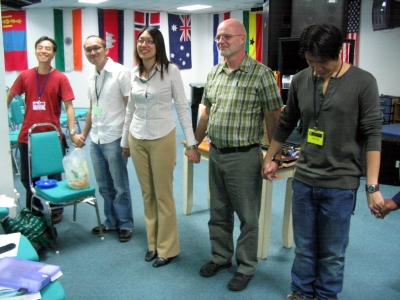
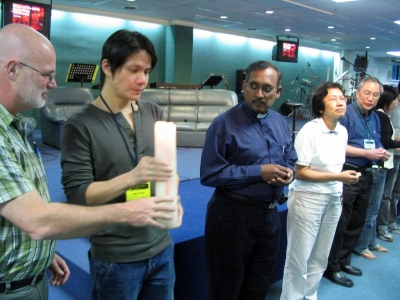
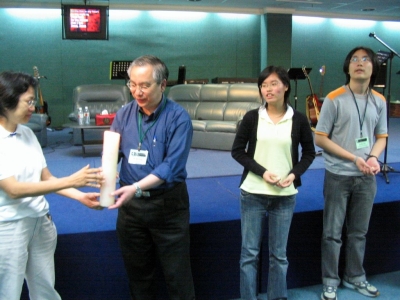
I almost ended my series of reposting other people's posts :-) but then I couldn't resist this excellent piece Friends in Conversation - A Quiet Revolution of Hope from Kevin (who's progressing to a Brian McLaren hairstyle *smile*). I added some flavour by throwing in some pictures of a segment he alluded to.
_______________________________________
"Brian McLaren in Malaysia! That must have been the main draw for me. But I was looking forward to listening to what the conversation partners, comprising of some of the top Christian minds in Malaysia, had to say too. It’s exciting to think about what such a conversation can lead to, and I hope that this event will launch the Malaysian church into new adventures with God in the years to come!I need to get the DVD to listen to the session recordings again though. There were just too many thoughts and words flying all around the sanctuary in CLGC. Some of them really got me thinking hard. But I’ll need to listen carefully and prayerfully at least one more time to be able to digest them. I have to acknowledge that I learned more from the local partners in conversation, with the likes of Sherman Kuek, Dr. Ng Kam Weng, Tan Soo In, Dr. Voon, Rev. Fr. Dr. Jojo Fung, Dr. Herman Shastri, and Elder Tan Kong Beng among them, more than Brian McLaren himself. I guess it’s all down to the fact that I’ve already read quite a number of his books, and most of what he said was already quite familiar to me. Maybe I’ll write more about the contents of the conversation another time, at least after a second listening when I get the DVD.
I believe that this conversation has impacted me in many ways. And it’s not just about the things that were said during the event. Firstly, I have to admit that in listening to Brian and the conversation partners, as well as in mixing with many of the other participants in the conversation, I have been taught a great deal of humility. There is just so much more that I do not know; so much more that I have not experienced or even begun to put into practice in my own life. And there are so many people from whom I need to learn and follow even as they follow Christ.
It was through this conversation also, that my own faith was affirmed. After struggling with it for quite awhile, listening and engaging with people who think mostly (not entirely!) alike in terms of how we understand the gospel and what it means to follow Christ has given me the encouragement that I need to carry on. Maybe I’m not going down the wrong road after all. Maybe I’m not that heretical! Yes, I realize how much I need a community that can affirm my faith in this particular way. Maybe I should participate in more of these conversations with brothers and sisters from Emergent Malaysia. It will also help me to sharpen my own understanding and correct any maverick ideas that I may have!
Through the worship sessions, the songs that we sang inspired me to continue my own journey in carrying the cross daily and following Christ wherever He may lead me. It is time to live out the gospel of love, redemption, reconciliation and justice -- the kingdom of God -- in the context of my workplace in MMU. Praxis calls…

Of all the experiences during the conversation, the one that has left the deepest mark on me came at the closing of the event. All the participants stood in a large circle in the sanctuary.
A huge candle was lit and passed around. And we shared a meal of bread together, just as how Jesus shared a special meal with His disciples on that fateful night before He was arrested.
What made the experience so unforgettable? Why did it leave such an indelible mark on me? The session was led by Rev. Father Jojo Fung, a Roman Catholic priest. Every time I think about it, that same sense of awe that I had then returns to amaze me. In that short moment, it felt as if the body of Christ was one and undivided. It gave me hope for the Church in Malaysia and in the world.
posted by sojourner @ Monday, March 19, 2007"
______________________________________________
March 18, 2007
Friends 2007: The Last Word ...

I'll need to warm up after being absent from blogging couple of days due to some days off at Kuantan. I think walking on the beach did me some good. And I managed to do some substantial theological reading while watching TV and sleeping (all not at the same time *smile*). Had lots of good food too.
Alwyn's does a nice wrap up post I think on our recent event Friends in Conversation which has pretty much dominated my blog for quite a while... Here's some of Alwyn's thoughts in his post The Last Word (where relevant italics and bold emphasis can be SEEN clearly). The post gets an affirming comment from our resident philosopher aporetic :-) who seems to be emerging more into the open again.
__________________________________________
Love your neighbour as yourself - the new commandment which helps sum up the Law. Love your enemy - the (also new) commandment which makes us perfect.Brian McLaren's last word at the QRoH conference was a reminder of the power of loving thy neighbour. I imagine he wanted to sum up his two days generally as a call to love all at all times, especially the unlovable or unloved-before.
If you forget everything else about the conference, if you experience sudden theological amnesia, if you lose all your books, if you're not sure what to think anymore - don't be unsure about peace-making, about replicating the love of Calvary in the community, about being genuinely unambiguously kind. Even to those who beg to differ.
He told a story about two previously warring African tribes engaging sharing a meal, with one tribe not minding being laughed at, another laughing because it didn't realise the other could even talk. Reconciliation and friendship after violence, expressed in the virtue of laughter.
If people with strained relationships can sit down and share a meal, that's an excellent first move to embody a Gospel of hope, peace and world renewal. If you can share the basics in communion/community with another near you, you can begin to love the person as yourself. If you can love your neighbour as yourself - if you can care for him/her as intensely as you would for you - then you can care for your enemy in the same way.
Because (I suppose) it soon dawns on you that loving your enemy and loving your neighbour (as yourself) are not two separate acts but one grand act seen in two angles.
This ultimately 'betrays' McLaren's over-arching motive in writing, in speaking, in visiting churches and peoples all around the world. This last word, this final "don't-leave-conference-without-it" beseeching is McLaren's first and greatest item on the agenda : to model the so kind, so paradoxical, so sacrifical, so self-condescending love of God. Like someone commented somewhere (I think it's Sherman), McLaren doesn't have a theology - he is his theology.
__________________________________________
Friends 2007: Adventures in getting the point
Here are some quotes from blogs where I think what they say represents what I feel are adventures in getting the point from the Friends 2007 event. There are times where we will miss the point or need time to process ... but these gems are pretty good.
__________________________________
"... the Friends in Conversation event, you have to understand, was a difficult and risky step for me. One it meant me making a choice for myself to step aside from 'family' decisions, and two, it meant me coming out in the open and admit it, so yes, I've had some issues with 'church', and for far too long I've been sweeping it under the carpet." - An uncommon departure"... on a more personal level, today was a good day for me. Far from being weary, my time away has enabled me to be refreshed by the conversations today ... evoking thoughts and feelings that I have not felt for sometime. Privately, I was thinking again about the basic tenets of my faith .. my Salvation, His death on the cross, the stark realisation of my own failings, vulnerability and helplessness ... and the word GRACE seemed to be echoing in my head all the time. While it is true that for me, I found grace outside the church yet I cannot deny that it was GOD that had extended it to me, and for that I am grateful.
I came. I listened. I have no regrets.
Perhaps it IS true that God works in many, mysterious and wondrous ways." - Who?"I began this blog with this description of myself - one "who embraces God's gift of life -to eat, drink and make the most of my job and whatever else wonderful that comes my way." While this attitude towards life remains true, dialogues at "Friends in Conversation: A Quiet Revolution of Hope" recently made me think about greater issues than myself.
I've not had so much "food for thought" in awhile. What caught my attention, quite dramatically, was the small group discussion in which I participated late Saturday afternoon. The day sessions comprised plenary and panel discussions on the topics of "Gospel" and "Church." It would, at that point, have been easier to go into small groups that were discussing the Gospel or the Church.
The one I ended being part of was to discuss the "World." Now, why did I sign up for this? I don't remember why actually, except that I must have thought it was a session that would tell me what God was doing on a large scale and around the world. As a Christian, I believe it is good to be in touch with "the waves" that God's creating around the world. Knowledge helps shape our thoughts, attitudes, behaviors and actions." - A Quiet Revolution of Hope
"The conversations are still going on, more vibrant in fact, after one week since QRoH. I fell really sick after the first day and missed the session on World the next day. But for me, the conference ended just on the right note - with Sivin reading out the Franciscan Benediction which echoes some of my own introspection:
May God bless you with discomfort
at easy answers, half-truths and superficial relationships
so that you may live deep within your heart.May God bless you with anger
at injustice, oppression, and exploitation of people
so that you may work for justice, freedom and peace.May God bless you with tears
to shed for those who suffer from pain, rejection, starvation, and war
so that you may reach out your hand to comfort them and to turn their pain into joyAnd may God bless you with enough foolishness
to believe that you can make a difference in this world
so that you can do what others claim cannot be done. " - QRoH - A Compilation
______________________________________
March 15, 2007
Friends 2007: Gems from an encounter with Brian McLaren
I think the time Brian had at the seminary was a very fruitful one in the classroom and outside the classroom. The topic was 'The Church Emerging In The Post-al Age'. My young friend Ben Ong has some wonderful gems worth sharing below from his post Gems from an encounter with Brian McLaren. It made me pick up a Stanley Grenz book to read last night. :-)

______________________________________"That morning, I met up with Brian McLaren at the PJ Hilton while waiting for Sivin and company (i.e. Bob Kee, Kia Meng, Yew Khuen, Jaime Sim). Recognised him from behind, heheh...
There were some interesting thoughts during his session at Seminari Theoloji Malaysia on Monday, 5 March.
For instance, "The turtle was found to be fully functional, and when the ring was removed, it was able to grow into the normal shape."
* * * * *
Dr Voon, during the Conversation segment, remarked on the loss of the relational aspect in our relationships, citing SMS as an example of how we tend to choose the cheapest way to communicate, regardless of relational value.
She also commented that the church has become somewhat utilitarian, wanting people for their abilities but not necessarily for who they are. A typical conversation might go like this:
Church leader: Wow, you're a pianist; you can play piano during worship!
Visitor: Wait a minute... do you want me for me, or for what I can do?* * * * *
In commenting on shifting worldviews and perspectives, McLaren shared this interesting thought/quote from Max Planck, the great quantum physicist:
"New ideas thrive, not so much because they are good in themselves, but because their enemies die out."
* * * * *
But above all, the words that resonated most with me from that day, were not spoken during the official session (as with all the best thoughts in life), but in the Unser on the way to STM, as we were passing the A&W restaurant.
The conversation had moved to the late Stanley Grenz, who came under much fire because of his opinions, and not many stood by him.
On this, McLaren said, "It's not so much what your enemies say, but the silence of your friends..."
Let us not be silent."
_______________________________
March 14, 2007
Friends 2007: Adakah saya untuk diri saya?
Here's another gem in our national language Bahasa Malaysia :-) Adakah saya untuk diri saya? I'm motivated to improve on my grasp of this beautiful language.
Saya bersetuju dengan artikel yang ditulis dalam blog Warkah Pascamoden. Anda boleh melihat artikelnya di bawah.Brian McLaren juga mengingatkan saya dalam sesi perbincangan bahawa kita dicipta dan ditebus bukan untuk diri kita sahaja tetapi untuk jiran-jiran kita dan dunia ini. Adakah keselamatan yang diberikan baginda Isa AlMasih hanya untuk membawa jiwa kita ke syurga sahaja? Kita mempunyai peranan dalam membantu jiran-jiran kita untuk merealisasikan kerajaan Allah dalam hidup mereka agar mereka dapat melihat Yesus dalam hidup kita.
Memang patut kita mempertahankan kebenaran AlKitabiah (Apologetik). Umat Kristian diseru untuk memberikan jawapan yang kukuh supaya mereka dapat memahami iman Kristian sebenarnya. Akan tetapi kita lupa masalah-masalah yang dihadapi oleh jiran kita. Contohnya, bila adanya dialog antara agama, kita sangat petah dalam perdebatan kita. Tetapi bila nak bantu jiran kita bila ditimpa bencana banjir, di mana kita?
Saya rasalah kita memang lupa peranan kita membantu jiran-jiran yang ditimpa masalah. Sebaliknya kita berada di suasana yang selesa bersama dengan kawan-kawan kita bermain, membeli belah, tengok wayang dan sebagainya. Kita ni lebih suka pergi ke gereja yang bertaraf "Mega Mall". Kita pergi gereja di mana lagu-lagu pujian dan khutbah yang memenuhi citara kita. Di manakah misi kita untuk jiran kita?
Perbuatan kita boleh mencerminkan identiti dan iman kita dalam baginda Isa. Hanya perbuatan yang diiringi dengan kasih diluahkan kepada jiran kita menyedarkan mereka identiti kita. Bantulah jiran kita dengan hati yang ikhlas tanpa mengharapkan apa-apa balasan dari mereka.
Saya juga berpendapat kita boleh berkerjasama dengan jiran-jiran yang bukan seiman dengan kita untuk kebaikkan bagi masyarakat kita. Kita tidaklah perlu risau kerana ia dapat membantu kita untuk mengenali jiran-jiran kita dengan lebih mendalam lagi.
Marilah kita ikut jejak baginda Isa AlMasih yang mempunyai belas kasihan terhadap mereka yang miskin, tertindas, sakit dan sebagainya. Ya baginda sering mengajar dan menyampaikan berita kerajaan Allah. Baginda juga mengiringinya dengan perbuatan kasihNya.
Berikut adalah artikel dalam blog seperti yang dikatakan tadi :
-------------------------------
Brian telah mengatakan sesuatu yang telah meninggalkan kesan kepada saya:
Manusia boleh memilih daripada empat opsyen berikut dalam menjalankan tanggungjawab mereka kepada “jiran” mereka yang berlainan dari mereka.
1. Memaksa mereka menukar agama/kaum/bahasa dan lain-lain dan diasilimisasikan
2. Menindas dan mengetepikan mereka
3. Tidak mempedulikan dan mengasingkan mereka
4. Kasih dan mengenal, melayan dan melindung.Sebagai rakyat kerajaan baginda Al-Masih, seorang kristian mesti memilih opsyen keempat.
Dalam zaman sekarang yang dibelenggu terrorisme samada tindak-tanduk hegemoni Amerika di dunia terutamanya Iraq mahupun serangan pengebom berani mati di khalayak mangsa-mangsa yang tidak berdosa, titah baginda Yesus kepada rakyat kerajaannya mesti dipatuhi:
Markus 12:29-31 Jawab Yesus: “Hukum yang terutama ialah: Dengarlah, hai orang Israel, Tuhan Allah kita, Tuhan itu esa. Kasihilah Tuhan, Allahmu, dengan segenap hatimu dan dengan segenap jiwamu dan dengan segenap akal budimu dan dengan segenap kekuatanmu. Dan hukum yang kedua ialah: Kasihilah sesamamu manusia seperti dirimu sendiri. Tidak ada hukum lain yang lebih utama dari pada kedua hukum ini.”
Kasih-mengasihi tidak haruslah pada permukaan sahaja. Sebaliknya orang yang dikasihi harus dianggap sebagai kaum keluarga sendiri. Kenali jiran dengan mendalam. Layanilah mereka dengan hati senang. Lindungilah mereka sekiranya mereka dalam bahaya.
SEORANG KRISTIAN BERTANGGUNGJAWAB DEMIKIAN TIDAK KIRA KAUM, AGAMA, STATUS SOSIAL ATAU KEWANGAN!
“Kalau engkau hanya membantu semasa sendiri dan sejenis, engkau tidak berbeza daripada orang lain yang menolong semasa sendiri sahaja”
Dalam konteks dunia hari ini, konflik agama merupakan konflik yang terbesar. Rakyat jelata baginda Al-Masih mempunyai tanggungjawab sosial untuk membantah sebarang kekerasan yang digunakan untuk menindas golongan yang tidak berupaya. Namun sekadar protes tidak memadai. Teori mesti diiringi dengan praktis. Apa gunanya berhujah panjang jika tidak diringi dengan langkah-langkah yang kukuh dan konkrit dan meninggalkan kesan?
Homili-homili di dalam surat Yakobus, saudara kepada baginda Yesus amat penting untuk direnungkan. Salah satu nas berbunyi:
Yakobus 1:26-27 Jikalau ada seorang menganggap dirinya beribadah, tetapi tidak mengekang lidahnya, ia menipu dirinya sendiri, maka sia-sialah ibadahnya. Ibadah yang murni dan yang tak bercacat di hadapan Allah, Bapa kita, ialah mengunjungi yatim piatu dan janda-janda dalam kesusahan mereka, dan menjaga supaya dirinya sendiri tidak dicemarkan oleh dunia.
Dan lagi:
Yakobus 2:26 Nah, sebagaimana tubuh tanpa roh adalah tubuh yang mati, begitu juga iman tanpa perbuatan adalah iman yang mati.
Bukalah minda dan dada.
Jangan kita ulangi Perang Salib yang dicetuskan oleh Kristian Katolik terhadap Timur Tengah pada Zaman Pertengahan. Jangan kita lupa kekejaman orang Katolik Sepanyol yang menakluki Amerika Tengah dan Selatan dan membunuh kaum tempatan.
Bayangkanlah betapa indahnya sekiranya kita mengamalkan Pemerintahan Allah dalam cara kita melayani mereka yang berbeza daripada kita. Satu dunia tanpa peperangan dan kekejaman.
Idealisme? Tidak, sekiranya semua manusia mula mengasihi satu sama lain.
Dan perubahan bermula daripada diri sendiri.
Posted by Daud Ting at Sunday, March 11, 2007
Friends 2007: "Further along the conversation..."

[David BC Tan & Alwyn Lau in conversation!]
My friend David BC Tan nudges "Further along the conversation..." while I left a comment at the end :-)
The recently concluded QROH seminar with Brian McLaren made me look back through my own archive of writings on emergence. A post dated 29 Oct 04 had this to say:Pointing to the problems of making truth claims to a culture cynical of adjectives like objective or absolute the church will only find its good intentions rejected. "...arguments that pit absolutism versus relativism, and objectivism versus subjectivism, prove meaningless or absurd to postmodern people: They're wonderful modern arguments that backfire with people from the emerging culture," said McLaren.
The alternative as every emergent reader would know is not to ditch our allegiance to Christ or Scripture, but build authentic communities that draw people the way Jesus himself drew the masses, especially the marginalised, to himself. I think we can all agree with that. There is no question about the need to live authentically as a vibrant community expressing kingdom values in all its demands. But the niggling question is, is that all, and if not, in what way do we have to think about being 'relevant'?
The seminar certainly succeeded in avoiding touchy theological points but instead focused on the larger issue of Kingdom imperatives. No argument there. The Church needs to hear a lot more about being a community contributing to God’s Kingdom within our social reality - without resorting to triumphalism or tokenism. In recent years men like Mark Noll, David Wells, and Ronald Sider have also lamented the scandal of our evangelical digression. On this score Brian is on the same page. Where they differ however is the coherence of a theological mandate founded upon a 'fixed centre' (Pascal), which seems the least important in Brian’s dialectic.
Some of Dr Alex Tang's 9-point observation squares with quite a few evangelicals who fear Brian’s deconstruction of truth (after Grenz) and his emphasis on a less precise notion which is described simply as “being in sync with God” (NKOC) – which arguably sits better with a postmodern sense of spirituality. A whole bunch of people are understandably disturbed, some of whom have articulated their concerns in a hard hitting compendium titled, Reclaiming the Center. It's not a boxing ring for the timid, this book. While Brian claims not to have denied the basic tenets of faith (i.e., Nicene Creed) they may unfortunately be diminished due to the emergent worldview (is there one?) he professes, and because of what appears to be waffling on his part. However Scott Mcknight in an excellent piece attributes the misunderstanding to prophetic rhetoric (or 'exaggeration' as Brian admits). It would be assuring if Brian's considerable literate skills clarify the specifics, as theologian John Frame reminds us, God and the devil are in the details.
I was amused when at the forum Dr Voon Choon Khing to everyone’s delight said she couldn't understand the flak Brian was getting: "Give the man some respect; he’s not stupid." I too believe Brian to be a sensitive and intelligent man whose soul-searching over real issues has ignited our imagination. As a creative thinker, Brian’s vision can be infectious. Where he gets it right about the church in community, I sense compassion and a genuine desire to loose the church into a world that badly needs salt and light. The ongoing argument is tiresome, but I also happen to believe that serious real estate is at stake in the long term. So what price relevance? Theological reflection demands a rigorous and robust engagement, therefore this part of the conversation is just as needful. Well. As Pas Fong Yang said, the church is reformed and reforming.
Nevertheless I belong to the 'old' school. As much as I subscribe to aspects of Brian’s perspectives on the new kind of Christian and his articulation of Jesus’ secret message, it is my conviction that knowledge is not the main or only cause of the Church’s present complacency: it is loving Jesus by obeying Him, which is the crux of true discipleship. It is loving God by loving our neighbour, which is the heart of servanthood. Sadly, obedience, that act of dying to self which is so antithetical to every generation (perhaps more so in this present one) has been bartered for personal fulfilment and heaven on earth. Similarly, old-fashioned holiness is no longer a virtue to pursue while God Himself has been domesticated and no longer feared. That’s a hard message for a world more inclined towards soft options and multiple choices. Perhaps that’s what’s missing. Brian’s 'nemesis' D.A. Carson notes:
"People do not drift toward Holiness. Apart from grace-driven effort, people do not gravitate toward godliness, prayer, obedience to Scripture, faith, and delight in the Lord. We drift toward compromise and call it tolerance; we drift toward disobedience and call it freedom; we drift toward superstition and call it faith. We cherish the indiscipline of lost self-control and call it relaxation; we slouch toward prayerlessness and delude ourselves into thinking we have escaped legalism; we slide toward godlessness and convince ourselves we have been liberated."
We need to dream the dream of God, as much as we need to have the mind of Christ. We need to reform the way we do church as much as we need to reaffirm the authority of God’s unchanging Word. We need men like Brian as much as we need scholars like Carson. As long as we’re talking, I’m hopeful.
posted by David BC Tan @ 2:38 AM
3 Comments:At 8:22 AM, Sivin Kit said...
I agree with you different people play different roles in whether in visionary and/or scholarly ways. I think in the coming days we will see more people working on the details perhaps more sympathetic to Brian's imperfect but "seeking to be holistic and integrated" vision. I think the late Dr. Grenz has been a little too under-rated in the English speaking evangelical circles (like how most people in the pew in Malaysia have under-rated Dr. John Stott or Dr. Alister Mcgrath both whom I find more helpful to me than Dr. D.A. Carson matters of theological engagement)
I think your last statement is noteworthy .. "As long as we’re talking, I’m hopeful." but this requires critics to be slower with their "anathema-like" approach.
There are those who are working in the details (or have already talked about these issues but have not been popular writers or scholars within English speaking evangelicalism). For example, Reading a older book "The Soul of Ministry" by Ray Anderson totally blew me away by the similarity in methodology but with more theological precision. Of course, now names like Miroslav Volf and Le ron Shultz is gaining some hearing. Scot McKnight will be coming out with a book later this year.
As someone who's been trained and are on friendly terms with "old schools" (never fully at home with it and yet appreciative) and "new schools" (trying to be part of the construction of it), I find myself looking for models/examples of people whether older or younger who can model can work on these manners closer to our Asian & Malaysian sensibilities (without being ignorant of global realities - whether it's culture or crisises) I confess, it's only natural to be drawn to some and not others. More when we meet face to face again.
At 1:09 AM, David BC Tan said...Thanks for expanding the horizon here. Like you I believe in theological engagement although admittedly the tone of voice varies from person to person. Thanks also for pointing me to new names to follow up on, some I've heard and read of, but whose books I have yet to read (or own!). I know there's talk about a statement of faith (Shults)but I don't think my idea of precision means one - unless of course emergent is going the institutional route which would be a misstep.
Your mention about Asian and Malaysian 'sensibilities' is interesting. It's easier for me to locate these ideas geographically
than culturally, having grown up and studied almost exclusively in a western frame of mind. Seriously, what's a Malaysian model? :)
At 12:38 AM, Sivin Kit said...Malaysian model is doing theology with "Makan" :-)
March 12, 2007
Friends 2007: McLaren in Malaysia
Everyday, I'm reading more feedback and responses to Brian's visit last week. Here's one from my new friend (who's much more experienced and wiser than I am) Todd Nelson in a nice little post McLaren in Malaysia. I recall listening to Todd talk about his experiences in the USA and light bulbs were popping in my head gaining greater insight on Christianity in the USA. So, it's interesting to read his take on last week.
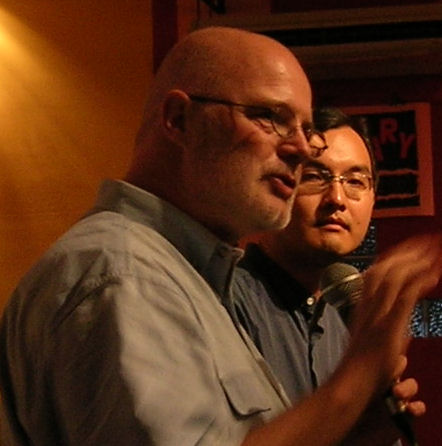
"On March 3rd and 5th, I got the chance to meet and converse a bit with American pastor-teacher-author and spokesman of Emergent Village, Brian McLaren. He was invited by our mutual friend and Malaysian pastor Sivin Kit to stop over in Malaysia on his way to Australia. (That's Brian and Sivin in the photo.)I’m glad I went to the conference and the dinner that Sivin and several others organized. I listened closely to Brian's provocative talks, interpretations of Scripture, and wide-ranging stories. I wrote elsewhere that his approach to theology and evangelism intrigues, inspires, and troubles me, all at the same time--which is, I think, the kind of reaction he is hoping for from pastors like me (I’m only five years his junior.) I found Brian to be very down-to-earth, approachable, and eschewing of any VIP treatment. He genuinely wants to interact and learn from others--especially in the "two-thirds world". This is refreshing. I also appreciated the insights of the several Malaysian church leaders and thinkers who engaged him in public conversation.
Brian's visit prompted me to hurry and read one of his many recent books before he arrived, A Generous Orthodoxy, and to look again at Reinventing Your Church, his first book. I bought that book (now republished as The Church on the Other Side) back in 2004 as part of a small bundle of books for the elders of our brand new church to read and discuss. And in 2006 I bought A Generous Orthodoxy to see what all the fuss was about regarding Emergent ideas and Brian McLaren. When I heard he was coming to KL, I thought I should at least go ahead and read what I bought! Maybe I could ask an intelligent question. (Turns out I did a lot of listening and thinking and processing instead.)
What attracts me most about Brian and the whole emerging church movement is the combination of humility and passion--humility expressed through listening in conversations with Christians and non-Christians about truth and ultimate reality, and passion expressed in reaching present and emerging generations with the Good News of Jesus through patient and serving relationships.
I don't necessarily agree with everything Brian writes or says, but that’s ok. The conversation can sharpen us both, if we’re willing to listen to one another and keep conversing, rather than shut down too quickly and lazily label the other as an opponent. Too many of us Christians operate this way over theological, political, and moral issues.
Thank you, Sivin, and thank you, Brian, for your "quiet revolution of hope". I believe Jesus is calling us all to be revolutionaries in His cause--to participate in passionate actions and humble conversations for the purpose of world transformation. And all the while, we must stay in intimate connection with Jesus lest we get off track. "Thy Kingdom come, Lord, thy will be done on earth as it is in heaven."
Posted by Todd Nelson at 3/12/2007 08:38:00 PM"
Friends 2007: my tint of hope
I think it's easy to just be engaged on more conceptual conversations which a number of the previous posts I've pointed to tend towards. So when i read Janelle's my tint of hope I thought it was refreshing. Read on ...
"How would you consider something to be good or bad? Why would two person go to watch the same movie and each coming out with different opinions? Why would some people like a speaker but others consider him to be boring or rude? Why would some people consider certain fashion to be cool while others think it is boring? A certain seminar could be meaningful to some but totally a waste of time to others. Whatever it is, this is the diversity and the creativity we see in God's handiwork. Each having their differences in taste and view point.I think something is meaningful to someone because that person could relate to it and found it useful while others maybe refuse to relate and have their own mind set already.
I was one who had a very closed mindset about other denominations, their beliefs and practices. I was "critical" and never believed in traditions until lately my view pooint about this has drastically changed. Thanks to people like Sivin and Sherman. I have learnt to appreciate them. Infact, I practice some of these spiritual traditions myself in my quiet time.
The question that was in my mind was, could the churches in Malaysia be unified? Can it be put in the Kingdom context. Can we as Malaysian Christians live out church the way God has intended it to be and be unified in our mission. Which is God's mission. Currently, they seem so disunited. Each denomination trying to promote their belief and practices and things like "if you are of a different denomination then you cannot come to our church to partake communion with us".
I saw that tint of hope when I attended a conference last weekend. "A quiet revolution of hope. Friends in conversation". (To read more about the event itself, read Sivin's blog). There were people of defferent walks of life. Different denominations coming together to talk about kingdom and church and what really matters in Malaysia in relation to us (Christians). Current issues etc. There were Catholics, Baptists, Lutherans, Methodists, Evangelical Free Church, Protestants, Pentecostals etc. Although there were only a handful comepared to the thousands of Christians around Malaysia but they represent the voice of Christianity. We have Fathers, Bishops, Pastors, leaders and just church goers. The conversations were good but what impacted me the most was to see these different walks of life coming together talking about the same things. I see their heart for the church and for the things in the heart of God. Although they have different view point, I am hopeful that God is at work and I just had a glimpse of the unity of the body of Christ in Malaysia to want to see God glorified in Malaysia. Those little differences did not seem to matter much compared to the bigger picture.
A highlight for me was the closing when we broke bread with each other. I was standing in a circle looking at the different people, holding my piece of bread and remembering the significance of this. Identifying myself with the body of Christ in Malaysia and with Christ. Remembering that everytime we do this, Jesus was in our midst. I nearly cried. I am hopeful. As long as we are in conversations with each other, even though we may disagree, the fact that we have these conversations, shows that we are interested in the body. We are interested in God's plans for us. A little light of unity in the body.
Posted by Janelle on Monday, March 05, 2007 at 9:45 PM"
March 11, 2007
Friends 2007: Conversations: A Revolution of Hope
I'm still trying to catch up with the after event conversations ... here's one by Egalitaria worth some time - Conversations: A Revolution of Hope
"Thoughts have been clamouring to get out. Having been involved with the recent weekend event, and meeting Brian McLaren face to face with the privilege of personal interviews (not interrogation!), it’s only natural that I feel the need to articulate in writing my ideas of religion and Christianity. Note that these are only my interpretations and understanding of these new concepts, and may need (a lot more) retuning and refining!Brian McLaren, as many would know, has been one of the foremost writers and speakers representing the Emergent Network in the
United States. Over the last weekend some of us have had the opportunity to be in conversation with him and many other leadingMalaysian Church leaders, people like Father Jojo (Jesuit priest), Rev. Wong Fong Yang, Tan Soo Inn, Sherman Kuek and so on. We had a great weekend talking about the Gospel, Church, Discipleship and the World. What a refreshing time to rethink all our conventions of "Christianity"! So many of the things discussed resonated deep within my heart and were manifestations of things I have always thought of but was never quite willing to explicitly say.
The question I asked him when we first met on Friday night (amongst many many other questions) at dinner was,
"What started you on this journey".
And he replied, "It started when Bush get elected into office."
I personally found that so hilarious and pertinent that I used that story when facilitating the final session on engaging the World.
Essentially the Emergent story is based on the need to present an alternative Christianity that most of the world has been exposed to these recent decades. The typical "Christianity" that has been presented has been a largely Western, Evangelical, Proselytising Christianity that focuses on saving the world through little booklets and tracts, short of forcing anyone to conform to a church culture and accepting in entirety the historical creeds, in long words and theological jargon that twists the mind and tongue. Made worse is the Christianity professed and marketed in America, the Christianity of television evangelism, "charismatic" repetitions of phrases shouted with the purpose of indoctrination versus a real inward reflection.Finally of course, the Republican faith has done no better in reflecting the Church, by justifying foreign policy of war and imposition of regulation and (a certain interpretation of) democracy in the Middle East. Without a deeper analysis and reflection, much of the world can be and has been convinced that this is the only true version of Christianity. One that supports the victimization of others, supposedly based on biblical principles.
So does the Bible really support such action? If not, what does the Bible say? If "Christian" really means "follower of Christ", should we not look at the things that he did and said in exemplifying a godly humanity?
The premise is that Jesus did NOT primarily come to this earth to die. He mentions "Kingdom of God" most times in his speeches. His vision was for the kingdom of God to be acted out, principles of life which would transform systemic evil that existed in this lifetime to goodness and holiness – emphasizing humility, sacrificial love, compassion, justice, and so on, to counter a world that was encroached upon by Roman dominance, deceit, lying, pomp, and pride.
I find that most Christians can agree with the execution/practical implications but not the theoretical premise behind it. For example, the need for Christians to engage with the world is not a new concept. In fact, the Catholic Church has done a great deal of work in social justice, acting on behalf of the poor and sickly. Think Mother Teresa. There needs no argument to convince that the Bible has stated a case clearly for principles of justice, equality, speaking up for the oppressed and so on.
But maybe more important and revolutionary is that all of this stems from the understanding that Jesus actually came to the earth to present a Kingdom of God in the here and now primarily. If so, then it gives a whole new meaning to the constant mantra we’ve often heard and believed, "If you believe in Jesus, you will be saved". One that begs the definitions of each component of that statement – belief, Jesus, salvation.
Belief - belief and trust and faith in a person who has given you life principles that you can live by and experience abundance, just as how I believe in my mother. Salvation – salvation from the horrid injustices, poverty of spirit, depression, bitterness, hatred, institutional evil in this world but turning to a life that is marked by light, love, compassion.
The implications of this are far-reaching. It makes one rethink many things, a paradigm shift of how we should be living today.
1. Jesus' Death ... Did Jesus have to die? Perhaps it was a historical necessity rather than anything else. Anyone who proclaims a Kingdom alternative to the Roman Empire at the time would have been executed and killed. Anyone who proclaimed a Kingdom alternative to the sort of bigoted Pharisaic regulation-oriented “religion” would have been condemned to die. In that sense, yes Jesus died because he proclaimed something so revolutionary that most people would not have accepted. But yet he had to say those things.
2. Grace ... The concept of grace is huge, in Christianity. The fact that we can never do enough good deeds to "get us to heaven" is justified by God’s tremendous grace swooping down upon us to “get us there”! But, as pointed out, perhaps we are not asking ourselves the right question. Maybe the question is not all about “getting to heaven” but "living heaven out on earth today". We acknowledge incapability and inadequacy at being perfect, but God’s love is so great so we do the best we can. Grace still applies very much in this framework. But it is not so much a "grace that will get me to heaven and the finishing line”, but a “grace that allows me to admit my weaknesses and help others along and practice humility in living a godly life".
3. Evangelism ... I have always hated the way we have “done evangelism”, through evangelistic rallies and convincing people to say the “sinner’s prayer” and believe that Jesus is the son of God, that he died and rose again, and accepting him into your heart as Lord and saviour, this 1-2-3 step ABC that everyone has been convinced is necessary for the Christian faith. I beg to differ. Evangelism should now mean the telling people to look at Jesus because here is a man who taught such wonderful life changing principles, and being hands and feet to people through real and solid helping "save" lives of poverty, rejection and discrimination.
4. Jesus' resurrection... I haven't quite got my head around this one yet.
5. Eternal life... Haven't figured this one out yet either.
6. Relating to people of other faiths ... Anyone who looks to Jesus as a teacher, prophet, great man, can be a follower of Jesus, can they not? Or must the person go through the strict process of believing Jesus is the son of God and so on and so forth? And where does one cross the line? Perhaps it is a spectrum of possibilities, a continuum that one goes through and experiences daily. And because one cannot clearly define a particular point of "engaging in an active relationship with Jesus", then perhaps we are all one and the same – people struggling to follow Jesus and all that he represents.
This inspires me to an even greater degree to do the work of Jesus here on earth. What this means is different to each person. Perhaps a lawyer feels that he needs to engage in human rights in order to stand up for the oppressed and underprivileged (of course this does not apply to the huge law firms of the world), the social activist to look at issues faced by the discriminated against, the businessman to ensure he uses his money wisely to responsibly care for the environment and sustainable development, the politician to represent the views of the people whose neighbourhoods must be well taken care of. It is indeed kingdomic principles that we need to wake up to. The right questions must be asked, in order for the right answers to be made clear to us.
For now, we see yet through a glass darkly."
Friends 2007: Conversations with Alex Tang [continues]
Looks like the conversations over at Dr. Alex Tang's blog post A Quiet Reflection on QROH continues with much life and vigor :-) It will be interesting if Jason Clark joins us. For now, eavesdrop and enjoy ... Please remember to read the original post for context.
" Alex Tang said...Hi Yew Khuen,
Thank you for the kind comment. I agree with you that I wish Brian has had more time to unpack his ideas.
Basically, you have hit the nail on the head. The emerging church is a protest, as C.A. Carson says, to the ineffectiveness of the institutional church. What I have not heard anyone in the United States say is that the emerging church movement is an attempt to re-evangelise the United States. It is trying to do contextualize the Christian faith in a rapidly changing culture. It is never meant to be a challenge to the status quo but an attempt at reformation. In doing so, they are trying to legitimize their position by building up a theology. You mentioned Grenz, Wink, Kierkegaard, Nietzche, Willard & NT Wright.
The emerging church drew most of their ‘postmodern’ theology from Grenz but Grenz is not really postmodern. Wink, Kierkegaard, Nietzche, Willard and Wright are actually very “modern” in their thinking.
Yes, it is difficult to talk to a varied crowd and I am sure there are people who do not understand why this conversation is even necessary.
Yow Khuen, I look forward to our next meeting.
Blessings
10:14 PM
Alex Tang said...Hi Sivin,
There is a lot of work done about contextualization, especially in the missiology sector. And there are many people who begin to see the issue of the emerging church is the issue of contextualization. That is why David Hesselgrave criticized Brian’s model of contextualization. David is a renowned professor emeritus of missiology. I do not know whether Tony Jones has finished his D.Min. from Fuller’s.
“But I see myself at this stage encouraging critical creative work and construction in our context.” I am happy to hear you say that. But it is not enough to encourage. You will need to do some critical creative work and construction. We need to approach this at two levels. One is from the academia level where one has to do research and publish papers and books. The other is from the grassroots level where one has to becoming the community of the followers of Christ.
Actually there are more than three levels of engagement. It is natural to think of the pastoral level and the academic level. Do not forget that we have a large group of people who are on the same level as the pastoral people but who are not pastors or full time workers. Many of our “laypeople” are well educated, well read, and some even have theological training. These people will create the different levels as they engage with their workplace, their community, their families and relatives, and their denomination. As you wrote, “Each engagement with a different focus and accent.” I am very excited about this. For the first time we are regaining what the Puritans, the Quakers, and the Brethrens have been telling us. Forget the artificial division of clergy and laypeople.
We do not have to wait for Jason Clark to come over. We can invite him to join our conversation here :)
Blessings
10:37 PM
Alex Tang said...Hi Alwyn,
Interesting way you used Brian’s presentation in his Gospel talk and link it to the framing in the World talk. Actually framing comes from the work of Donald Schon and Martin Rein. This was developed further and connected with the meta-narratives. Framing is often misused as the rich and powerful rewrite history. Paulo Freire ( I am sure you are familiar with him, others ‘google’) gave the power back to the people.
By a “theological construct” I mean, for example Karl Barth’s Christology or Wright’s Atonement. It is a propositional, definable system of belief. It is easy to build theological straw man.
“Standing with him” means at least agreeing with him or try to support Brian’s ideas. No, I do not mean theologians who has become postmodern. NT Wright, Grenz, Franke, Bryan Walsh, Brueggemann, and Webber, are mentioned by Brian to support his ideas, not the other way round. Again, these guys are not postmodern.
Andersen’s book is interesting but he needs stronger support for his propositions.
Blessings
11:10 PM
Alex Tang said...Hi SK,
Thank you for your insightful contribution. I agree with you that there will not be a theology of the emerging church. It is far too diverse for one.
I like the "Theology is contextual, so let's all do theology contextually!" (now, is that a truism?) I believe that is what Brian is trying to share with his theology of model making. Again we come back to the universal (truth) and particular (culture) of the Gospel. The danger is making the particular the main emphasis. Then we have idolatry. This is what the systematic theologians are afraid of. It is as you mentioned, the “chaninging of the rules” that worry them.
I don’t know whether we qualify to be the “anonymous Christians” that Karl Rahner refers to, but hey, we’re talking :)
Blessings
11:22 PM
alwyn said...Hi Alex, hey I think you've gone way ahead of me there: I've never heard of Schon, Rein and Freire - guess I got a lot of catching up to do.
I'm surprised, though, you said that Grenz, Walsh and Franke aren't postmodern. But hey this would be another conversation. ;>)
12:14 AM
Sivin Kit said...Alex,
some quick comments before I sleep (and look how linear I will present them!).1. I'll try and see whether I can get Jason Clark to give some comments.
2. As far as encouragement and construction, I think we're all participating in this. Encouragement is more immediate (and often lacking). Construction needs more time (and patience)
3.Here is where it's important for conversation. I use the word "pastoral" not exclusively for clergy. Thus, I affirm your comment: "Many of our “laypeople” are well educated, well read, and some even have theological training. These people will create the different levels as they engage with their workplace, their community, their families and relatives, and their denomination."
And I believe in their "pastoral" and "priestly" role in their respective locations. But this shift in appreciating the priesthood of all believers is more to help us relook at current practices and values. I think we have seen how merely changing the forms does not necessarily get to the core of the matter. In churches where there are no clergy/laity distinction, my friends share with me other "ugly stories" of how we fail to handle the issue of power. That's another topic.4. The other buzz word is "postmodern". During the event, and even in our conversation here, I find it to be a red-herring at times. For example, the question for me is not whether Grenz or Wright, or whoever is "postmodern" (whatever that means). My question is what are the question they are asking and what context are they engaging. And if that's the question asked, then Grenz did make a shift to seriously engage his postmodern context and interact with "postmodern" philosophers. This can also be said of NT Wright in some of the lectures I've heard lately where he is no friend of modernity and refuses to sleep with postmodernity and uses the image of "walking through" postmodernity to the other side.
5. On the issue of reading into. I did ask Brian did he get his ideas from Marx for his last session (a friend of mine asked me becoz he felt what he seemed to have heard it before). Brian said "no". I confess, I'm not that well read and thus am not able to guess where maybe Brian's sources. Most of the time he mentions them, other times perhaps it's more hidden.
6. I think in many ways, we seem to be asking questions that Brian did not intend to answer by his quest. For me, I see him as a model of a reflective practitioner (a phrase he uses on himself) and not a academic scholar. This does not mean we can't critically engage his thought academically but I wonder whether those energies could be channeled to perhaps engaging the authors of "The Missional Church" where they clearly set out their theological vision. I read both books the missional church and church on the other side almost the same time. The missional church book fired my theological imagination, Brian's first book showed me how one works it oout pastorally and in less technical language. Together they have been very formative to get my own thinking going.
7. I think when we talk about the theology of the emerging church it's useful to contrast an earlier movement in the last century in the English speaking world -e.g. what is the theology of the evangelical church? Does everyone follow John Stott's theological vision? Is it Pat Robertson? Or Alister McGrath? How about the Latin Americans like Rene Padilla? Or Asians like Stephen Tong? In short, the diversity is more of a reality of the various streams within the wider world of Christianity.
8. As for Idolatry, I think Calvin said it well, "the human mind is an idol factory". so, for me whether it's universal or particular the danger lies in both ends. The moment we fall in love with our concepts of the one whom we worship more than the one who created us and relates to us ... we are all in danger. This doesn't mean we do not formulate any means of understanding God but we begin to learn to use language with more humility and with an open posture and hearts more open for the inbreaking of God's kingdom in our understanding. This is an ongoing process in conversation and in community with the saints/sinners of the past and the saints/sinners present. Of course, I'd have to mention Christ, Canon, Creed and more ... but this will make this comment a little too long if I continue unpacking those words. More another time. :-)
12:29 AM
Alex Tang said...hi alywn,
It's like Sivin said, postmodernism is such a nebulous term that it is so hard to define.
Second, is that the people you have mentioned are not consistent in what they say. Maybe it is the context in which they say it. Or maybe their thinking is evolving. So it sounds great to walk past postmodernism into ?what. Quantum modernism?
Blessings
1:04 AM
Alex Tang said...Hi Sivin.
1. That will be great if Jason can join us and give us his input.
2. I like the encouragement and construction. As long as we do not be too reductionist in our thinking.
3. Yes, I know what you mean. One of the thoughts that Brian stirred in my mind during the conference and I have filed to explore another day is the spirituality of power.
4. Agreed. It is a buzz word. Any suggestion on what other words we can use?
5. On the issue of reading into, it is interesting that I am not the only one who thinks of Marx.
6. Okay, missional church.
7. I think we all agree about the diversity. It was some time before the word “evangelical” come into being.
8. goodnite :)
1:19 AM
sk said...Hi Dr Tang,
Wow, it's been some time since I've engaged in a lengthy discussion in somebody's blog comments section. But this is getting too interesting to ignore. :p
I just have a note in relation to what you mentioned about the universal (truth) and the particular (culture). Yes, an over-focus on the particular isn't the way it's supposed to be. Further to that, though, an engagement in the particular often (if not always) necessitates the theological thinker to re-examine what he once thought was universal. I think this reality is what makes many theologians shudder.
This is especially when we come from traditions that "fossilise" what we think to be universal. Whilst what we think is universal may be so, there's an inclination to forget that our ARTICULATIONS of that which is universal themselves aren't universal. These articulations are encouched within a cultural reality and are also never exhaustive of the universal in its entirety.
To do theology contextually is indeed an endeavour fraught with danger. But because all theological articulations are inevitably contextual, the entire theological arena is itself fraught with danger. And all the more, we cannot retreat from the necessity of walking this path. We play the game, and in the process of playing the game, find that we have to re-examine (and modify or change) some of the rules of the game because we find that some of the existing rules either 1)misrepresent the nature of the game itself, 2)reflect a way of playing relevant to the way the game used to be played before but is now acknowledged to be archaic because of the growth of wisdom in that field, or 3)ignore the reality that there are other players of the same game in other parts of the world and in different points of history playing the very same game using a different set of rules we never knew about.
4:03 PM
Alex Tang said...Hi SK,
That's why I am so excited about it. Yes, it is good that you recognise we are playing a game, a very dangerous game.
Lamin Sanneh influenced my thinking very much on this. There is a real danger of us fossilising the universal. And I believe this is where many theologians and denominations at at this stage.
Like you say, we are playing a games with changing rules in relation to culture, historical, socio-economic development, ideologies, powers and principalities, and what is worst, in a neo-colonisation of a superpower mono-hegemony. Sounds familiar? Like the New Testament church all over again.
Blessings
4:34 PM"
March 09, 2007
Friends 2007: Christian Today Interviews Brian McLaren
(photo by Christian Today Malaysia Edition)
For the full interview go here ... Interview: Brian McLaren Engaged with Malaysia’s Christian Leaders. I'll pick out some excerpts to wet our appetites.
"... I like the way that these [conversations] are being set up. Through the conversations I have had in Malaysia, I have learnt so much.
... it is hard to explain what is “emergent”, but it is often described as friendships and networks. It is not really an organisation. There is no budget, there are no staff, but it is friends that try to stay in touch; on the internet or also by gathering together like this.
Despite all this, people tend to think that it is an organisation. But it is really a conversation and an extended friendship.
About the vision, what I can say is that we need to talk, because we have a lot of problems. We need to help one another and we need to have a global conversation.
... I think a lot of the criticisms are at the point of misunderstanding. For example, a lot of it was associated with the word “post-modern”, which is very controversial. It is a word with a thousand definitions. So a lot of people are making assumptions about me based on the assumptions on that word.
...Another issue is the way we counter people from other religions. I believe, as a Christian, Jesus is the saviour and the Lord. But I also believe, as a Christian, I have been called to love the neighbours of other religions - to enjoy them as a neighbour, and to work together with them for a more just world. But to some of my critics, they think that this should not be compromised."
Friends 2007: Conversations with Alex Tang (Updated)
A number of us found Dr. Alex Tang's quiet reflection post helpful providing an invitation for further interaction. I still have not sat down and written down my own reflections :-) in a more systematic way. Have fun eavesdropping on this current one first.
" Bob K said...Dr Tang,
I really appreciate your reflections abt McLaren. It is very refreshing to hear/see a more critical assessment of the message McLaren brings to us, the Church, as a whole, without the atypical flippancy that most criticisms of the emergent conversation seem to take upon.
I can understand that the challenges which McLaren throws to the Church and Evangelicalism specifically can be very difficult to digest and occasionally challenges what seems to many already set in stone. That is why I am happy that while you still affirm the foundations of Evangelicalism, you have found yourself able to embrace McLaren as a person and able to open yourself to some of the more critical posits presented.
Perhaps this is where your praxis of the theology of modelling is put into action and that makes you part of the process of defining what is still somewhat vague in what is emerging in the Church this century.
Blessings,
Bob K
7:57 PM
Sivin Kit said...I think unlike many who came .. you came most "prepared" and I'm glad you had the chance to have more interaction with Brian.
I think due to the nature of the event .. where I saw Brian as more of a conversation initiator (and thus the attention was meant to point away from him), we had less chance to directly engage his thoughts.
Overall, I appreciate your quiet reflections :-) I think they are helpful and hopeful to get us thinking for ourselves.
I'm glad my camera taking skills are of acceptable standards. I think the final picture looks good. And the final paragraph captures the special blessing for you and many of us ...
"There are still a lot of questions and even more answers are need. I value Brian as a friend. Hey, we had Yee Sang on Chap Goh May. I believe that he has an important message for us here in Asia. At the very least, I can tell my grandchildren (when I have them) that I once shared the stage with Brian McLaren."
I'll interact with your points over at my blog in a different way. :-)I'll leave you with this link to wet your appetite.
What (again) is an emerging theology?
I think we're more used to engage with the British way of presentation? :-) Enjoy
10:29 PM
alwyn said...
Alex, were you reading my mind? (grin)
I think your 9 reflections are very helpful in setting some kind of 'agenda' for thinking more about what Brian said.
(And, sigh, this was just going to be a short comment but), moving straight to point 5 regarding his lack of a theological model, I *suspect* that:
- he isn't very keen developing anything even resembling a 'systematic theology', not because he think it's bad but because he feels that isn't a priority; he MAY even ask, "What was Jesus' "theological model"?
- he's more concerned about throwing out new ideas and trajectories, as opposed to 'fleshing them out' Biblically, hermeneutically, etc.
- he prefers that others more qualified than him (with a theo degree, unlike him) would take up this task
- he'll likely say that all Christians/theologians are influenced by psychology, sociology, politics, etc. and might even insist it's a good thing, 'good' being measured by how closer it brings us to obedience and the kind of aggressive yet quite kindness characteristic of a 'new kind of humanity'
All the above is speculation about how Brian might respond, but hey didn't u manage to ask him about this when you were with him? ;>)
(I only popped him one direct question: Have you read Greg Boyd's Myth of a Christian Nation? He said yes and it's a good book. Not the best book, but a good one)
10:34 PM
Alex Tang said...Hi Bob,
Thank you for your comments. It is important that after all the excitement and after the "mountain top" experience of any religious event, we need to reflect on what has been said.
I like Brian. I hope he likes me.
However we need to engage in what he has taught us; firstly to understand him, secondly, to critically reflect on what he said, thirdly, to accept or reject what he said, and finally, to act on our critical reflection. As Sivin said, the end of the conference is just the beginning.
12:21 AM
sk said...Thanks, Dr Tang, for the post-Conversation reflection... it's much appreciated, as it helps me recap much of what had been spoken throughout the three days.
Wow, you read ALL of Brian's 10 books?! I guess I must confess now... I've not read a single one of Brian's books. *mournful look*
I think Brian's purpose wasn't so much to establish an apologetic for the emerging church movement; this perhaps explains his silence on this issue. In fact, it probably isn't very consistent with the ethos of the emerging church to establish a self-protectionist apologetic for itself.
I think there is probably a lot in Brian's reservoire of understanding which he wasn't able to share with us in the light of the limited time given. Also, he probably wasn't very interested in taking on a prescriptive approach.
If I read Brian's words and heard his talks correctly, I think he was more interested in affirming what we're already doing in Malaysia, particularly those of us who're primarily interested in contextualising our faith. I think Brian would agree with me when I say he's NOT asking us to do something that we're not already doing.
One classic example of this contextual concern is your Asian approach to spiritual formation... S.H.A.L.O.M!
1:08 AM
Alex Tang said...hi Sivin,
Thank you for the opportunity to interact with Brian. You have been a gracious host.
No, as I said in my post, this is not a criticism of Brian or of your organisation of the conference. In fact, you and your team did an excellent and fantastic job. Well done!!
I understand very well that the objective of the conference is that Brian initiate the conversation which will be carried on by the local conversation partners.
Thank your for your links to the open theology blog. It is an interesting concept that people can build up a theology by contribution from anyone, as sort of wikipedia or wikitheology. However, there will come a time when any theology must be subjected to the vigorous examination of the academia.
Here is a caution.In our headlong rush into post modern/ emerging church ideas, be careful that we do not end up anti-intellectuallism. This is a real danger that we must be aware of.
I look forward to your interactions with my points in your blog.
Not really, I have my fair share of both American and British presentations in both medical and religious context so I can differentiate between the two.
BTW, I have email a copy of my post to Brian for his comments. I want to be fair in my observations.
Blessings
1:39 AM
Alex Tang said...hi Alwyn,
No, I was not reading your mind. Is that one of the new spiritual gift? :)
I have enjoyed your postings very much.
Straight to point 5.
he isn't very keen developing anything even resembling a 'systematic theology', not because he think it's bad but because he feels that isn't a priority; he MAY even ask, "What was Jesus' "theological model"?
Even postmodernism has some rules and guidelines or it is just total chaos. Modernism has foundamentalism while post modernism has web of knowledge. It is epistiomology that is important. Brian has to develop the epistemiology of the emerging church. After 10 years, he cannot say it is still not a priority. BTW, Jesus does have a "theological model". His mission is to train the disciples, bring in the kingdom of God and die on the cross. His theological framing is the Law and the prophets.
he's more concerned about throwing out new ideas and trajectories, as opposed to 'fleshing them out' Biblically, hermeneutically, etc.
I agree with you in this.His time is limited and he has so much to say. To be fair to him, he threw out his main outline and his main points.
he prefers that others more qualified than him (with a theo degree, unlike him) would take up this task
That may be true but again after more than 10 years, where are the theologians? Is there anyone prominent standing with him other than Andersen. I have searched the database for PhD and DMin dessertations on the emerging churches and there are only a handful only. Why? Is it because it is hard to study something that has no one focal point but many?
he'll likely say that all Christians/theologians are influenced by psychology, sociology, politics, etc. and might even insist it's a good thing, 'good' being measured by how closer it brings us to obedience and the kind of aggressive yet quite kindness characteristic of a 'new kind of humanity'
That is exactly what he is saying. He is saying that all of the theologies of 19th and 20th Century theologian are modern, contaminated by culture and the new knowledge (psychology, etc). It does not seem to work because our cognitive knowledge does not translate to our actions, which is to be obedient and loving. That is why he is suggesting a new kind of Christianity.
Blessings
2:01 AM
Alex Tang said...Hi SK,
You are right in that Brian is not trying to present an apologetics for the emerging church movement. In fact, I have a distinctive feeling that he was trying to avoid the use of the words "emerging" and "postmodern". However, some of the other pastors of the emerging churches are not so restrained. This is helped by the publisher Zondervan and the Leadership Network which are publishing books about the emerging movement as fast as they are written. Anyone ever wondered why such a small group of people can produce so many books and generate so much publicity?
I agree with your reading of Brian's words and talk. He is interested in affirming what we are doing. But he is also interested to know whether what he is doing and teaching in North America can be applied in Asia.
Blessings
2:16 AM
y2k said...Hi Alex,
Thanks for your post and reflections. Really appreciate your interaction, and the discussions taking place on this page itself! In danger of too much self-consciousness, may I say that you really help us to model a way of conversation that would be so helpful for Christians to move ahead, not get stuck in false dichotomies/dualisms/polarities.
You know, I also wish Brian could unpack his ideas a bit more for the rest of us - or even point us to source literature that forms the basis of a lot of his stuff. So hopefully he'll drop by KL again some point soon.
You mentioned that there's not much academic work published specifically on the emerging church movement(ECM) even after over 10 years. My conjecture is that the ideas that fuel this "movement" (that's a bad word in these circles, by the way :)) aren't all that new - ECM is a form of contextualisation, as has been observed by various postings around QRoH. So, while I haven't read them myself, I suspect understanding the foundation for the ECM would entail going back to some of these source "ideas" (some that I've heard being quoted includes Grenz, Wink, Kierkegaard, Nietzche etc - I've read Willard & NT Wright). But you'll be pleased to know that there has been one or two recent books exploring/proposing a theology for the emerging church (Sivin can help here?).
Interestingly, there were some participants I know for a fact who found even the stuff he presented to be way too deep. So going into more elementary explorations would've completely lost these poor brothers/sisters. I guess it's hard to pitch it with such a varied audience. All the more reasons for the conversations to continue beyond last weekend!
Hope to see you in KL again sometime, or when I head down south..
God bless
Yew Khuen7:24 AM
Sivin Kit said...Alex, I must state clearly that I appreciate this post. I think this is the kind of conversation and tone which is contextual to our social location as well as seeking to be faithful to the Gospel. I REALLY enjoyed interacting with you too ...
I see it in 2 ways (surely there's more):
1. It will be interesting to observe and even interact with how those participating in this conversation work on the contextualization (which I was surprised to know is not a welcome word in some quarters)in the USA and North America (especially since they have a strong publishing ability and influence) Examples of this is found here Emersion Books. It seems to be people like Tony Jones and Doug Pagitt would be leading the way in their context. So, Brian is one of the participants and an important voice but probably not the "systematic" one.2. I think in a broader scale (and perhaps more academic)the place and people to engage with would be the Gospel and Our Culture Network USA and perhaps those in UK as well ... Another 2 blogs I've keeping an eye on would be Generous Orthodoxy Think Tank and the church and postmodern culture: conversation. I think there's a place for critical engagement with the ideas found there. But I see myself at this stage encouraging critical creative work and construction in our context.
3. I thought it was two but then now I realize there is three ...I think there are different levels of engagement (e.g. ranging from pastoral to Academic). I recall a model by Grenz and Olson that was very helpful in their book Who Needs theology? which seems to be behind my mind right now. Each engagement with a different focus and accent. This is my observation and intuitive guesses after thinking about this day and night for the last 7 years consciously and unconsciously (and of course especially in the last few days pre and post Friends 2007). :-) So, in my mind I have this "fuzzy" model of how I do it, now I'm catalyzed by your post to put it our clearer.
Let me send my son to school first and I'll talk more. :-)
p.s. your post is not seen in anyway as a negative criticism. On the contrary, it's very helpful to move the conversations forward. Thanks for your contribution.
8:08 AM
Sivin Kit said...
Oh yes .. I think my friend Jason Clark would be a conversation partner who would be helpful from a UK context. We're trying to work out a possibility for him to come to Malaysia. I think that would enrich our constructive thinking here.
9:12 AM
*Update 1*
alwyn said...Hi Alex,
Jesus does have a "theological model". His mission is to train the disciples, bring in the kingdom of God and die on the cross. His theological framing is the Law and the prophets.
I take it that you want to see (explicitly) the methods with which Brian derives his conclusions, right? Point taken - so there's no hint of it in any of his 10 books?
But wouldn't you consider what Brian presented in his Gospel session as the 'framing' part? So it could go something like:
1. Kingdom of God as world transformation, world-loving, THEREFORE
2. Church and Mission primarily involves loving, knowing, healing, serving, etc.
3. Culture is both the domain of God's activity and source of bridge-building and/or 'knowledge integration'
4. Christian as agent of love, reconciliation, etc.It's kinda like Grenz & Franke's model, which leads me to suggest another reason : Maybe Brian's work is an elaboration and 'building up' models which already exist(?). Stil, I confess it's speculation again on my apart...I guess I'm still trying to understand what you mean by a 'theological model'...
After more than 10 years, where are the theologians? Is there anyone prominent standing with him other than Andersen. I have searched the database for PhD and DMin dessertations on the emerging churches and there are only a handful only. Why? Is it because it is hard to study something that has no one focal point but many?I think we need to tease apart the phrase 'standing with him'. Do you mean the theologians who've adopted 'postmodernism' and/or those whose work, if put in layman's language, might sound like what McLaren talks about? In that case, I think people like NT Wright, Grenz, Franke, Bryan Walsh, Middleton, Brueggemann, McClendon, Raschke, Webber, even Pinnock (with his missiological focus) may be included.
I do not think there will be many people who will selfconsciously write works with titles like "Emerging Theology" because, as you rightly imply, it's really not like, say, presuppositionalism or Dispensationalism which has a 'fixed' canon/focal point of principles (such that one can easily tell, "Oh THAT'S Wesleyianism, or that's NOT Open Theism, etc.").
What did you think of Andersen's book, btw? I haven't read it...hope to one day...
1:41 PM
sk said...I don't know if it's really possible to frame a theology of the emerging church. It's like asking me to present a theology to justify contextual theology. Essentially, contextual theology is about approaching things using a different methodology from that which is conventional, as it were, changing the rules of the game (for good reason, of course). So how do we use the old rules to justify changing (at least some of) the rules of the game? That would mean pandering to the old rules of the game all over again. Some people feel safer sticking by the established set of rules, some others see its deficiency and decide to move on to explore hopefully better alternatives.
As I see it, it's simply about seriously engaging our cultural contexts in our theological understanding and articulation of things. In our world (at least the world I come from), we say "Theology is contextual, so let's all do theology contextually!"... I think this is what the emerging church is saying too. Whilst we will try to describe how we've redefined the rules of the game in our contexts, we will not prescribe the same set of rules for others in different contexts; otherwise we'll simply be repeating that same old cycle of theological imperialism again. Now, if there is no one indefinitely fixed framework, how do we then know if our localised theological methods are largely faithful to the faith of the larger Body? The key lies in CONVERSATIONS.
It's not that we must always agree with what the emerging church is doing - in fact, there probably isn't ONE WAY of doing things in the emerging church for us to agree or disagree on. What makes them emerging churches is that they're "moving on" to engage seriously with their contexts and effecting the necessary changes to implement what it means to BE CHURCH in these contexts. Many of us are already engaged seriously with our contexts and are doing what the emerging church is doing even if we don't call ourselves "emerging people". I think Karl Rahner would call us the "anonymous emerging Christians"!
Just as in the realm of contextual theology, we get theologians seriously engaging their contexts through liberal positions, liberation positions, feminist positions, and a myriad of other positions, it's probably true with the emerging church too. But just because there are a couple of liberals or feminists or liberation people within the emerging church we may or may not disagree with doesn't naturally mean we should absolutely discount the cause for which the emerging church movement stands.
So let's keep the conversations going! :)
3:39 PM "
Friends 2007: A Quiet Reflection on QROH ...
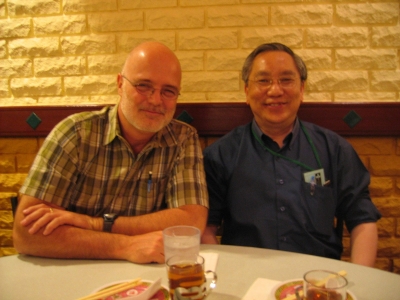
Dr. Alex Tang has been very much engaged in this conversation especially the last few months and even more so as Friends in conversation 2007was approaching. And now, after the event, the conversation continues. Here is A Quiet Reflection on QROH by him which has some good responses from those of us under 40 :-)
"The conference, Friends in Conversation: A Quiet Revolution of Hope was held in Petaling Jaya on 3-4 March, 2007. The main speaker is Brian McLaren. Aside from the conference, Brian also gave a lecture at STM on 5 March 2007.Jamie Sim reported the event in Christian Today online magazine here
Alwyn Lau’s reflections are here, here,and here. I am sure Alwyn has much more to say. David Tan comments on his blog. Another comment is found in Ad Majorem Dei Gloriam. It is encouraging to note the conversation is still going on and people are engaging with the experience.
I have prepared myself for this conference by reading all 10 of Brian’s books (which he has autographed), and also whatever I can find on the internet. I engage in conversations with people involved with the emerging church movement. My objective is to learn as much about the emerging church movement as possible. I thank my brothers in the JB Pastor Fellowship for their concern; especially those warned me and sent me emails and reading materials about the dangers of the emerging church. Fortunately, this conference allowed me to have a lot of time of interactions and quiet conversations with Brian McLaren.
Here are a few of my observations:1. Brian is a gentle soft spoken man. I believe that he is a committed Christian seeking to follow and serve Jesus as we all are doing. I do not believe that he is a charlatan with his own selfish agenda.
2. I do not think Brian is "a threat to the gospel" as reported in a report. However, his interpretation of the inclusiveness and exclusiveness of the gospel is slightly wider than what most evangelicals would allow. However, we need to understand where he is coming from in his definition of gospel. Brian is an excellent communicator and as he tells his stories and illustrations, that we can be so caught up with enjoying the way he tells them that we missed what he is telling us, and more importantly, what he is not saying. It is good that he tells of the two versions of the gospel. One is the gospel of self which can be roughly translated as "I am saved so to hell with the rest of the world." The other version is the kingdom of God. Brian has not mentioned that there are other versions of the gospel. He also needs to clarify whether he means that the kingdom of God is the gospel. He is not too clear in his talks on that. And he also needs to clarify what he means when he uses the word, "kingdom of God."
3. Brian's emphasis is on contextualization of the gospel rather than attempting to create a systematic theological definition. As a friend of mine points out, this is akin to Lamin Sanneh's concept of "translatability." The gospel is both universal (truth) and particular (culture). Other scholar who may have shaped Brian’s thinking is Lesslie Newbigin (who is a guy in spite of his name) and David Bosch. Brian is in fact being a missionary to the North American church. However, it is relevant to us in Malaysia and Singapore or other part of Asia to examine this "translatability" of the gospel especially in a pluralistic, materialistic, and multicultural context. It is important that we examine the universal and the particular.
4. Brian was a pastor and his approach is mainly pastoral in nature. One needs to understand his approach from this direction. While giving us three illustrations about the emerging church, Brian did not give us much information about the emerging church or on what exactly is an emergent church. He then talks about deep ecclesiology in such a vague way that we are free to interpret the term to mean whatever we want to. It would have been helpful for Brian explain his diagram in respect to "liquid", "ghost", and why the vertical arrow is bidirectional. What makes this ecclesiology "deep"? There is a danger that we are so engrossed by high sounding words that we fail to understand what it means.
5. I have problem with his theological construct on which he builds his emerging churches. The emerging churches are strong in practice but weak in theology. This is a weakness that Brian has to address if his theology of model making is to be accepted by the church. Another friend of mine comments that Brian "artificially contrasts between the 'bad' timeless propositional model which is a caricature and then puts it beside his model which is vaguely described. The assumption is that his theology has all the qualities which the earlier models lack." While it is obvious that Brian is influenced by N.T. Wright, we need to, in comparison look at the ecclesiological theology of Barth, Erickson, Luther, and Calvin. His theology is very much influenced by sociology, psychology, politics, pragmatism, secular individualism than by biblical propositions. However I do not think that he is "New Age", of which he is accused to be associated with by another friend of mine. Still at this moment his theology construct is still weak.6. Though he claims to be post-modern, he is very 'modern' in the way he thinks. I do not see how one can think of God, the Trinity and the gospel without being propositional. In his last talk in the conference about the world, he gives his analysis of the problems of the world. His reasoning reminds me of the theories of Karl Marx and Nietszche. His answer, as in all his other three presentations is simplistic without much offering in the sense of how do we translate his concepts to action.
7. His definition of theology as "an ongoing creative enterprise of making models of the universe based on beliefs about God" was presented at the STM lecture. I was disappointed that the many STM theologians present did not engage in this definition. It sounds too universalistic and scary for many evangelicals. I would like to know what limitations does he place on his model making and what hermeneutic role does the Bible plays in his theology.
8. He is concerned about the weaknesses of the institutional church, and I share his concern that we are losing a large number of our younger people from the church. Would the model of emerging church be an answer?
9. Brian is articulate, intelligent, and well meaning. I have enjoyed his company. I believe we should listen to what he has to say. The least we can do is to offer him Christian hospitality which means that we listen to one another. However, we must critically reflect on what he says. We need to examine his propositions in the light of the Word of God. Finally, we need to come to our own conclusions, not depending on the conclusions of others.
This is not a criticism of Brian and should not be taken as such. These are some of my reflections and of a few other pastors and theologians I have spoken to. There are still a lot of questions and even more answers are needed. I value Brian as a friend. Hey, we had Yee Sang on Chap Goh May. I believe that he has an important message for us here in Asia. At the very least, I can tell my grandchildren (when I have them) that I once shared the stage with Brian McLaren."
March 08, 2007
Happy Birthday Elysia!
wow! you are two years old today on International Women's Day!
Friends 2007: Christian Today Reports ...
Again thanks to Jaime whom I believe made many new needed contacts through this event gives her report on the event here in Influential Speaker Brian McLaren Engages with Local Christian Leaders. Here's some excerpts:
"Approximately 140 Christians from different denominations and age groups participated in the event, and they indeed demonstrated unity among Malaysian Christians throughout the event.The conversation has not only provided the opportunity for Christians from different denominations and fields of ministry to hold open discussions on specified topics, but also has enlightened the young minds of many participants, who were mostly in their 20s or 30s, on the viewpoint of their Christians leaders."
I was delighted to see a substantial young presence for the event. But I was even more humbled to see numerous senior leaders of the Malaysian church present. I think this serves as a great encouragement for us.
"The speaker, McLaren was also very encouraged from the conversations he had with the local Christian leaders."I think it [the conversation] has gone very well. I like the way that this being set up. For me having such conversations in Malaysia, I learned so much," McLaren told Christian Today after the event."
I'm glad the event provided a chance for a more mutual two way learning process. I believe this kind of conversation is what we need today and towards the future.
Friends 2007: Short Videos [Gospel]
Thanks for these videos by Dr. Alex Tang. I'll chip in some random reflections
It's refreshing to have a guest speaker who comes as an equal to engage in conversation with us. And in many cases Brian showed himself to be a good student listening in order to understand our context. And that started the moment he step in the car when we picked him up from the airport.
When Brian was sharing about his encounter with this particular theologian and talked about the gospel. My mind wonders to numerous life changing conversations I have had with people who had a gift of helping me see things I have been blind too.
Dr. Ng Kam Weng systematically shares his response and helped set the tone and focus of the first round of the interaction between conversation partners. There was a lot of ground covered in that 1 hour of conversations.
Friends 2007: Brian McLaren's hope
My friends David BC Tan posted this excellent piece Brian McLaren's hope with a nice picture of Brian speaking (and a interesting funny caption - "taichi"). Read on for a perspective from a more "senior" leader :-)

"It's hard not to feel the sense of anticipation in the crowd during the last 2 days with Brian McLaren. No doubt some of us were all ears listening out for key points that might well raise red flags. But there was little or hardly any controversy. There was nothing really new to my mind, possibly because some of us have been around, read some books, lived through the throes of liberal theology, hung out with McGavran (for which we still suffer from a hangover), surfed the Third Wave. In fact, not too long ago, the late Schaeffer asked if the Church had a future in the book,The Church at the end of the 20th Century. Not surprisingly, he pointed to orthodoxy, a genuine relationship with Jesus, compassion and community, as key.
You could say McLaren is restating the same truths for our postmodern generation. Except that the man has a knack for the incendiary. Just as well I suppose, because his books made a lot of people sit up.
Not at the recently concluded seminar however. Then, the messages were 'tame'; provocative only in the way he gently dusted off cobwebs that have settled on our ideas of Church. The only thing I suspect that was a mite too unsettling was his "al-Queda" analogy to the empire language of Jesus - but only if taken out of the larger context of his talk.
I loved the TV-style forum. On stage with "the usual suspects" (as some noted) the conversations were largely amiable, and notable in its ecumenical consensus. Dr Herman Shastri of CCM had a story about a former boy soldier from Liberia who makes crucifixes out of spent shells, and that moved me deeply. Some questions from the floor had a jagged edge I dare say, but then no blood was drawn.
My own take is that McLaren has brought a global perspective to the fore in his explication of the Kingdom of God. Which always merits a hearing, familiar as it is to some of us old fogies. It’s something that has to be said more often. But what if people do not want the Kingdom, but a passport to heaven - which may explain why the Church is in the state she is in today.
Yet I also sensed a bit of self-flagellation (unconscious perhaps?) in remarks about the Church losing her way. In our small group discussion, someone said something like Christianity indeed has done so much that’s wrong "especially to Muslims, and let's admit it." It made me wonder if the little that was mentioned about the Church’s failures ought not to have been balanced against all the positive things that God has graciously done through her in spite of everything. So many of our young people and adults know too little about church history they throw the baby out with the bath water, no thanks to the media.
Nevertheless there’s a stirring, as I mentioned to Sivin when some of us met for a sort of debriefing and dinner with McLaren on Monday. Cool! There we were, followers of Christ from so many different churches, sharing, talking – fellowshipping - which pleased me no end. We nodded with agreement when someone spoke up that such a gathering would have been inconceivable in Malaysia 20 or 30 years ago. Isn't that a quiet revolution of hope?
"We may have tried to make people 'nice' – quiet citizens of their earthly kingdoms and energetic consumers in their earthly economies – but we didn't fire them up and inspire them to invest and sacrifice their time, intelligence, money, and energy in the revolutionary cause of the kingdom of God. No, too often, Karl Marx was right: we used religion as a drug so we could tolerate the abysmal conditions of a world that is not the kingdom of God. Religion became our tranquilizer so we wouldn't be so upset about injustice. Our religiosity thus aided and abetter people in power who wanted nothing more than to conserve and preserve the unjust status quo that was so profitable and comfortable for them.What would happen, I wonder as I sit in the light of the glorious stained-glass windows of a cathedral in Prague or Vienna or London or Florence, if we again tasted the good news of Jesus – not as a tranquilizer but as a vibrant, potent new wine that filled us with joy and hope that a better world is possible? What if, intoxicated by this new wine, we threw off our inhibitions and actually began acting as if the hidden but real kingdom of God was at hand?" - Brian McLaren (The Secret Message of Jesus)
More reports and loads of pictures on Friends in Conversation at Sivin's, Alwyn's, and Dr Alex Tang's. Now these guys really know how to cook, so go there for a blow-by-blow account."

Friends 2007: Catholic Participation
All the way from Malacca from a new friend from the Catholic Church there :-) Here's most of what he said in his blog post.
I wanted to take my time to write this entry. After all, it was a two whole tiring days in PJ CLGC. The conversations were not that provocative or controversial. But I got interesting insights and some good reflectionsImportant points noted
1. The Catholic Church seeks to reduce "deep ecclesiology" by empowering the laity and making the church more accessible to the mass (Vatican Council II and on a local context PMPC III)
The Protestant Churches are moving towards "deeper ecclesiology" and seeking to be united in theology and management. A public theology is implored.
Since we are at opposite ends at this point of time moving in directions towards each other. Perhaps we could set aside some egos and shut up and learn from one another?
2. Ecumenism is very much lacking when the Malaysian churches are more interested in IRD due to political and local circumstances.
What? Ecumenism is supposed to be a western concern and IRD an Asian concern due to the melting pot we live in? It's equally important. How do we have IRD when we cant even be ecumenism is not burning in our hearts too? How can we answer queries as to "Kristian apasal banyak church, semua ajar lain cerita punya?" and expect to share and learn of other faiths outside the Christian world?
3. The Gospel of Jesus is " The Kingdom of God is at hand". The good news is about Jesus. The good news of Jesus is that the Kingdom is at hand. Get the difference? All proto evangelium references in the Old Testament points to Jesus. Following Jesus points us where?
4. The shift from a "personal God" focus gradually to being a fruit bearing Christian in a Church. ..."
Friends 2007: BM Special
Thanks Kebaktian for this "contextual" post on Brian McLaren. Terima Kasih!
"Sessi perbincangan dan dialog oleh Brian McLaren mengingatkan saya akan pelayanan ke atas komuniti orang asli. Misi Integrasi yang disampaikan beliau memberikan ilham dan perspektif di mana ia mengembalikan maksud sebenar misi pelayanan kita. Kita dicipta untuk dunia ini. Dunia ini menjadi medan pelayanan bagi umat Kristian tidak kira dia tu pendita atau pekerja sekular biasa.Sebagai warga kerajaan Allah di bumi ini, kita boleh merealisasikan Kerajaan Allah di muka bumi ini atau di tempat kerja serta di komuniti kita sendiri. Kita kembalikan hak asasi, pelajaran, ekonomi dan keadilan untuk orang asli. Kita boleh menunjukkan realiti kerajaan Allah dalam tempat tinggal mereka walaupun ia jauh dari arus pembangunan. Berita baik atau injil bukanlah hanya melalui percakapan sahaja tetapi juga bagaimana kita membantu memenuhi kehendak mereka seperti mana Yesus yang berbelas kasihan melihat mereka yang sakit dan miskin. Kita mahu melihat semua dimensi dan aspek iaitu kebudayaan, sosial, ethnik ditransformasikan mengikut kehendak Allah yang asal.
Kesimpulannya, marilah kita merealisasikan kerajaan Allah dalam komuniti kita dan perkerjaan kita.
"Biarlah kerajaanMu datang, Biarlah kehendakMu terjadi di bumi seperti di syurga ... " doa yang diajar Yesus
Amin
Bolehkah anda melihat kerajaan Allah dalam komuniti ini?"
Posted by sivinkit at 12:04 AM | Comments (0)

March 07, 2007
Friends 2007 (Bonus): Brian McLaren at Seminari Theoloji Malaysia


I still haven't come to the stage of writing my thoughts yet. Some solitude was good today and a decent movie plus a needed book. For now, I'll let the pictures speak for themselves. :-)
Friends 2007: Detonations of Hope
I think it's important to note these are very raw reflections from Alwyn, but he always has a gift for eye grabbing titles like this --> Detonations of Hope
"I'm gonna sound like I'm Brian McLaren's No.1 fan in Malaysia.Maybe it's because I've been part of Emergent for the past 2-3 years. Maybe it's my inadequate reading of McLaren (only 3 books out of about a dozen). Maybe it's God knocking me on the head, on account of my lack of "spiritual involvement". But there were so many instances during McLaren's talks at the QRoH conference which "blew me away", for instance:
...when he tied discipleship to the making of the rare violins (like the Stradivarius), sharing how a master violin-maker and his apprentice would go cottage to cottage in the mountains of Switzerland looking for a particular wood to make high-quality violins, with the apprentice slowly mastering the art by imitating the master. It dawned on me that I've been spending so much time thinking and talking about the faith that I haven't been devoting enough attention to immitating its Leader and Perfecter. I/We have been so obsessed with rules of mastery that we've forgotten to follow and eat with and live like and love as much as, the Master.
...when he counseled that, with respect to adherents of other faiths, the proper response is to "love and know, serve and protect" them. Serve and protect Buddhists, "free-thinkers", Muslims?? Serve and protect them?! Protect them from Christians, maybe? This response feels so right and even though the Biblical 'alarm-bells' are ringing, I sense that's what God desires of His children. Our Christian narrative is not to be an irresistible meta-narrative steamrolling its way over other framing stories, but a redeeming narrative, suffering (even) for those who seek to stamp it out.
...when he suggested reworking our language in communicating the Gospel and declaring something like, "We are the Al-Qaeda of God, preparing detonationgs of hope, firing bullets of goodness, flying planes of truth into buildings of deception."
And to think that I initially declined being a facilitator...(*Alwyn shakes head at himself*)"
Here ends what Alwyn has written.
A Special Note From Me [Sivin] (Just in case anyone is tempted to misunderstand Brian's quote above): In reference to the final paragraph above on reworking our language ... I don't think Brian is suggesting we use it carelessly. What I understand is how often the content and language of the gospel no longer impacts us or shocks us into a place where we'd sit up and listen and consequently stand up into action/respond. Usually artist or poets would accent colours or their language to capture the attention and imagination of their audience. During our 2 days there were many moments where Brian was operating in this mode. And reading Alwyn's post is encouraging to see the positive and good effect it has had on him.
Friends 2007: You Are Always Welcome Here
Alwyn Lau is offering a blog feast again with You Are Always Welcome Here I still have not come to the place where I'm putting down my thoughts yet. Had some time of solitude today.
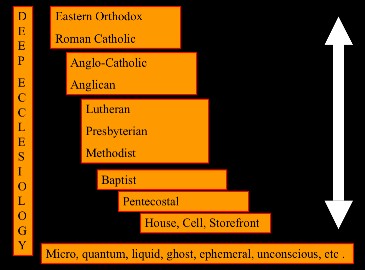
"Micro. Quantum. Ghost. Liquid. Unconscious.Cool ways to describe church, huh? From Roman Catholic to Unconscious - a deep ecclesiology.
If I heard McLaren right, he's saying that church "happens" in any and all forms. Any (regular?) gathering of any number of people to discuss, among other things, God and goodness, and the presence and relationship between both in our world.
I think McLaren was trying to move us away from thinking about how-to-do-it frame of mind to a just-do-it paradigm. So if God can nurture his new kind of redemptive agent via twice-monthly latte sessions or tri-weekly cook-ins', we should honour this process. And we could even call this church.
I was very moved by his story of a Cathedral pastor, seeing the small multitude of punk-haired 'street people' seated in his church side by side with properly dressed middle- and higher-class church-goers, who then whispered to McLaren, "I want you to let this people know that they are always welcome here."
There is no male or female, no Jew or Gentile, no high- or low- culture, no sophisiticated or unsophisticated, no big sinner or small sinner. For all are in Christ?
This is so gracious, so redemptively counter-church culture and gives us so much hope that all those stories about people being turned away from church (by disgust, shame or hurt) can have a Go(o)d ending.
We ought to value and learn from these church-forms wherever and however they occur. We must love and accept everyone in Christ, no matter how shabbily they look or 'unconventional' they appear.
Even bishops and black sheeps of the church can be friends. Even if some overdress occasionally (smile)."
Friends 2007: A Franciscan Benediction
Thanks Soo Choo for sharing this "Franciscan Benediction" with me during this event.
May God bless you with discomfort at easy answers, half truths, and superficial relationships, so that you may live deep within your heart.May God bless you with anger
at injustice, oppression, and exploitation of people, so that you may work for justice, freedom, and peace.May God bless you with tears
to shed for those who suffer from pain, rejection, starvation, and war, so that you may reach out your hand to comfort them and to turn their pain into joy.And may God bless you with enough foolishness
to believe that you can make a difference in this world, so that you can do what others claim cannot be done.
March 06, 2007
From Burden to Adventure ...
(via beauty. (t)ruth. god.)
Friends 2007: Terima Kasih

Ok Alwyn and Jade is missing from this picture. But want to give you due credit :-) Thanks to the Friends in Conversation 2007 coordinating group and whole team for helping to make this event possible. Especially Mike Foong who worked so hard for the DVD, powerpoints and getting the sound guys working together (and his work hasn't ended yet! Editing will begin ...) while Reuben made sure the church premises was ready for us. Laurie (who went the extra mile) and Siew Foong worked especially hard to make sure the registration and name tags was in order (want to include Janelle who helped too). Kia Meng and his team who lead us into the worship liturgies ... and of course, Bob (who even had a nightmare before the event , i mean "daymare" to share my stress) made sure communications was done well. Of course, we need to appreciate our wives and our kids for being patient with us and releasing us for one week (Represented here by Elaine and Charis!).And we must not forget Yew Khuen who labored with heart and soul!
Thank you to all the conversation partners too for taking the risk to be part of this.
Thank you to all the participants ... for participating and being open for next steps...
Let's not forget .. Thanks Brian ... for sharing, listening, and learning together with us while gently encouraging us to look through Scripture, look at our world closely again and be open to the leading of the Spirit, by his example and encouragement.
TERIMA KASIH
March 05, 2007
Friends 2007: For God So Loved The World
Seems other people are blogging faster than me ... the conversations are flowing ... Here's one from my good friend Alwyn: For God So Loved the World
"Tan Soo-Inn's voice sounded a lot deeper than I remembered. Ng Kam Weng appeared more playful than I've ever seen him. Alex Tang, Tan Kong Beng, Herman Sastri and many others I was pleased to meet 'in the flesh' for the first time. Jojo Fung is one groovy dresser and can make the entire floor erupt whilst maintaining a straight face. Sherman blessed us with more than his smile. Bishop Philip Lok proved himself no stranger to spontaneous fun and laughter.And we also (*smile*) had Brian McLaren lead us, a group of friends, in a 2-day conversation about sparking quiet revolutions of hope(QRoH) for the world.
Revolutions is the right word, although only a few will say that McLaren's material was entirely new to them. I think we've all felt that something wasn't clicking with this whole Christianity/Church thinggy, but we've never totally articulated them, trashed them out, at least not in such a forthright manner. And whilst it appears that we certainly need more granularity in the solutions discussed during the conference, it's lways a good thing that new sets of questions are raised and given new life to - this can be revolutionary.
All kudos for Sivin, Yew Khuen and the Alex's post for more comprehensive summary). This fresh Gospel was contrasted with the generally conservative portrayal of Jesus' message as being essentially about how the self could escape the eventual destruction of the world and eternal torment in hell.
McLaren delivers his messages in a serious yet gentle manner. His words flow effortlessly and smoothly, producing (and is this just me?) a calming effect on his listeners, clearing the path for new models of understanding, or new ways of seeing things. He makes you want to listen to him.
I think McLaren is doing the Church a favor by refocusing us back to what Jesus said the Gospel was about. Was it mainly about avoiding hell and reaching a blissful afterlife? Or was it about, somehow, transforming the world via the creation of a new kind of people?
"Repent, for the kingdom of God is at hand!" This is Jesus. Not Luther, not Calvin, not the Baptist General Convention and definitely not the American President.
Now, I've read N.T. Wright many times, but why did I still feel like this message was new to me?! Could it be because there's a tendency to keep reverting to an equilibrium which is so "heavenly" minded it neglects efforts to make earth AS IT IS in heaven?
A Christian is someone who is healed of AIDS so he can join the healing initiative to rid the community of the disease. It's the community, the world, which drives the entire plan of God and one finds meaning (and "salvation" from ultimate punishment) by accepting the world-mission of the Creator and locating one's self within His grand plan.
As McLaren's slides illustrated so wonderfully (and I've certainly missed out something here but I think you'll get the picture), a huge problem today is that ESCAPING HELL has so often been the main big title of the Gospel contract, with a sub-title about personal happiness, followed by a small footnote on character development, with an even smaller footnote on service and contributing to the Christian community, and finally the tiniest footnote about social and global transformation.
I absolutely loved his stories, too. The first session included a hilarious one about his daughter's Japanese Shiba Inu dog who runs away at the first available opportunity yet turns back at the smell/sound/sight of its owner waving cheese at him! He was using this to illustrate what he thought was a good picture of the 'old gospel' church: the preacher waving cheese at his members, promising enough self-fulfilment to take them through another week of secularism, materialism and hedonism with a gospel of sin-management, before repeating the process again.I guess what he was trying to say that if we do NOT constantly keep the big picture of God's love for the world in mind, we'll end up either adding to the world's problems or giving up any semblance of following Jesus. Or both."
Thanks Alwyn, and you did great as a facilitator.
Friends 2007: Quick Musings Continued
I'm off to the seminary soon. So, I'll post up more pictures during my own posts. For now, another round of applause for Dr. Alex Tang for his quick musings (which aren't random at all *smile*)
From QROH: Session 3: Discipleship
"Sorry. Would have posted last night but my internet access went kaput.It has been a long day. This session starts at 8pm and it is heartening to note that the hall is still filled with people. Brian entitled his talk, "Spiritual Formation in Emerging Churches."
Spiritual formation is defined by Brian as the development of people be, think, feel, work, relate, serve, play…in the way of Jesus. Brian made an emphasis on the play aspect. Living in the way of Jesus.
Brian then tells a story about making violin. BTW, Brian is an excellent story teller. Apparently great violin that produces the best music can only be made from certain wood. These are from trees that have survived a cold season at a certain time period. That is why master violin maker will visits houses built in that period and look for such wood in the attics. This will be the wood from these trees. A master violin maker will be able by touching, feeling and smelling the wood, to judge whether the wood will be suitable to make a violin. His apprentice will be following him and observing him for many years. One day, the master violin maker will turn to his apprentice and says, "You make the violin." Spiritual formation is like that. We follow Jesus closely until one day we find that we are like Jesus. Like the violin maker's apprentice, we "unconsciously pick up the art". This is called "elbow knowledge", that it has become instinctive. Brian mentioned that his understanding of spiritual formation as "elbow knowledge" is influenced by Michael Polanyi.
He also mentions that spiritual formation is the art of loving in Jesus. This is especially important in a community where must be constant exposure of modelling and exposure to loving in Jesus.
I am impressed by Brian's stamina. After a 30 hours jetlag, he is still functioning coherently. At least I think he is. Either he is full of grace or he is zoned out. But the fact that he is coherent and still able to tell stories make me think that it is by grace.
Sivin is the facilitator and the conversation partners are Dr. Voon Choon Khing, Dr. Tan Soo Inn and yours truly. The range of conversation covers a large area of spiritual formation and discipleship. It started with an exploration of spiritual formation approaches in the modern context, postmodern, and Asian context. Confucius was included. Then one conversation partner shared about brokenness and formation and another shared about the "dark side" of the church.
This leads to an exploration of being in a church where one has been hurt. A written question about a person who has been hurt in or by a church wonders what he or she should do. The conversation partners were careful to point out that context is important and it is hard to give advice without knowing the context. However, they commented that the person should first talk with someone, talk to God, try to resolve the conflict, and only as the last resort leave the church. At this point, Brian mentions the value of confession in the church. It was an interesting session.
Father Jojo Fung, a Jesuit priest is invited to sum up the session. He gives an excellent summary with an interesting reflection, 'I am because we are.'"
And one more, from QROH: Session 4: World
"Session 4 on world starts at 2pm on a Sunday afternoon. Brian says that he is sharing materials from a book he will be publishing soon. He also mentions that he has been thinking about this issue about the world and the church for many years. Unlike previous sessions, there are no stories but a straight forward presentation.Brian started with the many organisations and projects which are working hard to identify the problems of the world today. There are about a list of about 11 problems/issues that needed to be addressed.
However, Brian presents his view of the problems facing the world as he sees it. In his conceptual, societal structure, prosperity is an important factor. Equity is the way wealth is created and thus equity is another factor. Unfortunately prosperity and equity makes the rich richer and the poor poorer. This makes the poor discontent. They then either migrate, turn to crime or revolt. Security for the rich becomes the next factor. Brian shows a diagram where prosperity, equity and security are circles which intersections. The centre area where all three circles overlap is what he calls "framing story". Often the framing story is religion. Religion is often used by the rich and powerful to keep the poor underfoot. Religion is used to justify why the rich are rich and the poor should remain poor.
Therefore, the framing story is a metanarrative. A metanarrative is a story that erase all other stories and replace it with its own. Brian gives Caesar's framing narrative:
Equality, prosperity and security come from a powerful leader (Caesar) who concentrates the means of violence and imposes peace through domination. The empire of Caesar is at hand.
Jesus confronts the system by reframing Caesar's narrative:
Equality, prosperity and security come from a sacrificial people who embody reconciliation and bring peace through justice and love. The kingdom of God is at hand.
Later, Brian makes a comment about narrative.
Metanarrative as mentioned above wipes out other stories and replace them with its own.
Local narratives are your story, my story, their story etc. Unfortunately they are easily wiped out by the metanarrative.
Brian mentions a redemptive narrative which calls people to live with one another in peace and not wipe out others’ narrative.
In conclusion, Brian mentions four possible responses to "my neighbour (of another religion)"
(1) convert and assimilate
(2) persecute and marginalise
(3) ignore or isolate
(4) love and know…serve and protect.The last response should be our response.
The facilitator is Tricia Yeoh and the conversation partners are Father Jojo Fung S.J., Dr. Hermen Shastri, and Steven Wong. The discussion started with Hermen informing us of his work with the World Council of Churches, the national CCM, interfaith committees and dialogue with the government. He ended his introductory remarks with a poem and shows us a metal cross made out of a bullet cashing. He says that the artist used to be a boy soldier in Liberia who becomes a Christian and now works as an ambassador of peace for the UN.
Steven mentions NECF's work and Father Jojo explained the Roman Catholic Church involvement in Malaysia. Father Jojo also shares about his work with the Orang Asli and the Muruts in Sabah. He also raises two important points in reflection on Brian's presentation; one is where does the smaller religions fit into the framing narrative, and how does the ancient civilisations, like Confucianism and Brahmanism affects the framing narrative. After this reflection, he concluded by considering a pig, a lowly creature allowing itself to be consumed. He sees himself as a pig to be consumed by others so that others may live a better life. Father Jojo quotes Gandhi, "We have to live simply that others may simply live."
Then the discussion went onto to politics in Malaysia and what should Christians do about it. Here the conversation partners were divided. One suggests that politics should be left to the "experts" while another calls for more Christians to be involved in vigil, protest, etc.
This is the last session and it concludes by all participants standing in a circle, breaking bread and passing around a lighted candle.
Much has been said, much reflection needs to be done."
Once again... Terima Kasih, Dr. Alex Tang :-) We will have further conversations after I get some sleep :-)
March 04, 2007
Friends 2007: Quick Musings
Dr. Alex Tang who is one of our conversation partners beat me in terms of the speed of blogging the event. I'll just quote him and throw a few pictures.


"The long awaited conference, Friends in Conversation: A Quiet Revolution in Hope started today at Christian Life Gospel Centre, Petaling Jaya. The first session is on the Gospel (9.15am-12 noon).Brian McLaren started the plenary session by sharing his thoughts about the different versions of the gospel. One version is "You can get saved and go to heaven and to hell with the rest." Another version is about the Kingdom of God coming to earth. He used his circle illustrations. One is of three separate circles; one for self, one for the world and one for church. That he says is one of the ways some people perceive doing church. The next illustration shows one large circle: the world, and two small circles inside the large circle: self and church. Brian has used these illustrations in the chapter on "Why I am Missional" in Generous Orthodoxy.
Brian then went on to explain the kingdom of God, based mainly on the gospel. In this talk, he drew on what he has written in his book, The Secret Message of Jesus. He concludes by illustrating that the way they proclaim Jesus as King is in the same format that the Romans proclaim Augustus Caesar as god.
After his presentation, the conversation partners, Sherman Kuek, Dr. Ng Kam Weng, and Elder Tan Kong Beng were invited to give their responses and views. Alwyn is a good faciliatator who kept the conversation going. Actually with Kam Weng and Kong Beng ( who is in his lecturer mode), he did not have any problem getting the conversation going! The emphasis is on the definition of the gospel and the kingdom of God. Kong Beng made a good point about compassion in sharing the gospel. Sherman raised a few eyebrows with his Eastern Orthodox view about theosis and continuing salvation.
The questions from the floor are good questions too. One person raised the statement that if the church is growing at 30% annually, why should they bother about anything else? This led to some responses about spiritual growth, gospel and more about kingdom of God.
This promises to be a good start for the conference. This posting is mainly about my immediate impressions. I shall post my reflections on this conference later. BTW they are videotaping the sessions who emergent Malaysia shall be selling for RM 20.00. Check their website for more information."
Another one from QROH: Session 2: Church
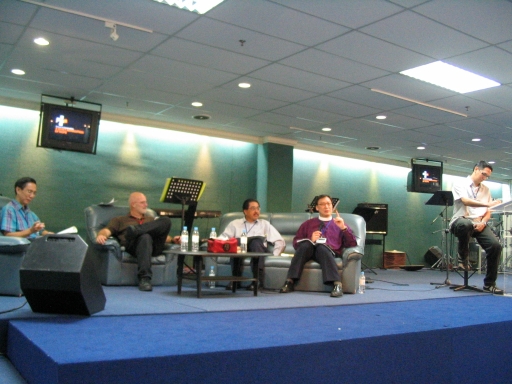
"Session two starts at 2pm in the afternoon after lunch. Again Brian gives the plenary talk followed by the conversation partners and conversation participants. People are beginning understand that the whole conference is a great big conversation.Brian talks about the emerging church. He starts by using Eddie Gibbs and Ryan Bolger's 9 points descriptors of emergent churches:
(1) Identifying with Jesus
(2) Transforming secular space
(3) Living as community
(4) Welcoming the stranger
(5) Serving with generosity
(6) Particpating as producers
(7) Creating as created beings
(8) Leading as a body
(9) Merging ancient and contemporary spiritualities.He said that the main descriptor is number one and all the rest is built on it. He then goes onto to illustrate the emerging churches by three diagrams. The first is a box with four quardants and a red circle in the centre. The centre represent the emerging church and the four quardant represent evangelical, charismatic, social concern and liturgical. Brian said that people who are unhappy with thier tradition tend to try traditions in the other quadrant and end in the red circle in the middle.
The second illustration is of a tree trunk with concentric rings. The traditional churches are further in the trunk while the emerging churches represent the outermost ring.
The third illustration is of two circles. One represent the older paradigm while the other circle represents the church of tomorrow. He then put a link between the two and call it a transitional link. He also label it the emerging church. I am very mch taken by this third illustration that the emerging church is the transition to the church of tomorrow.
Then he went on to talk about deep ecclesiology.
The conversation partners for this session are Elder Chris Leong, Bishop Philip Lok and Rev. Wong Fong Yang. The partners did not engage directly on Brian's talk about the emerging church. Instead they shared on their own theology, perception and the way they do church. Bishop Lok shared about the Lutheran tradition. Pastor Wong shared about his past church experience and what type of church he wanted when he started his present church. Chris Leong shared on the novel way they are doing church. They also shared about evangelism in Malaysia.
There are a couple of questions from the conversation participants. One asked about syncretism. Brian shared a story about a Christian practicing Tai Chi but using the movements to represent Christian values.
After the second session, there was time for small group discussion."
March 03, 2007
Friends 2007: Brian is safe and eating well in Malaysia!

He's safe ...
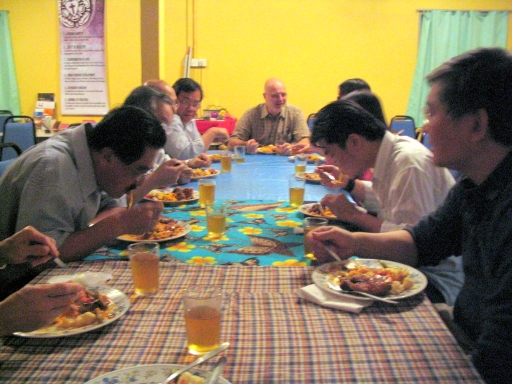
and eating well ...
I felt the orientation with most of the conversation partners and facilitators went much better than I expected. Thanks be to God!
March 02, 2007
Friends 2007: Appreciate Prayer Support [1]
I sent an email to some friends to pray for us the next couple of days. And I thought maybe I'd post this up so anyone following our little adventure thus far can join us in some way (at least in intercession). In a chat conversation with Bob our communications guy, he approved. Here's a glimpse of the our short exchange:
8:34 AM me: I might post the content (of the email) on my blog what say you? a vulnerable postRobert: sure :)
8:35 AM the rev sivin kit is still human
:)
me: i'm very well aware of thatRobert: despite rumours to the contrary LOL
and now the email:
"Dear friends,Tomorrow, we will be hosting an event called "Friends in conversation 2007: A Quiet Revolution of Hope" with Brian McLaren as the guest speaker (conversation initiator) and 12 other Local respected Malaysian leaders (conversation partners) with 4 other younger leaders who serve as conversation facilitators (including myself (3 is below 35 and 1 is in her twenties!) . For more information: http://emergentmalaysia.org/
I would appreciate some extra prayer support. As this is our first time doing it, and I for one am a little anxious on how it will turn out. This has been a most stressful week, the whole event was organize in 2 months with mostly volunteers (cf. that means about 10 of us!). Now to date with have 140participants for 2 days - Saturday and Sunday. Brian later will speak another day at a local ecumenical seminary on Monday. I need all the prayer I can get, physically, emotionally and spiritual (in fact not just me, but all who are working behind the scenes and on stage). I do recognize having Brian over to speak is controversial for some quarters, for others they are totally excited at the opportunity, and many in between who are curious and inquisitive. For me personally, I'm thankful to have a chance to meet him face to face for the first time (Brian's writings and personal friendship had been a tremendous encouragement to me ... even when I have areas I'm not in total agreement with him on specifics after reading his stuff depending which book and which paragraph *smile*, I suppose that's part of friendship and being in conversation with another too.) Another joy is the chance to introduce him to some Malaysian senior leaders and emerging younger leaders (or potential leaders).My sincere prayer is that this event and other little bonuses around it will be a blessing to the Church in Malaysia in ways I suppose only God fully knows. We takes risks in baby steps and sometimes with a little big leap. I'm sure we would fall and make mistakes at times and then pick ourselves up again. Often, we'd be surprised by the good which emerges after the dust is settled. Of course, We also need to keep my focus centered Christ and God's purposes for us and celebrate the little victories we are reaping even now I believe which advances his agenda more than ours.
So, I'd appreciate your prayer support. Thanks.
God bless
Sivin Kit"
March 01, 2007
Friends 2007: Christian Today Malaysia Edition & Another Email [2]
Jaime Sim was a very friendly and inquisitive journalist. And I'm encouraged by her desire to see how we can keep Christians in Malaysia and worldwide informed on what's happening here in her home country.
The result of our "conversation" :-) resulted in this piece Influential Speaker Brian McLaren to Address Modern Challenges to Church, a title which she chose. I thought it was interesting what she decided to highlight as far as what I said ... (and I said a lot of things!), Here are two that came out:
"We do not see this [event] as a conference… to promote a programme or a quick-fix or one size-fit-all solution for the problems before us. For us, we just want to create a space and opportunity for people to talk and to listen, and also connect with those exploring similar concerns"
"emergentMalaysia wants to create the possibilities of moving forward, which is the heart of the whole idea for conversations like this...,"
I was also deeply delighted to get an email from my friend Tony Jones who is the National Coordinator, Emergent Village. Now, surely the content of our conversations we have in Malaysia will probably be different in substance and in tone compared to our friends around the world. And yet, at the same time, there may be areas that we may converge due to this increasingly globalized world - and the common influences we have had in our Christian development. I think there is also the awareness that we cannot be isolated from each other as we all seek to understand, live and practice the Gospel in our time and age. :-)
Anyway, I'll come back to Tony's kind affirming words to us, "Terima Kasih" (Thank you in Malay):
"You've got friends around the world, which bespeaks the true spirit of emergence that is building around the world. We're praying for your wonderful event here in the States, and I'm confident that God will bless it richly! "