Countdown 2: The Micah Mandate

4 05 2008

micah_kwout1

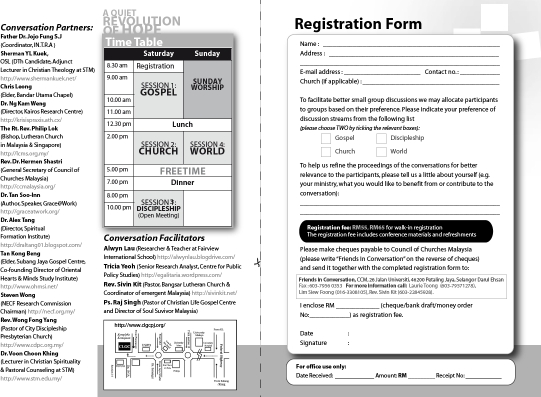
Here’s a sneak preview of what’s coming soon :-) I feel so honored to be part  the process that gave birth to The Micah Mandate.  The last one week, Gareth and Elysia has been consistent in sharing our Highs and Lows almost every day.  And I must say being part of the initiators for this effort has been most rewarding and a definite HIGH.  It has brought a sense of integration and wholeness together with Friends in Conversation and RoH Malaysia as well as my work as a local church pastor in Bangsar Lutheran Church and my wider involvement through the Lutheran Church in Malaysia and Singapore. I think that’s a pretty full plate, and I’m pretty much stretched to the limit, but it’s fulfilling! :-) It’s fulfilling because I feel we are in a moment of Malaysian history where we are more conscious of the fact that all of us have a role to play in making history.


Tony Jones Interview

6 04 2008

I watched all three of the clips at one go and thoroughly enjoyed myself :-)

Emergent Village Coordinator, Author and my friend Tony Jones looks like he’s having a great time too!

There’s quite a lot of ground covered here in such a short time.

I love the ending … or shall I say the "beginning"? In many ways for many people we can honestly relate to what Tony talks about on the question of faith  in various degrees :-)


Emergent Strikes Back

26 03 2008

Brian McLaren Responds to Everything Must Change Concerns

As a pastor, I say Amen to Brian here …

I was deeply impacted a few years ago by Alan Roxburgh at one of our events (you may have been there?) when he said, the church is like a person who gets invited to a party and only talks about himself. I’ve been thinking that we get into a syndrome of trying to save our lives denominationally, etc, which makes us lose them … when instead, our churches need to lose our lives, pour ourselves out for the sake of the world, become more interested in joining God in caring for the world than in getting God to join us in caring for ourselves, that sort of thing. But of course, at heart I’ll always be a pastor, and in the end, none of this matters unless it’s embedded in local churches of whatever form.

I De/Renounce You!

I can relate to some of this … don’t you?

Dan Kimball was recently peppered with questions about Brian, Doug, and me when he spoke at the Crystal Cathedral. I often get asked to defend Doug’s views on soteriology or the Trinity. And just last week, a caller to a conservative Christian radio talk show I was on asked me how I could be friends with Brian since he practices Buddhism.

Of course, I was shocked to learn that one of my closest friends is a closet Buddhist. Brian, I feel so betrayed. I barely knew ye!

But this demand to denounce and renounce friends has come into high relief in the presidential campaign. And, honestly, I think that most of us can see how insane it all is. In another prescient column, Stanley Fish argues that, of course, we can only be responsible for what we say, not for what those close to us say.

Which Way to the "Third Way"?

Good turn by my friend Steve Knight …

The ‘third way’ isn’t a point on a spectrum between ‘liberal’ and ‘conservative.’ The ‘third way’ is another parallel spectrum altogether, that I would say is above (and transcends) the liberal/conservative spectrum. The ‘third way’ is relationship/friendship, and the spectrum is simply how close/tight-knit or far/separate we are relationally. …

“To put it one way: The question isn’t so much ‘how are we different in what we believe/think?’ as it is ‘how are we connected? what can I appreciate and learn from that other person’s perspective/tradition/tribe/camp?’”

Why we are open to the Emergent Conversation: My journey, and books along the way

A mouthful here from an excellent survey …

We rejected an over-rigid or over-important theology to show that a God-breathed lifestyle demanded a Christian perspective and imaginative re-construal of every area of life, in light of God’s Word, not just in doctrinal matters.  Systematic theology, for better or worse, became less vital as we embrace narrative, Biblical theology.  To argue over theological arcana when we didn’t equally argue about aesthetics or politics or psychological theory seemed to be suggesting that doctrinal fine-tuning was more important than being faithful to the Lord in every field of life, as if the specialty of theologians and pastors somehow mattered to God more than the work of potters or farmers or businesspeople.  And we knew that that was to make theology itself an idol—-all of life was to be redeemed, so doctrinal disputes and denominational matters took a back seat to the big issues of the day, the concerns of lay folk in their particular callings, and the vision of a multi-dimensional, uniquely Christian world and life view.  We thought this, as I recall, not because we didn’t think theology mattered—it does—but because the Bible doesn’t itself over-indulge in rationalistic doctrinal formulations; most of the Bible is story, history, poems and laments, after all.  Scripture itself is a storied telling of God’s redemptive work in history, forming a people who live differently, filled, finally, with the love of a Risen Redeemer, a gracious King who is reclaiming his hurting world.  I heard 35 years ago from conservative scholars that even Paul was to be read narratively (an important insight of most emergent Bible readers nowadays, and a matter for which they are considered controversial.)  So we thought about a Christian view of life, including theology, but didn’t make theological precision the only important concern. Our dogma and creedal life was seen as part of our whole worldview and way of life, an all-encompassing, whole-life opening up of life in the Spirit in God’s good but fallen creation. We really didn’t care how many angels could dance on the head of a pin.

An Efficient Gospel?

Always good to return to the Gospel … I’m glad Tim Keel’s voice is emerging more! A big amen to the following statement!

The gospel must become incarnate. It’s something that must be lived. We cannot approach God or the gospel a-contextually.


Conversations with Tony Jones

26 03 2008

My friend Tony Jones is pretty good in articulating his thoughts moving at ease with word pictures to more than one syllable words! :-)


Emergent Chinese New Year "Yee Sang"

18 02 2008

It’s been a while since I’ve done this, before the Chinese New Year Celebrations wrap up, I’ll post up some long overdue links.

Pubs, Clubs and Altworship

Eye-grabbing title to draw the discussion deeper into more critical concerns. check out some main themes the author brings out:

Community:  Emergent Christians place a premium on community, living life together in all its messiness. However, community can take many shapes, and emergent or altworship communities often do not resemble traditional church community with a paid staff and centralized leadership.  It’s a dispersed community that is lived in the rough-and-tumble of everyday life.  So a premium is placed on togetherness, journeying with and alongside others.

Transformation:  Emergent types are passionate about transformation, both personal and structural.  They tend not to view themselves as finished products, as “saved” or even as “Christian.”  Instead, they speak of themselves as “being saved” and “becoming Christian.”  They tend to be political activists and socially “liberal” in the sense that they care deeply about the proverbial “widow, orphan and alien,” those who are marginalized, oppressed, and disenfranchised and about changing the personal and structural realities that perpetuate the disenfranchisement and marginalization.  They believe that engaging in such tasks is to follow Jesus.

Worship:  Emerging Christians are innovative and imaginative in the aesthetics of worship, and they are technologically savvy.  They’re sacramental and incarnational, sometimes employing large-scale transformative theatre (Ikon). Revelation, one of the communities we visited, offers a sophisticated blend of ancient ritual and liturgy and cutting-edge image technology and participation. Typical of the worship in these communities is worship that engages us as whole and embodied beings, providing a feast for most if not all of our sensory modalities: sight, sound, smell, and tactile experience.

Social Engagement: Emerging Christians enthusiastically endorse Jesus’ claim that “by their fruits you will know them.”  Thus, they seek to be active agents of God’s reconciling, redemptive, and restorative agenda in and for the world. 

ep 6.9 - Tony Jones & The New Christians

One thing for sure Tony Jones is excited about the book! :-) Tallskinnykiwi gives his take on Tony Jones: The New Christians … where he says,

The New Christians its a good and enjoyable book. Its not as eloquent nor as grand as Brian McLaren in Everything Must Change but its more gritty and personable and locked on to the expected grids of contemporary theological thinking, yet at the same time avoiding polarities and divisive categories.
Shoot . . that was a really long sentence . .
And it is not as deliciously subtle as Pete Rollins in How (Not) To Speak of God but it is more approachable and explanatory. Tony often pauses to define the words he is using for those who need an onramp to the conversation.

In fact, that is what the book is to me: an onramp for those who want to join the conversation, and a scrapbook of thoughts and memories for those who have been coming along for the ride.

O Lord, Deconstruct Me!

I’m not surprised Tony would choose a blog title like this.

What I’m most afraid of, I suppose (and I fear this for Jack, too), is that someone would hear my answers to a few of the hot questions of the day and call me a "liberal." Or a "conservative."  In my mind, I’m clearly neither, and I want to be neither.  I want to be "beyond liberal and conservative" — a phrase I both use and hear a lot — whatever that means.

Common Misconceptions About Emergent

Interesting little bit … with my friend DJ Chuang’s name thrown in.

I had a great conversation with DJ Chuang about this the other day for an upcoming podcast. He made an excellent point that what most white, male emergents are wrestling with and practicing is not the same type of things nor theology that 2nd generation, Asian Americans are wrestling with and practicing. But that doesn’t make them any less emergent. They are simply doing their theology and practicing their theologies in different contexts. They are not branded or labeled as Emergent, but rather they are doing emergent and are very much a part of the spirit of emergent.

A battle cry for Christian reform

I’ve always felt Brian does well in interviews …

But some Christians may see the title of your book and worry that you’re saying that what also needs changing is some basic doctrine. For example: Jesus’ divinity. Is that negotiable?

I affirm in the book that I am completely orthodox in all of my beliefs about Christ. I affirm all the ancient creeds.

But here’s where we have to face some deeper issues. The creeds teach us to affirm the deity of Christ. But then we have to say: What does it mean to live out the belief that Jesus was really the word of God incarnate? If we really believe that, then we’ll take very seriously what he said about how we treat our enemies. Instead, we often affirm the doctrine in our words — we can say "Lord, Lord" — but then we don’t actually do what he said.

The change I’m interested in is helping us flesh out what it means to affirm the ancient creeds and historic faith.

Must everything change?

Brian McLaren hope for the emerging church movement in 20 years …

"Well, my real hope is that in 20 years we won’t be talking about "the Emerging Church Movement." My hope is that the issues a number of us are raising will become accepted elements of a more mature and holistic Christianity that is shared by Christians in general. One dimension of that more mature Christianity would be, I hope, an assumption that diversity and creativity in forms of worship is a good thing, not a bad one, and that change is not only unavoidable and normal, but a wonderful opportunity for growth. That will mean moving on from the old assumption that there’s only one right method or liturgy or doctrinal statement or organizational structure, and moving into a realization that our mission and message can take many forms. To use Jesus’ image, we’ll recognize more and more that what counts is the new wine of the message we carry, not the shape of the wineskins we carry it in. The creative diversity of churches in Charlotte already demonstrates this vitality, I think. I’m really looking forward to meeting people from all of these churches — across styles and denominations — who are interested in seeing what the core message of Jesus has to say to the global crises that challenge both us and our children and grandchildren. I’ve found that when we address these issues, it’s not depressing at all. I think it’s actually exciting and motivating and unleashes hope and energy. I think people of faith in Charlotte have a big role to play in all this!"

This Changes Everything: An Interview with Brian McLaren

Quite an in depth interview responding to a review …

Dutch theologians from an emerging church perspective.

A good reminder on context …

There is one crucial remark on Kuyper, Schilder and neocalvism in general: For me, living in the Dutch culture and history, a reading of Kuyper and Schilder is very different compared someone non-Dutch. I recently had a conversation with US based reformed theologian on Schilder. He reads Schilder very different from me. Jamie reads a book form 1932 and interprets it. I read a book from 1932 and interpret it with a full history in my mind, including the outcome of Schilders work in church history. The same about Kuyper, he also played a more questionable role regarding “apartheid” in South Africa. In both cases the “darksides” are more present in my dutch context, both readings are valid in different ways.

Emerging in Germany

I very much agree with Chris on the second part on "a liberation into"…

While I am not comfortable with the line of reasoning that runs ‘Postmodernity, therefore…’, my own experience of things emergent has been of a liberation into a reforming and healthy theological adventure. So all I can say about this news is ‘Wonderful!’

The Importance of Definitions

From the man who had "The Emerging Church" as the title of his first book!


Christian Perspectives on Politics in Malaysia IV

5 02 2008

1000 apologies for the delay of the final installment. Domestic responsibilities, church ministry, and some extra clutter has slowed me down. But before the Chinese New year, and the next elections. I thought it’s best to wrap this conversation up for now. Thanks for persevering through the ride :-) If you want to catch up a little … you can go back to Part I, Part II and Part III. All those in blue are added to the original interview…

006

Christian concerns and needs of churches

Chun Wai: The number of Christians has risen to around nine to 10% of the population, even larger than the Indians at about 6.3%. Why is the voice of Christianity more subdued than other religions?

Kim Kong: The church’s main concern is spiritual rather than political. Also, the church, as a whole, does not have a common political agenda to bind them together. I think the separation between the state and religion is a very clear doctrine of Christians.

Steven: It is a false dichotomy to differentiate between spiritual and political. Christian spirituality encompasses the material world and this includes politics. As I have mentioned, we have a very strong precedence in the ancient biblical prophets. And it was shown that Jesus himself saw that his ministry was not merely “spiritual” in our popular understanding but had a tangible social agenda. Thus to say that being spiritual is one thing and being political is another is a huge fallacy, albeit one which has plagued certain sections of the church for centuries.

Raj: True Christian spirituality must involve how we live our whole lives. We cannot differentiate between being more concerned with spiritual matters verses political. Our political involvement can be an outcome of, and an expression of our spirituality.

Sivin: I prefer to say that the church’s main concern is for the good of the world, and especially for people - whom may be seen as the least, the last and the lost. Least in the eyes of society, last to be given needed attention, and lost in terms of life direction and overall purpose of existence. And since the church connects this with God’s agenda for the world, thus the spiritual dimension transcends our limited human vision, an integrated and holistic perspective is still in touch with human life and suffering which has both personal and public implications. So, here again we run full cycle in this conversation and cannot run away from dealing with politics. The church cannot be driven by political agendas outside of herself, but the church cannot ignore decisions made by politicians affecting the environment all people live in. So, there is a kind of critical and yet creative engagement with the public sphere - perhaps more directly in partnership with civil society, and indirectly and cautiously with the government and even political parties when necessary. This may take a more institutional form like the Christian Federation Malaysia as an important voice to public discourse, or the encouragement of individuals who are already engaged in various spheres of influence.

Hermen: I think we have to complement that with the reality of the Catholic church which has a strong presence and has always made its position known. If you read their Herald (the Catholic newsletter), it is different from the other Christian newsletters as they raise issues like pro-life, migrant workers and a host of other things, which are part of their agenda.

Bob: Notwithstanding what Rev. Wong said, I disagree that the church’s main concern is merely spiritual. This is as much a fallacy as saying the church’s main concern is merely social. The gospel as I understand it has a unified message that is multi-dimensional – one that proclaims Jesus as the Saviour who died for sinners and was raised to rule as Lord at God’s right hand. It also proclaims Shalom (peace) and the reconciliation of mankind both to God and to one another.

Jesus’ ministry targeted a generation of people who had various Messianic hopes and expectations of salvation and his preaching concentrated all these into one central theme – the entrance of the “kingdom of God” into human history. The source and hope for this message is in the restoration of all things; both spiritual and physical; under the Lordship of Christ. This work of reconciliation and restoration starts with the church and is a foreshadow of the fullness of things to come.

We see this also in how the disciple were taught to pray – rather than being called to despise this world and look longingly for redemption in the thereafter, they are to pray for the arrival of the kingdom of God and the establishment of God’s will both on earth as it is in heaven. Spiritual things are sought, not as other-worldly contemplations, but as necessities for earthly existence.

The gospel of Luke quotes Jesus as saying, “The spirit of the Lord is upon me, because he has anointed me to preach the good news to the poor. He has sent me to proclaim release to the captives and recovering of sight to the blind, to set at liberty those who are oppressed, to proclaim the acceptable year of the Lord”.

I don’t see how this can be consistent with the contention that the church’s main concern is spiritual.

Sivin: Many people see the word “spiritual” as an other worldly posture, which critics scorn as of no earthly use. Like the word “politics:”, we need to take a richer meaning of spiritual encompassing all of life rather than becoming a compartmentalized faith which is often seen as avoiding the hard questions raised in our socio-cultural-political climate.

Chun Wai: Let’s talk about the needs of the Christians, what they would like to see done, and what is being done.

Lee: Freedom of religious practice is always paramount. Number two, places of worship have always been an issue. Under our existing guidelines, when we approve any project, we have to allocate places for mosques and suraus. Two years ago, the Cabinet came up with a decision that any project more than 50 acres must provide places of worship for non-Muslims as well. It is a good step but some go round this directive by proposing less than 50 acres, so the ruling is not effective in this aspect.

Hoh: Youths today are facing a lot of problems. If we Christians can step up and solve this problem and help society, this is good. As for education, we can see the Chinese are very concerned about education. Christians can also be involved in raising funds, providing scholarships. These are some of the things we can do.

Kok: The concern is the missionary schools. When crosses are taken down, for instance, this has become an issue; also, the Bahasa Malaysia documents and bibles. When I attend campus student gatherings, their prayers and songs are all in Bahasa Malaysia. When the Government interferes so much over the language issue, it creates some kind of unhappiness in the Christian community.

Why are not many Christians involved in politics? I think we have many good quality, educated Christians but they are involved in evangelical activities. They think it’s godlier. Also because of their background, they are more educated, upper middle-class people, they don’t want to dirty their hands because getting involved in politics also means getting your name tarnished, and your hands dirtied. There are also Christians who ask me to leave politics and get involved in more spiritual work.

Sivin: I think what you do Teresa as a Christian in politics to be equally spiritual with what I do as a pastor. Christians need to move away from the superior-inferior view of vocation and one’s calling. Of course, there are those who see church work as inferior even though they pay lip service and say it’s spiritual. Each occupation has its hazards :-) and I suppose not everyone is cut out to be a politician or pastor. But someone has got to get the job done!

I think the role of the church is to provide pastoral and spiritual support and guidance for those involved in politics (rather than spending energy asking them to get out!). This would apply to those in the corporate sector, civil society, charity work, as well as church work.

Bob: This is a question that you can ask a dozen Christians and get a dozen different answers. Each of us have our own unique expectations and wants. Personally I’d like to see us transform our wants into what we see our neighbour needs. This, in my opinion, would be consistent to the Golden Rule of doing unto others what I would have them do to me and the commandment to love our neighbours as ouselves.

There is a community element in Christianity that needs to be re-emphasised. There is a call to seek the common good; sometimes through our impact on the lives of individuals. In my opinion, one of the tools that can bring about this common good is in the respect and upholding of the rights of people; whether its civil and political rights; or economic, cultural and social rights. These rights were not formulated by a few people sitting in cloistered halls over a few days but represent the collective noble values of humanity throughout history and it would encompass all the concerns mentioned above; and many more which are left unmentioned in this interview; all of which would be legitimate concerns of Christians.

Chun Wai: Dr Hermen, in all these issues that have cropped up, when you speak to the leadership and dialogue with the Prime Minister, they are very fair. The problem starts at the lower level, when one or two officers start to implement rules that make the cases complicated

Hermen: I think the only way to get through to this, when the down line becomes problematic, is to deal with the issue as an issue, not as a religious one. They would want to make every issue religious, that’s their problem.

For example, the case of the confiscation of books at MPH. These are Christian books in English with pictures of Moses, Noah and all that. This one unit within Internal Security says you cannot show a picture of Moses because it is sensitive to Islam. This is not an Islamic book. I would like to appeal to the Prime Minister to look into this matter.

Chun Wai: Do you agree that when these bureaucrats start imposing these rules according to their religious interpretation, it shows the politicians in power are actually affected?

Steven: The failure to coordinate their subordinate shows the failure of good governance on the part of the senior officials and up to the Ministers and Prime Ministers. We cannot keep hitching on bureaucratic problems, it all boils down to effective leadership from top-down.

Hermen: Yes, correct.

Kok: I think the Prime Minister should interfere. He has the Islamic credentials and he is a moderate Muslim. He needs to speak up.

Bob: As mentioned by Dr Hermen Shastri, these aren’t a religious issue. However, many problems in Malaysia end up being ethnic or religious issues, primarily because we fail to acknowledge and take a rights based approach to matters. A rights based approach would help pare down a lot of these issues into matters of common concern and help remove the more thorny partisan and communal elements from the issue.

Unfortunately, generally speaking, incumbents in power tend to view such an approach with less enthusiasm because it curtails their liberty to take advantage of their positions and manipulate circumstances and issues. And in our context, it would seem that the continued segmentation of issues along narrow communal and religious lines acts to the incumbents’ advantage. I don’t see any change in attitudes forthcoming in the near future.

Chun Wai: In conclusion, the Christians make up a substantial chunk of votes in the elections and these are issues of concern to them. In the battle for hearts and minds, their voices and their votes certainly matter.

Sivin: Here’s a little after word following Chun Wai’s conclusion, many thanks to the invisible blue gang - Bob Kee, Steven Sim and Pastor Raj for joining me in this creative non-fiction exercise. There’s is an obvious lack of women’s voices in our conversation. Let’s not forget the East Malaysian input as well. I see the obvious lack of representation of other communities even in this creative non-fiction effort. This is partially descriptive of my immediate contacts, as well as the speed in which we wanted to get some views out. Conversations like this should be never signify an end to the discussion, it needs to be a starting point to hear more voices (the comments has been open for others to chip in).

Taking it one step further, our hope is that this does not just become a stimulating and energizing conversation, but all who eavesdrop on the conversations and insights would be lead to some form of proactive positive action - from the most grass root level of voting with discernment, to learning how to voice not only our concerns as Christians, but the concerns of every person residing in Malaysia. Finally, it’s more than about making noise … it’s about making a difference. And making a difference involves personal commitment and the synergy of working together. We have had some wonderful and diverse models in the Christian heritage mentioned earlier like Mother Theresa, William Wilberforce, Dietrich Bonhoeffer, Martin Luther King Jr., etc, to guide our way forward. Perhaps now we can write history for the future of our children and become the change we would like to see happen for a better tomorrow.


Christian Perspectives on Politics in Malaysia (Another Interlude)

4 02 2008

I confess I’m slow on the final installment for this series (It should come tonight). The weekend had overwhelmed me a little. But there is some input in the comments worth some air time. So here they are in Green again.

From Christian Perspectives on Politics in Malaysia (Interlude)

millemeow (04:39:47) :

edwin paul,

juz outta curiosity, whr did u hear abt tis flag burning incident?

i was one among the many of the 10/11 bersih participants who was present at the “flashzone” of masjid jamek from the beginning until the end when we dispersed to march towards the istana. even when subjected to physical attacks by the gorilla enforcers of pdrm, i did not witness even one single ugly (or as u hv defined it, “outrageous”) incident such as tat of flag burning. on the contrary, one of the many epiphanies i had on tat eventful day was from observing the victims who stood resilient despite multiple blows at the receiving end of the teargas and water cannon. they had displayed tremendous restraint instead of giving in to retaliation by way of violence. and to these brothers from PAS, i salute them, for even under the most arduous of maltreatment, they did not buckle. it has certainly made a whole world of difference in how i view them and their religious faith now.

1 02 2008
Collin Nunis (10:53:31) :

Oh come on Edwin, you can’t be that passive about this, can you? :D

While I personally feel that public walkout and protests are something we need to work on, it being something in its infant stages here in Malaysia, something needs to be done and we can all contribute to it in our own way. The point here is, affirmative action must be taken to make sure that we get heard. But in our own way.

So some of us are frustrated with the political situation… Lets do something about it. Depending on what gifts the Spirit has blessed us with, we can do something to contribute to a cause that will benefit the country. The people in Bersih came together for a common cause by walking throughout the city to send a message. If you don’t want to protest, fine. But don’t sideline these people and imply that they’re not doing the right thing. Being patriots in their own little way, it would stupid of them to burn the flag. They defeat their purpose in doing so and suppose, no one who’s suffering for the country’s sake will do such a thing. Amen.

1 02 2008
Bob K (22:07:37) :

I think it was in reference to the roadshow by BERSIH in Batu Burok, Terengganu where a ceramah was supposed to be held. The crackdown was pretty bad too and the press focussed on an unknown individual who was caught on camera burning the flag. However, it was not mentioned who that individual was and how that person was affiliated with BERSIH plus the photograph was allegedly taken a few hours after things have settled down.

What the press didn’t mention though, at least until much later, was that 2 local residents were shot by plainclothes police officers; one in the chest and the other in the neck. And instead of investigating the officers for a possible unlawful discharge of a firearm in a public place, the 2 victims were charged for rioting instead. Go figure.

1 02 2008
Bob K (22:23:10) :

In fact, it kinda reminds me of what the Chinese government did after the 1989 Tiananmen protests. After sending in tanks and armed troops to break up the protest, and in the process causing quite a few deaths (the actual figure is still disputed, from a few hundred to a few thousand), the propaganda machine swung into action and the victims quickly labelled ?? (bandits) or ?? (rogues).

With their absolute control of the media, it wasn’t too difficult and the fact remains that in China today, most young people below the age of 25 cannot identify some of the more iconic symbols of that period like the photograph of the solitary man who stopped a column of tanks or the statue of the goddess of democracy. And for those that do know a bit about what happened, most of them are not aware that it originated in university campuses nationwide and are under the impression that it was a mob riot.

Apparently we learnt quite a bit from that. Of course this is a different age and the “culprits” would most probably be labelled ???? (terrorist) today .. kinda like how, depending on which audience is being addressed, a Malayalee can be accused of being a Tamil Tiger and groups like BERSIH villified as being a Malay movement (hence implying that its none of our business).

From Christian Perspectives on Politics in Malaysia I

ric. (23:44:20) :

Christian voices are too fragmented, how can we be a force to be reckoned….

3 02 2008
Bob K (00:08:57) :

Fragmented or diverse? Diversity doesn’t necessarily mean division.


Christian Perspectives on Politics in Malaysia (Interlude)

1 02 2008

Before we the 4th installment, I thought it would be nice to repost some of the comments in one blog post which I thought was helpful to get a wider input … Read on … (I’m keeping the words in blue as one of the invisible blue gang member :-) ) but for the comments let’s go for green.

From Christian Perspectives on Politics in Malaysia I

Edwin Paul (11:42:11) :

The phrase some people use is radical.Being a radical Christian is a good thing but in politics? The key issue is collision. Like Bersih, burning the Jalur Gemilang is not radical but outrageous and the particiants were not Christians.it’s better if Christians could limit combining forces with people who can’t seem to agree with our terms which is the way of peace, with no intentions to incite hatred when delivering the truth.

30 01 2008
Med (14:02:49) :

Are you by any chance suggesting that BERSIH advocates the burning of the Malaysian flag?

Are you saying that the participants of BERSIH did not include Christians? BERSIH comprises over 70 organisations including multiracial DAP and PKR as well as highly regarded NGOs like Suaram, Aliran, CIJ, DEMA, JERIT, SOS Penang, etc. and I’m more than 100% sure that there are Christians among them! Sue me if I’m wrong!

Are you also suggesting that only Christians love peace??? And BERSIH and everyone else incites hate???

Wow, I’m getting riled up at this over-generalisation and misinformed remark, and I’m not even Christian!

30 01 2008
splim (14:27:03) :

Edwin Paul,

Who told you it was Bersih participants who burned the national flag? Until now no one has been arrested for that.

I’m a Christian and I was there on 10/11 and so were many of my church members and even my pastor

What makes you imply that Bersih intended violence and incited hatred?

Med,

I’m just as riled up.

From Christian Perspectives on Politics in Malaysia II

Edwin Paul (11:22:51) :

I think every Christian has the right to speak up his mind despite it’s consequences but always for the good of everyone and the glory of God. For some believers, the church could be the only place to pour out their feelings and burdens regarding politics just like about their own personal problems.
Of course some believers dislike political sermons from the pulpit but I think most of us are actually directly or indirectly involved in it. I noticed that in my church whenever the pastor talkes about the political situation of our country from the pulpit, the sleepy-head members are actually wide awake.
As a Lutheran (Tamil) church goer myself, political subjects are common before or after church not to mention phone text messages on updates during the service ( which is inappropriate).

From Christian Perspectives on Politics in Malaysia III

Paul Long (04:25:17) :

Interesting interview :-)

I think that many who claim to be “apolitical” are actually by default “pro-government”. Can’t run away from this. That’s my 2 cents … now anotother 2 more cents!

If it is true that the Christian population is 9.1% (baserd on the 2000 census) and the Indian population 7.7%, the Christian population have a much bigger voice than the MIC and other smaller Indian based parties!!!

Of cousrse this is only if we are willing to unite for the many issues that we should have no problem agreeing on. Issues related to justice and human dignity are broad areas we should have no problem agreeing upon.

If we can’t, then it is a BIG shame. if we want to be non partisan, then I am sure we can be mature enough not to care who came up with a good idea / policy and whose name is more prominent if the cause is right and God is glorified since we will have to agree (happily or reluctantly) that the Kingdom of God comes before denomination or personal name

If the govt sees it important to allow MIC a voice (albeit a small one) because the percentage of Indian citizens are still significant (when they kind of unite …), how much more if the Christians unite for causes that are not just beneifical to Christians / Church but for the nation?


Christian Perspectives on Politics in Malaysia III

31 01 2008

I’m happy the two earlier blog posts Christian Perspectives on Politics in Malaysia I and Christian Perspectives on Politics in Malaysia II is generating some conversation even though there isn’t an avalanche of comments. Maybe the Invisible Blue Gang isn’t that provocative or controversial. Then again, we always meant to join the panel to talk about the issues not to focused on rhetoric. Tonight we carry on the third installment. Let’s see where this will lead us. :-) perhaps to a better tomorrow?

055_building_sky_trees

Chun Wai: In Malaysia, politics have always been quite partisan and even emotional at times. While the church may agree on certain issues, there’s always the question of approaches that can divide the congregation. For example, the pastor can be very anti- or pro-government, and the congregation is made up of people with various political affiliations and they may not be too happy with the stand taken by the pastor. Will that create division in church?

Steven: There are many issues that can divide an institution not just politics, but I guess this is where maturity and the Christian’s concept of brotherly love comes in. Everyone ought to be welcomed and given the space to express themselves and with such space respect ought to be given for the persons even if we differ in ideologies. We cannot treat our congregation as childish and immature to handle differences.

Hermen: You just take one issue, let’s say our response to a certain concern. And then, you will find in the church some will say get involved, others say don’t. They are no different from the rest of society.

Sivin: The church has always dealt with divisions since day one. And we still do, whether we like it or not. We have been learning and still learning how to cope with diversity of legitimate view points without being divided, and yet sometimes division maybe inevitable on this side of heaven. This may range from the what may seem the most trivial like musical taste to the more critical doctrinal differences. I’m confident we can learn to deal with the issue of politics. My reading of the Gospels give me an impression that even Jesus early disciples came from differing political persuasions. Historically and even today we can locate a diversity of responses to politics and our relation to the government. So handling strong diverse views is a constant challenge.

The question for me, is why do people take these positions? What are the factors influencing them to decide their conclusions? Even if a pastor’s stand may at first glance appear to create division. Perhaps, we need to ask deeper questions beyond whether one is happy or not with the pastor’s opinion. We’re talking a little too abstract here. Which frustrates me a little. Let’s take a concrete example, if I take a stand to choose to dialogue not only with UMNO or MCA politicians but also am willing to engage PKR, DAP or PAS politicians (which usually is seen as anti-government), it is potentially divisive because we are seen as being used by either party, but then it may also reflect the maturity of the church in engaging strongly opposing views. What if the dialogue is in order for me as a religious leader not only to clarify their views, but also hopefully they would be open to our input?

Chun Wai: Teresa, you are a Catholic and Catholic churches are known to be more vocal, please share your experience.

Kok: We are duty-bound to speak up for justice. If you can’t speak up, can’t act, at least pray for the situation. I used to attend mass in Petaling Jaya and during the community prayer time, the priest always has no choice but to bring certain issues into prayer, and certain religious words banned, you have to pray for that. And ISA being used, you pray for the detainees and the families. And we pray for press freedom, religious freedom, for independence of the judiciary, pray for the Prime Minister so that he has the wisdom to rule the country – that is all for the good of the society.

What I also find interesting is that the priest also prays for Chua Soi Lek, so that he can have reconciliation with his family. All these, you can say they are political messages of prayers, but it is our duty to pray over what is happening in our country. People might think this is political. But, in fact, for me, it is not. It is our duty as Christians to bring out all these messages to act, and to pray, and participate in the restoration of the wrong things that are happening in the country.

Chun Wai: But when certain approaches are taken, do you feel that sometimes this particular church can be seen to be anti-government? Will it help at all?

Steven: I must reiterate that the church is called to be biased towards justice, peace and truth. While we are non-partisan, we must not be seen as afraid to play the prophetic role of speaking against anyone who sought to compromise these values. I must say though, there are many ways we can go about doing this but whatever we do, our undergirding principle must be that of charity, love.

Sivin: I’m trying to understand where we are heading if we are locked into this “anti-government” or “pro-government” talk … if the government has failed in any of it’s promises, and there’s concern or even criticism coming from the church, even helping the church members articulate their frustrations in prayer and intercession, is that not a legitimate response. We also have times where we express affirmation to good government policies or give thanks for good changes, does that make us “pro-government”? The fact is churches or pastors taking a more critical reflective stance towards how the faith of the community is connected to sociopolitical concerns is a minority (especially in the protestant circles), and I think these voices are needed. I’ve always been challenged by the Catholic church which like Chun Wai said is more vocal.

Kok: I have heard that some parishioners had left that parish and they go to other Catholic parishes because they don’t like the priest to talk about or pray like this. But it has also encouraged parishioners to be more socially and politically concerned.

Lee: I think you have to differentiate between current issues and also party issues. There is nothing wrong for a church to talk about or pray about issues of the day. But I don’t think there is any church that will say, oh, I support the MCA or DAP .

Church leaders have to be neutral on the pulpit but on the ground, if he or she supports a political party, or take part in a rally, or attend a pro-government activity, I think he or she has that right.

Bob: The polemic of being “anti-government” is something that those who are in power will have to deal with. We didn’t invent it and don’t appreciate it being imposed on our discourse. I don’t think the church is going to abdicate theological interpretation to the state.

I have yet to see partisan politics being advocated from the pulpit. This may have been true in the past when the pulpit was used to bash “ungodly” ideologies like communism, et al, but I think those times are over.

However, to have social concerns being voiced and advocated over the pulpit ought to be expected. If the powers that be are consistent in their practice with principles and values that Christians hold dear, then there ought to be no concern for any form of “anti-government” feelings by the former.

Chun Wai: But Datuk, if pastors, whether they wear their collar on Sunday, and after that, never wear their collar, should they be involved in politics?

Hoh: Definitely not, because it can be very sensitive for both sides. But let’s say it is a social programme like a charity and they help as individuals, that is a different story.

Sivin: In one sense, Datuk Hoh is right. If I were to join a political party as a pastor, this is problematic because it’s harder to play the role of a guide when one has to campaign for a party position. That’s why at least in the denomination I serve in we are not allowed to do so. And what he mentions in terms of social programs is one level of engagement. But I think for some of us even as pastors especially in the Malaysian context, who in the process of seeking to be in solidarity with the poor, the powerless, the disempowered and marginalized, and also helping churches to be in touch with the suffering of others, suddenly find ourselves unable to ignore the political dimension and systemic problems beyond what is seen on the surface.

Like it or not, in all honestly and being true the calling of following Jesus, one is moved to another level where the we’ll have to ask the hard questions, and in good conscience apart from being more politically informed and aware, step into some form of engagement with those more directly involved. This may range from participating in a candle light vigil to giving a voice to issues in specific forums, and this does not mean  involvement in such activities is officially alignment  to a political party or endorsement to political personalities. It’s a road not many will travel, but some will. And of course, some will go further. While I personally won’t do get involved in party politics, I respect those who feel this is a move they want to make.

Bob: It really isn’t that uncommon elsewhere. A person’s decision to participate in partisan politics ought to be the person’s prerogative; even if that person is a pastor. There are, of course, concerns that due to a pastor’s position, he or she might have undue influence over their respective congregations.

This can, in part, be mitigated by better public education about the role of politics and civics in general. Unfortunately, due to the lack thereof in Malaysia, this is a legitimate concern. This is where individual denominations and churches will need to prayerfully and wisely consider and decide on their policies as to whether or not to allow serving clergy to take up non-clerical roles outside their official functions.

Having said that, I believe that there are circumstances, especially in cases where mitigating factors exist, that pastors, as community leaders in their own right, need to take up a more overt political role and challenge existing systems. This isn’t unique. In the 20th century alone, these pastors from the various Christian traditions have all taken similiar paths - Dr Martin Luther King, Archbishop Desmond Tutu, Dietrich Boenhoeffer, Oscar Romero et al

Steven: I cannot do better than Bob to raise the example of Christians ministers who wear their collars and brought real transformations to their society because of a direct involvement in politics.

Raj: And lets not forget people like William Wilberforce who helped end slavery in England.

Sivin: In Wilberforce’s example, while he was in the frontline, the pastoral support and encouragement was more hidden and invisible played an important and I believe an influential role. This is a more indirect way of being involved in politics through specific members who are called to confront specific issues and play key roles in society. This can be one good model for us to consider.

Chun Wai: Rev Wong, in Sabah and Sarawak, it is very common for pastors to be involved in politics. I think there are quite a number of pastors in PBS. Why do you think it’s different in Sabah and Sarawak?

Kim Kong: They are slightly different in terms of political engagement because of the social fabric of the community. They are more conscious of the political process because their social economic status compels them to be more politically orientated.

As a result of that, pastors being much more exposed and educated, the chances for them to alleviate the social condition are much higher compared to Peninsular Malaysia. As a result, some of them engage in politics but there is a very clear demarcation, in a sense that if you have to be involved in politics, you have to resign as a pastor.

Then, the second issue is, Christians or people in general need to distinguish between political parties and the Government. I may meet the Prime Minister or minister, but it does not reflect that I am meeting the Umno president or the MCA president. I think there’s a need to distinguish between the role of the Government, of the Prime Minister and their role as the presidents of the political parties.

Chun Wai: Teresa, can you tell us about the DAP fielding a pastor in the election?

Kok: This is a pastor from Sabah, Pastor Jeffrey Kumin. I was introduced to this pastor and every time we pray together and he’s the only pastor who is willing to pray for me and the DAP … (panel laughs). My party approached him and he agreed to stand as a party candidate.

Sivin: I think the many of us would love to sit down and hear Pastor Jeffrey Kumin’s story. (The Invisible Blue Gang members Bob, Steven and Raj, all nod their heads virtually in smiling agreement) :-) :-) :-)


Christian Perspectives on Politics in Malaysia II

30 01 2008

We started the ball rolling with our little creative non-fiction experiment with Christian Perspectives on Politics in Malaysia I. And here’s our second installment. Again nothing fancy, just raw from the heart stuff hopefully with enough clear headedness :-) from a bunch of nobodies (I mean those of us responding in blue…) But then, while we maybe nobodies depending on who looks at us. We are still part and parcel of Malaysia, and also belonging to the Christian family as well. So here goes…. I repeat we were not there for the original interview, but thanks to the internet, we are virtually there now from the future ….

010

Politics from the pulpit

Chun Wai: In one particular church in Petaling Jaya, we have received feedback that the person concerned had been bringing up strong political views which some in the congregation perceived to be anti-government. And sometimes, the members feel uncomfortable because when they go to church, they want quiet time with God to unload their burdens, but they end up hearing political views. Does this kind of orientation fit in?

Steven Sim: I guess we have to relook at going to church for “quiet time with god”. I think that’s important but more than that we need to realize that the church is not an escapade to go into some sort of religious state of denials and god should not be made to be an excuse to run away from the problems of the world. Christians are called to groan with the suffering world. St Paul said that the Church needs to identify and suffer with the world where it is at pain. And while we are at this, god through his Spirit will groan in us and through us.

Pastor Raj: Going to church is not just for quiet time with God. We are called to carry the needs/pains of the people to God, and this is where being aware of situations in our nation is important. As we go to God in worship, we also bring the needs and pain of our fellow citizens to God. We reflect on God and the situation and that should inform us on how to respond as followers of Christ to the situation in the nation.

Kim Kong: I think the Bible is very clear – the church has to be apolitical and not be involved in the political process directly. The church is a neutral institution; we cannot take any political inclination towards any particular party or candidate. However, the biblical value of good government can be taught.

Steven: While we may mean other things, to me using the word “apolitical” is like putting an apathetic period to the issue. I think what is clear in the Bible is that Christians are called to be utterly biased for justice, peace and truth. In this sense, we are never to be neutral. Of course, I can agree that the church as an institution cannot be partisan, but we are never to be passive and neutral, and still less apolitical. We have to differentiate between being political and being partisan, that’s important.

Whom did the ancient prophets addressed? Usually kings, rulers, lawmakers, policy makers, community leaders, land owners, employers. And what issues did the prophets raised? We’ll be surprised, they were usually on good governance, justice, tax laws, trade, exploitations of workers and foreigners.

Hermen: In my 25 years in the ministry, I have been exposed to churches here and in the world councils. Notwithstanding what Rev Wong has said, I think church comprises human beings and human beings are caught in the social context, and much of the politics of the day are reflected in the social context. They always look after their own interests and everything is communal here. Urban constituencies more exposed to a modern way of life will be more interested in engaging different parties.

Bob Kee: Again I’d like to question what it means to be “anti-government”? Aren’t partisan political parties who choose to participate in the process of government; ie. through participation in the elections, taking oaths to serve as legislators; et al, part of the government? The legislature (both Federal and State) are integral parts of the government too.

As the Gospels quote Jesus, “A house divided against itself cannot stand”. It would seem far fetched to accuse those who participate in the process of government; irregardless of which side of the house they sit on; to be against the very institution that they themselves are part of.

Having said that, I disagree with Rev. Wong when he says that the church has to be apolitical. Perhaps what he may have wanted to mean was that the church has to be non-partisan. The church by its nature is part of society and has to engage the society in which she finds itself in; whether as an institution or as individuals. Couple that with the mandate that the church needs to intervene and care for the poor, the sick, the hungry, et al, and it would be inevitable that the church would engage and have to deal with systems and the exercise of power – the very essence of politics

Raj: I think we need to consider what being “political” means. It is far beyond just being involved in part politics. Its being involved in the affairs of the nation. This idea of being “apolitical” can lead to churches being so uninvolved in the affairs of the nation and we just end up isolationg ourselves in the comfort of our Christian activities and sub culture. I don’t believe that this is what the gospel calls for.

Rev. Sivin: I remember an old line where it said the church needs to be a place where the disturbed are comforted, and the overly comfortable are disturbed. I just came across an interesting book entitled “The Bible in Politics” by a highly respected Christian scholar Richard Bauckman with a fascinating subtitle : How to read the Bible politically. One of the mind grabbing chapters is “the Political Christ”. I highly recommend the book for further conversation among Christians who may hold different views in how they individually, and corporately as the Church could or should relate to the different representatives in all level of politics.

Like many words today “Politics” is a word which need unpacking. The church has often been scorned as playing church politics. So in some ways we are “experts” in politics (*grin*). On a more serious note, when the church sees injustice, corruption, abuse, and the disregard of what is right, we cannot and must not be neutral. So there is a “political” dimension as part of our role in society. But at the same time, Religion and the church or Christians specifically as we can see in the west can be easily co-opted by political powers for the politicians gain. So, I would prefer not to say the church is “apolitical” – I would frame it as the church should not be dragged into partisan politics which would mute our prophetic voice and calling to keep those in direct political involvement in check, as well as in touch with the needs of the Rakyat and especially the poor and marginalized. When appropriate, I think there is a place for pastors to relate more explicitly Christian teachings to social political realities even in the pulpit. It’s a delicate step …and caution is needed so it’s not a political campaign speech for or against specific individuals or parties.

For me even if we don’t explicitly mention specifics, whoever speaks out against injustice and wrongdoing cannot escape having political implications and overtones. One way of saying it is that we walk in the line of the Prophets of old challenging what has gone wrong with society and especially those who are entrusted with the power, authority and resources to govern the environment in which all of us live in day in and day out. Many Christians may find it strange or uncomfortable because we are more familiar with the pastoral or caring role of the church towards society in terms of social concern and welfare work. The Church has a dual role whether pastoral or prophetic here depending on the issues before them. This approach is beyond being pro or anti government wholesale. It’s about being for what is for the common good for all.